Also in: Português · Español · Italiano · 中文 · हिन्दी
Main points
- Ozempic face is the face that gets thinner and tired-looking when a person loses a lot of weight fast with a weight-loss injection, with hollow cheeks, marked dark circles and looser skin.
- The most accepted explanation is the weight loss itself, because the fat in the face goes away along with the fat in the body. The same change shows up after bariatric surgery and with Mounjaro, and the US label for Ozempic does not list this effect.
- The more weight comes off, the more the face changes: in a study with CT and MRI, the volume of the midface fell along with the weight, and the fat right under the skin was the one that shrank the most.
- Enough protein, strength training, sunscreen and not smoking protect muscle and skin, although no study has tested whether this prevents Ozempic face.
- Filler, collagen biostimulators and surgery are options for those who already have the change, with studies that are still small, and the best time is after the weight stabilizes.
Ozempic face is the nickname the press and social media gave to the face that thins out during treatment with weight-loss injections. The cheeks become more hollow, the temples and the area under the eyes sink, the folds beside the nose and mouth show more and the skin of the chin and neck gets looser, which makes the face look older and tired. It happens with any injection in this family, such as Ozempic, Wegovy and Mounjaro, and with any other way of losing a lot of weight in a short time, because the face has fat and it goes away along with the fat in the rest of the body. There is still no study showing how to prevent this change, but you can protect your muscle and skin while you lose weight, and there are treatments for when the face has already changed, with studies that are still small.
In 2025, three plastic surgeons in the United States gathered the papers from their specialty on these injections and also used Google to follow what people were searching about the face. The work came out in the journal Aesthetic Surgery Journal Open Forum (with no outside funding) and concluded that the facial aging in people who use the injection probably comes from fast weight loss, which removes fat without giving the skin time to adjust, and that there is no proof the drug removes more fat from the face than from the rest of the body. When I wrote about the side effects of weight-loss injections, I gave this topic a single paragraph. Here I explain what changes under the skin and who is more likely to notice it, plus what helps prevent it and what to do when the face has already changed.
Why the face gets thinner and what you can do
The face gets thinner because it loses fat from the compartments that give volume to the cheeks, the temples, the area under the eyes and the jawline, and these compartments shrink when a person loses weight, the same way the fat on the belly and thighs does. The skin does not pull back at the same speed, especially in older people who already have less collagen, so it ends up loose and sagging. The injection comes into the story because it leads to a lot of weight loss in a few months, and the more weight comes off, the more the face changes. Eating enough protein, doing strength training, protecting your skin from the sun and not speeding up weight loss beyond what you agreed on with your doctor protect muscle and skin, although no study has tested whether this prevents the change in the face. People who already have the change can turn to filler, collagen biostimulators, devices that firm the skin and surgery, preferably after the weight stops dropping.
What changes in the face before and after the injection
Before and after the injection, what changes is the volume of facial fat, which is split into compartments, some right under the skin and others deeper, close to the bone. The superficial ones give the cheek its full contour and soften the folds, and the deep ones support the skin from underneath. With age, both types change and the facial bone remodels, so weight loss empties the fat on top of a structure that was already changing. A 2026 review in Clinics in Dermatology also discusses the role of muscle loss in the body.
A 2025 study in Otolaryngology Head and Neck Surgery measured how much this fat shrinks. The authors searched the records of a US university hospital for people who had a CT or MRI of the head before and after receiving an injection from the GLP-1 family, and found a small group of patients, mostly middle-aged. Based on the images, the midface lost about 7% of its volume for every 10 kg the person lost, and the superficial fat was the one that shrank the most.
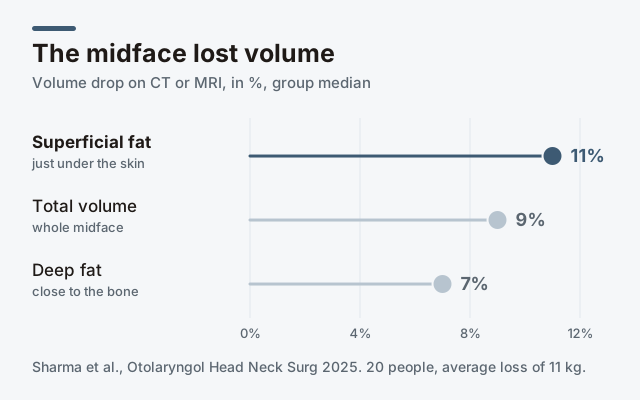
The 7% for every 10 kg is a calculation by the authors that links the face to the weight lost, different from the drop in each layer across the whole group, which is in the chart. The superficial fat fell more and was the one that most closely tracked the kilos lost, while the deep fat varied a lot from one person to another. It is a small study that looked back at scans done for other reasons and had no comparison group without the injection, and the authors themselves present it as one of the first measurements in numbers of Ozempic face, which until then showed up mostly in photos and personal accounts.
Eating very little for months can also affect the skin. When hunger disappears for a long time, the amount of protein, iron, zinc, vitamin D and B vitamins reaching the body drops, and the skin uses all of these to make collagen and repair itself. A 2026 review in the same Aesthetic Surgery Journal Open Forum suggests that these shortfalls add to the loss of fat and worsen skin quality, still without a study to prove it. The surgeons in the 2025 review also point out that, with little fat in the diet, the skin barrier may weaken and the skin may become drier and duller.
Is it Ozempic or is it the weight loss?
The evidence so far points to the weight loss, since the US label for Ozempic does not mention loss of facial fat among its side effects and the plastic surgeons’ review found no proof that semaglutide targets the face. A paper published in 2024 in the Journal of Drugs in Dermatology asked the same question right in its title, natural weight loss or Ozempic face, and pointed out that it is up to the health care team to tell a new effect of the drug apart from a natural consequence of losing weight fast.
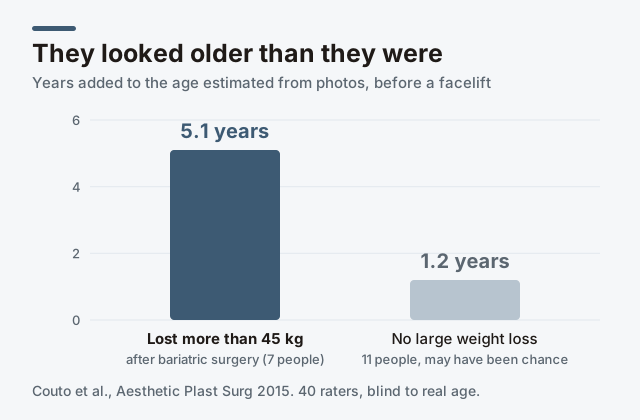
Before the injections became popular, plastic surgery already saw this same face in people who had bariatric surgery. In a 2015 study in Aesthetic Plastic Surgery, raters who did not know the patients estimated the age, from photos taken before a facelift, of people who had lost a lot of weight after the surgery, with no injection involved, and they looked about 5 years older than they really were. In the comparison group, of people who had not lost as much weight, the difference was small and may have been chance. There were few patients, and the authors concluded that losing a lot of weight may speed up the apparent aging of the face and neck.
There is a hypothesis that the drug does more than cause weight loss. A 2025 review in Endocrine gathered lab studies showing that fat and skin cells, such as the fibroblasts that make collagen, have a receptor for GLP-1 (a kind of lock the hormone fits into), and raised the idea that the injection acts directly on these cells. No one has shown this in people so far, and the 2026 review on nutrition and skin calls for caution with this conclusion.
Mounjaro fits the same picture, because tirzepatide acts on the GLP-1 receptor and also on the GIP receptor, another gut hormone, and on average leads to more weight loss than semaglutide, as I showed when I compared which injection leads to the most weight loss. Since the face follows how much weight a person loses, those who lose more weight, with any injection, are more likely to notice a thinner face, and there is still no study comparing the faces of people who used one or the other.
Who is more likely to end up with a sagging face
The amount of weight lost and age are the factors that show up most in the studies. In a survey answered by patients in a US weight-loss program with remote follow-up, the complaint of a hollower face was more common in those who had lost more weight, and half of those who lost more than 20% of their weight noticed this change. The study came out in 2026 in Dermatology and Therapy.
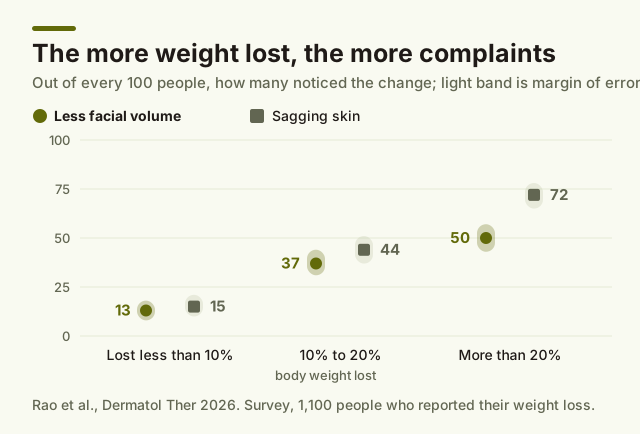
These numbers come from what each person reported, with no measurement of the face, and from those who chose to answer, mostly white women, which may inflate or hide the complaint. Even so, the result matches the CT and MRI images, because people who lose more weight tend to lose more volume in the face, and the complaint of sagging skin rose the same way.
Age is the other factor that shows up in the reviews. Older skin has less collagen and less elastin, the fiber that gives it elasticity, and pulls back less after emptying. The same weight loss therefore usually marks the face of an older person more than that of a young person. A 2026 review in Aesthetic Surgery Journal left two questions open: whether the pace of weight loss, apart from the total lost, changes the result in the face, and how much menopause and hormone therapy play a part. Losing weight more slowly may help, but for now it is a hypothesis.
How to lower the chance of your face changing so much
No study has tested a measure to prevent Ozempic face itself. What exists protects the muscle and skin of people who are losing weight, and it applies to anyone in this phase. As for pace, the injection dose goes up gradually and your doctor adjusts it based on your response, and raising the dose on your own increases nausea with no proven benefit for the face. In a 2020 analysis in the British Journal of Nutrition, which pooled several studies, those who lost weight slowly lost a little more fat than those who lost it fast, with the same total loss, and lean mass, which includes muscle, was similar in both groups. In these studies, losing weight slowly did not spare muscle, and no one measured the effect of pace on the face.
Protein and strength training are what protect muscle most during weight loss, and training goes well with the injection. In a Danish study published in the New England Journal of Medicine (funded by the Novo Nordisk Foundation), people who had just lost weight with a diet and then combined exercise with liraglutide, an older injection from the same family, lowered their body fat percentage more than those who did only one of the two, although the study did not measure the face. With less hunger, protein is usually the first thing to disappear from the plate, and I gave ideas for low-appetite days when I wrote about nausea with Mounjaro. Training is explained in detail in the post on losing weight without losing muscle mass.
If you are eating very little, talk to your doctor about the quality of what goes on your plate. The 2026 review on nutrition and skin suggests paying attention to iron, vitamin B12, vitamin D and zinc in people who eat little for a long time, with blood tests when there is a risk and supplements only when something is lacking.
For the skin, sun protection is the measure with the most research. A 2021 review in Scientific Reports, which pooled studies on skin aging, listed sun, smoking and pollution among the factors you can change, and people who used sunscreen had fewer wrinkles. The basics are sunscreen with UVA and UVB protection every day, not smoking, moisturizer for dry skin and water throughout the day. Water deserves attention because, according to a 2026 European consensus on food and weight-loss injections, the drug also reduces thirst. For aging the sun has already caused, the cream treatment with the most research is tretinoin, which the dermatologist prescribes. Collagen powder has weak results on the skin in studies without industry money, as I described when I reviewed whether collagen works for the skin.
What if the face has already changed?
If your face is already more hollow, you have options, and the choice depends on how much it has changed and what bothers you. Filler with hyaluronic acid restores volume where it is missing, such as the cheeks, temples and under-eye hollows. Collagen biostimulators, such as calcium hydroxylapatite and poly-L-lactic acid, make the skin itself produce more collagen over months. Radiofrequency and some lasers help firm the skin. In surgery, a face and neck lift removes the excess when there is a lot of loose skin, and fat grafting from your own body restores volume.
Studies in people who lost weight with an injection are still few. A 2026 systematic review in Aesthetic Plastic Surgery found only small studies, all with favorable results, but too weak to say which treatment works best. Since none of them had a comparison group, there is also no way to know how much of the improvement would have come with time.
As for when to treat, the same review recommends having a stable weight for at least 6 months before plastic surgery, and by extension it makes sense to wait before treating the face as well. If the injection is stopped and the weight comes back, part of the facial volume comes back with it, and a filler done at the peak of weight loss can leave the face too full. Among the products, hyaluronic acid is the only one that can be dissolved with an enzyme. Look for a doctor experienced in these procedures who examines your face first, uses a product registered with Anvisa (Brazil’s health regulator) and explains what to expect, and be wary of any promise of a guaranteed result.
Does stopping the injection bring the face back?
The plastic surgeons’ review notes that stopping the injection because of the face may not be worth it for people whose weight, heart and metabolism improved with it. In the follow-up of the STEP 1 trial, most of the weight lost came back in the year after semaglutide was stopped, and blood pressure, blood sugar and cholesterol got worse along with it, as I described in the post on stopping the weight-loss injection.
The face may not go back to what it was when the weight returns, because the fat does not always settle the way it did before. You decide with the doctor who follows your treatment whether to keep, reduce or stop the injection, weighing the face together with your health as a whole, and before that conversation it is worth reading what is known about using Mounjaro for years.
How much evidence each measure has
Protecting muscle and skin is what has the most research, and the procedures still rely on small studies. No study has tested the prevention measures directly on the face.
| Measure | What it is for | What is known |
|---|---|---|
| Losing weight at the agreed pace | Avoid losing weight too fast | Effect of pace on the face not yet measured |
| Protein and strength training | Protect the body’s muscle | Protects muscle; not tested on the face |
| Sunscreen and not smoking | Protect the skin’s collagen | Fewer wrinkles in observational studies |
| Iron, vitamin B12, vitamin D and zinc at normal levels | Give the skin raw material | Reasonable hypothesis, no direct study |
| Filler and biostimulator | Restore volume and stimulate collagen | Small studies, no comparison group |
| Facelift and fat grafting | Remove excess skin and restore volume | Used after large weight loss; little studied in people who lost weight with an injection |
| Stopping the injection | Get volume back | The weight comes back and the face may not return the same |
Signs that go beyond a thinner face
A thinner face on its own can wait for your next appointment. Some signs that come with it, however, call for a talk with your doctor before the next appointment:
- very fast weight loss, eating almost nothing for several days;
- heavy hair loss, weak nails or wounds that are slow to heal;
- weakness, dizziness when standing up or tiredness that does not go away;
- dry mouth, dark urine and sunken eyes, which can be dehydration;
- wanting to quit treatment because of how you look;
- severe pain and white or purplish skin right after a filler, which need care right away, from whoever injected it or at an emergency room.
For the other signs on the list, talk to the doctor who prescribed the injection before the next dose. The adjustment may involve holding the dose, reviewing your diet and ordering tests, and it is your doctor who decides with you. Nausea, tiredness and the other common discomforts of the injection are in the post on the side effects of Mounjaro.
In practice
- Before starting the injection, talk to your doctor about what may happen to your face, especially if you are older or need to lose a lot of weight.
- Follow the agreed dose increases, step by step, without speeding up on your own to lose weight faster.
- Include protein in every meal and do strength training regularly.
- Use sunscreen every day, do not smoke, moisturize your skin and drink water throughout the day.
- If your face has already changed and it bothers you, wait for your weight to stabilize and see a doctor experienced in facial procedures before deciding.
- Do not stop the injection on your own because of your face, and talk first with whoever follows your treatment.
Conclusion
Ozempic face is the face that empties out when a person loses a lot of weight in a short time, and the most recent reviews treat this effect as a consequence of weight loss, with no proof that Ozempic, Wegovy or Mounjaro act on the face on their own. The more weight comes off and the older the skin, the bigger the change. Protein, strength training, sun protection and no rush beyond what was agreed protect muscle and skin, even though no study has measured their effect on the face. For those whose face has already changed, filler, biostimulators and surgery are options with small studies, best done once the weight is stable.
All the best!
G
Responsible physician: Dr. Gilberto Nering Junior, sports medicine physician, CRM-SP 160822, RQE 142486 (Sports Medicine, Brazil).
This text was not sponsored, is for information only and does not replace an individual assessment. Questions about the content: contact the clinic.
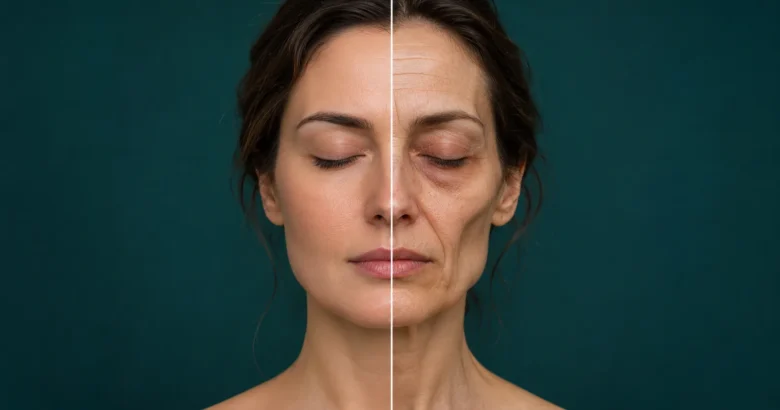
Cover illustration: a face split between a young half and an aged half, generated by artificial intelligence.
Frequently asked questions about Ozempic face
What is Ozempic face?
It is the popular name for the thinner, aged face that appears in people who lose a lot of weight fast with injections such as Ozempic, Wegovy and Mounjaro. The cheeks and temples sink, the dark circles and the folds beside the mouth become more marked and the skin gets looser.
Does Ozempic face go back to normal?
Part of the volume may come back if the person regains weight, but the fat does not always return to the same places. Stopping the injection just because of the face usually brings the weight back and takes away the health gains, and the decision needs to be discussed with your doctor.
Does Mounjaro also cause a sagging face?
It can, for the same reason: Mounjaro, which is tirzepatide, causes weight loss in a similar way and, on average, even more than semaglutide, and the face follows how much weight is lost. There is no study showing that one injection affects the face more than the other for the same weight loss.
How can you prevent Ozempic face?
No measure has been tested to prevent this effect, but enough protein, strength training, sunscreen, not smoking and not speeding up weight loss beyond what you agreed on with your doctor protect muscle and skin. Eating too little for months also harms the skin, and your doctor may order tests if there is a risk of nutrient deficiency.
Does filler fix Ozempic face?
Hyaluronic acid filler and collagen biostimulators restore volume and improve the skin in the studies done so far, but these studies are small and have no comparison group. Ideally, treatment is done with a stable weight, because if the weight comes back, the face may end up too full.
References
- Agência Nacional de Vigilância Sanitária (Anvisa). Medicamentos agonistas GLP-1 só poderão ser vendidos com retenção da receita. Brasília: Anvisa; 2025. gov.br
- Ashtary-Larky D, Bagheri R, Abbasnezhad A, et al. Effects of gradual weight loss v. rapid weight loss on body composition and RMR: a systematic review and meta-analysis. Br J Nutr. 2020;124(11):1121-1132. doi:10.1017/S000711452000224X
- Carboni A, Woessner S, Martini O, et al. Natural weight loss or “Ozempic face”: demystifying a social media phenomenon. J Drugs Dermatol. 2024;23(1):1367-1368. doi:10.36849/JDD.7613
- Couto RA, Waltzman JT, Tadisina KK, et al. Objective assessment of facial rejuvenation after massive weight loss. Aesthetic Plast Surg. 2015;39(6):847-855. doi:10.1007/s00266-015-0540-6
- Daneshgaran G, Shauly O, Gould DJ. “Ozempic face” in plastic surgery: a systematic review of the literature on GLP-1 receptor agonist mediated weight loss and analysis of public perceptions. Aesthet Surg J Open Forum. 2025;7:ojaf056. doi:10.1093/asjof/ojaf056
- Dobbie LJ, Tolvanen L, Alves D, et al. Nutritional, functional, and psychological considerations for incretin-based therapies in adults: an EASO, EFAD, and ECPO consensus statement. Lancet Diabetes Endocrinol. 2026;14(9):754-777. doi:10.1016/S2213-8587(26)00122-1
- Fathizadeh S, Hwang AS, Hoss E. Ozempic face and facial aging. Clin Dermatol. 2026. doi:10.1016/j.clindermatol.2026.10.004
- Karlin J, Li Z, Parsa K. The impact of glucagon-like peptide-1 receptor agonist-induced nutritional deficiencies on skin health: a narrative review with a proposed framework for the aesthetic practitioner. Aesthet Surg J Open Forum. 2026;8:ojag169. doi:10.1093/asjof/ojag169
- Lundgren JR, Janus C, Jensen SBK, et al. Healthy weight loss maintenance with exercise, liraglutide, or both combined. N Engl J Med. 2021;384(18):1719-1730. doi:10.1056/NEJMoa2028198
- Maglitto F, Salzano G, Trotta S, et al. Beyond weight loss: facial remodeling associated with GLP-1 receptor agonists. A systematic review and therapeutic framework. Aesthetic Plast Surg. 2026. doi:10.1007/s00266-026-06331-y
- Paschou IA, Sali E, Paschou SA, et al. GLP-1RA and the possible skin aging. Endocrine. 2025;89(3):680-685. doi:10.1007/s12020-025-04293-w
- Rao S, Midura I, Mangual KPS, et al. Skin impacts and tradeoffs of GLP-1 therapy: improved patient-reported outcomes of inflammatory skin disease in the era of “Ozempic face”. Dermatol Ther (Heidelb). 2026;16(9):4749-4760. doi:10.1007/s13555-026-01882-z
- Sharma RK, Vittetoe KL, Barna AJ, et al. Radiographic midfacial volume changes in patients on GLP-1 agonists. Otolaryngol Head Neck Surg. 2025;173(2):360-366. doi:10.1002/ohn.1209
- Wilding JPH, Batterham RL, Davies M, et al. Weight regain and cardiometabolic effects after withdrawal of semaglutide: the STEP 1 trial extension. Diabetes Obes Metab. 2022;24(8):1553-1564. doi:10.1111/dom.14725
- Wong QYA, Chew FT. Defining skin aging and its risk factors: a systematic review and meta-analysis. Sci Rep. 2021;11(1):22075. doi:10.1038/s41598-021-01573-z
- Yoo KH. Glucagon-like peptide-1 receptor agonist-associated facial changes: a comprehensive review of pathophysiology, clinical manifestations, risk factors, prevention, and management. Aesthet Surg J. 2026. doi:10.1093/asj/sjag230