

Also in: Português · Español · Italiano · 中文 · हिन्दी
Weight-loss injections (Mounjaro, Ozempic, Wegovy, Saxenda) are injectable drugs that really do make people lose weight, and a lot of it: in studies, average weight loss was about 15% with semaglutide and came close to 21% with tirzepatide, the most potent one (liraglutide, the oldest, delivers much less). These are study averages, not a promise for your case. But they are not a miracle, not a villain and not a shop-window product to buy on impulse. They are medication, with the right indication, real side effects and a catch at the end that almost nobody tells you about. So let’s settle this once and for all, with numbers and no hot air.
So, What Exactly Are These Injections?
“Weight-loss injection” is the nickname. The real name is GLP-1 analog: injectable drugs that mimic a gut hormone that cuts hunger and makes you feel full with less food. To explain it better: GLP-1 is a hormone your own gut releases every time you eat. It tells the brain that food has arrived, that it’s enough, that you can stop. These drugs are a souped-up copy of that hormone.
Today, the main ones you hear about are three molecules, with different brand names:
- Semaglutide: this is Ozempic (approved for diabetes) and Wegovy (approved for obesity). Rybelsus is the tablet version.
- Liraglutide: this is Saxenda (obesity) and Victoza (diabetes). It was the first of the batch and today is the weakest of the team.
- Tirzepatide: this is Mounjaro. It is the newest and most potent, for a reason I’ll explain shortly.
Almost all of them are injected under the skin once a week (liraglutide is daily). And no, it doesn’t hurt the way you’re imagining: the needle is tiny.
How They Work (The Part That Matters)
GLP-1 does three things at once. First, it talks to the hunger center in your brain and switches off that urge to eat that won’t go away. Second, it keeps food in the stomach longer, so you feel full with less. Third, it helps the pancreas control blood sugar (which is why it started out as a diabetes drug).
It’s like having a fullness button that your body always had, except the drug presses that button for you and holds it down. It’s not willpower. It’s biology. A person who used to be hungry all day simply stops thinking about food all the time. People who have been through it describe it as a quiet in the head that wasn’t there before.
Tirzepatide (Mounjaro) goes further: it copies GLP-1 and a second hormone, GIP. That’s two brakes instead of one. That’s why, in studies, it delivers more than the others. And in the lab there is already a next generation, with three hormones at once, but that’s for the end of the post.
Ozempic, Wegovy, Mounjaro, Saxenda: What’s the Difference?
This confusion tops the list of questions, so let’s put things in order. The names are brand names, and the same substance can have two names, depending on what it was approved for.
| Brand | Substance | What it’s for | Frequency |
|---|---|---|---|
| Ozempic | semaglutide | diabetes (became a craze in off-label use for weight loss) | once a week |
| Wegovy | semaglutide | obesity (same substance as Ozempic, at a higher dose) | once a week |
| Mounjaro | tirzepatide | diabetes and obesity (the most potent; approved for obesity in Brazil in June 2025) | once a week |
| Saxenda | liraglutide | obesity (the oldest and weakest; Victoza is the diabetes version) | every day |
To sum it up in one sentence: if you hear “I took Ozempic and lost weight”, know that there is a version made exactly for that purpose, and that choosing between one and the other is a medical decision, not a pharmacy-shelf one.
Do They Really Work? What the Studies Say (With Numbers, Not Hunches)
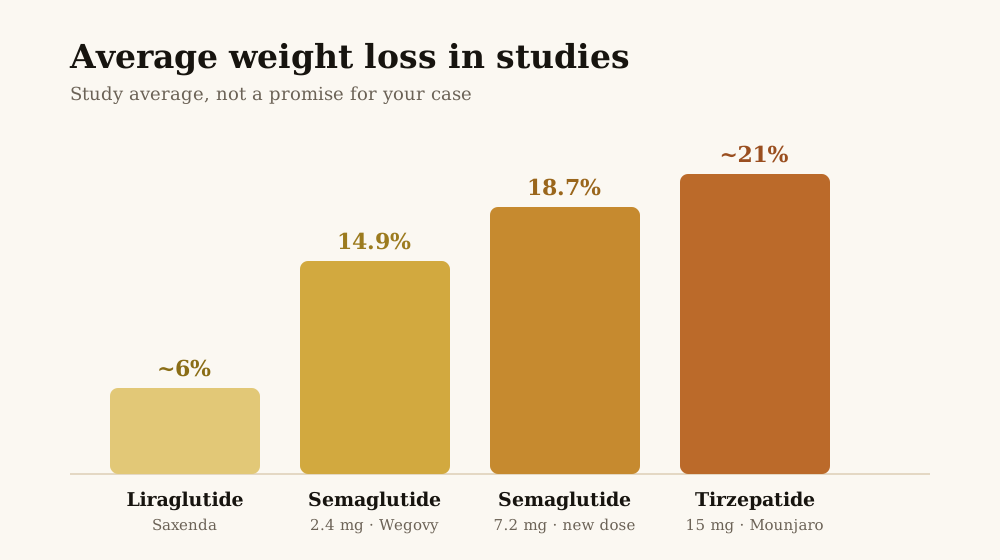
Short answer: they work, and a lot. In studies, average loss was 14.9% of body weight with semaglutide 2.4 mg and reached about 21% with tirzepatide 15 mg. An important warning: these numbers are the average of many people, not a promise for your case. Every body responds differently. No hunches here, just data from large, serious studies:
- Semaglutide 2.4 mg (Wegovy): in the STEP 1 trial, published in 2021, average loss was 14.9% of body weight over 68 weeks, compared with 2.4% for those on placebo.
- Semaglutide 7.2 mg (the new dose): in the STEP UP trial, published in the Lancet in 2025, the higher dose led to an average loss of 18.7% of body weight over 72 weeks. Almost half of the people lost 20% or more, and almost a third went past 25%.
- Tirzepatide 15 mg (Mounjaro): in the SURMOUNT-1 trial, average loss was about 21% of body weight (reaching 22.5% in those who took it as prescribed) over 72 weeks. More than half lost 20% or more.
To give you a sense of scale: the weight-loss drugs of the past delivered 5% to 10%, at most. Tirzepatide practically doubles that. It is weight loss that, until recently, only bariatric surgery could reach.
So You Just Go Out and Buy Them? (No. And That’s Half the Problem)
These injections are not for someone who wants to lose 3 kilos before a wedding. They are medication to treat a disease: obesity. The approved indications are for people with a BMI of 30 or more (obesity), or 27 or more with a related condition, such as diabetes, high blood pressure, sleep apnea or fatty liver.
And before starting, there is a serious conversation with a doctor: medical history, family history, tests, the medications you already take. Just because it worked for your neighbor doesn’t mean it’s right for you. Some people can’t take it, and I explain who in the next section.
Who Should NOT Use Them
This list is not for you to self-assess and clear yourself. It’s so you arrive at the appointment already knowing what the doctor will look into. The injections are contraindicated, or call for extra caution, in people with:
- A personal or family history of medullary thyroid cancer or the genetic syndrome MEN2 (a label contraindication, no middle ground).
- Past pancreatitis.
- Pregnancy, breastfeeding or trying to get pregnant.
- An allergy to any component of the drug.
- Gallbladder disease, gastroparesis (slow stomach) or advanced diabetic retinopathy, situations that call for an individual assessment.
If you checked any of these items in your history, it doesn’t necessarily mean a definite “no”; it means the conversation with your doctor needs to be more thorough before any prescription.
What About Side Effects? (Let’s Separate Fact From Rumor)
The most common side effect involves the stomach and gut: nausea, vomiting, diarrhea or constipation. In the STEP UP trial (Lancet, 2025), about 7 in 10 people felt something like this. That sounds like a lot, but hold on: in most cases it is mild to moderate, shows up mainly while the dose is going up, and improves over time. That is exactly why the dose starts very low and goes up slowly, to give the body time to adjust. People in a hurry who push the dose up fast are the ones who feel sick.
Now the rumors, which is where most people get lost:
- Thyroid: there is a serious label warning, but a specific one. The drug is contraindicated for people who have or have had medullary thyroid cancer, or the genetic syndrome MEN2. That’s why the doctor asks about your family. “Common” thyroid cancer (the differentiated, papillary type) is a different story: a 2026 study from Memorial Sloan Kettering, with more than a thousand patients, found no worsening at all with the injections. In other words: medullary and MEN2, don’t use it; everything else, talk to your doctor without panic.
- Pancreas: anyone who has had pancreatitis needs a careful assessment.
- Gallbladder: losing a lot of weight quickly favors gallstones, and the injections are part of that equation.
- The famous “Ozempic face”: that facial sagging is not some evil magic of the drug. It’s a consequence of losing weight fast. And there’s a detail that interests me as a sports medicine physician: if you only take the injection and don’t train or eat enough protein, you lose muscle along with the fat. Muscle is what supports your skin, your metabolism and your strength. Losing weight is not the goal. Losing fat is.
- Pregnancy: not used. People who can get pregnant need contraception.
- Birth control pills with Mounjaro: a little-remembered detail. Tirzepatide can reduce the effectiveness of the pill, especially when starting and at each dose increase. People who use the pill need to agree with their doctor on using condoms as well, or switching to a non-oral method (IUD, implant), for the first 4 weeks and at each dose increase.
What Treatment Looks Like in Practice
To get the “take it and you’re done” idea out of your head, let me show you how it really works.
The dose always starts low and goes up gradually, month by month. This isn’t fussiness; it’s the strategy to get around the nausea: by giving the body time to adjust, most of the stomach effects pass. People who try to speed things up and start at a high dose are the ones who end up vomiting and giving up.
Results don’t show up in the first week. They come over months, gradually. Those 18% and 21% figures I mentioned come from 68 to 72 weeks of treatment, in other words, more than a year. Real weight loss is a marathon, not a 100-meter dash.
And follow-up is part of the treatment, not a detail. Weight, body composition, blood tests, blood pressure, side effects: all of this is monitored. Alongside, strength training and a diet with enough protein come in, which is what makes sure you lose fat and keep muscle. The injection is a powerful tool, but it works better with company.
A safety warning few people know about: if you are going to have surgery, an endoscopy or any procedure with sedation or anesthesia, tell the doctor that you use the injection. Because it slows the stomach, there is a risk of aspiration, and the injection is usually paused a few days before, always under medical guidance.
The Million-Dollar Question: What Happens When I Stop?
This is the part the ads don’t show, and it’s the most important of all. Pay attention.
When a person stops the injection, the weight comes back. And not just a little. A 2025 review that pooled 8 studies and more than 2,000 people found the following: those who were on semaglutide or tirzepatide and stopped regained, on average, almost 10 kilos. And the regain was proportional: the more a person had lost, the more they gained back.
Why does this happen? Because your body is stubborn. There is a classic study (The Biggest Loser, Fothergill and colleagues, Obesity journal, 2016) that followed participants from an American weight-loss reality show: six years later, their metabolism was still slower, still fighting to regain the lost weight. The body treats lost fat as an emergency and spends years trying to bring it back.
This is where it clicks: the injection doesn’t fix that fullness button. It holds the button down while you take it. Let go, and the body pushes hunger back up. That’s why doctors treat obesity as what it is, a chronic disease, just like high blood pressure. Nobody takes blood pressure medication for 3 months and thinks they’re “cured”. With the injections it’s similar: it tends to be a long treatment, not a summer crash diet. This changes everything in your planning, including your budget, and you need to know it BEFORE you start, not after.
Beware of Compounded and Dubious “Imported” Injections
This section is for your safety, so I’ll be direct. With the injection craze, a dangerous parallel market appeared in Brazil: compounded versions from pharmacies, imported injections without registration, “cheaper” products nobody knows the contents of.
Brazil’s health regulator, Anvisa, has already acted. Since August 2025, compounded semaglutide has been banned. Compounded tirzepatide is still allowed, but under much tighter rules, and Anvisa has been seizing one irregular brand after another (one made in Paraguay, others with no registration at all). And retatrutide, the next-generation one, cannot be sold because it is still experimental; there is no approved version for sale.
The golden rule is simple: only use a registered product, with a real prescription. An unregistered vial may have the wrong dose, may be contaminated, may not even be what the label says. Saving money here is betting your health on a product nobody inspected. It’s not worth it.
Retatrutide and What’s Coming
Since I mentioned it: retatrutide is that next generation, with three hormones at once (GLP-1, GIP and glucagon). The early results in studies are impressive, perhaps the biggest ever seen. But hold on: it is still in the research phase and is not approved in Brazil. Anyone selling “retatrutide” today is selling something irregular. So, for now, it’s a topic for the future, not for now.
The No-Fluff Conclusion
These injections are, by far, the most effective drugs against obesity that have ever existed. That’s a fact, not hype. But three things need to stick in your head:
First, they are medication, not a shortcut. They have indications, contraindications, and call for real medical follow-up.
Second, the effect lasts as long as the treatment lasts. Obesity is a chronic disease, and treatment tends to be long. Go into it knowing that.
Third, and here I speak as a sports medicine physician: the injection alone is only half the way. Without strength training, protein and sleep, you lose muscle along the way and sabotage the long-term result. That’s why, at our clinic in São José dos Campos, Brazil, we measure before treating: bioimpedance shows whether you’re losing fat or muscle, and calorimetry shows how much your body really burns. Treating weight loss in the dark, by the scale alone, is like driving with your eyes closed.
If you fit the profile and are thinking about it, don’t buy injections on your own online. See a doctor, get assessed, and decide with information in hand. It’s the difference between treating a disease and getting yourself into trouble.
Take care, and see you next time!
Responsible physician: Dr. Gilberto Nering Junior, CRM-SP 160822, RQE 142486 (Sports Medicine, Brazil). This text is for information only and does not replace a medical consultation. None of the drugs mentioned should be used without a prescription and follow-up.
Quick Questions About Weight-Loss Injections
Do the injections work even without a diet?
They do, because they cut hunger and you end up eating less without noticing. But the result is much better, and lasts longer, when it comes with adjusted eating and strength training. Without that, you lose muscle along with fat.
Are Ozempic and Mounjaro the same thing?
No. Ozempic is semaglutide; Mounjaro is tirzepatide, a different and more potent substance that acts on two hormones instead of one.
Can I take it just to lose a few kilos before an event?
That’s not what it’s for. The indication is to treat obesity (or overweight with a related disease), not a one-off bit of vanity. Using it outside the indication exposes you to the risks without the health benefit that justifies the drug.
Will I have to take it forever?
Probably for quite a while. Since obesity is a chronic disease and the weight tends to come back when you stop, treatment tends to be long. “Forever” is an individual conversation with your doctor, not a fixed rule.
Will I gain the weight back if I stop?
On average, yes, and a good part of the weight comes back. In studies, people who stopped semaglutide or tirzepatide regained close to 10 kilos. That’s why stopping is a planned decision, not an “I’m tired of it”.
Are compounded injections safe?
They are not recommended. Compounded semaglutide is banned by Anvisa in Brazil, and irregular versions of tirzepatide have been seized. Wrong doses and contamination are real risks. Only use a registered product, with a prescription.
References
Effectiveness (how much is lost)
1. Wilding JPH, et al. Once-Weekly Semaglutide in Adults with Overweight or Obesity (STEP 1). N Engl J Med. 2021.
2. Wharton S, et al. Once-weekly semaglutide 7·2 mg in adults with obesity (STEP UP): a randomised, controlled, phase 3b trial. Lancet Diabetes Endocrinol. 2025;13:949-963.
3. Jastreboff AM, et al. Tirzepatide Once Weekly for the Treatment of Obesity (SURMOUNT-1). N Engl J Med. 2022.
Regain after stopping and obesity as a chronic disease
4. Berg S, et al. Discontinuing glucagon-like peptide-1 receptor agonists and body habitus: A systematic review and meta-analysis. Obesity Reviews. 2025.
5. Fothergill E, et al. Persistent metabolic adaptation 6 years after “The Biggest Loser” competition. Obesity. 2016.
Safety (thyroid and adverse effects)
6. Patrizio A, Mauguen A, Boucai L, et al. Exposure to GLP-1RA and Risk of Structural Progression in Differentiated Thyroid Cancer. J Clin Endocrinol Metab. 2026.
Next generation
7. Rosenstock J, et al. Retatrutide, a GIP, GLP-1 and glucagon receptor agonist, for people with type 2 diabetes: a randomised phase 2 trial. Lancet. 2023.
Overview and regulation in Brazil
8. Anvisa. Approval of Mounjaro (tirzepatide) for obesity, June 2025.
9. Anvisa. Ban on compounding semaglutide, August 2025; actions against irregular tirzepatide brands, 2026.
10. Sociedade Brasileira de Endocrinologia e Metabologia (SBEM). Statement on compounding semaglutide and tirzepatide, 2025.