Also in: Português · Español · Italiano · 中文 · हिन्दी
Main points
- The Mounjaro label does not forbid alcohol, but alcohol plays a part in problems it lists, such as low blood sugar, pancreatitis and dehydration.
- Drinking without having eaten, which gets easier when tirzepatide lowers your appetite, leaves more alcohol in the blood and can bring blood sugar down.
- Many people feel less like drinking on these injections, and the placebo-controlled studies that showed this were done with semaglutide, the drug in Ozempic and Wegovy.
- For tirzepatide, so far, there are medical records studies and user reports pointing the same way, and the placebo-controlled studies are still under way.
- If you have had pancreatitis, avoid alcohol during treatment. If you use insulin or a sulfonylurea, have vomiting or diarrhea, or feel you have lost control of your drinking, talk to your doctor before you drink.
The Mounjaro label does not forbid alcohol and has no warning of its own about it. People on the injection often want to know whether they can have a glass of wine with dinner or a beer on the weekend, and the question about Mounjaro and alcohol is whether drinking gets in the way of treatment or makes you sick. To answer it, I look at the risks listed on the tirzepatide label, such as low blood sugar, pancreatitis and dehydration, because alcohol plays a part in each of them. It also matters that people on the injection eat much less and may end up drinking on an empty stomach, and then more alcohol stays in the blood.
Many people notice, after starting the injection, that they want to drink less, and these reports caught the attention of researchers. In a study published in 2025, a team at the University of North Carolina, in the United States, gave low doses of semaglutide or a placebo injection for nine weeks to 48 adults who had a drinking problem (alcohol use disorder, in medical terms) and were not trying to quit. Those who got semaglutide drank less in a bar session set up in the lab, had fewer drinks on the days they drank and had less craving. This post grew out of that study, published in JAMA Psychiatry with public funding from the US research institute on alcohol. The drug tested was semaglutide, the one in Ozempic and Wegovy, not the tirzepatide in Mounjaro, and what holds for one does not always hold for the other.
Can you drink alcohol while taking Mounjaro?
Yes, with care, because no study has shown that alcohol cancels out the drug and the label does not forbid it. Even so, drinking during treatment can do harm: alcohol sometimes drops blood sugar in people who use insulin or a sulfonylurea, it is one of the main causes of pancreatitis and, in excess, it brings on vomiting, which dehydrates. For those who decide to drink, my advice is a little, slowly and after eating, with water between one drink and the next. On days of strong nausea and in the weeks right after a dose increase, it is better not to drink. If you don’t drink, there is no need to start; if you have had pancreatitis, avoid alcohol while on the injection; and if you feel you have lost control of your drinking, talk to your doctor.
What the Mounjaro label warns about and where alcohol comes in
The US and European labels for tirzepatide say nothing about alcohol, and no study has tested the two together in a controlled way. Both labels, however, warn about low blood sugar, pancreatitis and dehydration, three problems in which alcohol has a known role.
Low blood sugar after drinking
According to the label, the risk of hypoglycemia with tirzepatide shows up mainly in people who take it together with insulin or a sulfonylurea, common drugs in type 2 diabetes, and the label itself tells the doctor to consider lowering those drugs to reduce that risk. Alcohol keeps the liver from releasing sugar into the blood as it should and, taken without food, can cause hypoglycemia, with a higher risk when the liver’s sugar stores are low, as after many hours without eating.
The American Diabetes Association, in its 2026 recommendations published in Diabetes Care, points out that this drop can come hours after drinking and advises people who use insulin or a drug that stimulates insulin release to check their glucose in the hours after drinking. If you use the injection together with one of these drugs, work out with your doctor how to do these checks on the days you drink, and learn to recognize shaking, cold sweats, a racing heart and confusion as signs of low blood sugar.
Alcohol and the pancreas
Acute pancreatitis is an inflammation of the pancreas that causes severe, constant pain in the upper belly, often spreading to the back. The label says to stop tirzepatide when pancreatitis is suspected, not to restart it if the diagnosis is confirmed, and to use caution in people who have had pancreatitis before. Among the causes of acute pancreatitis, alcohol is second only to gallstones, and a 2026 review in Gastroenterology names alcohol abuse as the leading cause of pancreatic disease worldwide, counting acute pancreatitis, chronic pancreatitis and other conditions together.
Pancreatitis with tirzepatide is rare, as I explained when I wrote about the side effects of Mounjaro, and no study has measured whether drinking raises this risk in people on the drug. Still, if you have already had an attack of pancreatitis, I advise not drinking while you use the injection, because alcohol is a known cause of the disease and the label already asks for caution with tirzepatide in this group.
When drinking dehydrates you
The label warns that nausea, vomiting and diarrhea can lead to dehydration and, with it, worse kidney function, sometimes even acute kidney failure. The 2026 European consensus on food and weight-loss injections, in The Lancet Diabetes & Endocrinology, notes that alcohol makes you urinate more and worsens dehydration, although a 2017 study in older men found this effect small and short-lived with moderate amounts of wine and spirits (with beer it did not show up at all, and the study was done by researchers from a Dutch institute linked to the beer industry). Vomiting adds to this, since heavy drinking often brings nausea and vomiting, and someone who already feels sick from the injection loses fluid more easily. A paper from four US societies of lifestyle medicine, nutrition and obesity, published in 2025 in the American Journal of Clinical Nutrition, says alcohol can worsen the nausea and reflux of people on this family of injections and recommends cutting back on drinking.
In the days and weeks right after each dose increase, the nausea, vomiting and diarrhea of tirzepatide become more frequent, and on those days I would avoid drinking. Food and fluid tips for getting through this phase are in the post on nausea with Mounjaro, and what we know about the kidneys after years of use is in the post on whether Mounjaro is harmful in the long run.
What happens when you drink on a nearly empty stomach
On Mounjaro your appetite drops, and it becomes easy to skip meals without noticing and reach late afternoon having eaten almost nothing. This matters when you drink, because food in the stomach holds alcohol back, so it reaches the intestine, where most of it is absorbed, more slowly, and the liver clears it faster after a meal. A 2023 analysis in the Journal of Clinical Pharmacology pooled blood alcohol measurements from volunteers in earlier studies. In an example the authors calculated, the same amount of alcohol leaves about 40% less alcohol in the blood over ten hours when the person has eaten first, and this difference came mostly from faster clearance.
The injection changes this picture because it slows the stomach down. A small 2025 study, published in Scientific Reports, gave the same drink to people with obesity who used injections from the GLP-1 family (most on semaglutide, a few on tirzepatide or liraglutide) and to people with obesity who did not, all after a standard snack. In the injection group, breath alcohol rose more slowly in the first minutes and people felt less drunk at first, with no difference in nausea, but an hour later the levels were already the same as in the other group.
This slower start does not make drinking any safer. The authors see the delay as one possible way the injection cuts down drinking. In the study, however, the amount of alcohol was set for each person, without measuring how much each one would drink on their own, and in the placebo-controlled trials people on semaglutide did end up drinking less. The empty stomach weighs more, because the meal that would help lower blood alcohol is missing. For that reason, and because of the risk of low blood sugar, I ask people on the injection to eat before drinking, even if it is just a small plate.
Why the urge to drink goes down on the injection
GLP-1 is a hormone that the gut releases after meals and that also acts on the brain. In animals, drugs that mimic GLP-1 make the animals drink less and work less to get alcohol, and they dampen the response of the brain’s reward areas to alcohol, which suggests less pleasure from alcohol. A 2026 review in Biological Psychiatry brought these studies together and proposes that the drug reduces the reward that drinking gives, with the caveat that the slower stomach and nausea may play a part.
The North Carolina study
In the North Carolina study, the volunteers went through a bar session in the lab before and after treatment, with each person’s favorite drink and free time to drink at their own pace. At the end of treatment, the semaglutide group drank fewer grams of alcohol and reached a lower peak of breath alcohol. At home, people kept drinking on the same number of days, but had fewer drinks on each day they drank, had less craving and had a bigger drop in heavy drinking days. Among the few smokers in the study, cigarettes per day fell more with semaglutide. Side effects were the ones expected from the injection, mostly mild, with no serious cases and no reaction between the drug and alcohol. The authors themselves point out the limits of the study: few people, only nine weeks and doses lower than those used for weight loss.
Larger studies with semaglutide
A larger Danish study, published in 2026 in The Lancet, tested semaglutide at the Wegovy dose in 108 adults with obesity and alcohol use disorder who wanted treatment. For 26 weeks, everyone had cognitive behavioral therapy; half also got the injection and the other half a placebo injection. Funding came from Danish foundations, among them the Novo Nordisk Foundation, which is linked to the maker of semaglutide.
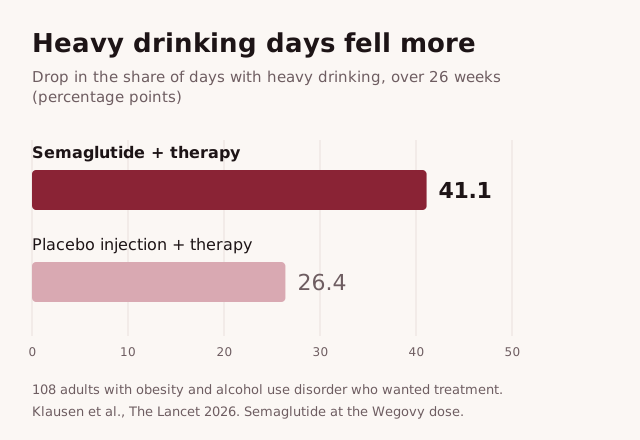
Therapy alone already reduced heavy drinking days, and semaglutide on top of it reduced them further. Side effects were mostly in the stomach and gut, mild to moderate and temporary, and they were more common in the injection group. A 2025 review with meta-analysis, in eClinicalMedicine, pooled controlled trials and observational studies and concluded that drugs in this family, especially semaglutide and liraglutide, reduce alcohol consumption, and it called for larger studies before this becomes a treatment.
What we know about tirzepatide and alcohol
Tirzepatide mimics GLP-1 and a second gut hormone, GIP. It acts on the GLP-1 receptor, the same target as semaglutide in the placebo-controlled trials that reduced drinking, so it is reasonable to expect a similar effect with Mounjaro, although the two drugs are not the same. This remains a hypothesis until a placebo-controlled study comes out, and the 2025 review did not include tirzepatide.
For tirzepatide, the data we have come from user reports and medical records. In a study published in 2023, the same research group behind the snack study analyzed thousands of Reddit posts about the injections and surveyed, remotely, adults with obesity who drank, and those using semaglutide or tirzepatide reported drinking less and having fewer binge episodes than before the drug and than people not on the injections. This kind of study depends on the memory and honesty of the people answering.
A medical records study published in 2026 in Diabetes, Obesity and Metabolism followed adults with type 2 diabetes who started semaglutide, tirzepatide or a diabetes drug from another family, one that does not act on GLP-1. Those who started one of the injections had fewer hospital admissions and emergency room visits for alcohol problems, and tirzepatide and semaglutide came out similar to each other.
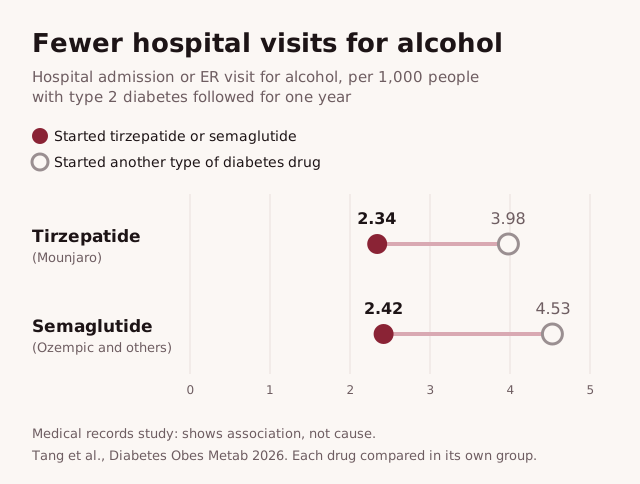
Another medical records study, in the same journal, pointed the same way for tirzepatide and semaglutide. Studies like these show an association and do not prove that the injection caused the difference, because people who get an injection may differ from those who get another drug in ways the records do not capture. In the US registry of clinical trials, there are tirzepatide studies for alcohol use disorder recruiting volunteers, and none has finished. How the two injections compare for weight loss is in the post on which injection leads to more weight loss.
| Question | Semaglutide (Ozempic, Wegovy) | Tirzepatide (Mounjaro) |
|---|---|---|
| Less drinking in a placebo-controlled study? | Yes, in two studies (2025 and 2026) | Not tested yet; studies under way |
| Fewer alcohol problems in medical records? | Yes, in the United States and Sweden | Yes, in two studies in type 2 diabetes |
| Do users say they drink less? | Yes | Yes |
| Does the label include treating alcohol use disorder? | No | No |
Can the injection treat alcohol use disorder?
None of these injections has the treatment of alcohol use disorder on its label. The authors of the main study call for larger studies before the injections are used for this. They also point out that weight loss carries risks for people at a normal or low weight, which means the injection is not a simple fix for someone who is not overweight and only wants to drink less. There are approved drugs for this problem (in the United States, for example, naltrexone and acamprosate), and it is up to the doctor to decide what to prescribe. If you drink heavily every day, do not stop all at once on your own, because alcohol withdrawal can be dangerous and needs medical supervision.
If you use the injection and have noticed that your urge to drink went down, this effect can help. If you feel you cannot control your drinking, with or without the injection, get help from your doctor, a psychiatrist or a CAPS AD, the alcohol and drug service of Brazil’s public health system (SUS).
Does alcohol get in the way of weight loss on Mounjaro?
No study has shown that alcohol weakens the action of tirzepatide. The problem is the calories, since alcohol has 7 calories per gram and brings no protein or other nutrients. A 2015 review on alcohol and obesity found weight gain linked more often to heavy drinking, while light to moderate drinking did not show this link clearly, and the American Diabetes Association lists weight gain among the risks of drinking.
On the injection, your appetite drops and you eat much less. If part of that little food comes from drinks, there is less room for the protein that helps you hold on to muscle while the weight comes off, the subject of the post on losing weight without losing muscle. For your other questions about the drug, the post on weight-loss injections explains how Mounjaro, Ozempic and Wegovy work.
Symptoms after drinking that cannot wait
The signs in the table, when they appear after drinking, should not wait for a routine appointment. If you use insulin or a sulfonylurea, you need to have agreed with your doctor beforehand on what to do if your sugar drops.
| Sign | What it may be | What to do |
|---|---|---|
| Severe, constant pain in the upper belly that may spread to the back | Pancreatitis | Stop the injection and go to the emergency room |
| Shaking, cold sweats, racing heart or confusion in someone who uses insulin or a sulfonylurea | Low blood sugar | Follow the plan you agreed on and seek care if it does not improve |
| Vomiting that won’t stop, little dark urine, dizziness when standing up | Dehydration that can affect the kidneys | Medical care the same day |
| An urge to drink you cannot control | Alcohol use disorder | Book an appointment soon with your doctor, a psychiatrist or a CAPS AD |
In practice
- Tell the doctor who follows your treatment whether you drink, how much and how often, and whether you use insulin or a sulfonylurea.
- If you are going to drink, eat a proper meal first, drink slowly and alternate each drink with a glass of water.
- Avoid drinking on days of strong nausea and in the weeks right after a dose increase.
- If you have had pancreatitis, do not drink during treatment.
- If you use insulin or a sulfonylurea, agree with your doctor on how to check your glucose in the hours after drinking.
- If your drinking has gotten out of control, get help, because the injection is not a treatment for that.
Conclusion
No warning on the Mounjaro label mentions alcohol, and the caution about drinking comes from risks the label already lists, such as low blood sugar, pancreatitis and dehydration. With less appetite, it becomes easier to drink without having eaten, and then more alcohol stays in the blood and blood sugar can drop. A small amount, after eating, with water and away from days of nausea lowers these risks, and anyone who has had pancreatitis should avoid drinking during treatment. The drop in the urge to drink was shown in placebo-controlled trials with semaglutide; with tirzepatide it shows up in medical records and user reports, while the ongoing studies have yet to report.
All the best!
G
Responsible physician: Dr. Gilberto Nering Junior, sports medicine physician, CRM-SP 160822, RQE 142486 (Sports Medicine, Brazil).
This text was not sponsored, is for information only and does not replace an individual assessment. Questions about the content: contact the clinic.
Cover photo: wine glass by Patrick Fore on Unsplash, cropped.
Frequently asked questions about Mounjaro and alcohol
Can I drink on the day of my Mounjaro injection?
No study has tested a waiting time between the injection and drinking. Tirzepatide acts in the body all week and takes about five days for half of the drug to leave. What lowers the risk is drinking a little, after eating and away from days of strong nausea.
Does alcohol cancel out Mounjaro?
No study has shown that alcohol weakens the action of tirzepatide. Alcohol hurts weight loss in another way, because it has 7 calories per gram and, when intake is high, it is linked to weight gain.
Does Mounjaro take away the urge to drink?
Many people on tirzepatide and semaglutide say they drink less. In animals, drugs in the GLP-1 family reduce the pleasure alcohol gives in the brain, and the slower stomach may make a drink take longer to kick in. The placebo-controlled studies that showed less drinking were done with semaglutide, and tirzepatide has not yet been tested this way.
Can drinking on Mounjaro cause hypoglycemia?
The risk is highest in people who use the injection together with insulin or a sulfonylurea, and the drop in sugar can show up hours after drinking. Drinking without eating can also lower blood sugar, because alcohol keeps the liver from releasing glucose as it should.
Can Mounjaro treat alcoholism?
No. The tirzepatide label does not include this use, and the placebo-controlled studies that showed lower alcohol intake were done with semaglutide. Studies with tirzepatide are under way, and anyone who has lost control of their drinking needs proper treatment for it.
References
- American Diabetes Association Professional Practice Committee. 5. Facilitating positive health behaviors and well-being to improve health outcomes: Standards of Care in Diabetes-2026. Diabetes Care. 2026;49(Suppl 1):S89-S131. doi:10.2337/dc26-S005
- Büsker S, Jones AW, Hahn RG, et al. Population pharmacokinetics as a tool to reevaluate the complex disposition of ethanol in the fed and fasted states. J Clin Pharmacol. 2023;63(6):681-694. doi:10.1002/jcph.2205
- ClinicalTrials.gov. Tirzepatide for alcohol use disorder (NCT06994338). Bethesda: National Library of Medicine; [cited 11 Nov 2026]. ClinicalTrials.gov
- Dobbie LJ, Tolvanen L, Alves D, et al. Nutritional, functional, and psychological considerations for incretin-based therapies in adults: an EASO, EFAD, and ECPO Consensus Statement. Lancet Diabetes Endocrinol. 2026;14(9):754-777. doi:10.1016/S2213-8587(26)00122-1
- Eli Lilly and Company. Zepbound (tirzepatide) injection: prescribing information. Indianapolis: Eli Lilly; 2026. DailyMed
- Eshraghi R, Ghadimi DJ, Montazerinamin S, et al. Effects of glucagon-like peptide-1 receptor agonists on alcohol consumption: a systematic review and meta-analysis. EClinicalMedicine. 2025;90:103645. doi:10.1016/j.eclinm.2025.103645
- European Medicines Agency. Mounjaro (tirzepatide): summary of product characteristics. Amsterdam: EMA; 2026. EMA
- Hendershot CS, Bremmer MP, Paladino MB, et al. Once-weekly semaglutide in adults with alcohol use disorder: a randomized clinical trial. JAMA Psychiatry. 2025;82(4):395-405. doi:10.1001/jamapsychiatry.2024.4789
- Henney AE, Riley DR, Heague M, et al. Relative efficacy of GLP-1 and GLP-1/GIP receptor agonists in the prevention of alcohol-use disorders using a target trial emulation approach. Diabetes Obes Metab. 2026;28(1):137-150. doi:10.1111/dom.70169
- Jerlhag E. GLP-1 and alcohol-related behaviors: insights from preclinical studies. Biol Psychiatry. 2026;100(8):814-822. doi:10.1016/j.biopsych.2026.04.022
- Klausen MK, Justesen SK, Pedersen JN, et al. Once-weekly semaglutide versus placebo in patients with alcohol use disorder and comorbid obesity: a randomised, double-blind, placebo-controlled trial. Lancet. 2026;407(10540):1687-1698. doi:10.1016/S0140-6736(26)00305-3
- Lähteenvuo M, Tiihonen J, Solismaa A, et al. Repurposing semaglutide and liraglutide for alcohol use disorder. JAMA Psychiatry. 2025;82(1):94-98. doi:10.1001/jamapsychiatry.2024.3599
- Mederos MA, Reber HA, Girgis MD. Acute pancreatitis: a review. JAMA. 2021;325(4):382-390. doi:10.1001/jama.2020.20317
- Mozaffarian D, Agarwal M, Aggarwal M, et al. Nutritional priorities to support GLP-1 therapy for obesity: a joint Advisory from the American College of Lifestyle Medicine, the American Society for Nutrition, the Obesity Medicine Association, and The Obesity Society. Am J Clin Nutr. 2025;122(1):344-367. doi:10.1016/j.ajcnut.2025.04.023
- Polhuis KCMM, Wijnen AHC, Sierksma A, et al. The diuretic action of weak and strong alcoholic beverages in elderly men: a randomized diet-controlled crossover trial. Nutrients. 2017;9(7):660. doi:10.3390/nu9070660
- Quddos F, Fowler M, de Lima Bovo AC, et al. A preliminary study of the physiological and perceptual effects of GLP-1 receptor agonists during alcohol consumption in people with obesity. Sci Rep. 2025;15(1):32385. doi:10.1038/s41598-025-17927-w
- Quddos F, Hubshman Z, Tegge A, et al. Semaglutide and tirzepatide reduce alcohol consumption in individuals with obesity. Sci Rep. 2023;13(1):20998. doi:10.1038/s41598-023-48267-2
- Tang H, Zhang B, Lu Y, et al. Semaglutide, tirzepatide and clinically recorded alcohol-related outcomes in type 2 diabetes: a target trial emulation. Diabetes Obes Metab. 2026. doi:10.1111/dom.71470
- Traversy G, Chaput JP. Alcohol consumption and obesity: an update. Curr Obes Rep. 2015;4(1):122-130. doi:10.1007/s13679-014-0129-4
- van de Wiel A. Diabetes mellitus and alcohol. Diabetes Metab Res Rev. 2004;20(4):263-267. doi:10.1002/dmrr.492
- Wang F, Görgülü K, Algül H, et al. The role of alcohol in pancreatic diseases: a comprehensive perspective. Gastroenterology. 2026;170(2):268-286. doi:10.1053/j.gastro.2025.08.025
- Wang W, Volkow ND, Berger NA, et al. Associations of semaglutide with incidence and recurrence of alcohol use disorder in real-world population. Nat Commun. 2024;15(1):4548. doi:10.1038/s41467-024-48780-6