Also in: Português · Español · Italiano · 中文 · हिन्दी
Main points
- A recent comparison, published in the BMJ, put side by side the obesity drugs studied to date.
- Tirzepatide and the combination of cagrilintide with semaglutide led to the most weight loss, about 15% of body weight more than diet and exercise alone.
- The drugs that take off more weight also tend to cause more nausea, more tiredness and more people stopping because of side effects.
- Injectable semaglutide was the only one that reduced deaths and heart attacks, in studies of people at high risk for heart disease.
- In heart failure where the heart pumps normally or almost normally, these injections improved symptoms and reduced episodes of the disease getting worse.
“Doctor, which injection is best?” It is one of the most common questions on the subject, and the short answer is that it depends. The good news is that in 2026 a large study compared the obesity drugs with each other, so we can now say with more confidence which injection leads to the most weight loss.
In my post on weight-loss injections, I explained how they work and who should not use them. Here I will show which one takes off the most weight, which causes the most side effects and what each one does for the heart, including in people with heart failure.
Why this comparison is different
Most obesity drugs have never been compared head to head. Almost all studies compare a drug with an injection without the drug, the placebo, and the comparisons that did exist between drugs were incomplete.
The review published in the BMJ in 2026 put all the studies into a single network, using a method that estimates even the comparisons that were never made directly. There were 262 studies, with almost 100,000 people with overweight or obesity. All drugs were compared against the same baseline: diet and exercise alone, over one year of treatment.
The authors also looked beyond the scale: side effects, muscle, quality of life, heart attack, death and heart failure.
The weight ranking
The chart shows how much weight the main drugs took off in one year, beyond what diet and exercise already achieved.
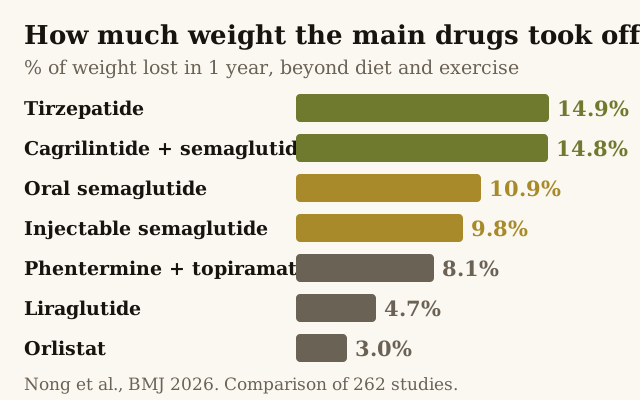
At the top are tirzepatide, the substance in Mounjaro, and the combination of cagrilintide with semaglutide, which was still under review by regulators when the study was done. Both took off close to 15% of body weight more than diet and exercise alone.
Right behind comes semaglutide, the substance in Ozempic and Wegovy. The tablet version came out a little ahead of the injection, but the difference between the two is within the margin of error. In longer studies, injectable semaglutide took off more weight than in short ones, so the one-year number underestimates what it does over time.
Liraglutide, in Saxenda, is an older injection and came in well behind. Orlistat, a tablet that reduces fat absorption, had the smallest effect among the best-known drugs. Phentermine with topiramate, which also appears in the chart, is a tablet that, according to the authors, is approved only in the United States.
Even newer drugs, such as retatrutide, mazdutide and ecnoglutide, took off weight similar to the top drugs. But they still have few studies, and the authors rated the confidence in these results as low or very low.
The authors also looked for groups of people who responded better to one drug than another, splitting them by degree of obesity, diabetes and heart disease. They found no reliable differences, so the ranking order holds for the groups studied.
What about semaglutide at a higher dose?
A common question is whether a higher dose solves things. The STEP UP study tested semaglutide at 7.2 mg per week, three times the dose used today, in 1,407 adults with obesity and without diabetes. Over 72 weeks, those on the higher dose lost 18.7% of their weight on average, compared with 15.6% on the usual dose and 3.9% on placebo.
The extra loss came with more side effects. Nausea, diarrhea and other gut symptoms appeared in 71% of those on the higher dose, compared with 61% on the usual dose. An unusual skin sensation, such as tingling or sensitivity to touch, appeared in almost one in four participants on the higher dose. Most of the time it was mild and went away by the end of the study. The study was paid for by the manufacturer.
More weight loss, more side effects
In the BMJ comparison, the drugs that took off more weight also tended to cause more side effects. Gut symptoms, such as nausea, vomiting, diarrhea and constipation, were the most common with these injections in general. Tiredness also increased with several drugs.
Stopping because of side effects was more frequent with most of the well-studied drugs. With tirzepatide, 28 more people per thousand stopped the drug within a year for this reason. With injectable semaglutide, it was 20. Orforglipron, a new tablet in the same family, had the highest number of people stopping.
Another effect worth knowing about is gallbladder trouble, such as gallstones. It increased with the combination of cagrilintide with semaglutide, with oral semaglutide, with liraglutide and, possibly, with tirzepatide. The extra risk was small, up to 13 more cases per thousand people in a year, but strong pain on the right side of the belly during treatment deserves an assessment.
To give the gut time to adjust, the dose of these injections goes up gradually, over weeks, and much of the nausea improves with time.
What about muscle?
Tirzepatide reduced body fat the most, but it also reduced lean mass the most, and lean mass includes muscle. Injectable semaglutide also took off lean mass. That is why people on these injections need enough protein and strength training, which help hold on to muscle while weight comes down. This loss can be tracked with bioimpedance, which estimates the body’s fat and lean mass.
And quality of life?
This was the finding that struck me the most. Even with the weight loss, no drug improved quality of life, measured by questionnaire, beyond the minimum that makes a difference to the person in the first year. Losing weight helps health a lot, but well-being also depends on other things, such as sleep, energy and how you feel on the treatment.
What these injections do for the heart
This is where they differ the most. Injectable semaglutide was the only drug that reduced deaths from any cause and heart attacks. This result came mainly from studies of people who already had a high risk for heart disease, so it applies most to that group.
Semaglutide and tirzepatide also lowered the risk of heart failure, and tirzepatide reduced hospital admissions for it.
Injections for people with heart failure
Heart failure is when the heart cannot keep up with what the body needs. More than half of cases are a type in which the heart pumps with normal or almost normal strength but is stiff and fills poorly. This type often goes along with obesity and diabetes, and it causes tiredness, shortness of breath and swollen legs.
A review published in 2026 pooled 7 studies with 6,525 people with this type of heart failure, comparing the injections with placebo. Those who used them had 38% fewer episodes of the disease getting worse, such as hospital admission, an emergency visit or needing more diuretic. Symptoms and quality of life improved, and the distance walked in six minutes increased. The benefit seemed larger in people with obesity, but this difference still needs to be confirmed.
The injections did not reduce deaths in these studies, and the result applies only to the type of heart failure in which the heart pumps normally. In the type in which the heart pumps weakly, a study of liraglutide in people with advanced disease, right after a hospital stay, showed no improvement and even raised the heart rate. So people with heart failure need to decide on these injections together with their cardiologist.
Tablet or injection?
There are already tablet options, such as oral semaglutide. Orforglipron, from the same family, is a newer tablet tested in recent studies. For people who are afraid of needles, that is an advantage.
In the BMJ comparison, however, the tablets were not free of problems. Oral semaglutide was among the drugs with the most gut symptoms, and orforglipron was the drug with the most people stopping because of side effects. The semaglutide tablet also has an annoying rule: you take it on an empty stomach, with a little water, and need to wait a while before eating.
So which one is best?
There is no single best injection for everyone. The BMJ authors themselves conclude that the choice should be made jointly by doctor and patient, weighing benefits and side effects. In practice, what counts in the choice is:
- how much weight you need to lose to improve your health;
- whether you have heart disease, heart failure or diabetes, because that tips the balance toward some drugs;
- how you tolerate the side effects, especially in the gut;
- whether you prefer a weekly injection or a daily tablet;
- the cost, because a treatment you cannot keep up does not work.
Keep in mind that when the injection is stopped, much of the weight usually comes back, as I mentioned in my post on weight-loss injections. So the choice also needs to think about the long term.
Conclusion
Tirzepatide and the combination of cagrilintide with semaglutide lead to the most weight loss, followed by semaglutide. The drugs that take off more weight, however, also tend to cause more side effects. For people at high risk for heart disease, injectable semaglutide has the most proof of protection, and in heart failure where the heart pumps normally or almost normally, these injections help with symptoms and with episodes of the disease getting worse. The best injection is the one that suits your health and that you can keep up.
See you next time, everyone!
Responsible physician: Dr. Gilberto Nering Junior, sports medicine physician, CRM-SP 160822, RQE 142486 (Sports Medicine, Brazil).
This text was not sponsored, is for information only and does not replace an individual assessment. Questions about the content: contact the clinic.
Cover photo: Julia Taubitz on Unsplash.
Frequently asked questions about which weight-loss injection works best
Which weight-loss injection works best?
In the comparison published in the BMJ in 2026, tirzepatide and the combination of cagrilintide with semaglutide took off the most weight, about 15% of body weight more than diet and exercise in one year. Semaglutide came right behind.
Does Mounjaro cause more weight loss than Ozempic?
Yes. Tirzepatide, in Mounjaro, took off more weight than semaglutide, in Ozempic and Wegovy, in one year. On the other hand, injectable semaglutide has the most proof of reducing heart attacks and deaths in people at high risk for heart disease.
Does the injection with the most weight loss have more side effects?
In general, yes. The drugs that took off more weight also caused more gut symptoms, more tiredness and more people stopping because of side effects.
Can people with heart failure use a weight-loss injection?
In the type of heart failure where the heart pumps normally or almost normally, studies showed better symptoms and fewer episodes of the disease getting worse. In the type where the heart pumps weakly, there is no proven benefit yet. The decision should be made together with the cardiologist.
Does the tablet work as well as the injection?
At the doses tested in obesity studies, which are not necessarily the same as the tablet used for diabetes, oral semaglutide had results similar to the injection in one year. Tablets also have side effects, mainly in the gut, and need care in how they are taken.
References
- Elazab A, Elbataa A, Mansour A, et al. Cardiovascular and functional outcomes of glucagon-like peptide-1 receptor agonists in heart failure with preserved or mildly reduced ejection fraction: a systematic review and meta-analysis of randomized controlled trials. Eur J Med Res. 2026. Article in Press. doi:10.1186/s40001-026-05199-7
- Nong K, Shi Q, Xie X, et al. Comparative effects of drugs for adults with overweight or obesity: systematic review and network meta-analysis. BMJ. 2026;394:e372161. doi:10.1136/bmj-2026-372161
- Wharton S, Freitas P, Hjelmesæth J, et al. Once-weekly semaglutide 7·2 mg in adults with obesity (STEP UP): a randomised, controlled, phase 3b trial. Lancet Diabetes Endocrinol. 2025;13(11):949-963. doi:10.1016/S2213-8587(25)00226-8