Also in: Português · Español · Italiano · 中文 · हिन्दी
Main points
- By the European consensus, people on Mounjaro who are losing weight have a target of one to one and a half grams of protein per kilo of adjusted body weight a day, and that weight is lower than what the scale shows.
- With a smaller appetite, protein tends to drop along with the rest of the plate, and in an American study fewer than half of the people on the injection reached the minimum target the researchers used.
- Start each meal with protein, choose low-volume foods such as eggs, fish, yogurt, white cheese and chicken, and spread the total across the day’s meals and snacks.
- In the studies, splitting protein evenly or concentrating it at dinner gave the same result for lean mass, and protein protects muscle more when it comes with strength training.
- Shakes and whey come in when food doesn’t reach the target, and people with kidney disease set the amount with their doctor.
A 1.65 m, 100 kg woman who starts Mounjaro has a target, by the math of the 2026 European consensus, of 79 to 118 grams of protein a day while she is losing weight. If she did the math with her scale weight, the target would go up to 100 to 150 grams, an amount that is hard to eat with the small appetite the injection leaves. Protein on Mounjaro is counted in grams per day, starting from an adjusted body weight, which sits between the upper limit of normal weight for your height and your scale weight, and you split the total into portions that fit in a stomach that fills up fast. Supplements come in only when food falls short.
When I wrote about losing weight without losing muscle, I gave the American protein range for people losing weight and warned that, in people with obesity, doing the math with current weight overstates the need. Here I do that math with you, step by step. The numbers come from two documents written for people on weight-loss injections. In the first, European obesity, dietitian and patient organizations gathered what is known about the diet, physical function and mental health of people on these injections and reached consensus recommendations, which The Lancet Diabetes & Endocrinology published in July 2026 (several authors have consulted for Novo Nordisk and Eli Lilly). In the second, four American societies, covering lifestyle medicine, nutrition and obesity, listed the nutrition priorities for people on these injections, in a 2025 paper in the American Journal of Clinical Nutrition (funded by the US National Institutes of Health, with authors who also have ties to both manufacturers).
The European consensus admits there is still little research in people on the injection to know which amount of protein best protects muscle, and it treats the targets as practical and individual. The American document presents the ranges as proposals and says there is still no agreement on which weight to use in the calculation.
How many grams of protein a day on Mounjaro
During the weight-loss phase, the European consensus suggests 1.0 to 1.5 g per kilo of adjusted body weight a day, with a minimum of 60 g, for people with no disease that requires eating less protein. The American guidance cites targets of 1.2 to 1.6 g per kilo and offers a shortcut for those who don’t want to do the math: 80 to 120 g a day. For a 1.65 m person who weighs between 80 and 120 kg, the European rule gives somewhere between 72 and 128 g, very close to that shortcut. You reach that total more easily by splitting it into meals with 25 to 30 g of protein each and topping up with snacks. Once your weight stops falling and maintenance begins, the European target drops to 0.8 to 1.0 g per kilo of adjusted body weight. People with kidney disease follow their own, lower calculation, worked out with their doctor and dietitian.
How to calculate protein with adjusted body weight
Adjusted body weight exists because doing the math with scale weight overestimates the protein needs of people with obesity, as the American document points out. A good part of that weight is fat, and the protein you eat goes mainly to muscle, organs and blood. The consensus starts from the weight the person would have at a body mass index (BMI) of 25 and adds one third of the difference up to their current weight, as in the example of the 1.65 m, 100 kg woman:
- Multiply your height by itself and then by 25. For 1.65 m, that’s 25 × 1.65 × 1.65 = 68 kg, the reference weight.
- Subtract that number from your current weight. At 100 kg, that leaves 32 kg.
- Add one third of that difference (the consensus uses 0.33) to the reference weight: 68 + 10.6 gives 78.6 kg, about 79 kg. That is your adjusted body weight.
- Multiply the adjusted body weight by 1.0 and by 1.5. At 78.6 kg, the target falls between 79 and 118 g of protein a day.
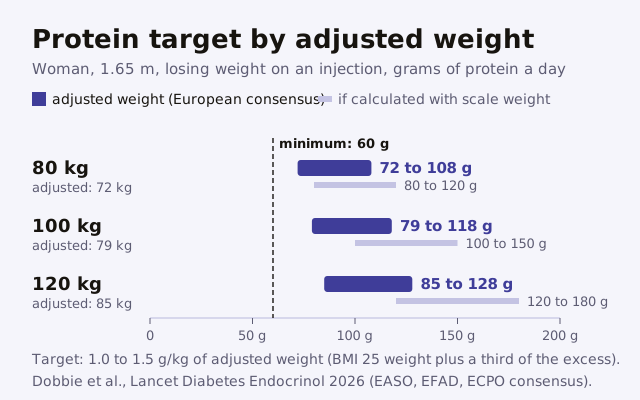
When the scale goes up by 40 kg, adjusted body weight rises only a little, and the top of the target goes from 108 to 128 g. Calculated with current weight, the same woman at 120 kg would have to eat up to 180 g of protein a day, the equivalent of more than half a kilo of grilled chicken breast. If you’ve had a bioimpedance test and know your lean mass (everything in the body that isn’t fat), there is another calculation, which the American guidance considers more precise: 1.5 g of protein per kilo of lean mass. Both calculations are starting points, and a dietitian adjusts the target to your age, your health conditions and what you can manage to eat.
Why people on the injection end up eating little protein
Tirzepatide, the active ingredient in Mounjaro, mimics two gut hormones, GLP-1 and GIP. With it, the brain gets the signal that you’ve eaten enough sooner, and the stomach empties more slowly. According to the American guidance, people on injections of this family eat 16% to 39% fewer calories than those on placebo. The European authors note that people eat less of everything (carbohydrate, fat and protein), and the American document adds that some people develop an aversion to the taste of certain foods.
In an American study published in 2025 in Frontiers in Nutrition (carried out by employees of GNC, a US chain that sells supplements), only 43% of people on the injection reached the minimum target the authors used for people losing weight, calculated from adjusted body weight, even though most said they had been eating more protein since starting treatment. The researchers asked a small group of adults already on treatment (most on semaglutide or tirzepatide) to write down everything they ate for a few days. It was an observational study, with food recorded by the participants themselves, and it shows a trend without measuring the effect on muscle.
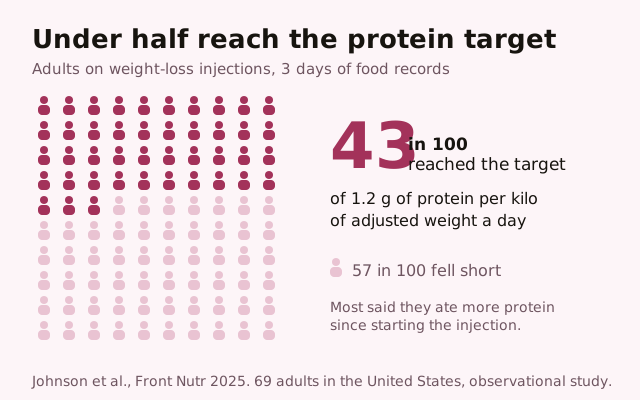
In this group, protein made up a share of daily calories within what is recommended, and the grams still came up short. The study didn’t measure why, and the simplest explanation, in my view, is that the whole plate shrank and protein shrank with it. So, if you’re on the injection, count your target in grams per day, adding it up meal by meal.
What protein does for muscle during treatment
Part of the weight lost on the injection is lean mass, and a 2024 review notes that lean mass lumps muscle together with water, organs and the fluid held inside the fat tissue itself. The same review concludes that the change in muscle in people on these injections looks like an adaptation to a lighter body, with better-quality muscle and less fat infiltration. Even so, the European consensus links an intake below 1.0 g per kilo of adjusted body weight to a higher risk of losing muscle, and that risk weighs more on people who are older or already have little reserve.
The 2020 review from Purdue University, the same one I cited when I wrote about losing weight without losing muscle, pooled studies without injections in which one group ate the minimum recommended protein for adults and another ate more. During calorie restriction, the higher-protein group held on to about 0.4 kg more lean mass, and in people who were neither dieting nor training, the extra protein didn’t change lean mass. The difference is modest, and the guidance from the American societies warns that more protein without strength training probably won’t preserve muscle. Training, which I covered in detail in that post, is what protects most, and protein does more when it comes with it.
Nobody knows yet exactly how much protein best protects muscle in people on the injection. A study under way in Kuwait is comparing training, extra protein and both together in adults starting semaglutide or tirzepatide, measuring thigh muscle with MRI. The results aren’t out yet, so for now the ranges from the two documents stand.
Do you need to split protein across meals?
The Europeans suggest 25 to 30 g of protein at each main meal, plus protein snacks in between, on the grounds that muscle makes more protein when it gets portions of that size throughout the day. A Purdue University team tested this in overweight adults who dieted and did regular strength training for a few months. Everyone ate 90 g of protein a day, but half split it evenly between breakfast, lunch and dinner and the other half left two thirds for dinner. At the end, both groups lost the same amount of lean mass. The study came out in 2017 in the American Journal of Clinical Nutrition, with public funding and money from American egg, dairy and beef producer associations, and nobody in it was on an injection.
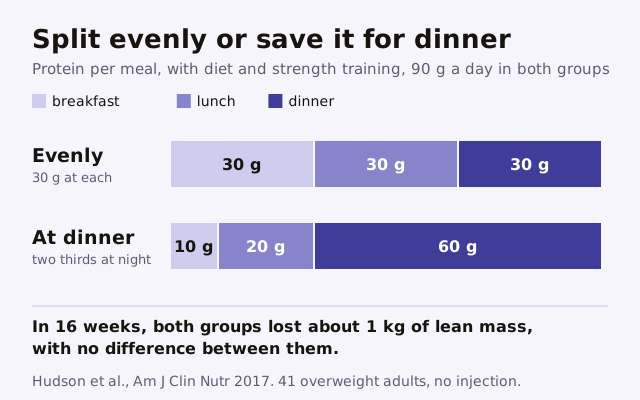
A 2024 study published in the Journal of Nutrition, which randomly assigned adult women on a diet to one eating pattern or the other, reached the same result: splitting protein evenly or concentrating it at dinner led to the same loss of lean mass. For people on Mounjaro, I see another reason to split it: a stomach that empties slowly doesn’t handle 60 g of protein in a single dinner well, and three meals with 25 to 30 g, plus one or two snacks, reach the total without overloading any of them.
How to reach the target when you eat little
With a low appetite, both documents suggest starting the meal with protein, so it goes in before the stomach fills up. If you eat half your plate, make it the half with the chicken, fish or egg, and leave the rice and bread for later, if there’s still room.
The American document recommends foods with little volume and a lot of protein: fish, eggs, Greek yogurt, cottage cheese, nuts, and peanut or almond butter. Two slices of Minas cheese with two eggs add up to about 24 g, and a 100 g grilled chicken breast fillet has more than 30 g, according to the Brazilian food composition table. For people who feel full after a few bites, the consensus suggests soft, easy-to-digest meals, like an omelet or yogurt, and I gathered the swaps for nausea days when I wrote about nausea on Mounjaro.
Drinks go after the meal or between meals, as the consensus advises, because water, juice or coffee before food take up the space protein needs. Skipping meals makes the daily total harder to reach, and snacks help close the gap: a cup of plain yogurt, a boiled egg, a slice of white cheese or a handful of unsalted peanuts, since the consensus caps the day’s nuts and seeds at about 30 g. If your target is 90 g and lunch and dinner give you 30 g each, you still need 30 g from breakfast and snacks.
Which protein is best on Mounjaro
Both documents favor fish and seafood, lean poultry, eggs, milk and dairy, beans and lentils, and the European one also lists skinless chicken and turkey, chickpeas, soy and tofu. The European consensus calls this protein of good biological quality, the kind that brings the amino acids muscle needs: meat, eggs, milk and soy bring all of them, and beans and lentils complete the picture when eaten with another source. Lean red meat comes in smaller portions. Processed meats, such as hot dogs, bacon, ham and sausages, should be few, because the American guidance mentions their link with type 2 diabetes, heart disease and bowel cancer in the general population.
Vegetarians and vegans can also reach the target, but they need a larger amount and more variety of plant protein, and the consensus asks for extra support from a dietitian in these cases. The table shows how much protein each common portion has, according to the Brazilian food composition table (TACO), from Unicamp:
| Food | Portion | Protein |
|---|---|---|
| Grilled lean beef | 100 g | 36 g |
| Grilled chicken breast | 1 fillet, 100 g | 32 g |
| Baked sardines | 100 g | 32 g |
| Baked hake | 1 fillet, 100 g | 27 g |
| Grilled salmon | 100 g | 26 g |
| Canned tuna in oil | 60 g | 16 g |
| Boiled egg | 2 eggs (100 g) | 13 g |
| Fresh Minas cheese | 2 slices (60 g) | 10 g |
| Ricotta | 2 slices (60 g) | 8 g |
| Plain yogurt | 1 cup (170 g) | 7 g |
| Tofu | 100 g | 7 g |
| Roasted peanuts | 1 handful (30 g) | 7 g |
| Cooked lentils | 100 g | 6 g |
| Cooked carioca beans | 100 g | 5 g |
For the same 100 g, meat and fish provide about four to seven times more protein than beans and lentils. The two legumes bring fiber, which many people who eat little are short of, and they work better added to an egg, some cheese or a piece of meat than as the only protein in the meal.
When whey and shakes help
A protein supplement comes in when food doesn’t reach the target, and the European document singles out people with nausea that won’t go away or who feel full after a few bites. Whey, casein, soy protein powder, ready-to-drink shakes and protein bars are on the list, ideally with guidance from a dietitian to choose the product and the amount. The same consensus asks that supplements complement food without taking its place, because they usually lack the fiber, vitamins and minerals that food brings.
When you choose one, read the label: check how many grams of protein each serving has and whether there is added sugar. Some bars and drinks use sweeteners such as sorbitol and xylitol, which the consensus says to limit in people with diarrhea, one of the most common side effects of the injection. People with healthy kidneys can use whey, and in the post on whey protein I summed up the studies on the kidneys, the dose and the types of product.
Who needs a tailored protein target
In the situations below, set your protein target together with your doctor and dietitian. Some of them also call for adjusting the injection dose, a decision that rests with the doctor.
- chronic kidney disease: the consensus mentions 0.8 to 1.0 g per kilo of adjusted body weight, but the right number depends on the stage of the disease, and it is set by the doctor together with a dietitian experienced in kidney care; don’t increase your protein on your own;
- older age, frailty or low muscle reserve, where the consensus calls for closer follow-up and, sometimes, slower dose increases;
- a vegetarian or vegan diet, which needs more quantity and variety to reach the target;
- a week or more eating fewer than 800 calories a day, a situation in which the consensus advises talking to your doctor about lowering the dose or pausing the injection;
- heavy hair loss during rapid weight loss, which, according to the consensus, may signal a lack of protein, iron or zinc;
- new difficulty climbing stairs, getting up from a chair or carrying shopping bags.
Both documents set limits in both directions: protein below 0.4 to 0.5 g per kilo a day can lead to muscle loss, and both advise against more than 2 g per kilo a day for long periods. To track what you’re losing, repeated bioimpedance under the same conditions and the changes in your strength tell you more than the scale. If you’re unsure who to see, I explained the difference between a nutrologist and a dietitian in another post, and the other side effects of Mounjaro are gathered in the post on that topic.
In practice
- Calculate your adjusted body weight (25 × height × height, plus one third of the difference up to your weight) and multiply it by 1.0 and by 1.5 to find your daily range in grams.
- Split the total into three meals with 25 to 30 g of protein and one or two snacks.
- Start each meal with protein and leave drinks for afterward or between meals.
- Choose fish, chicken, eggs, yogurt, white cheese, beans and tofu, and save processed meats for rare occasions.
- If the target still doesn’t add up, talk to a dietitian about whey or a shake and, when you buy one, read the label.
- Do strength training. If you’re sedentary and have heart disease, kidney disease or diabetes, get a medical evaluation first; with kidney disease, also agree on the amount of protein with your doctor before changing your diet.
Conclusion
If you’re on Mounjaro and losing weight, the European consensus target is 1.0 to 1.5 g of protein per kilo of adjusted body weight a day, close to the American shortcut of 80 to 120 g a day. In an American study, fewer than half of the people on the injection reached the target the researchers used, and the explanation that seems most likely to me is that the medication shrinks the whole plate. Start your meals with protein, choose low-volume foods, spread the total over the day and use a supplement when food isn’t enough. These targets are expert consensus, with little research done in people on the injection, and the effect of protein on muscle is greater in people who do strength training.
All the best!
G
Responsible physician: Dr. Gilberto Nering Junior, sports medicine physician, CRM-SP 160822, RQE 142486 (Sports Medicine, Brazil).
This text was not sponsored, is for information only and does not replace an individual assessment. Questions about the content: contact the clinic.
Cover photo: Alfonso Betancourt on Unsplash.
Frequently asked questions about protein on Mounjaro
What is the protein target on Mounjaro?
During weight loss, the 2026 European consensus suggests 1.0 to 1.5 g of protein per kilo of adjusted body weight a day, with a minimum of 60 g, which is close to the American shortcut of 80 to 120 g a day. Split the total into meals of 25 to 30 g. People with kidney disease need a lower target, set with their doctor.
How do you calculate protein on Mounjaro?
Multiply your height by itself and by 25 to find the reference weight, add one third of the difference up to your current weight and multiply the result by 1.0 and by 1.5. A 1.65 m, 100 kg woman ends up with an adjusted body weight of about 79 kg and a target of 79 to 118 g of protein a day.
Which foods help you reach the protein target on Mounjaro?
Both documents favor fish, lean poultry, eggs, yogurt, white cheeses, beans and lentils, and the European consensus also lists soy and tofu. Lean red meat comes in smaller portions, and processed meats should be few. On low-appetite days, low-volume foods such as eggs, fish and Greek yogurt help you reach the target.
Can I take whey while on Mounjaro?
Yes, when food doesn’t reach your protein target, especially if you have nausea or feel full very quickly. Whey should complement your diet without replacing meals, and people with kidney disease need to talk to their doctor before using it.
Is eating too much protein on Mounjaro harmful?
It can be when you go well past the target: both documents advise against more than 2 g of protein per kilo a day for long periods, because of the risk of harmful health effects. In people with chronic kidney disease, the target is lower and set with the doctor and the dietitian.
References
- Alawadhi AA, Alroudhan D, Alsaeed DJ, et al. LEAN mass Preservation with Resistance Exercise and Protein during semaglutide and tirzepatide therapy (LEAN-PREP study): a protocol for a randomised controlled trial. BMJ Open. 2026;16(4):e116911. doi:10.1136/bmjopen-2026-116911
- De Leon A, Roemmich JN, Casperson SL. Daily Dietary Protein Distribution Does Not Influence Changes in Body Composition During Weight Loss in Women of Reproductive Years with Overweight or Obesity: A Randomized Controlled Trial. J Nutr. 2024;154(4):1347-1355. doi:10.1016/j.tjnut.2024.02.009
- Dobbie LJ, Tolvanen L, Alves D, et al. Nutritional, functional, and psychological considerations for incretin-based therapies in adults: an EASO, EFAD, and ECPO Consensus Statement. Lancet Diabetes Endocrinol. 2026;14(9):754-777. doi:10.1016/S2213-8587(26)00122-1
- Hudson JL, Kim JE, Paddon-Jones D, et al. Within-day protein distribution does not influence body composition responses during weight loss in resistance-training adults who are overweight. Am J Clin Nutr. 2017;106(5):1190-1196. doi:10.3945/ajcn.117.158246
- Hudson JL, Wang Y, Bergia RE, et al. Protein Intake Greater than the RDA Differentially Influences Whole-Body Lean Mass Responses to Purposeful Catabolic and Anabolic Stressors: A Systematic Review and Meta-analysis. Adv Nutr. 2020;11(3):548-558. doi:10.1093/advances/nmz106
- Johnson B, Milstead M, Thomas O, et al. Investigating nutrient intake during use of glucagon-like peptide-1 receptor agonist: a cross-sectional study. Front Nutr. 2025;12:1566498. doi:10.3389/fnut.2025.1566498
- Mozaffarian D, Agarwal M, Aggarwal M, et al. Nutritional priorities to support GLP-1 therapy for obesity: a joint Advisory from the American College of Lifestyle Medicine, the American Society for Nutrition, the Obesity Medicine Association, and The Obesity Society. Am J Clin Nutr. 2025;122(1):344-367. doi:10.1016/j.ajcnut.2025.04.023
- Neeland IJ, Linge J, Birkenfeld AL. Changes in lean body mass with glucagon-like peptide-1-based therapies and mitigation strategies. Diabetes Obes Metab. 2024;26 Suppl 4:16-27. doi:10.1111/dom.15728
- Núcleo de Estudos e Pesquisas em Alimentação (NEPA), Universidade Estadual de Campinas. Tabela Brasileira de Composição de Alimentos (TACO). 4th ed., revised and expanded. Campinas: NEPA-Unicamp; 2011.