Also in: Português · Español · Italiano · 中文 · हिन्दी
Main points
- The most common side effects of Mounjaro involve the stomach and gut: nausea, constipation, diarrhea and vomiting.
- They show up more in the weeks when the dose goes up and tend to ease once the dose stops rising.
- In the trial that compared Mounjaro with Wegovy, only 2.7% of people on tirzepatide stopped the drug because of stomach problems.
- The weight loss does not come from the nausea: people who never felt sick lost about as much weight as those who did.
- Severe, constant belly pain or swelling of the face and throat calls for the emergency room right away; vomiting that won’t stop and signs of dehydration call for care the same day.
Almost half of the adults who took Mounjaro for more than a year, in a 2025 trial that compared it with Wegovy, said they had felt nausea at some point, with constipation and diarrhea close behind. These are the Mounjaro side effects that come up most. For most people the discomfort was mild to moderate and clustered in the weeks when the dose was being raised, and few people gave up the drug because of it.
Mounjaro is tirzepatide, the once-weekly injection that mimics two gut hormones, GLP-1 and GIP. I wrote before about weight-loss injections in general, covering Ozempic, Wegovy and Saxenda together. This post sticks to tirzepatide: how often each effect shows up, in which weeks it tends to come, how long it lasts, whether Mounjaro causes more or fewer effects than semaglutide, and which signs mean you should get care.
What are the side effects of Mounjaro
In the SURMOUNT trials and in the tirzepatide label, the most common side effects of Mounjaro involve the stomach and gut: nausea, constipation, diarrhea and vomiting, plus burping, heartburn and a bloated belly. Tiredness, headache, dizziness, redness or itching where you inject and hair loss also appear. Most are mild or moderate and cluster in the weeks when the dose goes up. Serious effects are rare: pancreatitis, gallbladder problems, dehydration bad enough to harm the kidneys, severe allergy and, in people with diabetes who use insulin or a sulfonylurea, low blood sugar.
How often each effect shows up
The trial with the clearest numbers on this is SURMOUNT-5, published in 2025 in the New England Journal of Medicine (funded by Eli Lilly, the maker of Mounjaro). The participants had obesity, did not have diabetes and were randomly assigned to tirzepatide or semaglutide, each at the highest dose they could tolerate, for 72 weeks. The chart shows the most common complaints in the Mounjaro group, counted as people out of every 100.
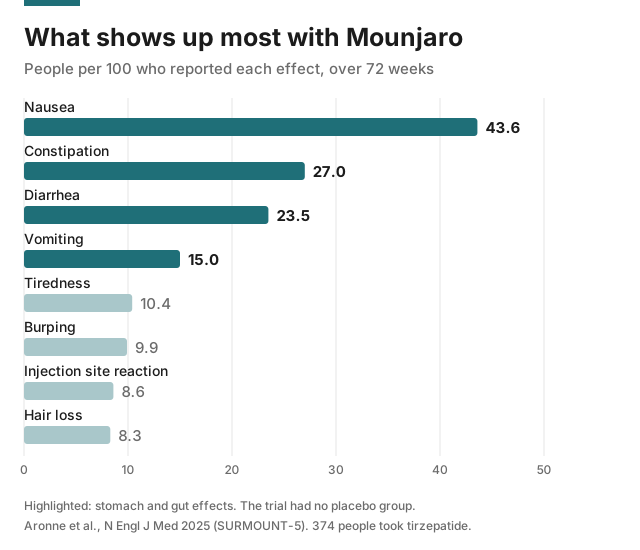
Each bar counts the people who reported the effect at some point, which is different from having it all the time: someone who felt sick for three days after a dose increase is counted the same as someone who felt sick for weeks. SURMOUNT-5 also had no placebo group. In the trials that did, some of the people who got an injection with no drug in it reported nausea, diarrhea and constipation, less often, which shows that some of these complaints come up over almost a year and a half with or without the injection.
In SURMOUNT-5, only 2.7% of people on tirzepatide dropped out because of nausea, vomiting, diarrhea or another stomach or gut effect. In SURMOUNT-1, the trial that led to the approval of Mounjaro for obesity, also published in the New England Journal of Medicine, the authors described these effects as mostly mild to moderate and concentrated in the period when the dose goes up.
In which weeks the effects appear and when they pass
Tirzepatide acts in two places at once. In the brain, it talks to the hunger center and makes you feel full sooner. In the stomach, it slows down how fast food moves on to the gut. That second effect helps hold hunger back, and it is also where the nausea, burping, heartburn and feeling of a full stomach come from.
That’s why the Mounjaro dose starts low and goes up gradually, step by step, with a few weeks between steps, to give the body time to adjust. In the trials, nausea, diarrhea and vomiting become more frequent around each step and ease once the dose stops rising. An analysis of the tirzepatide trials in type 2 diabetes, published in 2024 in the journal Diabetes, Obesity and Metabolism, described these effects as temporary and mild to moderate. In the obesity trials, people who needed medicine for nausea or diarrhea mostly started it during the dose-increase phase.
Going by the pattern seen in the trials, it is common for nausea to come back for a few days right after a dose increase, even in people who had already got used to the previous dose. Once people reach the maintenance dose, most feel much less. The size and type of the meal matter too: a large, fatty plate stays even longer in a stomach that is already slow because of the drug, and then the nausea, burping and bloated feeling hit harder.
With constipation, besides the slower transit, there is the fact that people start eating and drinking much less, which cuts the fiber and water that reach the gut. Water and fiber spread through the day usually help, and it is a good idea to talk to your doctor if you go several days without a bowel movement or have severe pain.
Does Mounjaro cause weight loss by making you nauseous?
Many people think the injection works because it makes you too sick to eat. An analysis of the first four SURMOUNT trials, published in 2025 in Diabetes, Obesity and Metabolism (also funded by Lilly), set out to check this. People who had no nausea lost about as much weight as those who did, and nausea, vomiting, diarrhea and heartburn together explained at most about 3% of the total weight loss.
The weight comes off mainly through less hunger and feeling full sooner, and not through feeling unwell. So feeling sick is no sign that the drug is working better. If the nausea is bad enough that you can’t eat the bare minimum or drink water, talk to your doctor instead of putting up with it in silence hoping to lose weight faster.
Mounjaro or Wegovy: which causes more side effects?
SURMOUNT-5 put Mounjaro side by side with Wegovy in people with obesity and no diabetes. Wegovy is semaglutide, the same substance as Ozempic, at the higher dose used for obesity. The total number of reported effects was similar in both groups, with nausea, constipation and diarrhea at the top of the list. Vomiting and reflux came up more with semaglutide, which also led more people to quit because of nausea, vomiting or diarrhea. On the other hand, injection site reaction (redness, itching or a small lump that goes away on its own) was much more common with tirzepatide.
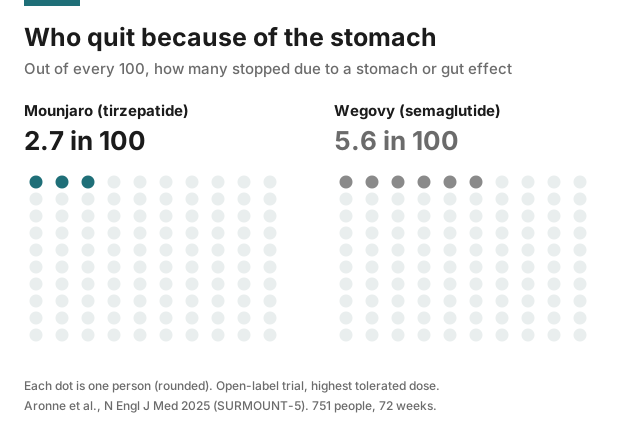
The trial was open label (everyone knew which injection they were taking), which may shift a little what each person reports, and it was not designed to compare rare effects. Since tirzepatide also produced more weight loss in the same trial, the choice between the two depends on your goal and your health conditions, and I compared them in detail when I wrote about which weight-loss injection works best.
Tiredness, hair loss and muscle loss
Tiredness and dizziness show up in some people and often go along with eating and drinking too little in the first weeks, when hunger drops sharply. If you stand up quickly after a day like that, you get dizzy more easily. Drinking water and making sure you have small but complete meals usually helps, and if it doesn’t get better, your doctor needs to know.
Hair loss was also on the trial’s list. The most accepted explanation is the fast weight loss itself, as happens after bariatric surgery or a very strict diet, and in these cases the shedding is usually temporary. Since it worries a lot of people, I’ll cover it in a post of its own.
Another effect that concerns me as a sports medicine physician, and that doesn’t appear in side effect tables, is losing muscle along with the fat. Anyone who loses a lot of weight quickly, by any method, also loses lean mass, and the injection is no exception. Strength training and enough protein make a difference, and I explained how in the post on losing weight without losing muscle.
Rare risks to watch for
The US label for tirzepatide for obesity (there it is called Zepbound, and it is the same drug as Mounjaro) lists rare risks that anyone using it should know about. Some also show up in people who lose weight quickly by other means, and others depend on the conditions a person already has.
Pancreatitis
Pancreatitis is an inflammation of the pancreas that causes severe, constant pain in the upper belly, often spreading to the back, with or without vomiting. A 2023 meta-analysis, published in Frontiers in Endocrinology, pooled the controlled trials of tirzepatide and found no clear increase in the risk of pancreatitis. Even so, there have been cases with tirzepatide and with other injections in the same family, and the label says to stop the drug and seek care when it is suspected. If you have had pancreatitis before, talk to your doctor before you start.
Gallbladder
In the same meta-analysis, gallbladder and bile duct disease (gallstones, inflammation) was almost twice as frequent with tirzepatide as with placebo or insulin, although it remains uncommon. The label itself links these cases to weight loss, which is a known factor in forming gallstones, with or without medication. Pain on the right side under the ribs, especially after eating, fever or yellowish eyes need to be checked.
Dehydration and kidneys
Severe vomiting and diarrhea can dehydrate you, and dehydration can harm the kidneys. According to the label, most cases of kidney injury happened in people who had these symptoms, mainly at the start and during dose increases. Little, dark urine, a very dry mouth and dizziness when standing up are signs that you are short on water.
Allergy, low blood sugar and eyes
Severe allergy, with swelling of the lips, tongue or throat and shortness of breath, is rare and calls for the emergency room right away. People with diabetes who use insulin or a sulfonylurea can get hypoglycemia on the injection, and the doctor usually adjusts these drugs at the start. People with diabetes and retinopathy need follow-up with an eye doctor, because a fast improvement in blood sugar can make the retina worse for a while.
Surgery, tests with sedation, the pill and the thyroid
Because the stomach empties more slowly, there is a risk that food is still in it during general anesthesia or deep sedation. So always say that you use Mounjaro before surgery, an endoscopy or a colonoscopy. A 2024 guidance document from US anesthesia, surgery and gastroenterology societies covers this, and your doctor decides what to do case by case. The interaction with the birth control pill and the warning about medullary thyroid cancer are explained in the post on weight-loss injections. And the pen is personal: the label forbids sharing it with anyone else, even with a new needle.
When to get medical care
Most Mounjaro effects improve with time and changes to what you eat, and can wait for the next appointment. The signs in the table call for care before that.
| Sign | What it may be | What to do |
|---|---|---|
| Severe, constant pain in the upper belly that may spread to the back | Pancreatitis | Stop the injection and go to the emergency room |
| Pain on the right side under the ribs, fever or yellowish eyes | Gallbladder problem | Care the same day |
| Vomiting or diarrhea that won’t stop, little dark urine, dizziness when standing up | Dehydration that can affect the kidneys | Care the same day |
| Swelling of the face, lips or throat, shortness of breath | Severe allergy | Emergency room right away |
| Shaking, cold sweat and confusion in someone with diabetes | Low blood sugar | Follow the agreed plan and tell your doctor |
| Lump in the neck, hoarseness that won’t go away, trouble swallowing | Thyroid change | Appointment to check it |
Nausea that keeps you from eating the bare minimum, constipation for several days and tiredness that doesn’t improve also deserve a call to your doctor before the next dose increase. Often the answer is to stay on the current dose for longer, a decision for whoever is following your treatment. If you are thinking of stopping for good, see what happens to your weight in the post on stopping weight-loss injections.
In practice
- Before you start, tell your doctor if you have had pancreatitis or gallstones, if your stomach empties too slowly (gastroparesis), if you are pregnant or planning to be, if anyone in your family has had medullary thyroid cancer, and if you use insulin, a sulfonylurea or the birth control pill.
- Follow the agreed dose increases without skipping steps, and expect a few days of nausea right after each increase.
- Eat slowly, in smaller portions, stop when you feel full and avoid very fatty meals, especially on the days of an increase.
- Drink water throughout the day and pay extra attention if you have vomiting or diarrhea.
- Do strength training and eat enough protein so you don’t lose muscle along with the fat.
- Keep the table of warning signs and always say you use the injection before surgery or a test with sedation.
Conclusion
The side effects of Mounjaro are, for the most part, in the stomach and gut, show up in the weeks when the dose goes up and ease once it settles. Few people need to stop because of them, and nausea is not what makes you lose weight, so nobody has to suffer for the drug to work. The serious risks, such as pancreatitis, gallbladder problems, dehydration and allergy, are rare and have signs you can recognize, gathered in the table in this post.
All the best!
G
Responsible physician: Dr. Gilberto Nering Junior, sports medicine physician, CRM-SP 160822, RQE 142486 (Sports Medicine, Brazil).
This text was not sponsored, is for information only and does not replace an individual assessment. Questions about the content: contact the clinic.
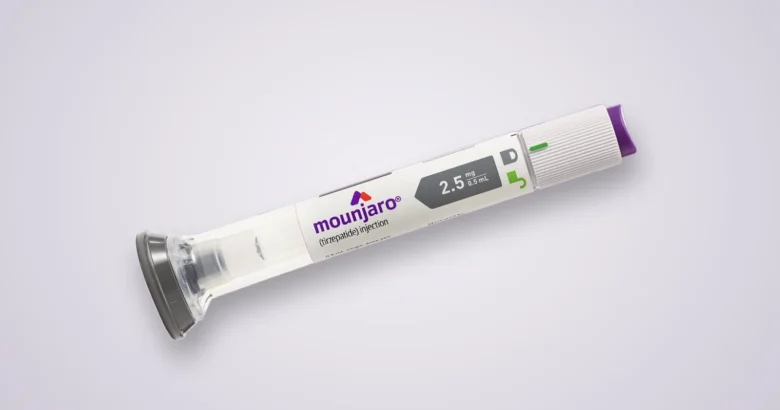
Cover photo: Mounjaro pen, Eli Lilly press image, cropped and placed on a studio background.
Frequently asked questions about Mounjaro side effects
How long do Mounjaro side effects last?
The stomach and gut effects show up most in the days and weeks after each dose increase and ease once the dose stops rising. On the maintenance dose, most people feel much less. If the nausea or diarrhea doesn’t improve, the doctor can keep you on the same dose for longer.
Is Mounjaro bad for the kidneys?
According to the label, most cases of kidney injury happened in people who became dehydrated from severe vomiting or diarrhea. Drinking water and getting care if the symptoms don’t stop help prevent this problem.
Does Mounjaro cause more side effects than Wegovy?
In the trial that compared Mounjaro with semaglutide at the Wegovy dose (the same drug as Ozempic, at a higher dose), the total number of effects was similar. Vomiting and reflux came up more with semaglutide, and injection site reaction was more common with tirzepatide, which also produced more weight loss.
Does everyone on Mounjaro feel sick?
No. Many people feel little or nothing, and among those who do, most have mild to moderate symptoms that cluster in the weeks of dose increases. In the trials, only a small share of people had to stop treatment because of them.
When should I stop Mounjaro because of a side effect?
Severe, constant belly pain that may spread to the back is a reason to stop and go to the emergency room, because it may be pancreatitis. Swelling of the face or shortness of breath also calls for immediate care. In other cases, talk to your doctor before stopping on your own.
References
- Aronne LJ, Horn DB, le Roux CW, et al. Tirzepatide as compared with semaglutide for the treatment of obesity. N Engl J Med. 2025;393(1):26-36. doi:10.1056/NEJMoa2416394
- Eli Lilly and Company. Zepbound (tirzepatide) injection: prescribing information. Indianapolis: Eli Lilly; 2026. DailyMed
- Jastreboff AM, Aronne LJ, Ahmad NN, et al. Tirzepatide once weekly for the treatment of obesity. N Engl J Med. 2022;387(3):205-216. doi:10.1056/NEJMoa2206038
- Kindel TL, Wang AY, Wadhwa A, et al. Multisociety clinical practice guidance for the safe use of glucagon-like peptide-1 receptor agonists in the perioperative period. Surg Obes Relat Dis. 2024;20(12):1183-1186. doi:10.1016/j.soard.2024.08.033
- Patel H, Khunti K, Rodbard HW, et al. Gastrointestinal adverse events and weight reduction in people with type 2 diabetes treated with tirzepatide in the SURPASS clinical trials. Diabetes Obes Metab. 2024;26(2):473-481. doi:10.1111/dom.15333
- Rubino DM, Pedersen SD, Connery L, et al. Gastrointestinal tolerability and weight reduction associated with tirzepatide in adults with obesity or overweight with and without type 2 diabetes in the SURMOUNT-1 to -4 trials. Diabetes Obes Metab. 2025;27(4):1826-1835. doi:10.1111/dom.16176
- Zeng Q, Xu J, Mu X, et al. Safety issues of tirzepatide (pancreatitis and gallbladder or biliary disease) in type 2 diabetes and obesity: a systematic review and meta-analysis. Front Endocrinol (Lausanne). 2023;14:1214334. doi:10.3389/fendo.2023.1214334