Also in: Português · Español · Italiano · 中文 · हिन्दी
Main points
- For most people, the weight comes back after stopping weight-loss injections. In the studies, between half and two thirds of what was lost came back within about a year.
- The regain starts fast, in the first few months, because hunger and the body go back to working in favor of the old weight.
- Blood pressure, blood sugar and cholesterol tend to get worse along with the returning weight.
- In one study, people who added exercise to the injection ended up lighter, one year after treatment ended, than those who used the injection alone. During treatment, strength training and protein are the recommended way to protect muscle.
- Stopping is a decision to plan with your doctor, and for many people the treatment is long term.
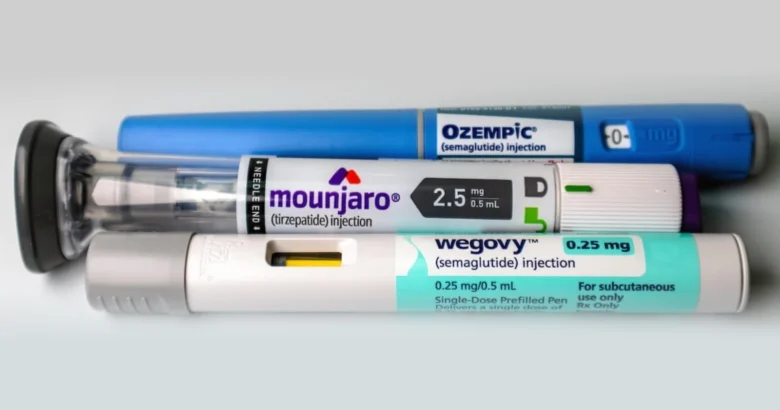
I stopped taking Ozempic or Mounjaro: will I gain the weight back? This question about weight-loss injections comes up a lot, and almost always after the results. For most people, the answer is yes: a good part of the weight comes back in the first year off the medication. In the post about weight-loss injections, I covered how they work, their side effects and, briefly, what happens when you stop. Here I go into that part in detail, the well-known rebound effect: how much weight comes back, why it comes back, what happens to your health and what to do to stop with less damage.
How much weight comes back after stopping weight-loss injections
In the studies, people who stopped the injection regained between half and two thirds of the weight they had lost within about a year, while those who continued kept losing or held on to the result. The best way to find out what happens when people stop is a specific kind of study. Everyone takes the medication for a while, and then some continue on it while the others switch to an injection with no medication in it, without knowing which one they are getting. The semaglutide and tirzepatide studies used this design.
In the STEP 4 study of semaglutide, the drug in Ozempic and Wegovy, participants took the medication for 20 weeks and lost an average of 10.6% of their weight. Then 803 of them were randomly assigned to continue or to switch to the injection with no medication. Over the next 48 weeks, those who continued lost another 7.9%. Those who switched gained 6.9% and gave back more than half of what they had lost.
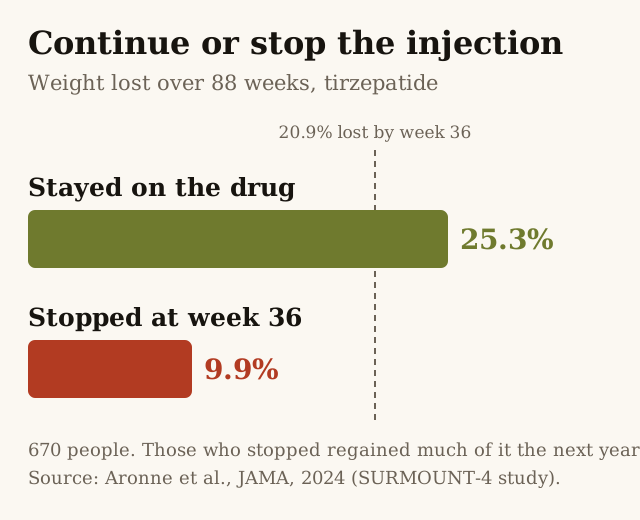
In the SURMOUNT-4 study of tirzepatide, the drug in Mounjaro (which I compared with semaglutide in the post about which injection leads to the most weight loss), the average loss was 20.9% of body weight in 36 weeks, and 670 people were randomly assigned to continue or stop. Over the following year, those who continued lost another 5.5%. Those who stopped gained 14% and gave back a little more than half of what they had lost. By the end, 9 in 10 people who continued were keeping off at least 80% of what they had lost, compared with fewer than 2 in 10 of those who stopped.
A third study, the STEP 1 extension, followed people who stopped semaglutide along with the study’s diet and exercise program. After a year without treatment, they had regained about two thirds of the weight they had lost.
A 2025 review pooled 8 of these studies, with 2,372 participants. People who stopped semaglutide or tirzepatide regained almost 10 kg on average. With liraglutide, an older injection with a smaller effect, the average regain was about 2 kg, because the loss had also been smaller. In the studies where people lost more, they also regained more.
| Study | Medication | What happened after stopping |
|---|---|---|
| STEP 4 (2021) | semaglutide | gave back more than half of the weight lost in 48 weeks |
| SURMOUNT-4 (2024) | tirzepatide | gave back a little more than half in one year |
| STEP 1 extension (2022) | semaglutide, without the study’s diet and exercise | regained about two thirds in one year, and blood pressure, blood sugar and cholesterol moved back toward their earlier values |
| Danish study (2024) | liraglutide, exercise or both | medication plus exercise ended 5 kg lighter than medication alone; those who only exercised kept their weight one year later |
Why the weight comes back
It is not a lack of willpower. When you lose weight, your body reacts by trying to get back to the old weight. Hunger goes up, and hormones that drive appetite, such as ghrelin, rise. I wrote about these and other adaptations, such as the drop in energy expenditure, in the post about the weight loss plateau.
While the injection is working, it keeps hunger down and that push from the body barely shows. When the medication wears off, hunger comes back all at once while the body still carries the adaptations from the weight loss, and that combination favors regain. This is why, according to a 2026 review, a good part of the weight comes back in the first few months without the medication.
This returning hunger can show up before the scale does: thinking about food more often, portions that creep up without you noticing, snacking between meals or at night, and feeling less satisfied at the end of a plate. Spotting these signs early helps you adjust the plan before the weight climbs.
What happens to your health
On the injection, your health improves along with your weight: blood pressure and blood sugar fall, the waistline shrinks and cholesterol tends to get better. When the weight comes back, most of that tends to be lost. In the STEP 1 extension, which followed people who stopped semaglutide, most of these improvements faded and, a year later, were heading back toward pre-treatment values.
Obesity as a chronic disease
The authors of the STEP 1 extension wrote that the results confirm obesity is a chronic disease. High blood pressure is similar: nobody is surprised when blood pressure goes up after the blood pressure medication is stopped.
For many people, treatment becomes long term, with follow-up and dose adjustments. For others, it makes sense to stop at some point, as long as it is done with a plan and follow-up.
Why people stop
Stopping treatment is common: in a 2025 US study, with data from more than 125,000 adults, about two in three people without diabetes who were using the injection for weight loss stopped within a year, and gut side effects made stopping more likely. The reasons vary, and almost all of them are legitimate:
- the cost of treatment;
- side effects, such as nausea and constipation, that sometimes do not improve;
- wanting to get pregnant, which requires stopping the medication beforehand, under medical guidance;
- the medication being out of stock at the pharmacy;
- the feeling that the goal has been reached and the medication is no longer needed.
In that last case, the result usually depends on the medication still working. People who stopped in STEP 4 and SURMOUNT-4, after already losing a lot of weight, regained a good part of it.
Before you stop: lay the groundwork
There is no study yet on the best time to stop, and my advice is not to stop in the middle of losing weight. If you also use the injection for diabetes, there is one more thing to watch: without the medication, blood sugar goes up, and any change to your diabetes treatment needs to be agreed with your doctor ahead of time. When it is time to lower the dose, it helps to have a few things already in place:
- A weight that has been stable for a few months, not still falling.
- Strength training and aerobic exercise already part of your week, not something to start later.
- A meal routine that works without the medication, with protein and fiber, which help you feel full.
- Body composition and lab work, both recent, as a point of comparison.
- An agreement with your doctor on how much regain should lead to rethinking the plan.
None of this guarantees the weight will stay put. On this list, exercise is the item backed by a study, and the rest is practical care so your routine works without the medication.
How to stop the injection with less regain
The role of exercise
A Danish study tested what happens after stopping, with and without exercise. Participants lost an average of 13 kg on a low-calorie diet, without medication, and then spent a year in four groups: supervised exercise, liraglutide (an older injection taken daily), both together, or placebo, an injection with no medication. After that, everyone stopped and was reassessed a year later.
In the year without treatment, those who had taken liraglutide alone regained 6 kg more than those who had only exercised. Across the two years, those who combined medication and exercise ended up about 5 kg lighter than those who took the medication alone. Those who only exercised kept their weight a year after the program ended.
Protecting muscle during treatment
Any weight loss takes some lean mass with it, and that includes muscle. In SURMOUNT-1, a tirzepatide study that measured body composition, about 75% of the weight lost was fat and 25% was lean mass, the same proportion seen in the group that lost weight without the medication.
Muscle helps maintain energy expenditure, strength and blood sugar control. So during treatment, two kinds of care are recommended:
- regular strength training, with the load increased progressively;
- enough protein at every meal, adjusted by your dietitian.
A lower dose or a gradual taper
A 2026 review cites recent studies in which continuing on a lower dose seemed to hold the weight better than stopping all at once. Tapering off gradually until stopping completely, on the other hand, still has no study showing whether it helps keep the result. For now, this decision is made case by case, with your doctor.
Close follow-up in the first few months
Because regain is fastest at the start, the first few months after stopping are the ones that call for the most follow-up. In practice, it helps to:
- weigh yourself regularly and measure your waist;
- repeat the body composition test to see whether what comes back is fat or muscle;
- keep the meal times and structure that worked during treatment;
- keep training, especially strength training;
- sleep well, because short nights increase hunger, as I explained in the post about sleep and fat loss;
- have an agreement with your doctor on what to do if the weight goes up quickly, such as going back on the medication or adjusting the plan.
When to go back on the injection
If your weight goes up again without the medication, you can go back on the medication without guilt, as with any chronic disease that shows signs again when treatment is stopped. The decision takes into account weight, health, cost and how many habits the person managed to keep. People who have gone weeks without an injection usually restart at a lower dose, set by the doctor, because jumping straight back to a high dose increases nausea and vomiting.
Conclusion
For most people, the weight comes back after stopping weight-loss injections, and it comes back fast: between half and two thirds of what was lost within about a year, with blood pressure, blood sugar and cholesterol tending to get worse along with it. Hunger and the body go back to pushing toward the old weight once the medication is gone. In one study, people who added exercise to the injection finished the follow-up lighter than those who used the injection alone, and strength training and protein help look after muscle during treatment. Stopping is a decision to make with a plan, and for many people the treatment is long term.
No rush, just consistency. Take care, everyone!
Responsible physician: Dr. Gilberto Nering Junior, sports medicine physician, CRM-SP 160822, RQE 142486 (Sports Medicine, Brazil).
This text was not sponsored, is for information only and does not replace an individual assessment. Questions about the content: contact the clinic.
Quick questions about stopping weight-loss injections
I stopped taking Ozempic or Mounjaro and gained weight. Is that normal?
Yes, that is what happens to most people. In the studies, between half and two thirds of the weight lost came back within about a year, and regain was greater where the loss had been greater.
Why does the weight come back so fast?
Because hunger returns as soon as the medication wears off, and the body still carries the adaptations from the weight loss, such as a bigger appetite. A good part of the regain happens in the first few months.
Can I stop using the weight-loss injection without gaining the weight back?
Some people manage to keep a good part of the result. In the Danish study, people who combined liraglutide with exercise ended up lighter, one year after stopping, than those who used the medication alone. Strength training, protein and close follow-up in the first few months help.
Do I need to lower the dose before stopping?
There is no set rule: continuing on a lower dose seemed to hold the weight better than stopping all at once, but tapering off gradually until stopping still has no study showing whether it helps keep the result. The decision is made with your doctor.
I stopped taking Ozempic. Can I start again?
Yes, as long as it is under medical guidance: after a few weeks without injections, the doctor usually restarts at a lower dose and raises it gradually, as at the start of treatment. That way nausea tends to be milder.
Will I need to use the injection forever?
Not necessarily, but many people need long-term treatment, as with other chronic diseases. Your doctor helps you decide between continuing, lowering the dose, stopping or going back.
References
- Aronne LJ, Sattar N, Horn DB, et al. Continued Treatment With Tirzepatide for Maintenance of Weight Reduction in Adults With Obesity: The SURMOUNT-4 Randomized Clinical Trial. JAMA. 2024;331(1):38-48. doi:10.1001/jama.2023.24945
- Berg S, Stickle H, Rose SJ, et al. Discontinuing glucagon-like peptide-1 receptor agonists and body habitus: A systematic review and meta-analysis. Obes Rev. 2025;26(8):e13929. doi:10.1111/obr.13929
- Damhof MA, van Bruggen FH, van Roon EN. Early Weight Regain After GLP-1 Receptor Agonist Discontinuation: Mechanisms and Implications for Treatment De-Escalation Strategies. Diabetes Obes Metab. 2026;28(10):8769-8776. doi:10.1111/dom.71075
- Jensen SBK, Blond MB, Sandsdal RM, et al. Healthy weight loss maintenance with exercise, GLP-1 receptor agonist, or both combined followed by one year without treatment: a post-treatment analysis of a randomised placebo-controlled trial. EClinicalMedicine. 2024;69:102475. doi:10.1016/j.eclinm.2024.102475
- Look M, Dunn JP, Kushner RF, et al. Body composition changes during weight reduction with tirzepatide in the SURMOUNT-1 study of adults with obesity or overweight. Diabetes Obes Metab. 2025;27(5):2720-2729. doi:10.1111/dom.16275
- Rodriguez PJ, Zhang V, Gratzl S, et al. Discontinuation and reinitiation of dual-labeled GLP-1 receptor agonists among US adults with overweight or obesity. JAMA Netw Open. 2025;8(1):e2457349. doi:10.1001/jamanetworkopen.2024.57349
- Rubino D, Abrahamsson N, Davies M, et al. Effect of Continued Weekly Subcutaneous Semaglutide vs Placebo on Weight Loss Maintenance in Adults With Overweight or Obesity: The STEP 4 Randomized Clinical Trial. JAMA. 2021;325(14):1414-1425. doi:10.1001/jama.2021.3224
- Wilding JPH, Batterham RL, Davies M, et al. Weight regain and cardiometabolic effects after withdrawal of semaglutide: The STEP 1 trial extension. Diabetes Obes Metab. 2022;24(8):1553-1564. doi:10.1111/dom.14725