Also in: Português · Español · Italiano · 中文 · हिन्दी
Main points
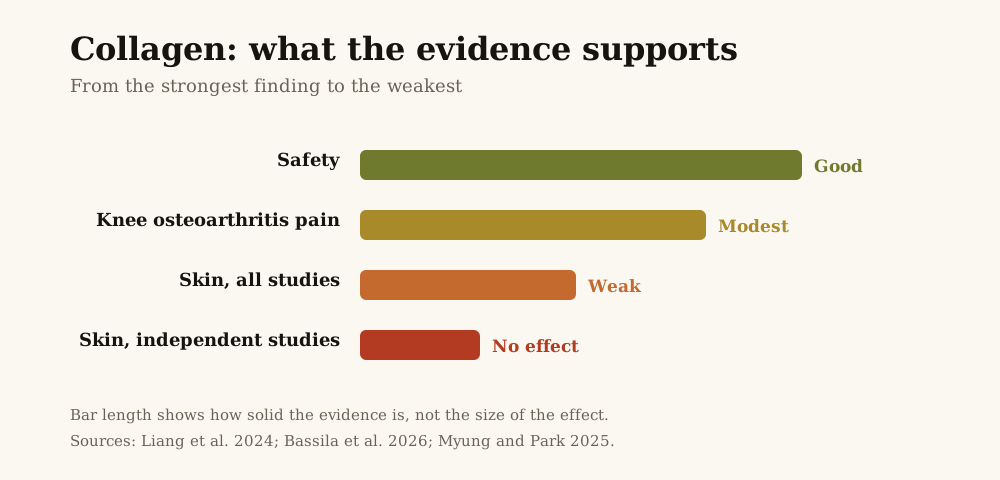
- Skin: pooling the studies, collagen improves hydration and elasticity after about three months, but in a 2025 meta-analysis of 23 studies the effect disappeared when only studies without industry funding, or only the better-quality ones, were included (Myung and Park, 2025).
- Osteoarthritis: a 2024 meta-analysis of 35 studies and 3,165 patients found a small to moderate improvement in pain and function (Liang et al., 2024).
- An independent 2025 study using UC-II plus a low dose of hydrolyzed collagen found no difference from placebo at 12 weeks, and the 2026 US VA/DoD osteoarthritis guideline takes no position for or against collagen (Yuenyongviwat et al., 2025; VA/DoD, 2026).
- Collagen caused no more side effects than placebo. Hydrolyzed collagen (grams per day) and undenatured type II collagen (40 mg per day) are different products (Liang et al., 2024; Lugo et al., 2016).
Collagen probably helps a little with knee osteoarthritis pain. For skin, the story is weaker than the packaging suggests, because most of the positive results come from studies paid for by companies that sell collagen, and the best-designed studies found little or nothing.
What happens to collagen after you swallow it
Collagen is the main structural protein of skin, tendon and cartilage. When you eat it, your gut digests it like any other protein, so it does not arrive intact in your face or your knee.
Some of it survives as small pieces. After someone takes hydrolyzed collagen, peptides containing hydroxyproline show up in the blood, mainly prolyl-hydroxyproline (Pro-Hyp), and the amount varies with the source of the collagen (Ohara et al., 2007).
The hypothesis is that these fragments act as a signal to the cells that make collagen. In a 2025 lab experiment, human skin fibroblasts exposed to collagen peptides produced more type I procollagen (Zague et al., 2025). These were cells in a dish, and the open question is whether that signal is strong enough in a real person to change something you can see or feel.
Undenatured type II collagen, sold as UC-II, starts from a different idea. It comes from chicken breastbone cartilage and is taken in a tiny dose, 40 mg per day, while most hydrolyzed collagen studies use anywhere from a few grams up to 10 g. The proposed mechanism is oral tolerance, an immune effect that begins in the gut, and the authors of the main study wrote that this mechanism still needs to be clarified (Lugo et al., 2016).
Skin: what the studies show
The first results were positive. A 2021 review of 19 randomized trials and 1,125 participants, 95% of them women aged 20 to 70, found better hydration, elasticity and wrinkles with hydrolyzed collagen than with placebo after about 90 days of use (de Miranda et al., 2021).
A 2026 systematic review of 25 studies counted improved hydration in 10 of 15 studies, elasticity in 10 of 13 and wrinkle depth or volume in 9 of 10. The same review rated most of these studies as having a high risk of bias and called the evidence preliminary (Bassila et al., 2026).
In a typical recent study, 85 women aged 45 to 60 took 2.5 g of collagen oligopeptides or placebo for 84 days. Firmness and elasticity improved with collagen, and hydration did not reach statistical significance (Zague et al., 2025). The first author works in the research and development department of Genu-in, a collagen manufacturer.
The funding problem
In 2025, Myung and Park pooled 23 randomized trials with 1,474 participants. Taken together, the studies showed that collagen improved hydration, elasticity and wrinkles.
Then the authors split the studies by who paid for the research. The industry-funded ones showed a significant effect, and those without that funding showed no effect on any of the three outcomes. Splitting by quality gave a similar picture: the high-quality studies found no significant effect on anything, and the low-quality ones found better elasticity. Their conclusion was that there is currently no clinical evidence to support collagen for preventing or treating skin aging (Myung and Park, 2025).
The industry challenged the paper. It argued that some studies were placed in the wrong funding group, that some doses and durations were recorded incorrectly, and that most studies were done in Asia with about 3 g per day (NutraIngredients, 2025). A subgroup comparison across different studies also does not prove that funding caused the difference, because the independent studies may have used other products, doses or populations.
Even with those objections, the best-designed studies are exactly the ones that found nothing, and I don’t think the skin effect can be called proven. For comparison, a 4.5-year study in Australia with 903 adults found 24% less skin aging in people who used sunscreen every day than in those who used it when they felt like it (Hughes et al., 2013).
Joints: osteoarthritis, almost always of the knee
The joint studies cited here were done in people with osteoarthritis, mostly of the knee. Collagen for tendons and ligaments in athletes is a separate question that this article does not cover.
In osteoarthritis, the evidence is stronger than for skin. The largest analysis cited here, published in Osteoarthritis and Cartilage in 2024, pooled 35 randomized trials and 3,165 patients with osteoarthritis. Collagen products reduced pain (standardized mean difference of −0.35, moderate certainty) and improved function (−0.31, high certainty), with no increase in side effects or dropouts compared with control (Liang et al., 2024).
The authors describe the effect as small to moderate. On average, that means a bit less pain, and because the studies measured pain and function, they say nothing about rebuilding cartilage.
A 2025 meta-analysis of 11 studies and 870 patients with knee osteoarthritis pointed the same way for pain and function, with high heterogeneity (I² of 75% for function and 88% for pain), meaning the studies disagreed a lot about the size of the effect (Simental-Mendía et al., 2025).
The best-known single study tested UC-II. In 191 people with knee osteoarthritis, 40 mg per day for 180 days lowered the total WOMAC score more than placebo and more than glucosamine with chondroitin (Lugo et al., 2016). Two of the three authors worked for InterHealth Nutraceuticals, the company that sold UC-II.
In 2025, an orthopedic group in Thailand that declared no conflict of interest ran a double-blind study in 68 patients using tablets that combined UC-II and hydrolyzed collagen. After 12 weeks both groups improved, and collagen was no better than placebo for pain, function, rescue painkiller use or satisfaction (Yuenyongviwat et al., 2025).
The tablets contained 20 mg of UC-II and 480 mg of hydrolyzed collagen, two at bedtime, which comes to less than 1 g of hydrolyzed collagen per day, well below the grams used in the other studies. The authors themselves say these doses may have been low. With 68 patients and 12 weeks, the study may also have missed a modest effect. The authors also point out that most earlier collagen studies in osteoarthritis were sponsored by industry.
What the 2026 guideline says
The 2026 VA/DoD guideline comes from the US Department of Veterans Affairs and Department of Defense and covers non-surgical care of hip and knee osteoarthritis. It places collagen among 18 supplements with insufficient evidence to recommend for or against. The panel’s reasoning is that the data are inconsistent and come from small, short studies. The collagen section still relies on a 2019 meta-analysis, and the panel found no new collagen evidence in its 2025 review. The same guideline strongly recommends weight loss for people with knee osteoarthritis and excess weight, and suggests a structured physical therapy program (VA/DoD, 2026).
If you want to try it
The first step is to pick the product that was tested for your goal, because each type of collagen was studied at one dose and for one purpose.
Products, doses and results
| Product | Dose tested | Goal | Best evidence |
|---|---|---|---|
| Hydrolyzed collagen peptides | About 2.5 to 3 g per day (Zague et al., 2025; NutraIngredients, 2025) | Skin aging | Benefit in the overall analysis, none in independent or high-quality studies (Myung and Park, 2025) |
| Collagen products (pooled analysis) | Varied; 10 g per day in three studies reviewed by the guideline | Osteoarthritis pain and function | Small to moderate benefit, moderate to high certainty (Liang et al., 2024) |
| UC-II | 40 mg per day | Knee osteoarthritis | Better than placebo at 180 days in an industry-linked study (Lugo et al., 2016) |
| UC-II with hydrolyzed collagen | Tablet with 20 mg of UC-II and 480 mg of hydrolyzed collagen, 2 at bedtime | Knee osteoarthritis | No better than placebo at 12 weeks in an independent study with less than 1 g of hydrolyzed collagen per day (Yuenyongviwat et al., 2025) |
Practical steps
- Buy the type that was tested for your goal. Hydrolyzed collagen was studied in grams per day (2.5 g in the skin study cited above, 10 g in three of the osteoarthritis studies the 2026 guideline reviewed), and UC-II at 40 mg per day. A 40 mg capsule and a 10 g scoop are different products.
- Give it about 12 weeks, close to the length of many of these studies, and judge it by something concrete, like the pain of climbing stairs or how far you walk before your knee complains. If nothing changes, stop.
- Keep the basics. In knee osteoarthritis, losing excess weight and following a structured physical therapy program carry more weight in the guideline than any supplement. For skin, sunscreen every day.
- The product on the shelf may not match the one in the studies, and the FDA, the US agency, does not evaluate the safety and efficacy of supplements before they go on sale (VA/DoD, 2026).
- Don’t count collagen as your main protein. It has no tryptophan and is low in the other essential amino acids (Paul et al., 2019). Because of that profile, complete proteins such as meat, eggs, dairy and whey are a better base for muscle.
Conclusion
In knee osteoarthritis, the pooled studies show a small effect of collagen on pain and function. An independent 2025 study with 68 patients, UC-II and less than 1 g of hydrolyzed collagen per day did not reproduce that effect at 12 weeks, and the 2026 guideline stays neutral. I think a 12-week trial is reasonable for anyone who wants to try, as long as it does not take the place of weight control and exercise. For skin, the gains in hydration and elasticity come mainly from industry-funded, lower-quality studies, and if the budget only stretches to one thing, I would spend it on sunscreen.
Take care, and see you next time!
Responsible physician: Dr. Gilberto Nering Junior, CRM-SP 160822, RQE 142486 (Sports Medicine, Brazil). This text was not sponsored, and no supplement company reviewed the content. It is for information only and does not replace an individual assessment.
Quick questions about collagen
Does collagen rebuild cartilage?
The studies cited here measured pain and function, not cartilage structure, and none of them showed cartilage growing back.
How long does collagen take to work?
The 2021 skin meta-analysis found an effect after about 90 days of use (de Miranda et al., 2021), and the osteoarthritis studies lasted 10 to 48 weeks (VA/DoD, 2026). Twelve weeks is a good point to decide whether it is doing anything for you.
Is collagen safe?
In the studies, it caused no more side effects than placebo (Liang et al., 2024), and a 2026 review of the skin studies found collagen well tolerated overall (Bassila et al., 2026). The bigger issue is product quality, since supplements are not evaluated by the FDA before they are sold. Collagen supplements come from fish, cattle, pigs or chicken, so people with a fish allergy should check the source on the label.
Is fish collagen better than other sources?
In a study of five men, fish scale collagen produced higher blood levels of hydroxyproline-containing peptides than pig skin collagen (Ohara et al., 2007). No study in this review showed that this turns into better results for skin or joints.
Can’t I just eat more protein?
For muscle, complete protein is the best base because of its amino acid profile. A 2019 analysis estimated that collagen can make up as much as 36% of daily protein without running short of any essential amino acid, and one of the authors works for a collagen manufacturer (Paul et al., 2019). Collagen is studied separately for skin and joints because of the specific peptides it releases during digestion, and that is the hypothesis the studies above tested.
References
- Bassila C, Bassila JC, Slim M. Efficacy and safety of hydrolyzed collagen supplementation on skin health outcomes: a systematic literature review of randomized controlled trials. Eur J Clin Nutr. 2026;80(9):867-885. doi:10.1038/s41430-026-01778-3
- Hughes MC, Williams GM, Baker P, Green AC. Sunscreen and prevention of skin aging: a randomized trial. Ann Intern Med. 2013;158(11):781-790. doi:10.7326/0003-4819-158-11-201306040-00002
- Liang CW, Cheng HY, Lee YH, Liao CD, Huang SW. Efficacy and safety of collagen derivatives for osteoarthritis: a trial sequential meta-analysis. Osteoarthritis Cartilage. 2024;32(5):574-584. doi:10.1016/j.joca.2023.12.010
- Lugo JP, Saiyed ZM, Lane NE. Efficacy and tolerability of an undenatured type II collagen supplement in modulating knee osteoarthritis symptoms: a multicenter randomized, double-blind, placebo-controlled study. Nutr J. 2016;15:14. doi:10.1186/s12937-016-0130-8
- de Miranda RB, Weimer P, Rossi RC. Effects of hydrolyzed collagen supplementation on skin aging: a systematic review and meta-analysis. Int J Dermatol. 2021;60(12):1449-1461. doi:10.1111/ijd.15518
- Myung SK, Park Y. Effects of collagen supplements on skin aging: a systematic review and meta-analysis of randomized controlled trials. Am J Med. 2025;138(9):1264-1277. doi:10.1016/j.amjmed.2025.04.034
- NutraIngredients (Stern C). Industry pushes back on meta-analysis concluding collagen supplements show no benefit for skin aging. NutraIngredients. August 26, 2025. www.nutraingredients.com
- Ohara H, Matsumoto H, Ito K, Iwai K, Sato K. Comparison of quantity and structures of hydroxyproline-containing peptides in human blood after oral ingestion of gelatin hydrolysates from different sources. J Agric Food Chem. 2007;55(4):1532-1535. doi:10.1021/jf062834s
- Paul C, Leser S, Oesser S. Significant amounts of functional collagen peptides can be incorporated in the diet while maintaining indispensable amino acid balance. Nutrients. 2019;11(5):1079. doi:10.3390/nu11051079
- Simental-Mendía M, Ortega-Mata D, Acosta-Olivo CA, Simental-Mendía LE, Peña-Martínez VM, Vilchez-Cavazos F. Effect of collagen supplementation on knee osteoarthritis: an updated systematic review and meta-analysis of randomised controlled trials. Clin Exp Rheumatol. 2025;43(1):126-134. doi:10.55563/clinexprheumatol/kflfr5
- VA/DoD (U.S. Department of Veterans Affairs and Department of Defense). Clinical Practice Guideline for the Non-Surgical Management of Hip and Knee Osteoarthritis, version 3.0. 2026. www.healthquality.va.gov
- Yuenyongviwat V, Anusitviwat C, Tuntarattanapong P, Hongnaparak T, Iamthanaporn K. Efficacy of combined undenatured type II collagen and hydrolysed collagen supplementation in knee osteoarthritis: a randomised controlled trial. Sci Rep. 2025;15(1):32313. doi:10.1038/s41598-025-17505-0
- Zague V, Pinheiro ALTA, Pinto JR, Facchini G, Eberlin S. Oral collagen oligopeptides as a modulator of skin health: a comprehensive evaluation of clinical and molecular effects. J Med Food. 2025;28(9):869-876. doi:10.1089/jmf.2024.0252
Cover photo: HowToGym on Unsplash.
{“@context”: “https://schema.org”, “@type”: “FAQPage”, “inLanguage”: “en”, “mainEntity”: [{“@type”: “Question”, “name”: “Does collagen rebuild cartilage?”, “acceptedAnswer”: {“@type”: “Answer”, “text”: “The studies cited here measured pain and function, not cartilage structure, and none of them showed cartilage growing back.”}}, {“@type”: “Question”, “name”: “How long does collagen take to work?”, “acceptedAnswer”: {“@type”: “Answer”, “text”: “The 2021 skin meta-analysis found an effect after about 90 days of use (de Miranda et al., 2021), and the osteoarthritis studies lasted 10 to 48 weeks (VA/DoD, 2026). Twelve weeks is a good point to decide whether it is doing anything for you.”}}, {“@type”: “Question”, “name”: “Is collagen safe?”, “acceptedAnswer”: {“@type”: “Answer”, “text”: “In the studies, it caused no more side effects than placebo (Liang et al., 2024), and a 2026 review of the skin studies found collagen well tolerated overall (Bassila et al., 2026). The bigger issue is product quality, since supplements are not evaluated by the FDA before they are sold. Collagen supplements come from fish, cattle, pigs or chicken, so people with a fish allergy should check the source on the label.”}}, {“@type”: “Question”, “name”: “Is fish collagen better than other sources?”, “acceptedAnswer”: {“@type”: “Answer”, “text”: “In a study of five men, fish scale collagen produced higher blood levels of hydroxyproline-containing peptides than pig skin collagen (Ohara et al., 2007). No study in this review showed that this turns into better results for skin or joints.”}}, {“@type”: “Question”, “name”: “Can’t I just eat more protein?”, “acceptedAnswer”: {“@type”: “Answer”, “text”: “For muscle, complete protein is the best base because of its amino acid profile. A 2019 analysis estimated that collagen can make up as much as 36% of daily protein without running short of any essential amino acid, and one of the authors works for a collagen manufacturer (Paul et al., 2019). Collagen is studied separately for skin and joints because of the specific peptides it releases during digestion, and that is the hypothesis the studies above tested.”}}]}
{“@context”: “https://schema.org”, “@graph”: [{“@type”: “Organization”, “@id”: “https://clinicanering.com/#org”, “name”: “Clínica Nering”, “url”: “https://clinicanering.com”}, {“@type”: “Person”, “@id”: “https://clinicanering.com/#dr-gilberto”, “name”: “Dr. Gilberto Nering Junior”, “jobTitle”: “Sports Medicine Physician”, “identifier”: “CRM-SP 160822 / RQE 142486”, “worksFor”: {“@id”: “https://clinicanering.com/#org”}, “sameAs”: [“https://www.doctoralia.com.br/gilberto-nering-junior”, “https://www.instagram.com/clinica.nering”]}, {“@type”: “MedicalWebPage”, “@id”: “https://clinicanering.com/blog/en/supplements/does-collagen-work-skin-joints/#webpage”, “url”: “https://clinicanering.com/blog/en/supplements/does-collagen-work-skin-joints/”, “name”: “Collagen: Does It Work for Skin and Joints?”, “inLanguage”: “en”, “datePublished”: “2026-10-22T09:00:00+00:00”, “dateModified”: “2026-10-22T09:00:00+00:00”, “author”: {“@id”: “https://clinicanering.com/#dr-gilberto”}, “reviewedBy”: {“@id”: “https://clinicanering.com/#dr-gilberto”}, “publisher”: {“@id”: “https://clinicanering.com/#org”}, “isPartOf”: {“@type”: “WebSite”, “name”: “Clínica Nering Blog”, “url”: “https://clinicanering.com/blog/”}}]}