Also in: Português · Español · Italiano · 中文 · हिन्दी
Main points
- Lipedema is a chronic disease of the fat under the skin. It shows up almost only in women and builds up on both sides, in the legs and sometimes in the arms.
- Pain when pressed, easy bruising and fat that stops at the ankle, leaving the foot untouched, are the signs that stand out most.
- Lipedema is not the same as obesity, but the two often appear together.
- The diagnosis is made during a medical visit, from the history and the physical exam, because no test confirms lipedema on its own.
- This is the first post in a series. In the next one, I talk about treatment.
Many women with lipedema know this sentence by heart: “I diet, I lose belly fat, but my legs don’t change. And they still hurt.” Some spend years repeating it until someone finally gives the problem a name.
Lipedema was described in the 1940s by two doctors at the Mayo Clinic, in the United States, who noticed in women a symmetrical build-up of fat in the legs, with pain and a swelling that spared the feet. Even so, it only got its own code in ICD-11, the World Health Organization’s classification of diseases, which came into force in 2022. In this post I explain what it is, which signs point to it and how to tell it apart from ordinary fat and from other kinds of swelling. Treatment is the topic of the next post in the series.
What lipedema is
A worldwide consensus published in 2026 brought together experts from 19 countries, who agreed on 59 statements about the disease. The definition that came out of it fits in one sentence: lipedema is a chronic disease of the fatty tissue that lies under the skin.
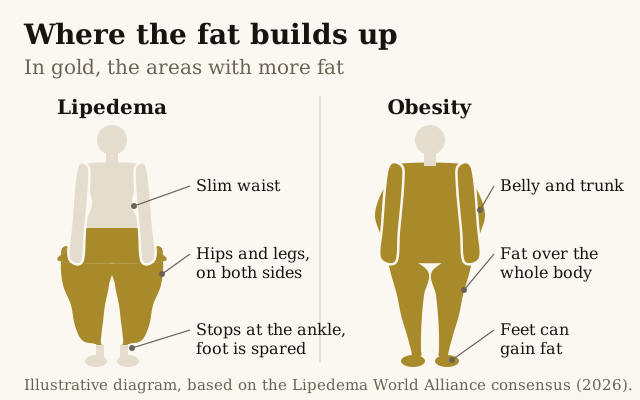
It usually appears as a symmetrical increase of fat in the arms or legs, on both sides, together with pain or discomfort. The build-up is out of proportion: the legs are much thicker than the trunk would lead you to expect.
The legs are the most affected, from the hips to the ankles. The arms can be involved too, always on both sides.
The signs that stand out most
According to the consensus and recent reviews, the most typical signs are:
- pain or tenderness when the skin of the affected areas is pressed or stretched, usually a dull ache that gets worse after long periods standing or walking;
- a feeling of heaviness or swelling in the legs;
- bruises that appear with little or no injury;
- fat that stops abruptly at the ankle or wrist, like a shirt cuff, leaving feet and hands untouched;
- legs that change little with dieting, even when the belly shrinks;
- to the touch, fat with small nodules that feel like grains of sand.
Two signs are usually missing. The first is the dent left when you press swollen skin with a finger, common in other types of swelling. The second is Stemmer’s sign: in lymphedema, the skin at the base of the second toe gets so thick that it can’t be pinched and lifted; in lipedema, it can.
Who gets lipedema
Lipedema affects almost only women. In men it is rare, and when it does appear it is usually linked to hormonal changes or to severe liver disease.
The consensus notes that hormonal changes can trigger or worsen the condition, so it often starts or gets worse at puberty, during pregnancy or at menopause. In some cases it is inherited and shows up in other women in the family.
How many women have lipedema? Nobody knows for sure. Estimates range from less than 1% to 12% of adult women, and a 2025 review puts it at about 10%. Counting is hard because many women are never diagnosed.
The consensus also mentions two conditions that seem to be more common in people with lipedema: hypothyroidism and very flexible joints, known as hypermobility. A 2026 Brazilian review cites a Swedish survey of 245 women with lipedema in which 1 in 5 had hypothyroidism, and reports that hypermobility shows up in up to half of women with lipedema. The 2025 review that came up with the 10% figure links lipedema to reduced mobility, osteoarthritis and blood clots in the veins.
Lipedema, obesity or lymphedema?
This is the most common mix-up, and it comes at a high price: years of trying to slim the legs down with diets, with no result and a lot of guilt.
| Feature | Lipedema | Obesity | Lymphedema |
|---|---|---|---|
| Where it builds up | Legs and sometimes arms, on both sides | Whole body, including the belly | Usually one side more than the other |
| Feet and hands | Left untouched | Can gain fat | The foot usually swells |
| Pain when pressed | Yes, with easy bruising | Usually not | More heaviness than pain |
| Dent after pressing with a finger | Usually not | No | May stay |
| With dieting | The legs change little | Fat goes down | Diet alone doesn’t fix the swelling |
Lipedema and obesity together
The 2026 consensus makes it clear that lipedema is not a complication of obesity, but that obesity often comes along with it. When the two add up, lipedema symptoms tend to get worse.
Body mass index, the well-known BMI, does little to tell one from the other, because it doesn’t show where the fat is or separate fat from muscle. I explained this in the post on body composition. To assess obesity, the consensus suggests the waist-to-height ratio, which looks at the belly, where lipedema doesn’t usually act.
German doctors described 13 women who had bariatric surgery, lost more than 50 kg on average and still had painful legs. Only after the surgery were they diagnosed with lipedema.
What about lymphedema?
Lymphedema is swelling caused by a failure of lymph drainage. It usually affects one side more than the other, involves the foot and gives a positive Stemmer’s sign. Over time, advanced lipedema can also affect lymph drainage, and then the two conditions overlap.
Another cause of swelling that often comes along is vein insufficiency, which, according to the Brazilian review, shows up in about 1 in 4 women with lipedema. It leaves a dent when you press with a finger near the ankle, can cause itching, restless legs and night cramps, and usually improves with the legs raised. When the swelling is large, kidney, heart, liver and thyroid diseases also need to be ruled out.
Why lipedema fat is different
In lipedema, fat cells get bigger, the tissue becomes more fibrous over time and the small blood vessels become fragile, which explains the easy bruising.
The consensus mentions signs of inflammation, the influence of hormones and a possible excess of fluid in this tissue. Another 2025 review points to a curious detail: the immune cells in this fat are of a different type from those found in obesity, and these women’s metabolism often seems preserved, even with a lot of fat in the legs.
The Brazilian review describes a study that compared women with obesity, with and without lipedema, of the same weight and the same amount of fat. The lipedema group had about 48% higher insulin sensitivity. Compared with lean women, however, they still had worse blood sugar, triglycerides and cholesterol, so this is no protection.
Female hormones, especially estrogen, seem to play a central role. A group of Brazilian researchers proposes that menopause is a turning point in the disease, but this is still a hypothesis that needs to be tested.
How the diagnosis is made
The diagnosis is clinical: it depends on the history, the examination of the legs and arms and ruling out other causes. According to the 2026 consensus, there is currently no imaging, blood or genetic test approved to confirm lipedema.
Some tests help along the way, but none settles the diagnosis on its own:
- waist, hip, height and weight measurements, which the consensus recommends in every assessment;
- segmental bioimpedance, which can show disproportionate fat in the legs;
- ultrasound, MRI or a lymph drainage scan, when lymphedema needs to be ruled out.
The stages
Lipedema is divided into stages by how the skin and the fat look: smooth skin with small nodules at first, uneven skin and larger nodules later, and folds and deformities in the most advanced stages. The consensus points out that this classification doesn’t show how much a woman suffers and that not everyone gets worse over time. There is also a division by the region affected, such as hips, thighs, whole legs or arms, which is only used to describe the condition.
The weight that doesn’t show on the scale
Lipedema can take a toll on mental health and quality of life. According to the 2026 consensus, when there is emotional distress, it comes, in most cases, from the symptoms, and not the other way around. And waiting for a diagnosis only makes that burden heavier.
That wait is common. The Brazilian review cites a survey of 508 doctors in Turkey in which more than half said they had no idea how lipedema presents, and another one, in the United Kingdom, in which only 46% of vascular specialists could recognize the disease. It is not unusual for a woman to find the name of the disease on her own, searching online.
The relationship with food is part of the picture too. Body shame and pain can lead to emotional eating, and disorders such as binge eating appear alongside lipedema in some women. They can push weight up and make symptoms worse, and they deserve care of their own.
When to get checked
If you recognized yourself in the signs above, take that suspicion to your doctor. Examining the legs, measuring the waist and looking at body composition help separate lipedema from obesity, and that changes the plan. If you use an injection to lose weight, it’s also worth reading what I wrote about weight-loss injections.
Conclusion
Lipedema is a chronic disease of the fat under the skin that affects almost only women, with build-up on both sides of the legs, pain to the touch, easy bruising and feet that are left untouched. It is different from obesity, although the two often appear together, and diet alone usually changes the legs very little. The diagnosis is made during a medical visit, from the history and the exam. In the next post in the series, I cover what works in treatment: diet, exercise, compression and surgery.
A hug to all of you, and see you next time!
Responsible physician: Dr. Gilberto Nering Junior, sports medicine physician, CRM-SP 160822, RQE 142486 (Sports Medicine, Brazil).
This text was not sponsored, is for information only and does not replace an individual assessment. Questions about the content: contact the clinic.
Cover photo: maks_d on Unsplash.
Frequently asked questions about lipedema
Can lipedema be cured?
No. Lipedema is a chronic disease, and treatment aims to relieve pain and symptoms and keep the condition from progressing. I go over the options in the next post in the series.
Is lipedema the same as obesity?
No. Lipedema is a disease of its own in the fat under the skin, which builds up in the legs and sometimes the arms, hurts to the touch and changes little with dieting. Obesity can come along with it and make the symptoms worse.
How can I tell if I have lipedema?
Thick legs on both sides, out of proportion to the trunk, that hurt when pressed, bruise easily and stop at the ankle are warning signs. Confirmation comes from a medical assessment, because no test confirms it on its own.
Can men get lipedema?
They can, but it is rare. Almost all cases are in women, and in men it is usually linked to hormonal changes or severe liver disease.
Does lipedema get worse at menopause?
Hormonal changes, such as puberty, pregnancy and menopause, can trigger or worsen lipedema. Brazilian researchers propose that menopause is a turning point in the disease, but this still needs to be confirmed.
References
- Cifarelli V. Lipedema: Progress, Challenges, and the Road Ahead. Obes Rev. 2025;26(10):e13953. doi:10.1111/obr.13953
- Cornely ME, Hasenberg T, Cornely OA, et al. Persistent lipedema pain in patients after bariatric surgery: a case series of 13 patients. Surg Obes Relat Dis. 2022;18(5):628-633. doi:10.1016/j.soard.2021.12.027
- Faria AM, Valerio CM, Barcellos CR, et al. Unraveling lipedema: comprehensive insights and the path to future discoveries. NPJ Metab Health Dis. 2026;4(1):3. doi:10.1038/s44324-025-00093-y
- Kruppa P, Crescenzi R, Faerber G, et al. Lipedema World Alliance Delphi Consensus-Based Position Paper on the Definition and Management of Lipedema: Results from the 2023 Lipedema World Congress in Potsdam. Nat Commun. 2026;17(1):427. doi:10.1038/s41467-025-68232-z
- Pinto da Costa Viana D, Caseri Câmara L, Borges Palau R. Menopause as a Critical Turning Point in Lipedema: The Estrogen Receptor Imbalance, Intracrine Estrogen, and Adipose Tissue Dysfunction Model. Int J Mol Sci. 2025;26(15):7074. doi:10.3390/ijms26157074
- Rabiee A. Lipedema and adipose tissue: current understanding, controversies, and future directions. Front Cell Dev Biol. 2025;13:1691161. doi:10.3389/fcell.2025.1691161