Also in: Português · Español · Italiano · 中文 · हिन्दी
Main points
- For most people, training in the morning or in the evening makes almost no difference to sleep. The best time is the one you can stick with.
- In most studies, evening training did not make sleep worse. What matters most is hard training close to bedtime.
- In a study of thousands of people wearing a fitness band, workouts that ended 4 hours or more before sleep did not affect sleep.
- Training regularly improves sleep.
- If you sleep badly after evening training, try lowering the intensity or finishing earlier before you give up on the workout.
People who work all day often can only train at night, and someone soon warns them that it will ruin their sleep. On the other side, there are people getting up at five in the morning because they read that training early is better for sleep. Both groups can relax a little.
In this post I show what the studies say about training time and sleep, how long before bed a hard workout should end, and what to do if the evening is the only time you have.
Why training affects sleep
To fall asleep, the body needs to slow down: core temperature drops a little and the heart beats more slowly.
Training does the opposite, at least for a few hours. During exercise, temperature rises, the heart speeds up and the body releases adrenaline. The harder the workout, the bigger this activation and the longer it takes to wear off.
But exercise also helps you sleep. Once that activation passes, tiredness sets in, and many people feel less anxious. So the time of day itself matters less than the gap between the end of the workout and bedtime.
Morning or evening: what the 2026 review showed
A review published in 2026 gathered 25 studies comparing morning training with late-day training, and pooled the results of 16 randomized studies, the ones where a draw decides who trains at each time. On average, morning training had no clear advantage over evening training on most sleep measures.
The one difference that showed up was modest: people who trained in the evening spent a little more time awake after falling asleep. The authors themselves urge caution with this finding, because small studies may have inflated it. And the difference appeared mostly with harder workouts.
For the authors, the best time is the one you can keep, taking into account how hard the workout is and how long you have until bed. They also point out that moderate to hard evening training can make sleep more broken.
Evening training did not hurt sleep in most studies
The idea that evening training disrupts sleep has been tested many times. A 2019 review pooled 23 studies of healthy adults whose sleep was measured after evening training or after no training. Overall, evening training did not make sleep worse and even slightly increased deep sleep.
The warning was for one specific case: vigorous training ending 1 hour or less before bed. Then sleep can take longer to come, be shorter and have more interruptions.
Another review, from 2021, looked only at high-intensity evening training in young and middle-aged adults who already slept well. When the workout ended between 2 and 4 hours before bed, sleep was not harmed. There was only a small drop in REM sleep, the dreaming phase. And those who did this kind of training regularly did not have their sleep disrupted.
What the fitness bands showed
Lab studies usually have few people, so a 2025 study looked at the question another way. The researchers used data from 14,689 physically active people who slept with a fitness band for a year, adding up to more than 4 million nights.
The later and harder the workout, the later people fell asleep, the less they slept and the worse their sleep quality. The heart also beat faster during the night, and heart rate variability, a sign of recovery, was lower.
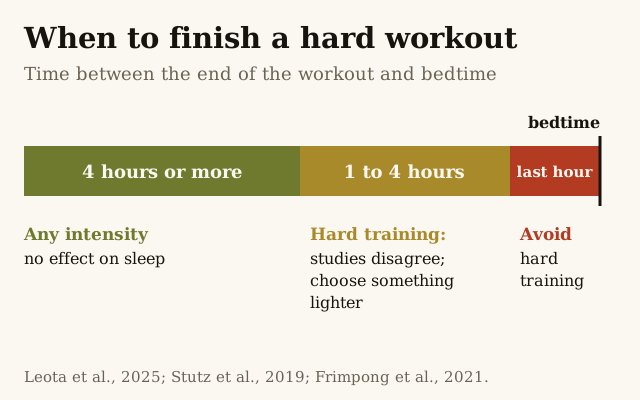
For daily life, the most useful finding was a different one: workouts that ended 4 hours or more before sleep did not affect sleep, whatever the intensity.
This study shows an association, and it does not prove cause and effect. It matches the lab studies on the overall message, but it was stricter about the time margin: in the lab, the problem only showed up much closer to bedtime. If you use a watch or band to track sleep, I wrote about which devices are the most accurate and about what to do with a low sleep score even after 8 hours of sleep.
“I’ll train hard so I crash into bed”
Many people bet on this: a really tough workout at the end of the day to arrive exhausted and pass out. The fitness band study suggests this strategy does not work well when the hard workout ends close to bedtime. The bigger the effort and the later the workout, the later sleep began and the shorter it was.
Tired muscles do not mean a body ready to sleep. Right after a hard workout, the heart is still racing and body temperature is still high. Sleep comes more easily once that phase has passed.
How long before bed?
Putting the studies together, you can build a simple rule:
- 4 hours or more before bed: any intensity is fine.
- Between 1 and 4 hours before: for hard training, the studies disagree. In the lab, finishing 2 to 4 hours before did not hurt sleep; in the fitness band study, hard training in this window went along with later and shorter sleep. If you can, choose something lighter in this window.
- In the last hour before bed: avoid hard training. A walk, stretching or gentle yoga usually do not get in the way.
People also respond differently. Some train hard at nine at night and sleep at eleven with no problem, and some feel wired after any workout. Your own sleep is the best gauge.
What about people who get up early to train?
Training early in the morning works very well for many people, but it has a hidden cost: if you get up at five to train and still go to sleep at midnight, the morning workout comes out of your sleep hours. In that case, what hurts your sleep is the short night.
If you prefer to train early, the math only works when bedtime also moves earlier. Trading an hour of sleep for an hour of training, every day, usually costs a lot.
And there is no need to train in the morning to sleep well. Based on the studies, people who like evening training can keep doing it, with care about intensity and about when they finish.
How to know if training is disrupting your sleep
Since each person responds differently, it is worth running a simple test for two or three weeks. Write down, quickly:
- what time the workout ended and whether it was light, moderate or hard;
- what time you went to bed and how long it took you to fall asleep;
- whether you woke up during the night;
- how you felt when you woke up.
Then compare the nights. If your sleep gets worse only after hard workouts that end late, you know what to change. If it is bad on any night, with or without training, the cause is probably somewhere else.
If you use a watch or band, you can also look at your heart rate during the night and your heart rate variability. In the fitness band study, hard late workouts left the heart faster at night and the variability lower. If this always shows up after evening training, it is a sign that your body has not slowed down yet.
Training regularly improves sleep
A 2015 review pooled 66 studies on exercise and sleep. People who started exercising regularly slept a little longer, fell asleep faster and, above all, reported better sleep quality.
So skipping training to protect your sleep is usually a bad trade. If the evening is the only time you have, training in the evening is better than not training.
Tips for people who can only train at night
If the evening is your time, a few small changes help:
- save the hardest workouts for early evening, or for the weekend, when you can train earlier;
- finish with a few minutes of light exercise and stretching, so your body starts to slow down;
- be careful with the caffeine in pre-workouts: in one study, a high dose of 400 mg disrupted sleep even when taken 6 hours before bed. Check the label to see how much yours has and, in the evening, train without it;
- if you have dinner after training, eat a normal meal, so you do not go to bed hungry or overly full;
- if your sleep got worse after you started training at night, try finishing earlier or lowering the intensity before concluding that the time does not work for you.
When the problem is not the training
If you sleep badly almost every night, whether you train or not, the time of your workout is probably not the main cause. Other common causes are coffee in the afternoon, alcohol at night, the phone in bed, sleep times that change a lot during the week and worries that come along to bed. Insomnia that lasts for months, loud snoring, pauses in breathing during sleep or strong tiredness during the day deserve a medical assessment.
In my sports medicine consultation in São José dos Campos, Brazil, I look at training and sleep together: timing, intensity, caffeine and recovery. If something needs to change, we adjust the plan to fit your routine.
Conclusion
Evening training does not ruin sleep for most people. What can get in the way is hard training very close to bedtime, and the safest margin in the studies was finishing 4 hours before. Beyond that, the best time is the one you can keep, and training regularly improves sleep.
Sleep well, and see you soon!
Responsible physician: Dr. Gilberto Nering Junior, sports medicine physician, CRM-SP 160822, RQE 142486 (Sports Medicine, Brazil), who sees athletes and active people in São José dos Campos, Brazil. This text was not sponsored, is for information only and does not replace an individual assessment. Questions about the content: contact the clinic.
Cover photo: Fitsum Admasu on Unsplash.
Quick questions about training and sleep
Does training at night hurt sleep?
For most people, no. In most studies, evening training did not make sleep worse. What matters most is a hard workout that ends close to bedtime.
How long before sleep should I finish my workout?
In a study of more than 14,000 people, workouts that ended 4 hours or more before sleep did not affect sleep at any intensity. Light training can be closer to bedtime.
Is training in the morning better for sleep?
On average, no. A 2026 review found no clear advantage of morning training over evening training on most sleep measures.
Does a pre-workout at night hurt sleep?
It can, because of the caffeine. In one study, 400 mg of caffeine disrupted sleep even when taken 6 hours before bed.
Does exercise help people who sleep badly?
Yes. People who started exercising regularly slept a little longer, fell asleep faster and reported better sleep quality.
References
- Drake C, Roehrs T, Shambroom J, et al. Caffeine effects on sleep taken 0, 3, or 6 hours before going to bed. J Clin Sleep Med. 2013;9(11):1195-200. doi:10.5664/jcsm.3170
- Frimpong E, Mograss M, Zvionow T, et al. The effects of evening high-intensity exercise on sleep in healthy adults: A systematic review and meta-analysis. Sleep Med Rev. 2021;60:101535. doi:10.1016/j.smrv.2021.101535
- Kredlow MA, Capozzoli MC, Hearon BA, et al. The effects of physical activity on sleep: a meta-analytic review. J Behav Med. 2015;38(3):427-49. doi:10.1007/s10865-015-9617-6
- Leota J, Presby DM, Le F, et al. Dose-response relationship between evening exercise and sleep. Nat Commun. 2025;16(1):3297. doi:10.1038/s41467-025-58271-x
- Souabni M, Del Sordo GC, Saurel M, et al. Effects of morning versus evening exercise on sleep: a systematic review of comparative studies with a meta-analysis of randomized controlled trials. Sleep Med Rev. 2026;90:102358. doi:10.1016/j.smrv.2026.102358
- Stutz J, Eiholzer R, Spengler CM. Effects of Evening Exercise on Sleep in Healthy Participants: A Systematic Review and Meta-Analysis. Sports Med. 2019;49(2):269-287. doi:10.1007/s40279-018-1015-0