Also in: Português · Español · Italiano · 中文 · हिन्दी
Bioimpedance is a quick test that estimates what your body is made of: how much is fat, how much is muscle and how much is water. In two minutes, standing on a platform and holding two handles, it gives you what the scale never will. But it is not a diagnostic test, it is not magic, and it has a few preparation traps that change the result. Let’s break it down, no fluff.
What Is Bioimpedance, Anyway?
The name sounds scary, but the idea is simple. The device sends a very weak electrical current through your body, so weak you don’t even feel it. Body tissues react differently to this current: muscle, which is full of water, lets the current pass easily; fat, which has little water, gets in the way.
It is from this difference in how easily the current passes that the device estimates your composition. Think of a pipe: water flows smoothly through a wide, clean pipe (muscle) and struggles in a narrow, clogged one (fat). Bioimpedance measures this resistance and, from it, calculates how much of each thing you have.
The good clinic devices are multi-frequency and segmental: they measure arms, legs and trunk separately, and can separate the water inside the cells from the water outside them. Pharmacy machines and home scales measure much less, and I’ll get to that shortly.
What the Test Shows (the numbers on the report)
A bioimpedance report usually includes, at a minimum:
- Body fat percentage: how much of your weight is fat. This is the number that matters, not raw weight.
- Muscle mass (or lean mass): the body’s engine. It is what you want to keep or gain.
- Body water: total, and on the better devices, split into water inside and outside the cells.
- Estimated basal metabolic rate: how much your body would burn at rest (note the word “estimated”, I’ll come back to it).
- Segmental analysis: how much muscle and fat there is in each arm, each leg and the trunk. Great for spotting imbalances.
- Phase angle: the number almost no one can explain, and one of the most interesting.
How to Read the Main Numbers
Each report comes with reference ranges from the device itself, and those are what you should go by. But so you don’t feel lost, here is a general idea:
- Body fat percentage: varies a lot by sex and age. Men and women have different healthy ranges (women naturally have more essential fat), and what is “normal” at 20 is not the same at 60. Always compare with the range printed on your report, not with your neighbor’s.
- Body water: usually sits around 50% to 65% in men and 45% to 60% in women. Muscle is full of water, so more muscle tends to push this number up.
- Muscle mass: here the target is the trend. If your training is working, this number rises slowly over the months. If it is falling, that is a warning sign.
- Visceral fat: some devices use a scale from 1 to 59. When it shows up, treat it as an estimate and check the legend on your own report, because the range changes from device to device.
The rule that applies to everything: a single number says little; the direction it takes over time says almost everything.
Why It Beats the Scale (and BMI)
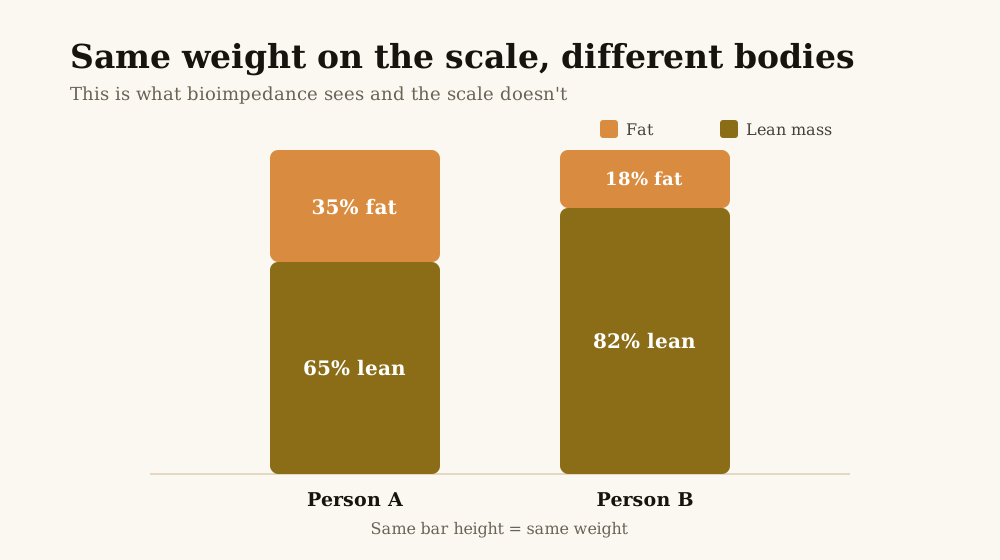
The scale insults you with a single number and hides everything. Two extra kilos can be fat (bad) or muscle and water (great), and the scale treats them the same. BMI is even blinder: it only divides weight by height, so a muscular athlete and a person with a lot of fat can have the same BMI.
Bioimpedance separates the wheat from the chaff. It shows whether the kilo that changed was fat or muscle. This explains the “skinny fat” person: someone with a normal BMI who looks thin but has a high body fat percentage and little muscle. The scale says everything is fine. Body composition says the opposite.
In practice, this is what lets you truly track progress: you can stay at the same weight all month and, inside, have swapped fat for muscle. According to the scale, “nothing happened”. According to bioimpedance, a lot happened.
Phase Angle: The Number Almost No One Explains
This one deserves its own paragraph. Phase angle is an indicator of the quality of your cells, of how intact and healthy they are. The higher it is, the better the state of your cells tends to be.
And it responds to what you do. In a study of older women (compiled in the body composition review in Curr Opin Endocrinol Diabetes Obes, 2016-2017), 12 weeks of strength training raised phase angle by 3.5%. And there is a detail I find fascinating: after a period of inactivity (detraining), phase angle dropped 7.6%, while the reference test (DXA) had not yet picked up any change in lean mass. In other words, it catches the decline in muscle quality before the rest shows up. It is an early warning bell.
What About Visceral Fat?
This is the dangerous fat, the kind around the organs, deep in the belly, linked to diabetes, high blood pressure and heart problems. Everyone wants to know theirs.
The honest truth: bioimpedance, at most, estimates visceral fat, and the gold standard for really measuring it is an imaging test, such as a CT scan or MRI. Some devices give a visceral fat number, but treat it as an estimate, not an exact measurement. At the clinic, we use bioimpedance to track what it does well (muscle, total fat, water, progress over time) and we don’t sell what it can’t deliver. If visceral fat is the central question, there are better routes, and that is decided at the consultation.
Do You Need to Fast? How to Prepare
This is the number one question, and preparation really does change the result, so it is worth following to the letter. The most common recommendations:
- Avoid eating, drinking coffee and exercising in the 4 hours before the test.
- Avoid alcohol and a lot of caffeine the day before.
- Drink water normally (don’t show up dehydrated or overloaded with fluids).
- Go to the bathroom beforehand, with an empty bladder.
- Remove metal objects, such as rings, earrings and watches.
Why all this? Because bioimpedance depends on body water to do its calculations. If you show up hungover, bloated, full of food or right after training, the water has shifted and the number comes out skewed. The golden rule: always follow the instructions of the clinic where you are getting tested, and always repeat the test under the same conditions.
How Reliable Is It? (The Honest Part)
Here is the part the ads don’t tell you. Bioimpedance starts from an assumption: that your hydration is standard (about 73% of lean mass is water). When hydration is off, the number loses accuracy. That is why it is less accurate in situations such as pregnancy, fluid retention, menstruation, a hangover or right after a lot of exercise.
That is why experts are blunt: bioimpedance is still not the reference method. The reference methods are imaging methods, such as DXA. Bioimpedance is quick, simple, cheap and radiation-free, which makes it excellent for one specific thing: tracking your progress over time, as long as you standardize the preparation. A single test is a rough snapshot. Several tests in a row, on the same device and under the same conditions, make a reliable film of your change.
Bioimpedance or DXA?
It is worth clarifying, because many people mix them up. DXA (dual-energy X-ray absorptiometry) uses a very low dose of X-rays and is considered one of the reference tests: it separates fat, muscle and bone more precisely, and it is the best option for someone who needs, for example, to assess bone at the same time. The downside is that it is more expensive, uses radiation (a little, but it does) and is not available on every corner.
Bioimpedance uses no radiation at all, is quick and affordable, and you can repeat it often without worry. It is less precise than DXA in a single test, but it is unbeatable for closely tracking your progress, month by month.
In short: DXA when you need the most accurate picture or bone along with it; bioimpedance to measure regularly and track change closely. One does not cancel the other; they complement each other.
What It’s Good for in Practice
It is not a number to decorate your Instagram. It is a decision tool. In practice, bioimpedance helps to:
- Confirm that you are losing fat, not muscle. This is gold for anyone losing weight, especially with weight-loss injections, where losing muscle along with fat is a real risk. Measuring prevents that mistake.
- Adjust protein intake and strength training to protect and build muscle.
- Detect muscle loss early (sarcopenia), especially in people who are getting older.
- Set a concrete target instead of “lose weight”. Losing 4 kilos of fat while keeping muscle is a goal; “losing 4 kilos” on the scale may even be bad.
That is why, in the bioimpedance test at our clinic in São José dos Campos, Brazil, the logic is always to measure before treating, together with indirect calorimetry, which shows how much you burn. Managing your body by the scale is like driving while looking only at the speedometer and ignoring the road.
The No-Fluff Conclusion
Bioimpedance is a snapshot of your body composition, not an X-ray of your whole health. It does not make a diagnosis, does not measure visceral fat precisely and gets it wrong if you show up outside the right conditions. But it does one thing the scale never will: show you whether you are gaining what matters (muscle) and losing what gets in the way (fat).
The real value is not in a one-off test, it is in measuring today and comparing two months from now. That is how you stop guessing and start knowing. If you are losing weight, building muscle or just want to understand your own body, it is worth measuring before you start training and eating in the dark.
Take care, and see you next time!
Responsible physician: Dr. Gilberto Nering Junior, CRM-SP 160822, RQE 142486 (Sports Medicine, Brazil). This text is for information only and does not replace an individual assessment.
Quick Questions About Bioimpedance
Does bioimpedance hurt or cause harm?
No. The current is so weak you feel nothing. The only caveat is for people with a pacemaker or another implanted electronic device: they need to let the team know and talk to their doctor first, as a precaution.
Do I need to fast?
Follow the preparation: no food, no coffee and no training for about 4 hours before, water as usual, an empty bladder and no metal on your body. The preparation is what guarantees a reliable number.
Is it better than a regular scale?
For knowing your weight, no. For knowing what that weight is made of (fat or muscle), much better. They are different things.
Does bioimpedance measure visceral fat?
At most it estimates it. To really measure visceral fat, the standard is an imaging test, such as a CT scan or MRI.
How often should I repeat it?
In general every 1 to 3 months, always on the same device, at the same time of day and with the same preparation. What counts is the comparison over time.
Are home or pharmacy bioimpedance scales reliable?
Less so. They usually measure only through the feet and with fewer points, so they are good for a rough idea of progress, not as a real report.
References
Body composition methods and accuracy
1. Current body composition measurement techniques. Curr Opin Endocrinol Diabetes Obes. 2017;24(5):310-314.
2. Kyle UG, et al. Bioelectrical impedance analysis: methods and principles. Clin Nutr (ESPEN guidelines). 2004.
Phase angle and response to training
3. Data on phase angle, strength training and detraining summarized in the Curr Opin Endocrinol Diabetes Obes review, 2017 (ref. 1).
Visceral fat and hydration limitations
4. Imaging gold standard (CT/DXA) and the limitation of BIA’s fixed-hydration assumption, according to ref. 1.