Also in: Português · Español · Italiano · 中文 · हिन्दी
Main points
- Lean mass is everything in the body that has weight and is not fat: water, muscle, organs, bones, skin, blood and glycogen, the sugar stored in the liver and muscles.
- Skeletal muscle is the largest piece of that sum, but it makes up only around half of it: lean mass and muscle mass are not synonyms.
- In the first days of a diet, much of the weight that comes off is the water bound to glycogen, and bioimpedance counts that loss as a loss of lean mass.
- DXA scans and bioimpedance measure lean mass; muscle itself only shows up clearly on MRI and CT.
- With weight-loss injections, part of the lean mass lost is muscle, and what protects it most is exercise, with strength training in the plan, together with enough protein.
Lean mass is the name tests give to everything left over when you take the fat out of your weight: water, bones, organs, skin, blood, glycogen (the sugar stored in the liver and muscles) and muscle. In other words, lean mass is only partly muscle: skeletal muscle, the kind attached to your bones that you train at the gym, is the largest piece of that sum and accounts for about half of it, according to a 2024 opinion article by three obesity researchers in JAMA. Water and glycogen change from one day to the next and make the lean mass number go up and down without you having gained or lost any muscle.
This post lays out the difference between the two terms: what goes into lean mass and how much of your weight is muscle. After that come the reason lean mass plunges at the start of a diet even though the muscle has not gone anywhere, the name that DXA, bioimpedance and MRI give to each thing, and what all this means if you use a weight-loss injection. How the bioimpedance device works is covered in the post on what a bioimpedance test shows.
Lean mass is muscle plus water, organs and bone
Lean mass and muscle mass are not the same thing: lean mass is your body weight minus fat and, for researchers, it is another name for fat-free mass. Inside it are skeletal muscle, organs, bones, skin, blood, tendons, water and glycogen, and muscle, the largest piece, comes to about half of the total. When a test shows you lost lean mass, the loss may have been water, glycogen, muscle or a little of each, and the test alone cannot tell them apart.
What lean mass is and what it is made of
Lean mass is everything in the body that has weight and is not fat, and on the inside it is almost three quarters water, according to a classic review on body hydration published in 1999. The rest is protein, which forms the structure of cells, minerals, most of them stored in bone, and a small reserve of glycogen. A 2025 guide, written by an international group of body composition experts and published in the American Journal of Clinical Nutrition, divides the body this way, into water, protein, bone mineral, cell mineral, glycogen and fat. The same guide asks that these names not be swapped for one another, since muscle is a tissue and fat-free mass is a chemical division of the body.
Looked at by tissue, lean mass brings skeletal muscle together with the heart, liver, kidneys, brain, gut, skin, blood, bones and tendons. Even fat tissue adds a little to this sum, because it carries cells, water and supporting fibers. A whole-body DXA scan (the low-dose X-ray test that also measures bone) counts as lean tissue everything that is neither fat nor bone, as Steven Heymsfield and colleagues point out in a 2024 review in Advances in Nutrition.
Organs weigh little compared with muscle and use far more energy. Going by the values a 2010 study checked with MRI and calorimetry (the test that measures energy use from the air you breathe), a kilo of heart, kidney, liver or brain burns many times more calories at rest than a kilo of muscle. This is why resting expenditure follows the whole lean mass, organs included; how that expenditure is measured is in the post on how many calories you burn at rest.
How much of your weight is muscle?
In men, skeletal muscle accounts on average for 38% of body weight, and in women the share is smaller. One of the most complete measurements of whole-body muscle came from the team of Ian Janssen and Steven Heymsfield, who did whole-body MRI on hundreds of adults, from young people to the very old, and published the work in 2000 in the Journal of Applied Physiology. The proportion of muscle starts falling slowly in young adulthood, and the amount in kilos drops more clearly around age 50, with the loss concentrated in the legs.
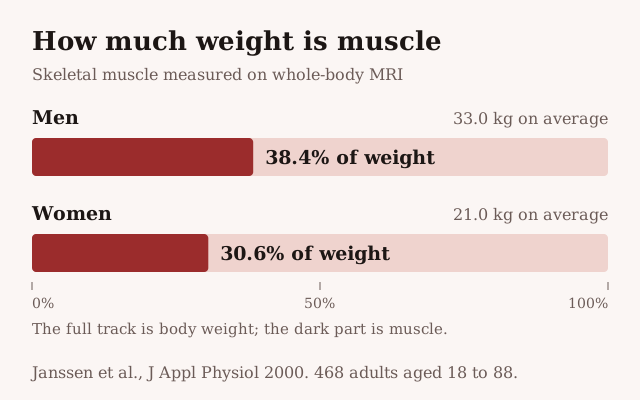
The same researchers found that each extra kilo of body weight brings less and less muscle with it. People who gain weight put on a little muscle and other lean tissue along the way, but most of the gain is fat. Ancel Keys and Josef Brozek, from the team behind the Minnesota starvation experiment, had already described in the 1950s that the weight gained in obesity brings cells, supporting tissue and water, and not only fat, as Heymsfield’s 2014 review recounts. When that weight comes off, this lean part goes with it, and the test records the loss as lean mass loss.
Why does lean mass drop so fast at the start of a diet?
Lean mass drops fast at the start of a diet because of glycogen, which is stored in the liver and muscles together with water. For every gram of glycogen, muscle stores at least three times that weight in water, as a 2015 Spanish study with muscle biopsies confirmed. When you start eating less, especially if you cut carbohydrates, the body uses up this reserve in the first days and the water bound to it leaves in the urine. The scale drops fast, and bioimpedance and DXA, which cannot tell this water from the water in muscle, show a fall in lean mass.
Francisco Grande, from the same Minnesota team, measured what was leaving the bodies of men on a diet at each phase, in a 1954 experiment. On the third day, about 70% of the weight lost was water. After three weeks, almost everything leaving was fat, with a little protein and no water at all. The numbers are in Heymsfield’s review published in 2014 in Obesity Reviews.
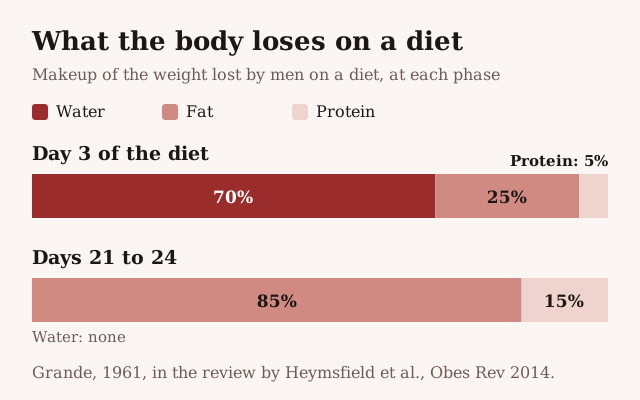
This first phase lasts from a few days to a few weeks, depending on how much fat each person has, and the review notes that the share of weight lost as lean mass is larger at the start and smaller later on. A note published in 1992 in the American Journal of Clinical Nutrition already spoke, in its title, of an illusion of easy weight loss. The water and glycogen that leave fast come back fast when carbohydrates return to your plate, and your weight goes up without the fat having returned. The same back and forth of water muddles the reading on the scale during the weeks of a weight-loss plateau. On a test repeated in the first weeks of a diet, much of what disappears from lean mass is this water, and the comparison that tells you something about muscle is the one made later, once your weight is falling more slowly.
Water, creatine and weight loss change the lean mass on the test
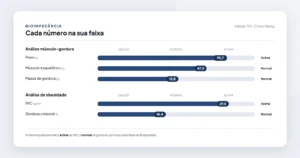
Bioimpedance does not weigh muscle: it measures body water by passing a weak electrical current through you and, with a formula, turns that water into lean mass, as the European guidelines for the test describe. If you arrive dehydrated, after a hot day of drinking little, there is less water and lean mass comes out lower. Swelling, from heart, kidney or liver disease, pushes the number up. A workout right before the test also shifts body water and the result, so the test should come before exercise.
Creatine also pulls lean mass up. In a study of young people who did strength training, it raised total body water and weight within a few weeks, and part of the extra lean mass that shows up on the test after you start creatine is this extra water in the body. Combined with strength training, creatine brings strength gains measured in testing, as I described in the post on what creatine does for training and whether it causes bloating.
In a 2023 study of adults with overweight and obesity on a diet, Heymsfield’s team saw that weight loss itself changes the recipe of lean mass: after losing weight, fat-free mass tended to hold a little more water and ended up with a little less protein. The calculations behind several methods assume this mix is fixed, and the authors urge caution when lean mass is used as a safety signal in weight-loss studies.
What each test calls lean mass and muscle
Each test measures one thing and gives it a name, and much of the confusion starts on the report. The 2025 terminology guide points out that bioimpedance devices often call muscle what, by the calculation they make, is an estimate of lean mass.
| Test | What the report calls it | What it includes |
|---|---|---|
| Ordinary scale | Weight | Everything together |
| Bioimpedance | Lean mass or fat-free mass | Everything that is not fat, calculated from water |
| Bioimpedance | Skeletal muscle mass | Muscle estimated by a formula |
| DXA scan | Lean mass or lean tissue | Everything that is neither fat nor bone |
| DXA scan | Appendicular lean mass | Lean tissue of the arms and legs, used in place of muscle |
| MRI or CT | Skeletal muscle | Muscle seen on the image and the fat inside it |
On bioimpedance, the skeletal muscle line comes from a formula, and one of the most widely used came from the same Janssen and Heymsfield team, who in 2000 compared bioimpedance with MRI in hundreds of adults and found that the formula underestimated muscle in Asian people. A formula holds for the group of people it was tested in, and the report depends on the formula each device uses.
A whole-body DXA scan separates fat, bone and what is left, which it calls lean mass or lean tissue. Since most of the lean tissue in the arms and legs is muscle, it uses appendicular lean mass as a stand-in for muscle, and a 2002 study showed that this measure closely tracks muscle on MRI in adults without severe obesity. Even so, skin, tendons and water are in there too.
MRI and CT show muscle apart from the fat around it and from the fat that seeps in between the fibers. They are expensive, CT involves radiation, and they end up reserved for research or for specific cases. Researchers also have a urine method, in which the person takes a small amount of creatine carrying a chemical tag that the lab recognizes in the urine, and the test calculates the size of the body’s muscle store. In a study of men with an average age above 80, muscle measured this way was more closely linked to falls and difficulty walking than DXA lean mass was.
Is losing lean mass on a weight-loss injection losing muscle?
Losing lean mass on a weight-loss injection means losing muscle only in part, and in the injection studies researchers often measure lean mass with DXA, which alarms anyone who reads the result as if it were all muscle. In SURMOUNT-1, a study paid for by Eli Lilly, some of the participants had DXA scans: those on tirzepatide, the substance in Mounjaro, lost much more weight than those on placebo, but the share of that weight lost as lean mass was the same in both groups. The injection took lean mass in the same proportion as lifestyle change alone, and in a larger amount because more weight was lost.
In STEP UP, a study of semaglutide, the substance in Ozempic and Wegovy, paid for by Novo Nordisk, a small group of participants had MRI from the middle of the trunk down to the knees, the test that separates muscle from everything else. Most of what came off was fat; thigh muscle volume decreased, the fat infiltrating the muscle also dropped, and the sit-to-stand test did not get worse. In the JAMA article, Caterina Conte, Kevin Hall and Samuel Klein point out that weight loss improves the quality of the muscle that remains and that physical function and mobility improve after losing weight, even in older people who started out with little muscle.
A 2026 review published in the Annals of Internal Medicine, with no outside funding, pooled the injection studies with a comparison group (placebo or lifestyle change alone) that measured body composition, and it arrived at a less reassuring picture. The authors used as a yardstick what is expected from ordinary weight loss: close to one quarter of the weight lost as lean mass on DXA or bioimpedance, and a smaller share when MRI or CT measure muscle. In most of the injection studies, and also in some of the comparison groups that lost weight without medication, the loss went past this yardstick. The variation between studies was large, and none of the ones they pooled measured physical capacity objectively.
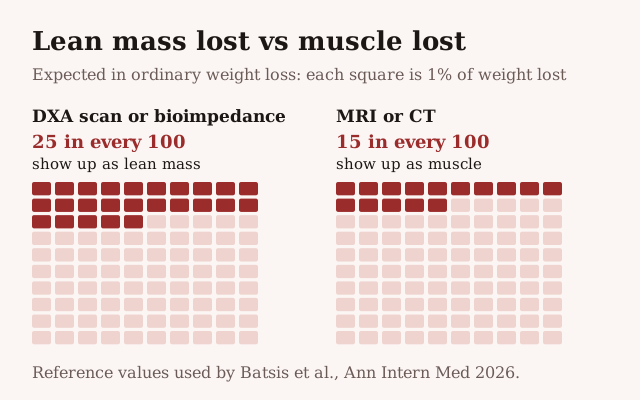
The 2025 joint recommendation from American societies on the injections also starts from the idea that muscle is about half of lean mass, and it lists, among others, the people who need more care: older people, women in perimenopause or after menopause, people who are sedentary, people who eat little protein and people who lose weight very fast. For them, losing muscle can take a bigger toll on balance and independence, and the study of men over 80 linked low muscle to falls and difficulty walking. The injection takes away appetite and can cause nausea, which cuts down on food and on the day’s protein; the symptoms and what to do about them are in the post on Mounjaro side effects, and the difference between the medications is in the guide to weight-loss injections.
What protects muscle while you lose weight
Exercise is what protects muscle most during a diet, and strength training comes first in the plan. Heymsfield’s 2014 review gathers supervised diet studies in which people who exercised, aerobic or strength, lost much less muscle than those who only cut calories. In a 2026 review that pooled dozens of diet studies with and without exercise, the same one I used in the post on losing weight without losing muscle mass, plans with strength training, alone or combined with aerobic exercise, had the largest effect on lean mass. The difference between types of training, however, was not large enough to be certain. Enough protein each day works together with training, and the 2025 American recommendation warns that eating more protein without strength training is probably not enough to hold on to muscle.
Keeping track of your strength helps you notice early if the loss is taking muscle with it. Grip strength measured on a device called a dynamometer, the time it takes to stand up from a chair several times in a row and the progress of your training loads say a lot about muscle. This kind of measure was what the injection studies pooled by the Annals of Internal Medicine review were missing, and the STEP UP authors also call for more research on muscle function.
Signs that the loss is taking muscle
A drop in lean mass on the report is not enough to say you lost muscle. It deserves attention when it shows up together with other signs:
- your training loads go down, or carrying bags and climbing stairs takes more effort;
- getting up from a chair or from the floor gets harder, or you start tripping and falling;
- your weight drops very fast, or you eat very little because of nausea or lack of hunger;
- lean mass keeps dropping test after test, on the same device and with the same preparation, after the initial phase of the diet;
- you are older, already had little muscle or have a disease that takes away your appetite or causes swelling.
In these cases, a medical assessment with a strength test is worth it and, when needed, a test that separates muscle better. With the result, your training, your food and the pace of weight loss can be adjusted.
In practice
- Read the lean mass line on the report as everything that is not fat, and the skeletal muscle line as an estimate made by a formula.
- In the first weeks of a diet, expect lean mass to drop because of water and glycogen, and compare the tests done after that phase.
- Repeat bioimpedance on the same device, at the same time of day and with the same preparation, without arriving dehydrated or right after a workout.
- If you have started creatine, keep in mind that lean mass may rise in the first weeks because of water.
- Do strength training, with sets and load as I explained when answering how many sets to do in strength training, and eat enough protein throughout your weight loss, with or without an injection; whey protein helps you reach your daily amount when your hunger disappears.
- Track your strength along with the report: training loads, stairs and getting up from a chair.
Conclusion
Lean mass is muscle plus water, organs, bones, skin, blood and glycogen, and skeletal muscle is around half of that sum. That’s why lean mass drops fast at the start of a diet without the muscle having disappeared, rises when you start creatine and varies with how much water you have on the day of the test. With weight-loss injections, a portion of the lean mass that comes off is muscle, and how much that matters depends on your age, the reserve you had and how you train and eat. Knowing what each line of the report measures, and tracking your strength alongside it, helps you notice a real loss of muscle early and not mistake the water that comes and goes for it.
All the best!
G
Responsible physician: Dr. Gilberto Nering Junior, sports medicine physician, CRM-SP 160822, RQE 142486 (Sports Medicine, Brazil), responsible for the clinic’s bioimpedance test.
This text was not sponsored, is for information only and does not replace an individual assessment. Questions about the content: contact the clinic.
Cover photo: back and shoulder muscles in a lithograph by Nicolas Henri Jacob for Jean-Marc Bourgery’s anatomy atlas, 19th century, public domain on Wikimedia Commons, cropped and without the plate numbers.
Frequently asked questions about lean mass and muscle
Is fat-free mass the same as lean mass?
In practice, fat-free mass and lean mass are the same thing: body composition researchers treat both as everything in the body that has weight and is not fat. A DXA scan sometimes leaves bone out of the count and calls the rest lean tissue, and it pays to read the legend on your report.
What is appendicular lean mass?
Appendicular lean mass is the lean mass of the arms and legs, measured by a DXA scan or estimated by bioimpedance. Since most of it is muscle, tests use this measure as a stand-in for the muscle of the arms and legs, but it also includes skin, tendons and water.
If my lean mass dropped on the test, did I lose muscle?
Not necessarily, because what left the lean mass on the report may be water, glycogen and the tissue that supported the fat, and usually only part of it is muscle. What deserves attention is a drop that continues test after test after the first weeks of a diet, even more so alongside a loss of strength. In people who are older, already have little muscle or lose weight very fast, muscle loss weighs more and calls for strength training and enough protein.
Does lean mass weigh more than fat?
A kilo of lean mass weighs the same as a kilo of fat, but it takes up less space, because lean tissue is denser than fat tissue. This is how your clothes can get looser without the scale changing.
Why did I lose lean mass on Mounjaro?
Because anyone who loses weight, on Mounjaro or with diet alone, loses water, glycogen, the tissue that supported the fat and some muscle along with the fat, and the test adds all of this into the lean mass line. DXA and bioimpedance do not separate muscle from the rest, and your strength and training loads help you follow the muscle along with the report. Strength training and enough protein help protect the part that is muscle.
References
- Batsis JA, Gavras A, Gross DC, et al. Effect of incretin-based and nonpharmacologic weight loss on body composition: a systematic review. Ann Intern Med. 2026;179(7):996-1013. doi:10.7326/ANNALS-25-00478
- Cawthon PM, Orwoll ES, Peters KE, et al. Strong relation between muscle mass determined by D3-creatine dilution, physical performance, and incidence of falls and mobility limitations in a prospective cohort of older men. J Gerontol A Biol Sci Med Sci. 2019;74(6):844-852. doi:10.1093/gerona/gly129
- Conte C, Hall KD, Klein S. Is weight loss-induced muscle mass loss clinically relevant? JAMA. 2024;332(1):9-10. doi:10.1001/jama.2024.6586
- Deller M, Weiershaus J, Held S, et al. Effects of calorie restriction with and without strength, endurance or mixed training on fat-free and skeletal muscle mass in overweight or obese individuals: a systematic review with pairwise meta-analysis and network meta-analysis of randomized controlled studies. Diabetes Obes Metab. 2026;28(8):6810-6823. doi:10.1111/dom.70873
- Fernández-Elías VE, Ortega JF, Nelson RK, et al. Relationship between muscle water and glycogen recovery after prolonged exercise in the heat in humans. Eur J Appl Physiol. 2015;115(9):1919-1926. doi:10.1007/s00421-015-3175-z
- Heymsfield SB, Brown J, Ramirez S, et al. Are lean body mass and fat-free mass the same or different body components? A critical perspective. Adv Nutr. 2024;15(12):100335. doi:10.1016/j.advnut.2024.100335
- Heymsfield SB, Gonzalez MC, Shen W, et al. Weight loss composition is one-fourth fat-free mass: a critical review and critique of this widely cited rule. Obes Rev. 2014;15(4):310-321. doi:10.1111/obr.12143
- Heymsfield SB, Ludwig DS, Wong JMW, et al. Are methods of estimating fat-free mass loss with energy-restricted diets accurate? Eur J Clin Nutr. 2023;77(5):525-531. doi:10.1038/s41430-022-01203-5
- Hjelmesæth J, Bhat S, Garvey WT, et al. Effect of semaglutide on thigh skeletal muscle volume, fat infiltration and physical function in people with obesity: secondary analysis of STEP UP. Diabetes Obes Metab. 2026;28(12):11653-11663. doi:10.1111/dom.71323
- Janssen I, Heymsfield SB, Baumgartner RN, et al. Estimation of skeletal muscle mass by bioelectrical impedance analysis. J Appl Physiol. 2000;89(2):465-471. doi:10.1152/jappl.2000.89.2.465
- Janssen I, Heymsfield SB, Wang ZM, et al. Skeletal muscle mass and distribution in 468 men and women aged 18-88 yr. J Appl Physiol. 2000;89(1):81-88. doi:10.1152/jappl.2000.89.1.81
- Kim J, Wang Z, Heymsfield SB, et al. Total-body skeletal muscle mass: estimation by a new dual-energy X-ray absorptiometry method. Am J Clin Nutr. 2002;76(2):378-383. doi:10.1093/ajcn/76.2.378
- Kreitzman SN, Coxon AY, Szaz KF. Glycogen storage: illusions of easy weight loss, excessive weight regain, and distortions in estimates of body composition. Am J Clin Nutr. 1992;56(1 Suppl):292S-293S. doi:10.1093/ajcn/56.1.292S
- Kyle UG, Bosaeus I, De Lorenzo AD, et al. Bioelectrical impedance analysis, part II: utilization in clinical practice. Clin Nutr. 2004;23(6):1430-1453. doi:10.1016/j.clnu.2004.09.012
- Look M, Dunn JP, Kushner RF, et al. Body composition changes during weight reduction with tirzepatide in the SURMOUNT-1 study of adults with obesity or overweight. Diabetes Obes Metab. 2025;27(5):2720-2729. doi:10.1111/dom.16275
- Mozaffarian D, Agarwal M, Aggarwal M, et al. Nutritional priorities to support GLP-1 therapy for obesity: a joint Advisory from the American College of Lifestyle Medicine, the American Society for Nutrition, the Obesity Medicine Association, and The Obesity Society. Am J Clin Nutr. 2025;122(1):344-367. doi:10.1016/j.ajcnut.2025.04.023
- Powers ME, Arnold BL, Weltman AL, et al. Creatine supplementation increases total body water without altering fluid distribution. J Athl Train. 2003;38(1):44-50. PMID:12937471
- Prado CM, Gonzalez MC, Norman K, et al. Methodological standards for body composition, an expert-endorsed guide for research and clinical applications: levels, models, and terminology. Am J Clin Nutr. 2025;122(2):384-391. doi:10.1016/j.ajcnut.2025.05.022
- Wang Z, Deurenberg P, Wang W, et al. Hydration of fat-free body mass: review and critique of a classic body-composition constant. Am J Clin Nutr. 1999;69(5):833-841. doi:10.1093/ajcn/69.5.833
- Wang Z, Ying Z, Bosy-Westphal A, et al. Specific metabolic rates of major organs and tissues across adulthood: evaluation by mechanistic model of resting energy expenditure. Am J Clin Nutr. 2010;92(6):1369-1377. doi:10.3945/ajcn.2010.29885