Also in: Português · Español · Italiano · 中文 · हिन्दी
Main points
- The new position stand from the American College of Sports Medicine (ACSM) reviewed what is known about weight training in healthy adults and concluded that few training details really change the result.
- To gain strength, what matters most is training with heavy loads, at least twice a week.
- To gain muscle, what matters most is the number of sets per week, and light or heavy loads both work if the set ends close to your limit.
- Going to failure, lifting tempo and the type of equipment did not consistently change the result.
- If you are just starting out, the best program is the one you can stick with, adding load little by little.
Spend one week at the gym and you will hear a dozen rules: you have to go to failure, you have to take three seconds on the way down, a body-part split beats full-body workouts, without periodization you won’t grow. Every trainer has their own, and every video online has a different answer for how many sets per week to do.
In 2026, the American College of Sports Medicine, the ACSM, published a new position stand on weight training. The authors pooled 137 reviews of studies to find out which training details truly change the result. In this post I show how many sets per week, how much weight and how many sessions make a difference, where experts still disagree and how to use all this in your own training.
How many sets per week, how much weight and how often: the ACSM summary
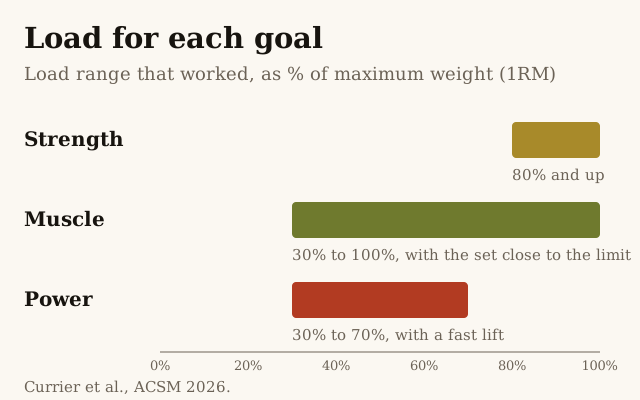
In the ACSM position stand, muscle grew more with at least 10 sets per week for each muscle group, and any load between 30% and 100% of your maximum weight worked, as long as the set ended close to your limit. For strength, what helped most was heavy load, from 80% of your maximum weight, in two to three sets per exercise and at least twice a week. Your maximum weight, which trainers call 1RM, is the heaviest weight you can lift just once.
| Goal | Load (% of 1RM) | How much to train | What helped most |
|---|---|---|---|
| Strength | 80% or more | 2 to 3 sets per exercise, 2 or more times a week | full range of motion and the main exercise at the start of the session |
| Muscle | 30% to 100%, with the set close to your limit | 10 or more sets per week for each muscle | emphasis on the lowering part of the movement |
| Power | 30% to 70% | few reps, up to about 24 across all sets | lifting phase as fast as possible |
Why strength training is worth it
Muscle strength is also a health matter. A 2018 review, with data from almost 2 million people, showed that those with greater grip strength had about a 30% lower risk of dying over the follow-up period than those with less strength. Another review, from 2015, found that this link holds even after accounting for how much a person exercises. It also shows up in people with heart disease, cancer, kidney problems or lung disease. These studies show association, and other factors may explain part of the difference, but the results generally point the same way.
As for safety, the ACSM itself cites a 2020 analysis of more than 38,000 participants in exercise studies, more than 11,000 of them older adults, in which exercise did not increase the risk of serious health problems. Mild complaints, such as muscle soreness, were more common in those who trained.
What the 2026 ACSM position stand is
The ACSM document is a review of reviews. Instead of looking at studies one by one, the authors pooled systematic reviews that had already gathered those studies and looked at where they agreed.
It focused on three outcomes: strength, muscle size, which experts call hypertrophy, and power, which is the ability to produce force quickly. It applies to healthy adults, and people with an injury or illness need individual guidance. For children and teenagers, I wrote about weight training for children.
The term 1RM, or one-repetition maximum, comes up all the time in the document. About 80% of 1RM is a weight most people can lift around eight times before they can’t do any more, with some variation from one exercise to another.
To gain strength
If you want to get stronger in an exercise, you need to train that exercise with real weight and do it often, and the reviews confirmed this. In the ACSM position stand, strength improved more with:
- heavy loads, from 80% of 1RM, and the heavier, the greater the strength gain;
- full range of motion, going all the way down and up in the exercise;
- two to three sets per exercise, better than a single set;
- the main exercise at the start of the session, while you are still fresh;
- two or more sessions a week.
To gain muscle: how many sets per week
Hypertrophy, the increase in muscle size, depended more on how much you trained than on the weight. According to the ACSM, muscle grew more with:
- more sets per week, at least 10 sets per muscle group;
- emphasis on the lowering phase, when the muscle works while it lengthens. Training with more load in this phase helped the muscle grow more.
Load, on the other hand, which many people think is decisive for hypertrophy, did not consistently change the result. Training at 30% or at 100% of 1RM gave similar results in muscle size, as long as the set ended close to the limit, with only a few reps left before you couldn’t do any more. Frequency also did not change the result when the total number of weekly sets was the same: training a muscle once a week or more than five times a week gave similar growth.
For hypertrophy, then, what counts most is the number of well-done sets per week, and you can spread those sets across the days however you like. For example, 10 sets for your chest can be 5 on Monday and 5 on Thursday. If you are trying to lose weight, I wrote about how to lose weight without losing muscle.
To gain power
Power matters for people who play sports and also for older adults, because it helps with getting up from a chair, climbing stairs and keeping your balance so you don’t fall. In the reviews gathered by the ACSM, it improved with:
- moderate loads, between 30% and 70% of 1RM;
- few reps in total, up to about 24 across all sets of the exercise;
- the lifting phase done as fast as possible, with control;
- Olympic weightlifting exercises, such as the snatch and the clean and jerk, for people who have the technique and proper coaching.
What made no consistent difference
A lot of gym debate revolves around details that carried little weight in the studies. According to the ACSM, these factors did not consistently change the results:
- going to failure, the point where you cannot do a single more rep;
- using machines or free weights;
- using single-joint or multi-joint exercises;
- different ways of structuring a set, such as pauses within the set or alternating heavy and light loads;
- time under tension, the famous tempo;
- blood flow restriction training, the cuff on the leg or arm;
- periodization, which means changing your training in planned phases.
“No consistent difference” means that, in the available studies, none of these options was clearly better than the alternative. If you like machines, you can use machines. If you prefer free weights, they work too. For strength, heavy loads are still the main thing.
Where there is still debate
Some points are still being debated among researchers and trainers. The position stand itself also has limits, and the authors acknowledge this in the text.
Do you need to train to failure?
The ACSM says going to failure is not necessary and may even be inadvisable for some people, such as older adults, because of the strain on blood vessels and the risk of injury when technique breaks down. The idea is to stop close to failure, which at the gym usually means ending the set with two or three reps still “in the tank.”
The studies do not all agree on the details. A 2023 review found no clear advantage in going to failure for building muscle. Another, from 2024, found that muscle grows more the closer to failure the set ends, while strength gains barely depend on it. As I see it, the two fit together: getting close to your limit matters, and going to failure on every set is more tiring and does not guarantee extra gains.
How many sets per week is too many?
The ACSM talks about at least 10 sets per week for each muscle, with more gain the more sets you do. But each extra set yields a bit less than the one before, and nobody knows for sure where the ceiling is. More sets require more recovery, and a beginner grows well with far less.
Periodization
Many trainers use periodization to organize months and years of training, with heavier phases and lighter weeks. The ACSM found no consistent advantage. One possibility is that most studies last weeks or a few months, too short to show a benefit that might appear over the years. Until someone tests this in long studies, I see periodization as a useful organizing tool, not an obligation.
The quality of the studies
The authors themselves acknowledge that many studies in the field are small and have methodological problems. Also, the conclusions apply to healthy adults. The ACSM also points out that beginners improve with many types of programs, as long as the load goes up gradually and they keep training. In people who have trained for years, gains slow down, and the details are what coaches of advanced athletes argue about most.
In practice: where to start
To put these suggestions together, I combined the ACSM position stand with what trainers commonly use in practice. They are starting points, and ideally you should fine-tune them with a qualified exercise professional.
If you just want to be healthy
- Two sessions a week, working the whole body.
- Pushing and pulling exercises, for the upper body and the legs.
- Two or three sets per exercise, stopping when you could still do two or three more reps.
- Altogether, about 30 to 60 minutes a week. In a 2022 review, this was the range linked to the largest reduction in the risk of death, heart disease and cancer.
Keep up your aerobic training too: in the same 2022 review, people who combined both had a lower risk of dying from any cause, from heart disease and from cancer. I explained how to dose aerobic exercise in the post on zone 2 and training zones.
If you are starting out and want to gain strength and muscle
- Start with two to three full-body sessions a week.
- Choose basic exercises, such as squats, leg press, rows and bench press, and focus on technique.
- Do two to three sets per exercise.
- When the planned reps become easy, add a little weight.
If you have been training for a while
- Three to five sessions a week, in whatever split fits your routine.
- At least 10 sets per week for each muscle group, adding more gradually if progress stalls.
- Rest of two minutes or more on big, heavy exercises.
- A lighter week every four to eight weeks, to recover.
If you get back pain when you train, have it checked and don’t give up weight training on your own. In the post on low back pain and strength training I go over what the studies show about strengthening your back.
Common mistakes
- thinking you need to leave every session wrecked to get results;
- changing your program every week and never increasing the load;
- copying an advanced athlete’s program right at the start;
- sacrificing technique to add more weight;
- holding your breath while you push: a 1992 study measured pressure inside the artery and found that holding your breath makes blood pressure rise more than the effort alone does;
- skipping weight training because time is short, when two short sessions already help.
When to get assessed first
Since 2015, the ACSM has recommended pre-exercise screening that takes three things into account: whether you already exercise, whether you have symptoms or heart, metabolic or kidney disease, and how hard you want to train. Based on this screening and the Brazilian guidelines, it’s worth getting assessed before you start, or before you greatly increase intensity, if you:
- have joint pain or an injury that hasn’t improved;
- have high blood pressure, heart disease, kidney disease or diabetes (with blood pressure of 180/110 mmHg or higher, the ACSM recommends assessment and treatment before you start);
- have been inactive for a long time, are over 35 and want to train hard, especially if you have heart risk factors (in that case, the Brazilian guidelines consider an exercise stress test);
- feel chest pain, unusual shortness of breath or dizziness during exertion.
If your question is about heart tests before you start, the criteria are in the post on sudden death in sport. There I explain who needs an exercise stress test and from what age.
Conclusion
The ACSM position stand makes weight training simpler than gym rules suggest. If your goal is strength, use heavy loads at least twice a week. If it is muscle, do enough sets per week and end each set close to your limit, with whatever weight you prefer. Failure, tempo and the type of equipment matter less than they seem. What counts most is training regularly and increasing the load gradually.
Happy training, one set at a time!
Responsible physician: Dr. Gilberto Nering Junior, sports medicine physician, CRM-SP 160822, RQE 142486 (Sports Medicine, Brazil).
This text was not sponsored, is for information only and does not replace an individual assessment. Questions about the content: contact the clinic.
Cover photo: Vitaly Gariev on Unsplash.
Frequently asked questions about sets, load and frequency in weight training
How many sets per week do you need for hypertrophy?
The ACSM talks about at least 10 sets per week for each muscle group. Beginners usually grow well with fewer.
Do you need to train to failure to gain muscle?
No. The ACSM concluded that going to failure is not necessary. Stopping when you could still do two or three more reps works and is less tiring.
Does training with light weights work?
For gaining muscle, light weights do work: loads from 30% to 100% of your maximum weight gave similar results, as long as the set ends with only a few reps to spare. For gaining strength, heavy loads are still better.
How many times a week should I do weight training?
At least twice a week to gain strength. To gain muscle, the total number of sets per week matters more than how many times you train.
Machines or free weights, which is better?
Machines and free weights both work, and the ACSM found no consistent difference between them. Choose what you can do with good technique and keep up.
Does weight training twice a week work?
Yes, it does: for strength, the ACSM saw benefits starting at two sessions a week. For muscle, what counts is the total number of sets per week, and beginners grow well even with fewer than 10 sets per muscle.
References
- Currier BS, D’Souza AC, Singh MAF, et al. American College of Sports Medicine Position Stand. Resistance Training Prescription for Muscle Function, Hypertrophy, and Physical Performance in Healthy Adults: An Overview of Reviews. Med Sci Sports Exerc. 2026;58(4):851-872. doi:10.1249/MSS.0000000000003897
- García-Hermoso A, Cavero-Redondo I, Ramírez-Vélez R, et al. Muscular Strength as a Predictor of All-Cause Mortality in an Apparently Healthy Population: A Systematic Review and Meta-Analysis of Data From Approximately 2 Million Men and Women. Arch Phys Med Rehabil. 2018;99(10):2100-2113.e5. doi:10.1016/j.apmr.2018.01.008
- Momma H, Kawakami R, Honda T, et al. Muscle-strengthening activities are associated with lower risk and mortality in major non-communicable diseases: a systematic review and meta-analysis of cohort studies. Br J Sports Med. 2022;56(13):755-763. doi:10.1136/bjsports-2021-105061
- Refalo MC, Helms ER, Trexler ET, et al. Influence of Resistance Training Proximity-to-Failure on Skeletal Muscle Hypertrophy: A Systematic Review with Meta-analysis. Sports Med. 2023;53(3):649-665. doi:10.1007/s40279-022-01784-y
- Robinson ZP, Pelland JC, Remmert JF, et al. Exploring the Dose-Response Relationship Between Estimated Resistance Training Proximity to Failure, Strength Gain, and Muscle Hypertrophy: A Series of Meta-Regressions. Sports Med. 2024;54(9):2209-2231. doi:10.1007/s40279-024-02069-2
- Volaklis KA, Halle M, Meisinger C. Muscular strength as a strong predictor of mortality: A narrative review. Eur J Intern Med. 2015;26(5):303-10. doi:10.1016/j.ejim.2015.04.013
- Niemeijer A, Lund H, Stafne SN, et al. Adverse events of exercise therapy in randomised controlled trials: a systematic review and meta-analysis. Br J Sports Med. 2020;54(18):1073-1080. doi:10.1136/bjsports-2018-100461
- MacDougall JD, McKelvie RS, Moroz DE, et al. Factors affecting blood pressure during heavy weight lifting and static contractions. J Appl Physiol. 1992;73(4):1590-1597. doi:10.1152/jappl.1992.73.4.1590
- Riebe D, Franklin BA, Thompson PD, et al. Updating ACSM’s Recommendations for Exercise Preparticipation Health Screening. Med Sci Sports Exerc. 2015;47(11):2473-2479. doi:10.1249/MSS.0000000000000664
- Ghorayeb N, Stein R, Daher DJ, et al. The Brazilian Society of Cardiology and Brazilian Society of Exercise and Sports Medicine Updated Guidelines for Sports and Exercise Cardiology – 2019. Arq Bras Cardiol. 2019;112(3):326-368. doi:10.5935/abc.20190048
- Pescatello LS, Franklin BA, Fagard R, et al. American College of Sports Medicine position stand. Exercise and hypertension. Med Sci Sports Exerc. 2004;36(3):533-553. doi:10.1249/01.mss.0000115224.88514.3a