Also in: Português · Español · Italiano · 中文 · हिन्दी
Main points
- In the largest study ever done, men with low testosterone and an at-risk heart who used testosterone gel did not have more heart attacks, strokes or cardiac deaths than those who used a placebo.
- Atrial fibrillation, pulmonary embolism and acute kidney injury showed up a little more often in the testosterone group.
- This result applies to men with a confirmed lack of the hormone, on a replacement dose and with regular blood tests.
- In a medical records study, men who started testosterone with no recorded lack of the hormone had more serious events over the years, mostly deaths, than those who started with a confirmed lack.
- Testosterone thickens the blood, and hematocrit needs to be monitored.
Does testosterone replacement cause heart attacks or harm the heart? For many years, the honest answer was that nobody really knew. The studies contradicted each other, and US drug labels carried warnings about the heart.
In 2023 the largest study ever done on the subject came out, and in 2025 the FDA, the US drug agency, changed the label because of it. In that study, testosterone replacement did not increase heart attacks, strokes or cardiac deaths in men with a confirmed lack of the hormone, but some small risks did show up. Here I explain what the study showed, what is still unanswered and who needs extra care. If you still want to know whether your testosterone is really low, start with the post on low testosterone: when to treat it and when not to.
Where the fear came from
In 2010, a US study of 209 men aged 65 or older, with difficulty walking and many health problems, ended early. In the testosterone group, 23 men had heart problems, compared with 5 in the placebo group. The study was small, done in frail men, and had not been designed to measure heart attacks.
The medical records studies that came next were split: some showed more risk and others found no increase. In 2015, the FDA required manufacturers to run a large study to settle the question. Before it came out, a 2022 review of 35 studies and more than 5,600 men found no increase in heart problems in the short and medium term, but longer-term data were missing.
What TRAVERSE showed about testosterone and the heart
TRAVERSE followed 5,204 men aged 45 to 80 at 316 centers in the United States. All of them had symptoms, two testosterone results below 300 ng/dL, and either existing heart disease or several risk factors, such as high blood pressure, diabetes and high cholesterol.
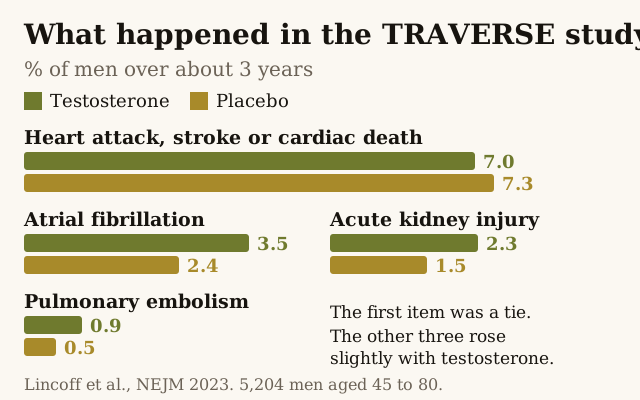
Half used testosterone gel every day, with the dose adjusted to keep the hormone within the normal range, and half used a gel with no hormone, without knowing which one they had. After about 3 years, heart attack, stroke or death from heart causes occurred in 7.0% of those on testosterone replacement and in 7.3% of the placebo group, a tie. Deaths from any cause were also similar in both groups.
The risks that went up a little
Besides heart attack and stroke, TRAVERSE counted other health problems. Three of them were more common among the men who used testosterone:
| What TRAVERSE measured | What it is | Testosterone | Placebo |
|---|---|---|---|
| Heart attack, stroke or cardiac death | the main outcome of the study | 7.0% | 7.3% |
| Atrial fibrillation | an arrhythmia in which the heart beats irregularly | 3.5% | 2.4% |
| Pulmonary embolism | a clot that travels to the lung | 0.9% | 0.5% |
| Acute kidney injury | a fast drop in how well the kidneys work | 2.3% | 1.5% |
Compared with placebo, blood pressure also ended up a little higher. In the first 6 months, it barely changed in the testosterone group and fell in the placebo group, a difference of about 2 mmHg.
The authors did not expect the atrial fibrillation or the kidney injury, and it is still unclear why they happened. These are small risks in absolute numbers, but they did show up and need to be part of the conversation.
As for embolism, a 2025 review in the New England Journal of Medicine points out that most cases of thrombosis during replacement occur in men with thrombophilia, a tendency to form clots that can be inherited or acquired. Some studies suggest this risk is higher in the first months of treatment. TRAVERSE excluded men who already knew they had thrombophilia, but the study did not ask for a test to look for it before starting.
Does testosterone replacement improve cholesterol?
A 2025 review of 25 studies found a drop in total cholesterol and LDL with replacement. The studies were very different from one another, and better cholesterol on a blood test does not mean fewer heart attacks. TRAVERSE measured what matters for the heart, heart attack and stroke, and testosterone did not reduce these events over about 3 years.
What changed on the testosterone label about the heart
In February 2025, the FDA ordered the sentence about increased heart risk to be taken out of the boxed warning on the labels. It also required the TRAVERSE results to be added to all testosterone products, along with a warning about higher blood pressure. The agency kept the notice that the safety and benefit of testosterone for the decline that comes with age alone have not been proven.
What TRAVERSE does not answer
TRAVERSE answered one specific question well, and many kinds of men and treatments were left out of it. These are the limits that change how the result should be read:
- everyone used gel, with the dose controlled so it would not go above normal, and the study did not test injections or high doses;
- many men stopped treatment partway through, close to 6 in 10 in both groups, and the average time on treatment was under 2 years;
- only men aged 45 to 80 took part, so the study says nothing about younger men;
- men with a recent heart attack or stroke, uncontrolled heart failure, a tendency to thrombosis or prostate cancer were left out;
- all of them had a confirmed lack of the hormone, so the study tells us nothing about people who use testosterone with normal test results;
- the study was paid for by testosterone manufacturers, and an independent academic center analyzed the data.
Is low testosterone bad for the heart?
Many people ask the question the other way around: they want to know whether it is low testosterone that harms the heart. In studies that only observe the population, men with low testosterone have more obesity, diabetes and high blood pressure, and they die earlier. What nobody knows is whether low testosterone causes these problems or simply shows up alongside them, as a sign of poorer health.
TRAVERSE was designed to measure the safety of replacement, not to prove that it protects. Even so, it helps: over about 3 years, testosterone did not reduce heart attacks, strokes or deaths. The Brazilian guideline also does not recommend testosterone replacement just to protect the heart, control blood sugar or lose weight. Men with low testosterone and an at-risk heart gain more by treating blood pressure, cholesterol, diabetes and weight, ideally by losing weight without losing muscle.
What about men who use it without needing it?
A 2026 study looked at medical records from 123 healthcare institutions and compared men aged 30 to 75 who started testosterone with and without a recorded diagnosis of low testosterone. The study added up heart attack, stroke, cardiac arrest and death from any cause over a period of up to 10 years. Those who started with no recorded lack of the hormone reached 16.5%, compared with 11.8%. Most of the difference came from deaths from any cause, and stroke, cardiac arrest and heart failure were also more common in this group.
A medical records study shows an association and does not prove that testosterone caused it. These men may differ in other ways, such as using it for performance and having less medical follow-up. Still, the message matches TRAVERSE: the safety seen in that study applies to men who have a real indication and are followed by a doctor.
A replacement dose is not a cycle dose
Replacement keeps testosterone at the normal level of a healthy man. An anabolic steroid cycle uses doses many times higher, and then the story for the heart is a different one. A 2017 study in the journal Circulation compared weightlifters who had been using anabolic steroids for years with others who had never used them. In the users, the heart pumped with less force and there was more plaque in the heart’s arteries, and the longer the use, the more of both. I wrote more about this in the post on low testosterone after a cycle. TRAVERSE cannot be used to say that anabolic steroids are safe.
Testosterone, hematocrit and the heart
Testosterone stimulates the production of red blood cells. In people with anemia, that helps. In excess, the blood gets thick, and this is the most common side effect of replacement, linked to a higher risk of thrombosis and heart problems.
The risk depends a lot on the form and the dose. In an Australian study with a long-acting injection, in men whose testosterone was not even that low, 22% ended up with a hematocrit that was too high. In TRAVERSE, with gel and an adjusted dose, it was 0.2%.
That is why the doctor orders hematocrit at 3, 6 and 12 months of treatment and then once a year. The Brazilian guideline recommends pausing testosterone when it goes above 54%, until it comes down. In a large 2021 Dutch study of people using testosterone, smoking, excess weight and lung disease raised the chance of the blood getting thicker.
Testosterone replacement: who needs extra care with the heart
Having heart disease does not rule out testosterone replacement: about half of the men in TRAVERSE already had it. But some situations call for more caution, according to the 2026 Brazilian guideline:
- a heart attack or stroke in the last 6 months, when it is best to wait for the condition to settle;
- severe or decompensated heart failure, because testosterone can cause fluid retention;
- a previous thrombosis or a tendency to thrombosis;
- severe sleep apnea that is not being treated;
- a hematocrit above 48% even before starting, because the chance of going above 54% during treatment is higher.
Since atrial fibrillation was more common in TRAVERSE, palpitations during treatment also deserve a check. The doctor may order an electrocardiogram or a Holter, the test that records the heart’s rhythm for 24 hours.
Signs that call for medical help
The signs below match the problems TRAVERSE measured and the ones that showed up more in the testosterone group, such as arrhythmia and embolism. During replacement, go to the emergency room or call 192 (in Brazil; in other countries, call your local emergency number) if you have:
- chest pain or tightness, including during training;
- sudden shortness of breath, or far more than the effort explains;
- chest pain when breathing, or coughing up blood;
- swelling and pain in one leg only;
- weakness or tingling on one side of the body, a drooping mouth or trouble speaking;
- strong palpitations, with dizziness or fainting.
If the symptom shows up during training, stop right away. Mild palpitations that come and go do not need the emergency room, but they do deserve a doctor’s visit. The same goes for swelling in both legs, fast weight gain or snoring that has gotten worse. If you train, you can also read the warning signs in the post on sudden death in sport.
How to protect your heart during testosterone replacement
In 2025 the US label started warning about higher blood pressure, and the 2026 Brazilian guideline sets the test schedule. Putting the two together, this is the routine I suggest:
- Check your blood pressure regularly, at home or at a pharmacy.
- Get your blood tests done on the right dates, especially hematocrit.
- Agree with your doctor on a target in the middle of the normal range, without chasing high values.
- Treat what you already have: blood pressure, cholesterol, diabetes and sleep apnea.
- Don’t smoke.
- Exercise regularly, which protects the heart. Training in zone 2 is a good start.
Conclusion
In the largest study ever done, testosterone replacement with gel, in men with a confirmed lack of the hormone and an at-risk heart, did not increase heart attacks, strokes or cardiac deaths. Atrial fibrillation, pulmonary embolism and kidney injury were a little more common, and blood pressure goes up slightly. This result does not apply to men who use it without needing it, nor to anabolic steroid doses. With the right indication, a replacement dose and regular tests, the heart is no longer an automatic barrier, but the small risks that appeared need to be watched.
Bye for now, everyone!
Responsible physician: Dr. Gilberto Nering Junior, sports medicine physician, CRM-SP 160822, RQE 142486 (Sports Medicine, Brazil).
This text was not sponsored, is for information only and does not replace an individual assessment. Questions about the content: contact the clinic.
Cover photo: Marek Studzinski on Unsplash.
Frequently asked questions about testosterone and the heart
Is male hormone replacement safe?
For men with a confirmed lack of the hormone, on a replacement dose and with regular tests, the largest study ever done showed no more heart attacks, strokes or cardiac deaths than placebo. Atrial fibrillation, pulmonary embolism and kidney injury were a little more common, and this safety does not apply to men who use it without needing it or to anabolic steroid doses.
What are the side effects of male hormone replacement?
The most common one is thicker blood, which is why the doctor keeps an eye on hematocrit. In TRAVERSE, blood pressure ended up a little higher, and atrial fibrillation, pulmonary embolism and acute kidney injury were a little more frequent than with placebo.
Does taking testosterone cause heart attacks?
In TRAVERSE, men with a confirmed lack of the hormone who used testosterone gel as replacement had a rate of heart attack, stroke and cardiac death similar to those on placebo (7.0% versus 7.3%). This applies to replacement doses with follow-up, not to anabolic steroids.
Can someone who has had a heart attack take testosterone replacement?
About half of the men in TRAVERSE already had heart disease. The Brazilian guideline recommends waiting at least 6 months after a heart attack or stroke, and the decision should involve the cardiologist.
Does testosterone raise blood pressure?
A little: in TRAVERSE, the difference was about 2 mmHg, and since 2025 the US label of every testosterone product carries a warning about it. It is a good idea to check your blood pressure during treatment.
Does testosterone thicken the blood?
Yes, it increases red blood cells. So the doctor orders hematocrit at 3, 6 and 12 months and then once a year, and pauses replacement when it goes above 54%, until it comes down.
Testosterone gel or injection: which is better for the heart?
TRAVERSE only tested the gel, so there is no direct answer. Gel and long-acting injections keep levels steadier than short-acting injections, and gel tends to thicken the blood less. But even the long-acting injection thickened the blood quite a bit in an Australian study, so the form does not replace the tests. No large study has compared the forms for heart attack and stroke.
References
- Baggish AL, Weiner RB, Kanayama G, et al. Cardiovascular Toxicity of Illicit Anabolic-Androgenic Steroid Use. Circulation. 2017;135(21):1991-2002. doi:10.1161/CIRCULATIONAHA.116.026945
- Basaria S, Coviello AD, Travison TG, et al. Adverse events associated with testosterone administration. N Engl J Med. 2010;363(2):109-22. doi:10.1056/NEJMoa1000485
- Bhasin S, Snyder PJ. Testosterone Treatment in Middle-Aged and Older Men with Hypogonadism. N Engl J Med. 2025;393(6):581-591. doi:10.1056/NEJMra2404637
- Ezeamii PC, Adebayo AA, Ozojide KO, et al. Cardiovascular Effects of Testosterone Replacement Therapy in Hypogonadal Men: A Systematic Review of Lipid Profiles, Inflammatory Markers, and Vascular Function. Cureus. 2025;17(12):e99456. doi:10.7759/cureus.99456
- Hohl A, Lopes L, Ronsoni MF, et al. Care of Patients with Male Hypogonadism: A Joint Position Statement from the Brazilian Society of Endocrinology and Metabolism (SBEM), the Brazilian Society of Urology (SBU), and the Brazilian Association for Sexual Medicine and Health (ABEMSS). Int Braz J Urol. 2026;52(3):e20250610. doi:10.1590/S1677-5538.IBJU.2025.0610
- Hudson J, Cruickshank M, Quinton R, et al. Adverse cardiovascular events and mortality in men during testosterone treatment: an individual patient and aggregate data meta-analysis. Lancet Healthy Longev. 2022;3(6):e381-e393. doi:10.1016/S2666-7568(22)00096-4
- Kerniss H, Curman P, Olbrich H, et al. Off-label testosterone therapy is associated with higher long-term cardiovascular risk in men. EBioMedicine. 2026;130:106373. doi:10.1016/j.ebiom.2026.106373
- Lincoff AM, Bhasin S, Flevaris P, et al. Cardiovascular Safety of Testosterone-Replacement Therapy. N Engl J Med. 2023;389(2):107-117. doi:10.1056/NEJMoa2215025
- Madsen MC, van Dijk D, Wiepjes CM, et al. Erythrocytosis in a Large Cohort of Trans Men Using Testosterone: A Long-Term Follow-Up Study on Prevalence, Determinants, and Exposure Years. J Clin Endocrinol Metab. 2021;106(6):1710-1717. doi:10.1210/clinem/dgab089
- Wittert G, Bracken K, Robledo KP, et al. Testosterone treatment to prevent or revert type 2 diabetes in men enrolled in a lifestyle programme (T4DM): a randomised, double-blind, placebo-controlled, 2-year, phase 3b trial. Lancet Diabetes Endocrinol. 2021;9(1):32-45. doi:10.1016/S2213-8587(20)30367-3
- U.S. Food and Drug Administration. FDA issues class-wide labeling changes for testosterone products. 28 fev. 2025. Acesso em 17 out. 2026. fda.gov