
Also in: Português · Español · Italiano · 中文 · हिन्दी
Metabolism is the set of reactions that keep your body alive. Basal metabolism, which is what you burn at rest, accounts for about 60% to 80% of everything you burn in a day. In other words: most of the calories you burn are not burned at the gym, they are burned sitting still, just to keep your body running, your heart beating, your brain thinking, your lungs breathing. How many calories is that, exactly? There is no single number; it depends on you. And there is a way to really measure it, instead of guessing.
What Metabolism Is (Really)
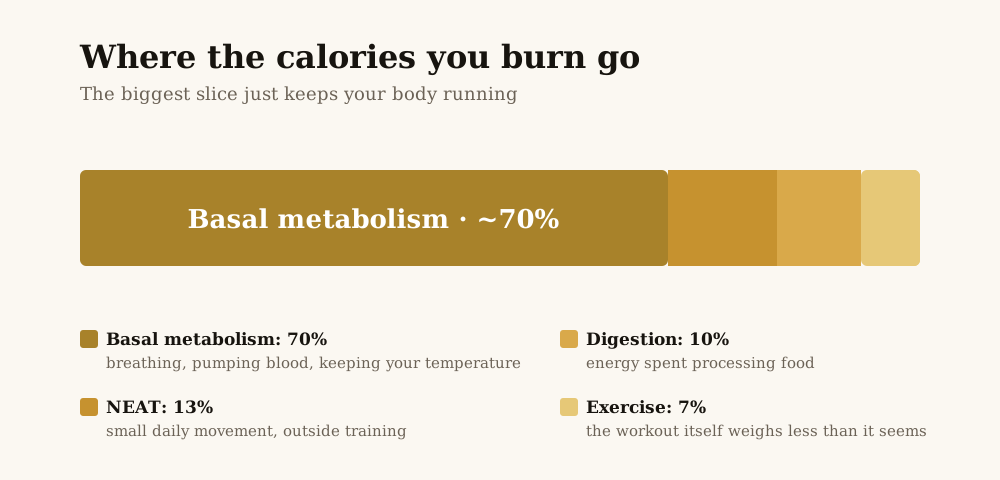
Metabolism is just the name for the set of reactions that keep you alive and moving. The energy you burn over the whole day, which textbooks call total energy expenditure, is split into three parts:
- Basal metabolism: what you burn at complete rest, just to exist. It is by far the biggest slice.
- Thermic effect of food: the energy your body spends digesting and processing what you eat. Protein is the one that “charges” the most to be digested.
- Physical activity: this includes training and, importantly, all the moving you do outside of it (walking, gesturing, taking the stairs, fidgeting). This day-to-day part even has a name, and it varies a lot from person to person.
Notice something almost nobody realizes: a one-hour workout is a small slice of the pie. What drives the total is your basal metabolism and how much you move during the rest of the day.
The Hidden Burn That Makes a Difference (NEAT)
This part is gold, because almost nobody looks at it. All the activity you do OUTSIDE of training has a name: NEAT (non-exercise activity thermogenesis), the energy you burn moving around in daily life. Walking to work, taking the stairs instead of the elevator, cooking, gesturing, not sitting still in your chair, moving around the house. It all adds up, and it adds up a lot.
The difference between a person who moves all day and one who stays seated can reach hundreds of calories a day, without either of them setting foot in a gym. That is why you can see two people eating almost the same and one gaining weight while the other doesn’t: the one who moves more is burning more without noticing.
The practical lesson is simple: you don’t just need training. You also need to keep moving the rest of the day. Small choices repeated over and over (stairs, walking, standing up) move the total more than it seems.
How Many Calories Do I Burn at Rest?
The honest answer is: it depends, a lot. Resting expenditure varies with how much muscle you have, your age, your sex and how your thyroid is working. Two people with the same weight can burn quite different amounts.
To give you a ballpark, an adult usually burns somewhere around 1,200 to 2,000 calories a day at rest alone. But treat that as a rough guess, because your real number depends on the factors above. Someone with more muscle, for example, burns more at rest than someone with more fat, even at the same weight. Muscle is expensive tissue to maintain; fat is cheap.
Why the Internet Calculation Gets It Wrong
Those online “how many calories do you need” calculators use formulas, the most famous being Harris-Benedict (from 1919) and Mifflin-St Jeor (from 1990). They take your weight, height, age and sex and spit out an estimated number.
The problem is that a formula is a population average, not you. It can overestimate or underestimate quite a lot, especially in people with a lot of body fat, in athletes with a lot of muscle, in older adults and even in people who live in hot climates. In a study that created a new equation specifically for people with overweight and obesity, the authors were blunt: the most accurate method for measuring resting expenditure is indirect calorimetry, and formulas are only approximations. In that study (Clinical Nutrition, 2018), the Mifflin-St Jeor formula got resting expenditure right (within 10% of calorimetry) in about 52% of people, and the best equation tested reached 60%. In other words, it misses in almost half the cases.
Translation: the internet calculation gives you a starting point. But if you want the right number, you have to measure it.
Indirect Calorimetry: Measuring Instead of Guessing
Indirect calorimetry is the test that actually measures your resting energy expenditure. And the coolest part is how it does it: through your breathing.
The logic is beautifully simple. To produce energy, the body uses oxygen and releases carbon dioxide. By measuring how much oxygen you use and how much carbon dioxide you produce, it is possible to calculate exactly how much energy your body is burning. And there is a bonus: the ratio between these gases (called the respiratory quotient) shows whether, at that moment, you are burning more carbohydrate or more fat as fuel (a quotient close to 0.7 indicates fat burning; close to 1.0, carbohydrate).
In practice, it is an easy test. You lie down or sit at rest, breathing normally for about 10 to 30 minutes, while fasting. You walk out with your real number, not with an estimate from a table.
How to Prepare for Calorimetry
Since the goal is to measure pure resting expenditure, the preparation is there so the result doesn’t get “contaminated”. The most common instructions:
- Arrive fasting (the clinic tells you for how many hours; it is usually a few hours without eating).
- Don’t train before the test, and ideally avoid heavy exertion that day.
- Avoid caffeine, stimulants and cigarettes beforehand, because they speed up metabolism and skew the measurement.
- Arrive early and rest for a few minutes before starting, so your body is truly at rest.
As always, the golden rule is to follow the preparation the clinic gives you, because small variations change the number.
What Changes Your Metabolism
To understand what you burn, it helps to know what affects it:
- Muscle: the biggest factor you control. More muscle mass means more calories burned at rest. It is the best argument for strength training.
- Age: expenditure drops over the years, but largely as a consequence of muscle loss, not age itself. Keep your muscle and you keep your metabolism.
- Thyroid: thyroid hormones are the main accelerator of metabolism. A thyroid problem directly affects what you burn.
- Very restrictive diets: here lies a trap. When you cut calories aggressively for a long time, your body reacts by slowing metabolism to protect itself. A classic study (The Biggest Loser, Fothergill and colleagues, Obesity journal, 2016) followed participants from a weight-loss reality show and, six years later, their metabolism was still about 500 calories a day below what was expected. The body fights to regain the weight.
“I Have a Slow Metabolism”?
This is one of the most common phrases in the doctor’s office, and the story is almost always more complex. A truly slow metabolism, caused by disease, does exist, but it is less common than people imagine.
Most of the time, what is behind it is a combination of: little muscle mass, the slowdown from repeated diets I mentioned above, and, let’s be honest, the tendency everyone has to underestimate how much they eat. It is not a judgment; it is what the studies show again and again.
The good news is that you can stop arguing based on hunches. Measuring expenditure with calorimetry settles the question: either your metabolism is within the expected range (and then the focus is elsewhere), or it really is low (and then you look into why). A number instead of an excuse or an accusation.
Calorimetry or Bioimpedance: Which One Should I Do?
The two get mixed up, but they answer different questions, and ideally they go together. Calorimetry answers “how much does my body burn”. Bioimpedance answers “what is my body made of”, how much is fat and how much is muscle.
Think of it this way: calorimetry tells you the size of your engine (the fuel consumption); bioimpedance shows you what is inside the car (the composition). Either one alone already helps. Together, they complete the picture: you know how much to eat (from the expenditure) and you can check whether you are losing fat and preserving muscle (from the composition). It is the difference between treating with data and treating by guesswork.
Why Measuring Matters
Knowing your real expenditure is not just curiosity; it is what lets you hit the target:
- Decide how much to eat, without guessing. To lose fat, you need a deficit based on YOUR expenditure, not a table’s. Guessing too low stalls the diet; guessing too high doesn’t lead to weight loss.
- Catch the slowdown in people who have dieted a lot, and adjust the strategy instead of insisting on what stopped working.
- Personalize nutrition based on what your body actually does.
This matters even more for people who are losing weight, including with weight-loss injections. That is why, at our clinic in São José dos Campos, Brazil, calorimetry goes together with bioimpedance: one shows how much you burn, the other shows what your body is made of. With both, it stops being guesswork.
The No-Fluff Conclusion
Your metabolism is not a seven-headed monster or a mysterious villain. It is, for the most part, the cost of keeping you alive, and you can know that cost as a number, not as a hunch. The internet formula is good for a rough idea. Calorimetry is for certainty.
If you are trying to lose weight, gain muscle or just understand why your diet isn’t working, knowing your real expenditure changes the game. With the number in hand, you stop fighting your body in the dark and start working with it.
Take care, and see you next time!
Responsible physician: Dr. Gilberto Nering Junior, CRM-SP 160822, RQE 142486 (Sports Medicine, Brazil). This text is for information only and does not replace an individual assessment.
Quick Questions About Metabolism
Are basal metabolism and basal metabolic rate the same thing?
In practice, yes. They are names for the energy your body burns at complete rest, just to keep its vital functions going.
Do I need to fast for calorimetry?
Yes. The test is done at rest and while fasting, so it doesn’t count the energy spent digesting food. Follow the preparation your clinic gives you.
Which is better, calorimetry or a formula?
Calorimetry measures your real expenditure; a formula only estimates it from a population average. For serious decisions about diet, measuring is much better.
Can you speed up your metabolism?
More muscle (strength training), enough protein and not living on crash diets help keep expenditure high. There is no magic pill or tea that speeds up metabolism in any meaningful way.
Can a very restrictive diet slow down metabolism?
Yes, it can. Aggressive, repeated cuts lead the body to save energy, and this can last a long time. A moderate, sustainable deficit is better.
How much do I burn per day in total?
Basal metabolism is usually the largest part, 60% to 80% of the daily total. The rest comes from digestion and activity. The exact number is individual, which is why measuring is worth it.
References
Measuring energy expenditure and the limits of formulas
1. Development and validation of new predictive equation for resting energy expenditure in adults with overweight and obesity. Clin Nutr. 2018.
2. Mifflin MD, St Jeor ST, et al. A new predictive equation for resting energy expenditure in healthy individuals. Am J Clin Nutr. 1990.
3. Harris JA, Benedict FG. A Biometric Study of Basal Metabolism in Man. Carnegie Institution, 1919.
Metabolic slowdown (adaptive thermogenesis)
4. Fothergill E, et al. Persistent metabolic adaptation 6 years after “The Biggest Loser” competition. Obesity. 2016.