Also in: Português · Español · Italiano · 中文 · हिन्दी
Main points
- RED-S stands for Relative Energy Deficiency in Sport. It happens when you eat less than your training and your body’s basic functions require, and the body starts saving on periods, bone, hormones and immunity.
- It is common: in a meta-analysis of 6,118 athletes, 44.7% had low energy availability, and the rate in men (49.4%) was similar to that in women (44.2%).
- A period that becomes irregular or stops is not a sign of good training. Along with stress fractures, low libido and performance that drops for no reason, it is one of the most important signs.
- Treatment is eating enough for the training you do, sometimes with a temporary cut in training load. The birth control pill does not treat RED-S.
RED-S is the name for what happens when the body of someone who trains spends too long receiving less energy than it uses. To keep up with training, it cuts spending on systems that are not urgent for survival: periods stop, testosterone drops, bone weakens, immunity gets worse and, in the end, performance itself goes away. It affects women and men, professionals and amateurs, and many people get there without dieting on purpose.
What RED-S is
The name stands for Relative Energy Deficiency in Sport. The International Olympic Committee (IOC) created the term in 2014 and published the updated consensus in 2023. In that document the abbreviation became REDs, and you will find both forms around. It is the same condition.
Before that, people only talked about the female athlete triad: low energy, menstrual changes and weak bone, always in women. RED-S widened the picture. Low energy also affects the heart, metabolism, immunity, muscle recovery, mood and growth in teenagers, and it happens in men too.
The “relative” in the name means the math is done with what is left after training has taken its share. Someone who trains two hours a day can, for example, eat 2,500 calories and still be short.
Why it happens
Specialists call the leftover energy energy availability: what you eat minus what you burn in training. That leftover has to pay for everything the body does in the background, like keeping its temperature, renewing bone, making hormones and repairing muscle. When it stays low for weeks or months, the body goes into saving mode.
Sometimes it is on purpose, like a diet to drop weight or body fat while training stays hard. But often it is unintentional. Intense training kills appetite, the routine leaves no time to eat properly, or the person increases training volume for a race and keeps eating as before. Cutting carbs on your own makes things worse, and the 2023 consensus gave more weight to this lack of carbohydrate than earlier versions did.
The mind counts too. In a 2026 study of 105 female athletes, dissatisfaction with one’s own body was the factor most linked to RED-S risk, and part of that link went through disordered eating. In daily life, this usually shows up as skipping meals, cutting out food groups or making up in training for what you ate. It was a cross-sectional study, which only shows association, but the finding matches what I see in my practice.
How to do the math
Energy availability is measured in calories per kilogram of fat-free mass per day. Fat-free mass is everything that is not fat: muscle, bone, organs and water. The calculation has three steps:
- Add up the calories you eat in the day.
- Subtract the calories you burned in training only.
- Divide what is left by your kilograms of fat-free mass.
An example: a 60 kg runner with 20% body fat has 48 kg of fat-free mass. If she eats 2,200 calories and burns 700 in training, 1,500 are left. Divided by 48, that is about 31 calories per kilogram of fat-free mass per day.
The most widely used ranges were summarized in a 2018 review and came from lab studies in women who were not athletes. For athletes and for men, they are only a rough reference:
| Energy availability (kcal per kg of fat-free mass per day) | What it usually means |
|---|---|
| 45 or more | Enough energy for the body to function and adapt to training |
| 30 to under 45 | Reduced range, which the body tolerates for a short time |
| Below 30 | Low energy, the range where hormones and periods start to be affected |
The runner in the example is close to the lower limit. This calculation gives a good idea, but it is not exact, because weighing food and estimating training energy have a large margin of error. A 2026 audit of 146 studies found that 82% estimated food intake from food diaries and 40% estimated training expenditure from equivalence tables. The IOC consensus itself acknowledges that, outside the lab, energy availability cannot be measured precisely, and the 2025 update of the triad consensus moved away from a single cutoff number.
So the number is one more piece of the assessment, alongside the body’s signs. At the clinic, fat-free mass is estimated by bioimpedance, and calorimetry shows whether resting energy expenditure has dropped, a sign that complements the math. If counting calories makes you anxious or fixated on food, skip the math and get assessed.
Who is most at risk
In the 2025 meta-analysis, risk was higher in three groups of sports:
- Endurance: running, cycling, triathlon, long-distance swimming.
- Aesthetic: gymnastics, ballet, figure skating, diving.
- Weight class: combat sports, judo, lightweight rowing.
Outside elite sport, I see it a lot in amateur runners getting ready for their first marathon, in people who combine a restrictive diet with daily training and in teenagers who train a lot at a stage when the body is still growing.
More common than it seems
A 2025 meta-analysis pooled 46 studies and 6,118 athletes: 44.7% had low energy availability. In men it was 49.4%, compared with 44.2% in women. In eight studies that assessed the risk of RED-S itself, 63% of athletes were at risk.
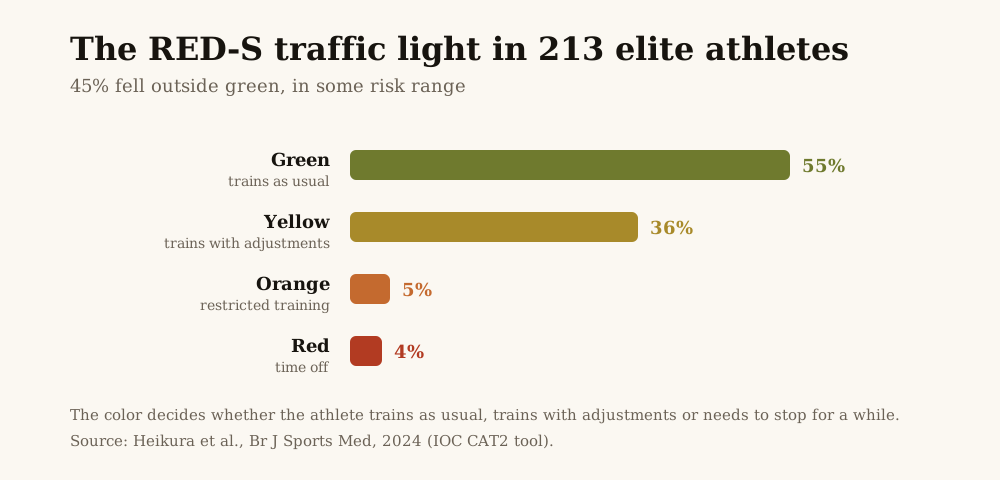
When a Canadian group applied the official IOC tool to 213 elite athletes, 45% fell outside green, in some risk range: 36% in yellow, 5% in orange and 4% in red on the traffic light I explain further down.
Even so, few people around the athlete know about the problem. In a survey of 99 Russian coaches in athletics and speed skating, only 39% had ever heard of RED-S.
Warning signs
No single sign settles the diagnosis, but some call for an assessment:
- In women, a period that is irregular or has stopped. Missing periods is not a normal effect of training, not even in athletes. It is the body switching off reproduction to save energy.
- In men, lower libido and fewer morning erections. This is usually a sign of low testosterone.
- Stress fractures, especially a second one or one in the femoral neck, the pelvis or the sacrum (the base of the spine). I wrote about this in my post on pain while running.
- Performance that stalls or drops, even with more training.
- Frequent colds and infections, tiredness that does not go away, feeling unusually cold, dizziness when standing up.
- Irritability, anxiety, low mood and constant thoughts about food, weight or body shape.
The 2025 meta-analysis found that athletes with low energy run worse, perform worse in explosive strength and agility, have more trouble concentrating and miss more training due to illness.
What happens inside the body
With low energy, the brain turns down the signal that drives the ovaries and testes. Estrogen drops in women and testosterone in men, and so does T3, the thyroid hormone that speeds up metabolism. A meta-analysis of cross-sectional studies with 1,006 athletes found that those with low energy had altered sex hormones, higher cortisol, and lower weight, BMI and bone density.
Bone is the biggest long-term concern. People build most of their bone mass by their early 20s, and low estrogen in this phase gets in the way. Part of the bone that fails to form in adolescence and early adulthood may not be recovered later, and the IOC consensus cites this risk of lasting damage as a reason to catch the problem early. A teenage girl who stops having periods because of training needs attention right away, without waiting for the first fracture.
How the doctor investigates
There is no single test that diagnoses RED-S. The IOC created an assessment tool (CAT2) that works in three stages: screening, severity rating and a decision made by the doctor together with the athlete, the coach and the team.
In practice, the assessment brings together:
- A detailed conversation about eating, training, periods, fractures, sleep and mood, sometimes with questionnaires designed for athletes.
- A physical exam, with weight, blood pressure and heart rate.
- Blood tests to check hormones, thyroid (including T3), iron, vitamin D and cholesterol, and to rule out other causes. A period that has stopped can be pregnancy, a thyroid or prolactin problem, or polycystic ovary syndrome.
- A bone density scan, which the Endocrine Society guideline recommends when periods have been absent for six months or more, when there are signs of more severe energy deficiency or when there has already been a stress fracture.
At the clinic, indirect calorimetry measures how much energy your body burns at rest. A value well below what is expected for your size fits with a body in saving mode and helps build the picture, together with the rest of the assessment. I explained the test in my post on metabolism.
When it is not RED-S
Tiredness, falling performance and repeated infections also show up with overtraining, lack of sleep, stress and many diseases. A group of researchers published a critique of the model in 2024 for exactly this reason: the symptoms are generic, and a person can be labeled with RED-S when low energy is not the cause. That is why the assessment includes tests to rule out other causes before confirming the diagnosis.
The IOC traffic light
The result of the assessment goes into a four-color traffic light, which grades the level of risk and guides training:
| Color | Risk level | What changes in training |
|---|---|---|
| Green | Low | Training and competition allowed |
| Yellow | Mild to moderate | Keeps training, with medical follow-up and some load adjustments |
| Orange | High | Training with bigger restrictions and close follow-up |
| Red | Very high | Time off training and competition until the signs improve |
In the Canadian study, athletes in the orange range had an almost eight times higher chance of a new stress fracture during follow-up than those in green, although with a wide margin of uncertainty.
What treatment looks like
The main treatment is giving back the energy that is missing. In practice, that means eating more, spreading meals better through the day, making sure there is carbohydrate around training and, when needed, reducing the load for a while. Working with a dietitian makes a big difference at this stage, and I explained the role of each professional in my post on nutrition doctors and dietitians.
A 2026 review on nutrition for recovery from training in general, which pulled together 130 articles, helps put the priorities in order. What has the most consistent support is eating enough energy for training and spreading good-quality protein across the day. Next come replacing carbohydrate when the gap between one session and the next is short, and replacing fluids and sodium according to what each person loses. For omega-3, curcumin, polyphenol-rich products and creatine, the evidence depends on the context and the product. In my practice, supplements only come in once these basics are in place.
The 2025 update of the female athlete triad consensus showed that periods usually come back with a moderate increase in food and a small weight gain. But the first period does not yet mean ovulation is back to normal: that usually takes several normal cycles in a row.
When there are signs of an eating disorder, treatment includes a psychologist or psychiatrist. It is common for athletes to be afraid of eating more and gaining weight, and dealing with that fear is part of the treatment.
What about the pill?
The Endocrine Society guideline recommends against using the birth control pill just to bring periods back or to protect bone. The bleeding on the pill is caused by the medication and does not show that the body has recovered. It hides the warning sign, and the bone still lacks what it needs.
For those who still have no periods and weak bones even after a serious attempt to restore energy, there is estradiol replacement by skin patch. In a trial of 121 athletes aged 14 to 25 with absent or irregular periods, the patch improved bone density in the spine and femur more than a standard pill. This decision is medical and individual.
How to prevent it
The IOC consensus puts a lot of weight on prevention: educating athletes, parents and coaches, and no longer treating weight and thinness as performance goals, especially with young people. For those who train, the practical steps are simple to understand:
- Eat before and after training, without cutting carbs on your own.
- Adjust your eating whenever training volume goes up.
- Be wary of any plan that promises fast weight loss while you train for a race.
- Treat a change in your period, a stress fracture or a drop in libido as a reason to see a doctor.
Conclusion
RED-S is common, affects men and women and almost always starts without obvious signs, with a body that trains a lot and eats too little for what it spends. Catching it early prevents fractures, bone loss that may not come back and months of lost performance.
If you recognized yourself in these signs, get assessed. At my clinic in São José dos Campos, Brazil, I do this investigation in the sports medicine consultation, with tests and calorimetry when they make sense, and the nutrition part continues with the team dietitian.
Take care, and see you next time!
Responsible physician: Dr. Gilberto Nering Junior, CRM-SP 160822, RQE 142486 (Sports Medicine, Brazil). This text was not sponsored, is for information only and does not replace an individual assessment. Questions about the content: contact the clinic.
Quick questions about RED-S
Is RED-S the same as the female athlete triad?
The female athlete triad describes three problems linked to low energy in women: menstrual changes, weak bone and low energy availability. RED-S, created by the IOC in 2014, includes the triad and adds other effects, such as on hormones, immunity, the heart and performance, and it also applies to men.
Can men get RED-S?
Yes. In the 2025 meta-analysis, the share of men with low energy availability (49.4%) was similar to that of women (44.2%). In men, some signs are low libido, low testosterone, stress fractures and falling performance.
Is it normal to stop having periods because of training?
No. Having no periods or very spaced-out cycles is a sign that the body is saving energy, and it deserves a medical assessment to rule out other causes and protect the bone.
Is there a test that confirms RED-S?
There is no single test. The diagnosis combines the history, the physical exam, blood tests, a bone density scan in some cases and ruling out other diseases that cause similar symptoms.
How long does recovery take?
It depends on how severe it is and how long it lasted. Periods usually come back with a moderate increase in food, but full recovery takes months for hormones, and sometimes years for bone, with follow-up.
References
- Ackerman KE, Singhal V, Baskaran C, et al. Oestrogen replacement improves bone mineral density in oligo-amenorrhoeic athletes: a randomised clinical trial. Br J Sports Med. 2019;53(4):229-236. doi:10.1136/bjsports-2018-099723
- Bezuglov E, Volel B, Kapralova E, et al. Awareness of Relative Energy Deficiency in Sport among Russian coaches working with athletes of various levels in athletics and short-track speed skating. Sports (Basel). 2026;14(8):341. doi:10.3390/sports14080341
- Gallant TL, Ong LF, Wong L, et al. Low energy availability and Relative Energy Deficiency in Sport: a systematic review and meta-analysis. Sports Med. 2025;55(2):325-339. doi:10.1007/s40279-024-02130-0
- Gordon CM, Ackerman KE, Berga SL, et al. Functional hypothalamic amenorrhea: an Endocrine Society clinical practice guideline. J Clin Endocrinol Metab. 2017;102(5):1413-1439. doi:10.1210/jc.2017-00131
- Han S, Kim J, Kim M, Oh T. A study for markers of low energy availability in athletes: a meta-analysis of cross-sectional studies. Eur J Clin Nutr. 2026. doi:10.1038/s41430-026-01811-5
- Heikura IA, McCluskey WTP, Tsai MC, et al. Application of the IOC Relative Energy Deficiency in Sport (REDs) Clinical Assessment Tool version 2 (CAT2) across 200+ elite athletes. Br J Sports Med. 2024;59(1):24-35. doi:10.1136/bjsports-2024-108121
- Jeukendrup AE, Areta JL, Van Genechten L, et al. Does Relative Energy Deficiency in Sport (REDs) syndrome exist? Sports Med. 2024;54(11):2793-2816. doi:10.1007/s40279-024-02108-y
- Logue D, Madigan SM, Delahunt E, Heinen M, Mc Donnell SJ, Corish CA. Low energy availability in athletes: a review of prevalence, dietary patterns, physiological health, and sports performance. Sports Med. 2018;48(1):73-96. doi:10.1007/s40279-017-0790-3
- Mănescu DC, Cerullo G, Petri C, et al. Nutritional strategies for recovery-adaptation coupling after exercise: from muscle damage to performance remodeling. Nutrients. 2026;18(15):2523. doi:10.3390/nu18152523
- Mountjoy M, Ackerman KE, Bailey DM, et al. 2023 International Olympic Committee’s (IOC) consensus statement on Relative Energy Deficiency in Sport (REDs). Br J Sports Med. 2023;57(17):1073-1097. doi:10.1136/bjsports-2023-106994
- Stellingwerff T, Mountjoy M, McCluskey WT, et al. Review of the scientific rationale, development and validation of the IOC REDs Clinical Assessment Tool: V.2 (IOC REDs CAT2). Br J Sports Med. 2023;57(17):1109-1118. doi:10.1136/bjsports-2023-106914
- Torstveit MK, Ackerman KE, Constantini N, et al. Primary, secondary and tertiary prevention of Relative Energy Deficiency in Sport (REDs): a narrative review by a subgroup of the IOC consensus on REDs. Br J Sports Med. 2023;57(17):1119-1126. doi:10.1136/bjsports-2023-106932
- Walker AE, McKay AKA, Rogers MA, et al. Methods of calculating energy availability in current research: a standardised audit. Sports Med. 2026. doi:10.1007/s40279-026-02526-0
- Williams NI, De Souza MJ, Misra M, et al. 2025 update to the Female Athlete Triad Coalition consensus statement part 2: clinical guidelines for screening, diagnosis, treatment, and return to play for adolescents and adults. Sports Med. 2026;56(2):375-427. doi:10.1007/s40279-025-02332-0
- Williamson J, Hannah S. Body image, disordered eating, and Relative Energy Deficiency in Sport risk in female athletes: associations across psychological and behavioral factors. Sports Health. 2026. doi:10.1177/19417381261486290