Also in: Português · Español · Italiano · 中文 · हिन्दी
Main points
- In most men who stop anabolic steroids, testosterone goes back to normal within a few months, and almost all of them recover within about a year.
- Recovery only starts once the hormone that came from outside has left the blood, and long-acting products, such as depot nandrolone, can delay that start.
- Years of use, high doses and several products mixed together make recovery slower, and in some men it stays incomplete.
- The tiredness, low libido and low mood of this phase don’t always match the blood test, and mood deserves as much care as the hormone.
- Testosterone drawn in the morning, fasting, together with LH and FSH, and repeated from time to time, shows where recovery stands and who needs medical treatment.
In most men who use anabolic steroids and then stop, testosterone goes back to normal after the cycle within a few months, and almost all of those who recover on their own get there in about a year. That is the summary the Society for Endocrinology (UK) gave in 2026, in a position statement on non-medical use of the male hormone published in Endocrine Connections. The same doctors warn that the timeline varies a lot from one person to another and that some men are left with low hormone levels for much longer.
In the post about low testosterone after a cycle, I explained why a cycle shuts down your own production, how long the hormone and sperm took to come back in the Dutch study, and the risk of a PCT copied from an online forum. Here I follow the recovery calendar: the order in which the hormones come back, what makes some men recover in weeks and others in years, what you feel in the meantime, what the blood test shows at each stage and who should get checked. I write this to reduce harm, with no lecture for those who have used and no encouragement at all for those thinking about starting.
How many months until the blood test is normal again?
In most men, testosterone goes back to normal between three months and a year after the end of the cycle. The signals the brain sends to the testicle, LH and FSH, usually reappear first, and the body’s own testosterone production follows right behind them. Men who used for a short time, a single product and smaller amounts tend to be at the early end of that range. Those who ran cycles back to back for years, mixed several products and used high doses usually end up at the late end of it or beyond, and some of these men still have a low result years later. In those cases, the doctor starts treating the remaining lack of hormone as hypogonadism, with its own criteria.
Why recovery doesn’t start the day the cycle ends
During a cycle, the hypothalamus and the pituitary, the two brain regions that control the testicle (doctors call this set the axis), sense that there is extra hormone and cut LH and FSH. When the cycle ends, that command only comes back after the level of the anabolic steroid in the blood drops below a certain point, as a group of Dutch doctors who treat and study men who use anabolic steroids explained in 2025 in Frontiers in Endocrinology.
The type of product matters here, because most injectable anabolic steroids are attached to an ester, a chemical tail that makes the hormone leave the muscle little by little after the injection. The longer that tail, the more slowly it leaves the depot. With nandrolone there is one more finding: in healthy volunteers who received one of its depot forms in research, nandrolone itself or its breakdown products showed up in the blood or urine for up to a year afterwards. The Dutch authors treat this as a hypothesis for some of the long delays. In men who had used a bit of everything, the expected duration of each product did not predict recovery time well, and this leftover hormone doesn’t explain the symptoms that remain either.
Once the command is back, LH, which tells the cells of the testicle to make testosterone, usually rises first. FSH and sperm production depend on slower work inside the testicle and take longer. A Greek review that pooled the studies on the subject, published in 2017 in Sports Medicine, saw this mismatch: LH and FSH returned to their earlier levels within a few months, while testosterone was still below the starting point. The chart shows the time ranges the British position statement gathered for each test.
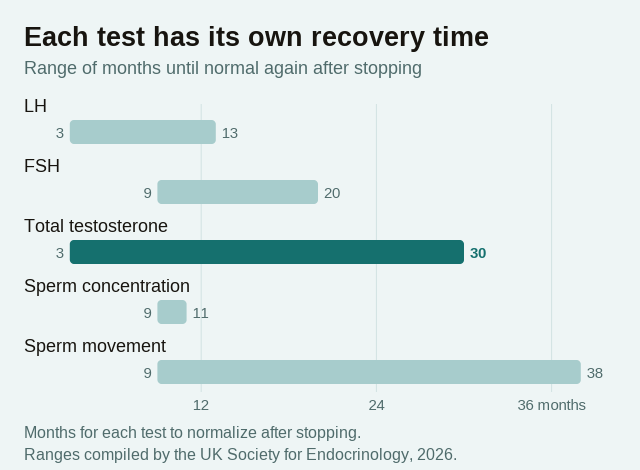
The testosterone range is the widest of all, from a few months to more than two years. Each range combines different studies, with men who used different things, so it shows what has been seen in groups and can’t predict your own timeline. Sperm, which matter to anyone who wants children, are usually the last to settle, and their movement takes the longest.
What makes recovery take longer
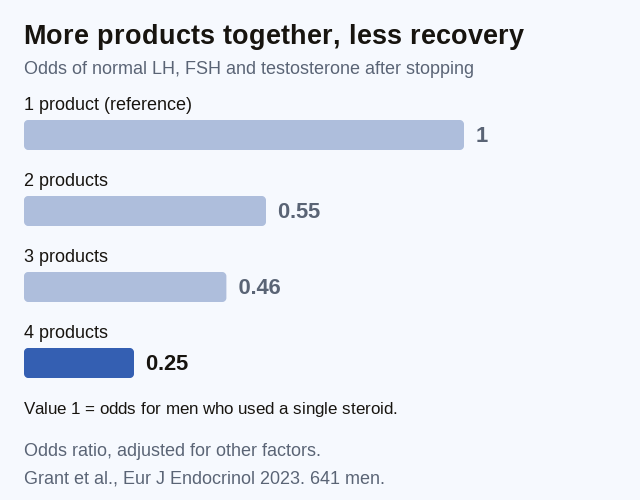
Researchers at Imperial College London went through the blood tests of hundreds of men who had stopped anabolic steroids up to three years earlier, each with a single sample, and only about half had LH, FSH and testosterone in the normal range. The survey, published in 2023 in the European Journal of Endocrinology, is the largest on the subject. The odds of having all three hormones normal fell as the number of anabolic steroids used together went up, as the chart shows. Having used for longer also lowered those odds, and having stopped longer ago raised them. Since each man had only one test, at any time of day and without fasting, the study shows how each one was on that day and does not follow the same person month by month.
Total time of use shows up in almost every study. In the Sydney study, published in 2020 in the Journal of Clinical Endocrinology & Metabolism, the duration of use was, besides the time since stopping, the only factor linked to a slower return of sperm, and it did not carry the same weight for the hormones. In the Copenhagen and Boston studies, men who had used for more years had smaller testicles. The 2026 joint position statement of the Brazilian Society of Endocrinology and Metabolism and the Brazilian Society of Urology points the same way, saying that the dose and the length of time the axis stayed blocked change the chance that it comes back, and that prolonged use can leave recovery incomplete even years later.
American doctors who treat these men wrote, in a 2014 review in Fertility and Sterility, that age may play a part: in their experience, younger men seem to have a more elastic axis, one that comes back faster and more fully. This is the impression of clinicians, with no study that has properly measured the size of the effect, and in the Sydney study age was not among the things that delayed the return of sperm.
Running one cycle straight into the next, or staying on a lower dose between them “to maintain”, keeps the axis switched off the whole time, and recovery only begins when use really stops. The same goes for use that continues without being mentioned, including by people who think they have stopped, such as an occasional injection or a supplement that contained a hormone without the person knowing. The British doctors ask for attention to this possibility, always without judgment. Everything that already brings down testosterone in men who have never done a cycle still applies in this phase, like sleeping too little, gaining fat and eating less than your training needs, which is the topic of the post on what lowers testosterone and of what I wrote about low energy availability in sport, RED-S.
| What can delay recovery | What the studies show |
|---|---|
| Several anabolic steroids together | Lower chance of normal hormones after stopping |
| Longer total time of use | Sperm come back more slowly and the testicle is smaller |
| High doses | Lower chance of full recovery, according to the Brazilian societies |
| Depot products, such as nandrolone | Recovery may start later (hypothesis) |
| Older age | Clinicians’ impression, still without firm proof |
| Back-to-back cycles or continued use | The axis stays off and recovery doesn’t start |
When the testicle doesn’t fully recover
Men who had used and stopped years earlier had lower testosterone than men who never used, and some of them were below the normal limit. This was measured by the Copenhagen researchers behind the main study of this post, in the paper that came out in 2016 in PLoS One. They compared this group with men who were still using and with others who had never used. Besides testosterone, they looked at inhibin B and AMH, two hormones the testicle produces when it is making sperm, measured the size of the testicles and asked in a structured way about sadness, tiredness, libido and erections. Among those who had stopped, the ones who had been off longer did not have higher testosterone than those who had stopped more recently, but since the study looked at each man only once, it does not prove that the hormone stopped rising at some point.
Five years later, the same Danish group measured INSL3, a hormone produced only by the testicular cells that make testosterone, which shows how much work those cells can still do. In men who had stopped years earlier, INSL3 was lower than in men who never used, even when testosterone was similar, and it was lower the longer the person had used. To the authors, who published in 2021 in the Journal of Clinical Endocrinology & Metabolism, this suggests that the problem is also in the testicle, as well as in the command from the brain. The British document adds that tests that stimulate the testicle showed a weaker response in a few men. The Dutch group lists other possible explanations for men who don’t recover, such as changes in the hypothalamus and pituitary, a genetic tendency, SHBG (the protein that carries testosterone in the blood) that stays low, and use the person didn’t mention.
In a Boston study of middle-aged men who had used for years, published in 2015 in Addiction, some still had very low testosterone even after many months without anabolic steroids, and the authors called the problem under-recognized. To give this condition a name, the Dutch group proposed in 2025 the term prolonged post-anabolic steroid hypogonadism, for low testosterone that continues six months after stopping, once the doctor has ruled out other causes.
In a recent paper in the same journal, doctors from the same Dutch group recommend considering testosterone replacement only when the lack of hormone, confirmed by blood tests and with symptoms, persists after at least a year without anabolic steroids, well beyond those six months. Before that, when treatment is needed, the doctor uses other approaches and decides case by case. If the time for replacement comes, the same criteria apply as for when to treat low testosterone, and the question about the heart is answered in the post on testosterone replacement and the heart.
How the body and mood feel while the axis settles
The most common symptoms in this phase are tiredness, lack of energy, low libido, weaker erections, low mood, irritability, anxiety and worse sleep. Strength and part of the muscle gained during the cycle usually go down, and the testicles may stay smaller for quite a while. In the Copenhagen study, years after stopping, about one in four of these men had symptoms of depression, more than among men who never used.
A 2026 British study of men who had stopped less than a year earlier found their testosterone already similar to that of men who never did a cycle, and even so their mood, anxiety, sex life and quality of life were worse. What weighed most on depression and anxiety was already having a psychiatric diagnosis, and lower testosterone had only a small link with sadness. The authors, who published in the Journal of Clinical Endocrinology & Metabolism, argue for psychological and behavioral support for people who are stopping, instead of relying on medication alone. In Denmark, another group found that men who had stopped anabolic steroids had worse quality of life than men who never used, years after stopping.
When the blood test is already normal and the symptoms are still there, care starts to include mental health, with psychological support and, when needed, treatment for depression or anxiety. The British doctors point out that these symptoms are among the reasons most often given by people who go back to using, and each return shuts the axis down again. Well-planned training and enough food help hold on to part of the muscle while the hormone settles, and the principles of how many sets, what load and how often to train apply to this period.
What the blood test shows at each stage
The basic test is total testosterone drawn in the morning, fasting, together with LH and FSH. The 2026 Brazilian position statement asks for two samples on different days to confirm low testosterone, and for LH and FSH to tell whether the problem is in the brain or in the testicle. When SHBG is off, and it often stays low for months after anabolic steroids, total testosterone can look lower than the amount that actually acts in the body, and then the doctor calculates or measures free testosterone. The details of the blood draw are in the post on when to treat low testosterone.
Right after stopping there is a common mistake, because nandrolone and other anabolic steroids that are not testosterone don’t show up on the standard testosterone test, as the British society points out. Someone who still has one of these products acting in the body may see very low testosterone and LH and FSH at zero, a result that looks like an axis that won’t come back, while the anabolic steroid is still present. For this reason the doctor needs to know what you used and when your last injection was.
| The test shows | What it usually means |
|---|---|
| Low testosterone, LH and FSH low or at the low limit | The brain’s command hasn’t come back yet; expected in the first months |
| LH and FSH rising, testosterone still low or rising | Recovery has started |
| Normal testosterone, LH and FSH | The axis is back; for fertility, a semen analysis is still needed |
| High LH and FSH with low testosterone | The testicle isn’t responding to the signal; the workup changes |
| Very low testosterone with LH and FSH at zero right after stopping | An anabolic steroid may still be acting, such as nandrolone |
A single test shows little, and what guides the next step is the direction of the results. The British document suggests repeating testosterone, LH and FSH every four to six months, which also keeps the person in follow-up. Men who want children add a semen analysis, the test that counts sperm, because sperm take longer than the hormones.
Who should get checked
Every man who has stopped anabolic steroids benefits from a medical assessment, even without symptoms. Some situations call for more urgency:
- symptoms that continue after the first months without anabolic steroids;
- wanting to have children in the next few years;
- use for years, at high doses or with several products together;
- a test that stays low six months to a year after stopping;
- a normal test with tiredness, low libido or low mood that won’t go away;
- wanting to go back to using just to feel good again.
At the appointment, the focus is on caring for the consequences of use: there is medical treatment to help the axis come back and for the hormone deficiency that remains, and it is individual: the doctor decides based on the tests, the length of use and whether or not you plan to have children. Without the history of what you used, the doctor can’t read the test, and what you say is protected by medical confidentiality. Endocrinologists, urologists and sports medicine physicians look after this condition. Men who used only oxandrolone can also have the axis held back, and that is the topic of the next post.
When to get help the same day
Intense sadness that won’t lift, losing the will to live or thoughts of hurting yourself call for help the same day, from your doctor, at an emergency room or through CVV, the Brazilian emotional support line, which answers for free, 24 hours a day, at 188. The British society treats suicidal thoughts after stopping as a case for urgent mental health assessment. Since mood in this phase depends on much more than the hormone, mental health care comes first, without waiting for testosterone replacement to resolve that risk.
Also get help soon if the urge to go back to a cycle has become something you can’t control. Anabolic steroid dependence is real and can be treated, with care that combines the hormone, mental health and behavior.
In practice
- Write down what you used, for how long, whether you mixed products and when your last injection was. This changes how the test is read.
- Get testosterone with LH and FSH in the morning and fasting, with medical guidance, and repeat it from time to time to see the direction.
- Give your body time: don’t start another cycle or a lower dose “to maintain”, because recovery only begins when use stops.
- Take care of what also lowers testosterone: sleep, enough food, weight and well-planned training.
- If you want to have children, ask for a semen analysis and tell the doctor at the very first appointment.
- If your mood is heavy, get help early, even with a normal test.
Conclusion
In men who have stopped anabolic steroids, the axis usually starts working again within a few months, and almost all recover within about a year. Recovery only begins when the anabolic steroid leaves the body, and it takes longer after years of use, high doses, several products together and depot products. In some men the testicle doesn’t fully recover, and only repeated testing shows who is in that group. Because the symptoms of this phase don’t always follow the blood test, the assessment also looks at mood, and when treatment is needed, the doctor decides on it for each person.
All the best!
G
Responsible physician: Dr. Gilberto Nering Junior, sports medicine physician, CRM-SP 160822, RQE 142486 (Sports Medicine, Brazil).
This text was not sponsored, is for information only and does not replace an individual assessment. Questions about the content: contact the clinic.
Cover photo: Mezidi Zineb on Unsplash.
Frequently asked questions about testosterone after a cycle
Does testosterone go back to normal on its own after a cycle?
In most men, yes, within a few months, and almost always within about a year. In some of them, especially after years of use, high doses and several products together, recovery stays incomplete and needs a medical assessment.
Can you speed up testosterone recovery after a cycle?
There is no home shortcut. What helps most is really stopping, without starting another cycle or a lower dose to maintain, and taking care of sleep, food, weight and training. When treatment is needed, there is medical treatment, always individual and based on tests.
How long does hypogonadism last after a cycle?
It ranges from weeks to years, and when testosterone is still low six months after stopping, doctors already call it prolonged hypogonadism. Replacement only comes up for discussion if the hormone deficiency with symptoms lasts at least a year without anabolic steroids.
Why is my testosterone still low if I stopped months ago?
The outside hormone may take a while to leave the body, the brain may not have started sending the signal again yet, or the testicle may have become weaker. Ongoing use, even a little, poor sleep, too little food and fat gain also keep the hormone down.
When should you get a testosterone test after stopping a cycle?
The doctor usually orders testosterone with LH and FSH in the morning, fasting, and repeats it every few months to see the direction. Testing too close to the last injection is misleading, because there may still be outside hormone in the blood.
References
- Anawalt BD. Diagnosis and Management of Anabolic Androgenic Steroid Use. J Clin Endocrinol Metab. 2019;104(7):2490-2500. doi:10.1210/jc.2018-01882
- Bulut Y, Brandt-Jacobsen N, Buhl L, et al. Persistently Decreased Quality of Life and its Determinants in Previous Illicit Androgen Users. J Clin Endocrinol Metab. 2024;109(2):e689-e697. doi:10.1210/clinem/dgad551
- Christou MA, Christou PA, Markozannes G, et al. Effects of Anabolic Androgenic Steroids on the Reproductive System of Athletes and Recreational Users: A Systematic Review and Meta-Analysis. Sports Med. 2017;47(9):1869-1883. doi:10.1007/s40279-017-0709-z
- Grant B, Campbell J, Pradeep A, et al. Factors predicting normalization of reproductive hormones after cessation of anabolic-androgenic steroids in men: a single center retrospective study. Eur J Endocrinol. 2023;189(6):601-610. doi:10.1093/ejendo/lvad164
- Grant B, Jayasena CN, Nag S, et al. Management of non-medical androgen use: a position statement by the Society for Endocrinology. Endocr Connect. 2026;15(9):e260361. doi:10.1530/EC-26-0361
- Grant B, Kean J, de Silva NL, et al. Clinical features of androgen abuse withdrawal in men during the first year of cessation: a community dwelling study. J Clin Endocrinol Metab. 2026;111(9):2649-2663. doi:10.1210/clinem/dgag110
- Hohl A, Lopes L, Ronsoni MF, et al. Care of Patients with Male Hypogonadism: A Joint Position Statement from the Brazilian Society of Endocrinology and Metabolism (SBEM), the Brazilian Society of Urology (SBU), and the Brazilian Association for Sexual Medicine and Health (ABEMSS). Int Braz J Urol. 2026;52(3):e20250610. doi:10.1590/S1677-5538.IBJU.2025.0610
- Kanayama G, Hudson JI, DeLuca J, et al. Prolonged hypogonadism in males following withdrawal from anabolic-androgenic steroids: an under-recognized problem. Addiction. 2015;110(5):823-831. doi:10.1111/add.12850
- Rahnema CD, Lipshultz LI, Crosnoe LE, et al. Anabolic steroid-induced hypogonadism: diagnosis and treatment. Fertil Steril. 2014;101(5):1271-1279. doi:10.1016/j.fertnstert.2014.02.002
- Rasmussen JJ, Albrethsen J, Frandsen MN, et al. Serum Insulin-like Factor 3 Levels Are Reduced in Former Androgen Users, Suggesting Impaired Leydig Cell Capacity. J Clin Endocrinol Metab. 2021;106(7):e2664-e2672. doi:10.1210/clinem/dgab129
- Rasmussen JJ, Selmer C, Østergren PB, et al. Former Abusers of Anabolic Androgenic Steroids Exhibit Decreased Testosterone Levels and Hypogonadal Symptoms Years after Cessation: A Case-Control Study. PLoS One. 2016;11(8):e0161208. doi:10.1371/journal.pone.0161208
- Shankara-Narayana N, Yu C, Savkovic S, et al. Rate and Extent of Recovery from Reproductive and Cardiac Dysfunction Due to Androgen Abuse in Men. J Clin Endocrinol Metab. 2020;105(6):dgz324. doi:10.1210/clinem/dgz324
- Smit DL, Verdegaal T, Bond P, et al. Approach to the Young Male Patient Who Abuses Androgens: Harm Reduction as a Clinical Strategy. J Clin Endocrinol Metab. 2026;111(1):e292-e297. doi:10.1210/clinem/dgaf496
- van Os J, Smit DL, Bond P, et al. Prolonged post-androgen abuse hypogonadism: potential mechanisms and a proposed standardized diagnosis. Front Endocrinol (Lausanne). 2025;16:1621558. doi:10.3389/fendo.2025.1621558