Also in: Português · Español · Italiano · 中文 · हिन्दी
Main points
- Anabolic steroids make the brain stop telling the testicles to produce testosterone. When the cycle ends, your own production takes time to come back.
- In most men, testosterone comes back within a few months. Sperm takes longer, close to a year.
- The longer the use, the slower recovery tends to be, and some men are left with low testosterone for years.
- Fatigue, low mood, low libido and weak erections are common in this phase, and depression can appear.
- Self-directed PCT, with medication bought without a prescription and no tests, can hide problems and create others. A physician can assess and treat the consequences of the cycle.
Anyone who has done an anabolic steroid cycle usually knows this phase. The cycle ends, strength drops, motivation disappears, libido goes away and your head feels heavy. The blood test shows low testosterone, sometimes very low. And the questions are always the same: will it come back? How long does it take? Do I need to take something?
I am not going to teach anyone how to run a cycle or judge anyone who did. I will explain what happens to the body afterwards, how long recovery usually takes and why it is better to see a physician than to follow a forum protocol.
Why testosterone drops after a cycle
Testosterone production works like a thermostat. A region of the brain, the hypothalamus, and the pituitary, a gland just below it, measure how much hormone is in the blood. When the level is low, the pituitary releases two messenger hormones, LH and FSH. LH tells the testicles to make testosterone. FSH, together with the testosterone inside the testicle itself, keeps sperm production going.
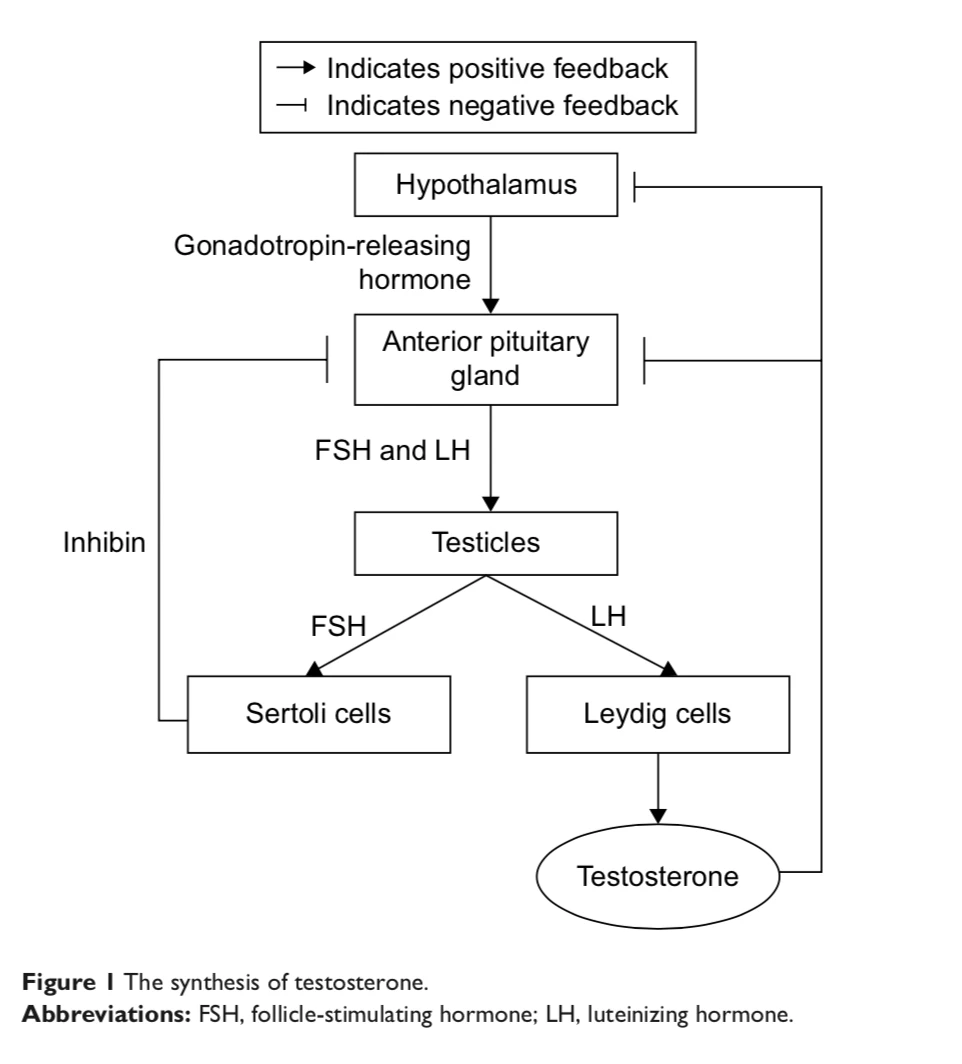
During a cycle, far more hormone enters the body than the testicles would produce. The brain reads this as a surplus and cuts off LH and FSH. Without that signal, the testicles stop producing testosterone and sperm and shrink. While the steroid is in the blood, you don’t feel anything missing, because the outside hormone covers everything.
The problem appears when the cycle ends. The outside hormone leaves the body within days or weeks, depending on the substance, but the brain and the testicles do not go back to work at the same pace. There is a period when the outside hormone is gone and your own is still missing. Physicians call this anabolic steroid-induced hypogonadism.
How long it takes to come back
The clearest data come from a Dutch study called HAARLEM. Researchers followed 100 men who did weight training and were about to start a self-directed cycle. They had tests before the cycle, at the end of it, three months after stopping and one year after starting.
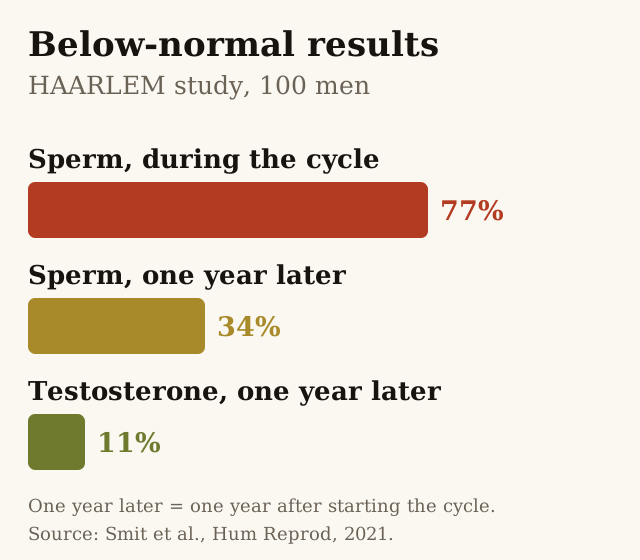
On average, testosterone was back to its pre-cycle level three months after the end of the cycle. Sperm took longer, and recovery took close to a year. Not everyone went back to normal: one year after starting the cycle, 11% still had below-normal testosterone, and a third still had a low sperm count. The authors note that this seems more common in men who had already used a lot of steroids before.
An Australian study of current and former users estimated the time for each stage. LH, the hormone that tells the testicles to work, took on average about 11 months to come back, and sperm production about 14 months. The longer the use, the slower sperm came back.
| What needs to come back | Average time | Study |
|---|---|---|
| Testosterone | about 3 months after the end of the cycle | Dutch (HAARLEM) |
| LH, the brain’s signal to the testicles | about 11 months after stopping | Australian |
| Sperm | about 14 months after stopping | Australian |
These are averages. The time varies a lot from person to person and is usually longer for those who used for longer.
In some men, testosterone stays low even years after stopping. In a Danish study, men who had stopped steroids an average of two and a half years earlier still had lower testosterone than men who had never used them, and more than a quarter of them were below the normal limit.
A 2019 review sums up what is known: people who used for less than a year usually recover normal function within a year of stopping. Long cycles run back to back, high doses and years of use make recovery slower and sometimes incomplete.
What you may feel in this phase
With little testosterone in the body, the most common symptoms are:
- fatigue and lack of energy;
- low mood, irritability and anxiety;
- low libido and weaker erections;
- loss of strength and of part of the mass gained during the cycle.
These symptoms can last quite a while. In the same Danish study, years after stopping, 4 in 10 former users still had low libido, a higher rate than in men who had never used.
Mood needs extra care. In a US study of long-term former users, almost 3 in 10 had an episode of depression in the phase when they stopped steroids, and some of them had never had depression outside that phase.
Feeling bad is also one of the reasons many people go back to cycling. You feel awful, remember that you felt fine on the hormone and start another one. That keeps the axis switched off for longer.
If you have intense sadness, a lack of will to live or thoughts of hurting yourself, seek help right away, from your physician or at an urgent care center. In Brazil, CVV answers for free, 24 hours a day, at 188; in other countries, call your local crisis line.
Why not to do PCT on your own
In forums and gyms, PCT, post-cycle therapy, has become almost mandatory. It is usually a combination of drugs such as clomiphene, tamoxifen, hCG and aromatase inhibitors, bought without a prescription and taken according to a protocol copied from the internet.
The idea behind it makes sense. Some of these drugs push the brain to start signaling the testicles again, and hCG mimics LH. The problem is in how they are used:
- No drug is approved specifically for this, and the studies are still small. Dose and length of treatment need to be decided case by case.
- Without a test beforehand, there is no way to know whether testosterone is low because of the cycle or because of another problem, such as a pituitary or testicular disorder.
- An aromatase inhibitor used without monitoring can drive estrogen too low, and men also need this hormone, for their bones, for example.
- Without follow-up, no one is checking the heart, blood, liver and mood, which are exactly the biggest concerns after a cycle.
Another common habit is bridging with a lower dose of testosterone to hold things over until the body recovers. On its own, that testosterone keeps the brain switched off and can delay recovery. Some specialists propose tapering testosterone gradually along with drugs that stimulate the axis, but this was designed to be done with tests and medical follow-up, and the approach has never been compared with other options in studies.
With medical follow-up, treatment can help in some cases. A recent study of 79 men who had done short cycles compared those who were only monitored with tests with those treated with drugs that stimulate the testicles, prescribed and monitored by physicians. Hormones normalized within six months in all three groups, but the treated men recovered faster. At 12 months, 87.5% of men on the most complete regimen had a normal semen analysis, compared with 58.6% of those who were not treated.
It is a small study that looked back in time, so better research is still needed. And the decision between treating and just monitoring depends on the test results, the length of use and whether you want to have children soon.
What the physician will assess
The consultation starts with a frank conversation: what you used, for how long, at what dose, when you stopped and what you are feeling. The physician needs this information to interpret the tests, and what you share is protected by medical confidentiality.
The tests usually include:
- testosterone, LH and FSH, to see where recovery stands;
- a complete blood count, because steroids can thicken the blood;
- cholesterol, because HDL, the good cholesterol, often drops sharply;
- liver tests, especially after oral steroids;
- a semen analysis, for those who want children;
- blood pressure, an electrocardiogram and, in some cases, an echocardiogram.
Depending on the case, others are added, such as estradiol and prolactin. The timing of the blood draw also matters. Right after the last dose, there may still be outside hormone in the blood, and the result is confusing. The physician adjusts the timing based on what was used.
The heart also needs attention
In men who used for years, the heart is among the biggest concerns. In a US study of 140 men who did weight training, those who had used steroids for at least two years had hearts pumping with less force and more fatty plaque in the heart’s arteries than those who had never used. The more years of use, the more plaque.
In Denmark, researchers followed men caught in gym doping tests for about 11 years and compared them with the general population. Users had three times as many heart attacks and a much higher risk of heart muscle disease. Another Danish study found three times higher mortality among users.
Some of this improves after stopping. In the US study, those who were no longer using had better heart function than those still using, and in the Australian study the pumping strength of former users’ hearts was similar to that of people who had never used. The studies did not show whether arterial plaque shrinks after stopping, which is why controlling cholesterol and blood pressure remains important after a cycle.
For those who want children
During a cycle, sperm production plummets. In the Dutch study, 77% of men had a below-normal count while using. In most it comes back, but it takes close to a year, sometimes more.
If you want children in the coming months or years, tell your physician. A semen analysis shows how production is doing. If it does not come back in the expected time, there are treatments that stimulate the testicles. Testosterone replacement, in this case, gets in the way, because it switches sperm production off again.
When testosterone does not come back
In some men, especially those who used for years, their own production does not return to normal even after a long time. When this is confirmed on repeated tests and comes with symptoms, it becomes hypogonadism like any other, and treatment may be testosterone replacement.
Replacement and a cycle are different things. Replacement uses the dose needed to bring the hormone to a normal level, with a prescription, regular tests and monitoring of blood, prostate and heart. A cycle uses doses far above normal to gain mass, and that is what switched the axis off.
What Brazil’s Federal Council of Medicine says
Since 2023, a resolution from Brazil’s Federal Council of Medicine (CFM) prohibits physicians from prescribing anabolic steroids and hormones for aesthetic purposes, muscle gain or sports performance, including in amateur athletes. The same resolution allows replacement when there is a proven deficiency.
No physician can put together a cycle for you. But a physician can, and should, take care of the consequences of a cycle: the hormone that does not come back, fertility, the heart, the liver and mood. Telling the truth at the consultation is what makes it possible to do this properly.
If you train a lot and eat little, also read what I wrote about RED-S, because eating too little also brings testosterone down. And if your goal is to gain mass, what I recommend is well-planned training, enough food and, when it makes sense, whey protein and creatine, which have evidence and are safe.
Conclusion
Anabolic steroids switch off your own testosterone production, and it does not switch back on the day the cycle ends. In most men, testosterone comes back within a few months and sperm in about a year, but those who used for years may take much longer or not fully recover. This phase brings real symptoms, including depression, and deserves follow-up. Instead of forum PCT, the safest path is a medical assessment with tests, which also looks at the heart, blood and fertility.
Look after yourself, and if you have any questions, just reach out!
Responsible physician: Dr. Gilberto Nering Junior, sports medicine physician, CRM-SP 160822, RQE 142486 (Sports Medicine, Brazil).
This text was not sponsored, is for information only and does not replace an individual assessment. Questions about the content: contact the clinic.
Cover photo: Maciej Karoń on Unsplash.
Quick questions about testosterone after a cycle
How long does testosterone take to come back after a cycle?
In most men, a few months. In a study of 100 men, three months after stopping the cycle, average testosterone was already back to its earlier level. Sperm takes close to a year. Those who used for years may take much longer, and some do not fully recover.
Do I need PCT after a cycle?
There is no protocol that works for everyone. Many men recover on their own, and some benefit from treatment with a prescription and tests. Doing PCT on your own can hide other problems and create new ones, such as driving estrogen too low.
Which tests should I get after a cycle?
Testosterone, LH, FSH, a complete blood count, cholesterol, liver tests and blood pressure, plus a semen analysis for those who want children. In some cases, also an electrocardiogram and an echocardiogram.
Do anabolic steroids make men infertile?
During use, sperm production drops sharply and can reach zero. In most men it comes back about a year after stopping, but not always. If you want children, get a semen analysis and talk to your physician.
Can a physician prescribe anabolic steroids?
In Brazil, since 2023, the CFM has prohibited prescribing anabolic steroids and hormones for aesthetics, muscle gain or sports performance. Replacement is allowed when there is a proven deficiency, and physicians can treat the consequences of a cycle.
References
- Anawalt BD. Diagnosis and Management of Anabolic Androgenic Steroid Use. J Clin Endocrinol Metab. 2019;104(7):2490-2500. doi:10.1210/jc.2018-01882
- Baggish AL, Weiner RB, Kanayama G, et al. Cardiovascular Toxicity of Illicit Anabolic-Androgenic Steroid Use. Circulation. 2017;135(21):1991-2002. doi:10.1161/CIRCULATIONAHA.116.026945
- Bhasin S, Brito JP, Cunningham GR, et al. Testosterone Therapy in Men With Hypogonadism: An Endocrine Society Clinical Practice Guideline. J Clin Endocrinol Metab. 2018;103(5):1715-1744. doi:10.1210/jc.2018-00229
- Conselho Federal de Medicina. Resolução CFM nº 2.333/2023. Diário Oficial da União, 11 abr. 2023. Text of the resolution (in Portuguese)
- Horwitz H, Andersen JT, Dalhoff KP. Health consequences of androgenic anabolic steroid use. J Intern Med. 2019;285(3):333-340. doi:10.1111/joim.12850
- İbis MA, Yap T, Satchi M, et al. Post-cycle therapy after short-term anabolic-androgenic steroid use: comparative outcomes in recreational bodybuilders. BJU Int. 2026;137(1):154-165. doi:10.1111/bju.70059
- Kanayama G, Hudson JI, DeLuca J, et al. Prolonged hypogonadism in males following withdrawal from anabolic-androgenic steroids: an under-recognized problem. Addiction. 2015;110(5):823-831. doi:10.1111/add.12850
- Rahnema CD, Lipshultz LI, Crosnoe LE, et al. Anabolic steroid-induced hypogonadism: diagnosis and treatment. Fertil Steril. 2014;101(5):1271-1279. doi:10.1016/j.fertnstert.2014.02.002
- Rasmussen JJ, Selmer C, Østergren PB, et al. Former Abusers of Anabolic Androgenic Steroids Exhibit Decreased Testosterone Levels and Hypogonadal Symptoms Years after Cessation: A Case-Control Study. PLoS One. 2016;11(8):e0161208. doi:10.1371/journal.pone.0161208
- Shankara-Narayana N, Yu C, Savkovic S, et al. Rate and Extent of Recovery from Reproductive and Cardiac Dysfunction Due to Androgen Abuse in Men. J Clin Endocrinol Metab. 2020;105(6):dgz324. doi:10.1210/clinem/dgz324
- Smit DL, Buijs MM, de Hon O, et al. Disruption and recovery of testicular function during and after androgen abuse: the HAARLEM study. Hum Reprod. 2021;36(4):880-890. doi:10.1093/humrep/deaa366
- Windfeld-Mathiasen J, Heerfordt IM, Dalhoff KP, et al. Cardiovascular Disease in Anabolic Androgenic Steroid Users. Circulation. 2025;151(12):828-834. doi:10.1161/CIRCULATIONAHA.124.071117
{“@context”: “https://schema.org”, “@type”: “FAQPage”, “inLanguage”: “en”, “mainEntity”: [{“@type”: “Question”, “name”: “How long does testosterone take to come back after a cycle?”, “acceptedAnswer”: {“@type”: “Answer”, “text”: “In most men, a few months. In a study of 100 men, three months after stopping the cycle, average testosterone was already back to its earlier level. Sperm takes close to a year. Those who used for years may take much longer, and some do not fully recover.”}}, {“@type”: “Question”, “name”: “Do I need PCT after a cycle?”, “acceptedAnswer”: {“@type”: “Answer”, “text”: “There is no protocol that works for everyone. Many men recover on their own, and some benefit from treatment with a prescription and tests. Doing PCT on your own can hide other problems and create new ones, such as driving estrogen too low.”}}, {“@type”: “Question”, “name”: “Which tests should I get after a cycle?”, “acceptedAnswer”: {“@type”: “Answer”, “text”: “Testosterone, LH, FSH, a complete blood count, cholesterol, liver tests and blood pressure, plus a semen analysis for those who want children. In some cases, also an electrocardiogram and an echocardiogram.”}}, {“@type”: “Question”, “name”: “Do anabolic steroids make men infertile?”, “acceptedAnswer”: {“@type”: “Answer”, “text”: “During use, sperm production drops sharply and can reach zero. In most men it comes back about a year after stopping, but not always. If you want children, get a semen analysis and talk to your physician.”}}, {“@type”: “Question”, “name”: “Can a physician prescribe anabolic steroids?”, “acceptedAnswer”: {“@type”: “Answer”, “text”: “In Brazil, since 2023, the CFM has prohibited prescribing anabolic steroids and hormones for aesthetics, muscle gain or sports performance. Replacement is allowed when there is a proven deficiency, and physicians can treat the consequences of a cycle.”}}]}
{“@context”: “https://schema.org”, “@graph”: [{“@type”: “Organization”, “@id”: “https://clinicanering.com/#org”, “name”: “Clínica Nering”, “url”: “https://clinicanering.com”}, {“@type”: “Person”, “@id”: “https://clinicanering.com/#dr-gilberto”, “name”: “Dr. Gilberto Nering Junior”, “jobTitle”: “Sports Medicine Physician”, “identifier”: “CRM-SP 160822 / RQE 142486”, “worksFor”: {“@id”: “https://clinicanering.com/#org”}, “sameAs”: [“https://www.doctoralia.com.br/gilberto-nering-junior”, “https://www.instagram.com/clinica.nering”]}, {“@type”: “MedicalWebPage”, “@id”: “https://clinicanering.com/blog/en/sports-medicine/low-testosterone-after-a-cycle/#webpage”, “url”: “https://clinicanering.com/blog/en/sports-medicine/low-testosterone-after-a-cycle/”, “name”: “Low Testosterone After a Cycle: How Long to Recover”, “inLanguage”: “en”, “datePublished”: “2026-10-28T09:00:00+00:00”, “dateModified”: “2026-10-28T09:00:00+00:00”, “author”: {“@id”: “https://clinicanering.com/#dr-gilberto”}, “reviewedBy”: {“@id”: “https://clinicanering.com/#dr-gilberto”}, “publisher”: {“@id”: “https://clinicanering.com/#org”}, “isPartOf”: {“@type”: “WebSite”, “name”: “Clínica Nering Blog”, “url”: “https://clinicanering.com/blog/”}}]}