Also in: Português · Español · Italiano · 中文 · हिन्दी
Main points
- Statins can cause muscle pain, but this happens much less often than people think.
- In the large placebo-controlled trials, only 1 in 15 muscle pain complaints from people taking a statin was the drug’s fault.
- Much of the pain comes from expecting to feel pain, the so-called nocebo effect.
- Severe pain with real weakness or dark urine is a warning sign and calls for an assessment the same day.
- People who train can take statins, and in a large study those who combined the drug with good physical fitness had the lowest risk of death.
- Don’t stop your statin on your own: you can switch to another one, adjust the dose or combine it with other medicines.
You started taking a statin to lower your cholesterol and, a few weeks later, your legs began to ache during workouts. The first suspect is the medicine. Sometimes it really is to blame, but most of the time it isn’t, and knowing that can keep you from giving up one of the medicines that do the most to protect the heart.
The short answer
Yes, statins can cause muscle pain. The real risk is small, shows up mainly in the first year of use and is a little higher with high doses. Most of the aches people blame on statins appear just as often in people taking a pill with no medicine in it at all, the placebo. Serious muscle damage does happen, but it is rare.
What statins are for
Statins cut the liver’s production of cholesterol and, as a result, lower LDL, the so-called bad cholesterol. Their names end in “statin”: simvastatin, atorvastatin, rosuvastatin and others. Excess LDL settles in the artery walls and forms the plaques that lead to heart attack and stroke. Lowering LDL reduces that risk, and statins are the medicines with the most studies showing it.
In people who have already had a heart attack or stroke, five years on a statin prevent a new serious artery problem in about 1 in 10 people. In those who haven’t had one yet but are at high risk, the benefit is smaller and still relevant.
According to the 2026 American cholesterol guideline, muscle pain, or the fear of it, is the most common reason people stop taking statins.
What the large studies show
In 2022, a group of researchers at the University of Oxford pooled the individual data of the participants in all the large statin trials. In every one of them, neither the patient nor the doctor knew who was taking the drug and who was taking placebo, so expectations weighed the same on both groups.
Many people reported muscle pain or weakness at some point during follow-up, in almost the same proportion in both groups. Muscle pain is common in adult life, with or without medicine. People who train also know delayed onset muscle soreness, the kind that shows up in the days after a harder workout (I talked about it in the post on cherry juice and muscle recovery).
The difference between the groups appeared only in the first year, and it was small: only 1 in 15 muscle pain complaints from people taking a statin was actually caused by it. After the first year, the difference disappeared. Higher doses led to slightly more complaints than moderate doses, and CK (creatine kinase), an enzyme that rises when muscle is under strain, changed so little that it made no difference in practice. When you start a new pill, you begin to notice every little ache, even when it’s a placebo.
The nocebo effect: when expectation hurts
You’ve heard of the placebo effect, when someone feels better on a pill with no medicine in it because they expect to feel better. Nocebo is the opposite: a person feels bad effects because they expect to feel them. When this happens with medicines, the American guideline calls it the “drucebo” effect.
I really like the design of a study from England on this. The researchers recruited people who had given up statins because of side effects. Each one got a bottle for every month of the year: some months it held a statin, other months placebo, and in others the bottle was empty. Nobody knew what was in each bottle that had pills, and every day they rated their symptoms in an app.
The result is in the chart:
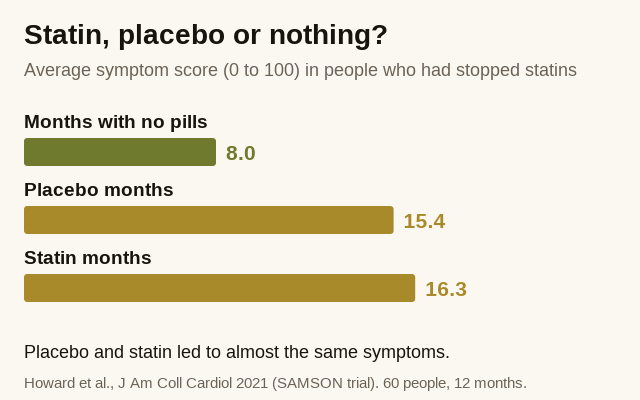
The placebo months were almost as bad as the statin months, and both were much worse than the months with no pills. By the authors’ calculations, about 90% of the symptoms that appeared with the statin also appeared with the placebo. After the study, half of the participants went back to taking statins.
Another British study, carried out in primary care practices with people who had stopped their statin, or were thinking of stopping it, because of muscle pain, alternated periods on the drug and on placebo and found no difference in pain between them.
The pain is real, even when the medicine isn’t the cause. The package leaflet lists muscle pain as a side effect, we read it, we expect to feel it, and the brain starts giving weight to any discomfort in the body.
When muscle pain may really come from the statin
In a minority of people, the pain does come from the medicine. The guideline describes the typical pattern: pain or weakness in the large muscles, such as the thighs, hips and shoulders, on both sides of the body, starting a few weeks after beginning the statin or raising the dose. It improves over a similar period once the drug is stopped and usually comes back when it is restarted.
Some situations raise the chance that a statin will cause pain:
- age over 65, female sex and very low body weight or obesity;
- hypothyroidism, diabetes and liver or kidney disease;
- alcohol use and very intense exercise;
- high statin doses;
- other medicines that raise statin levels in the blood.
The last item is often forgotten. Some medicines for the heart, for infections and for fungal infections change the way the body clears certain statins. Tell your doctor everything you take, including what you bought without a prescription.
Warning signs
True muscle damage caused by statins is rare: something close to 1 case per 10,000 people per year. The most severe form, rhabdomyolysis, in which muscle cells break down and release substances that can harm the kidneys, is rarer still.
Get medical care the same day if you have:
- severe muscle pain, unlike anything you’ve ever felt from training;
- real weakness, such as trouble getting up from a chair, climbing stairs or raising your arms;
- dark urine, the color of tea or cola.
These signs apply even to people who don’t take statins, because an extreme workout, especially in the heat and with too little water, can also cause rhabdomyolysis. In these cases, the doctor orders a blood CK test and decides whether the statin needs to be stopped. There is also a very rare immune-related form, in which the weakness continues even after the drug is stopped, and it needs to be investigated by a specialist.
What if you train?
Hard training, a long race or a new kind of exercise make CK rise in anyone, with or without a statin. The guideline does not recommend routine CK testing in people who take statins and don’t have severe symptoms, and in people who train, the test is even more confusing. For those who train hard, the doctor may order a CK test before starting the medicine, drawn after a few days without hard training, to have a value for comparison in case pain shows up.
For people who train, statins don’t usually cost performance. In an American study, hundreds of healthy people took a high-dose statin or placebo for six months. Muscle strength and exercise capacity did not change with the drug. The statin group had slightly more pain complaints, which confirms that the effect exists, but on average performance did not drop. And for those who compete, statins are not on the list of substances banned in sport.
A much smaller study, in sedentary, overweight people, suggested that one specific statin got in the way of fitness gains from aerobic training. This still needs to be confirmed in larger studies.
Medicine and training seem to add up. In a follow-up of thousands of American veterans with high cholesterol, those who took a statin and were physically fit had the lowest risk of death, much lower than those who relied on the drug alone or on fitness alone. I wrote about why fitness matters so much in the post on VO₂ max, and about who needs a checkup before training harder in the post on sudden death and screening before training.
Training pain or statin pain?
| Training pain | Pain that may be from the statin | Warning sign | |
|---|---|---|---|
| When it appears | 1 to 3 days after a hard or new workout | Weeks after starting or raising the dose | At any time |
| Where | In the muscle that did the work | Large muscles, on both sides | Can be all over the body |
| How it progresses | Gets better in a few days | Persists, even without training | Gets worse, with weakness |
| Other signs | None | Tired legs | Dark urine |
| What to do | Adjust your training | Talk to your doctor | Same-day medical care |
If you’re about to start a statin, avoid launching a much tougher workout or a new sport in the same week. If pain shows up, it will be much easier to tell where it came from. To increase the load gradually, see how many sets, how much weight and how many times a week to train.
I have pain. Now what?
- Don’t stop on your own. Stopping a statin raises the risk of heart attack and stroke, and often the pain isn’t even from it.
- Write down when the pain started, where it hurts, whether there is weakness and what changed in your training or your other medicines.
- Talk to the doctor who prescribed it. They will look for other causes, such as the thyroid and drug interactions, and order a CK test if the pain is severe.
- Agree on the adjustment together. Options include switching statins, lowering the dose, taking it fewer times a week (for the longer-acting statins) or adding other cholesterol-lowering medicines, such as ezetimibe, bempedoic acid and the injections that block PCSK9.
- After any change, repeat your cholesterol test to make sure the protection is still there.
The American guideline states that, in the vast majority of people, it is possible to put together a well-tolerated treatment that lowers LDL and protects the heart.
Is coenzyme Q10 the answer?
On paper, the idea makes sense. Statins reduce the production of coenzyme Q10, a substance involved in making energy inside muscle, so topping it up would seem logical. But the studies that compared CoQ10 supplements with placebo showed no improvement in pain, and they didn’t get more people to stay on their statin either. The 2026 guideline does not recommend coenzyme Q10 to treat or prevent statin muscle pain.
What about memory, sleep and mood?
Many people also fear these effects. In 2026, the same Oxford group looked at dozens of effects listed in statin package leaflets, using the large placebo-controlled trials. Memory loss, depression, sleep problems and tingling in the feet were not more common with the drug. The only differences were small changes in liver tests, slight changes in the urine and a little more swelling, all of them rare.
The authors themselves suggested that the leaflets be revised, because listing effects that aren’t confirmed scares people and leads some to give up a medicine that protects them.
Statins also slightly raise the chance of diabetes, mainly in people who are already close to the threshold. Even so, the guideline considers the benefit for the heart to be greater and does not recommend stopping the medicine because of it.
Conclusion
Statins cause muscle pain much less often than their reputation suggests, and most of the time it is possible to continue treatment, adjusting the medicine and without giving up training. If the pain gets bad, talk to your doctor before making any decision.
Take good care of yourself, and bye for now!
Responsible physician: Dr. Gilberto Nering Junior, sports medicine physician, CRM-SP 160822, RQE 142486 (Sports Medicine, Brazil).
This text was not sponsored, is for information only and does not replace an individual assessment. Questions about the content: contact the clinic.
Cover photo: Vitaly Gariev on Unsplash.
Frequently asked questions about statins and muscle pain
Do statins cause muscle pain?
They can, but less often than people think. In the large placebo-controlled trials, only about 1 in 15 pain complaints from people taking a statin was caused by the drug, and the excess appeared in the first year of use. Much of the pain comes from the nocebo effect, the expectation of feeling pain.
How can I tell if the pain is from the statin or from training?
Training pain shows up one to three days after a harder workout, in the muscle that did the work, and gets better in a few days. Pain that may be from the statin appears weeks after starting the drug or raising the dose, in the large muscles on both sides, and persists even without training.
Can I do strength training while taking a statin?
Yes. In a six-month study of a high-dose statin, strength and exercise capacity did not change. Very intense exercise slightly raises the chance of pain, so training should progress gradually, especially in the first weeks on the medicine.
Does coenzyme Q10 help with statin pain?
Placebo-controlled studies showed no improvement in pain with coenzyme Q10, and the 2026 American cholesterol guideline does not recommend the supplement for this purpose. Other strategies have more support, such as switching statins or adjusting the dose.
Can I stop my statin if I feel pain?
Don’t stop it on your own, because that raises the risk of heart attack and stroke. Talk to the doctor who prescribed it: you can switch statins, lower the dose or combine it with other medicines. The exception is severe pain with weakness or dark urine, which calls for medical care the same day.
References
- Blumenthal RS, Morris PB, Gaudino M, et al. 2026 ACC/AHA/AACVPR/ABC/ACPM/ADA/AGS/APhA/ASPC/NLA/PCNA Guideline on the Management of Dyslipidemia: A Report of the American College of Cardiology/American Heart Association Joint Committee on Clinical Practice Guidelines. J Am Coll Cardiol. 2026;87(19):2624-2757. doi:10.1016/j.jacc.2025.11.016
- Cholesterol Treatment Trialists’ Collaboration. Effect of statin therapy on muscle symptoms: an individual participant data meta-analysis of large-scale, randomised, double-blind trials. Lancet. 2022;400(10355):832-845. doi:10.1016/S0140-6736(22)01545-8
- Cholesterol Treatment Trialists’ (CTT) Collaboration. Assessment of adverse effects attributed to statin therapy in product labels: a meta-analysis of double-blind randomised controlled trials. Lancet. 2026;407(10529):689-703. doi:10.1016/S0140-6736(25)01578-8
- Herrett E, Williamson E, Brack K, et al. Statin treatment and muscle symptoms: series of randomised, placebo controlled n-of-1 trials. BMJ. 2021;372:n135. doi:10.1136/bmj.n135
- Howard JP, Wood FA, Finegold JA, et al. Side Effect Patterns in a Crossover Trial of Statin, Placebo, and No Treatment. J Am Coll Cardiol. 2021;78(12):1210-1222. doi:10.1016/j.jacc.2021.07.022
- Kennedy C, Köller Y, Surkova E. Effect of Coenzyme Q10 on statin-associated myalgia and adherence to statin therapy: A systematic review and meta-analysis. Atherosclerosis. 2020;299:1-8. doi:10.1016/j.atherosclerosis.2020.03.006
- Kokkinos PF, Faselis C, Myers J, et al. Interactive effects of fitness and statin treatment on mortality risk in veterans with dyslipidaemia: a cohort study. Lancet. 2013;381(9864):394-399. doi:10.1016/S0140-6736(12)61426-3
- Mikus CR, Boyle LJ, Borengasser SJ, et al. Simvastatin impairs exercise training adaptations. J Am Coll Cardiol. 2013;62(8):709-714. doi:10.1016/j.jacc.2013.02.074
- Parker BA, Capizzi JA, Grimaldi AS, et al. Effect of statins on skeletal muscle function. Circulation. 2013;127(1):96-103. doi:10.1161/CIRCULATIONAHA.112.136101
- World Anti-Doping Agency. The 2026 Prohibited List. Montreal: WADA; 2026. wada-ama.org/en/prohibited-list