Also in: Português · Español · Italiano · 中文 · हिन्दी
Main points
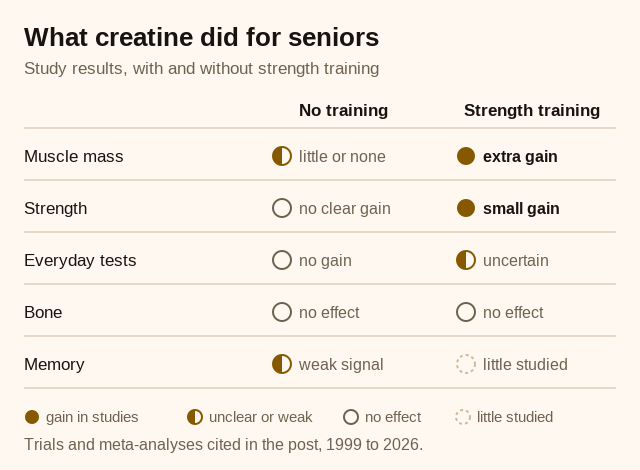
- Older adults can take creatine, but in studies of people who didn’t train, it barely changed strength, performance in everyday tasks or bone.
- Combined with strength training, creatine added about 1.4 kg more lean mass than training alone, and this is the use with the most evidence in older people.
- For memory there is a favorable signal, but the studies in older adults are few, small and flawed, and for Alzheimer’s there is only one pilot study, with no comparison group.
- In healthy older adults, studies found no harm to the kidneys or liver. If you have kidney disease or heart failure, or take many medicines, talk to your doctor first, because almost no one has studied creatine together with the medicines most used in old age.
- Strength training is the treatment with the most evidence for age-related muscle loss, and creatine comes in as an aid to that training.
Without strength training, creatine barely changed strength or bone in older people in the studies that tested this, even in those who took the supplement for two years. Older adults can take creatine without exercising, because it is safe for most healthy people that age, but the gain in muscle and strength that made the supplement famous showed up almost always in people who were doing strength training at the same time.
With age, the body slowly loses muscle and strength, and this process, called sarcopenia, makes it harder to get up from a chair, climb stairs and carry the groceries. When I wrote about creatine in menopause, for older adults and for memory, the part on older adults dealt with people who already do strength training. Here the question is about those who don’t train or haven’t started yet. You’ll see what creatine does on its own for muscle, strength, everyday tasks, bone and memory, then what changes once training comes in, whether it is safe for people who take several medicines and which creatine the researchers used.
Does creatine work in older adults who don’t exercise?
In the trials where older adults took creatine without training, for periods ranging from one month to two years, it brought no clear gain in strength, did not improve the sit-to-stand and walking tests and did not increase bone density. Muscle mass went up a little or not at all, depending on the study. In older adults who took creatine together with strength training, the meta-analyses showed more lean mass and a little more strength than training alone. Memory is the only area where the studies without training gave any signal in favor, and a weak one. If you are over 60 and don’t exercise, the step that counts most is to start strength training, and creatine can come later, as an aid.
Why older muscle needs load for creatine to work
Creatine is stored in muscle bound to a phosphate, as phosphocreatine, and acts as a quick energy reserve for short, hard efforts, such as pushing the weight through a set at the gym or standing up quickly. With a bigger reserve, you can do a few more reps and recover faster between sets. Over weeks, that slightly bigger workout is the stimulus that makes muscle grow. Creatine also draws water into the muscle fiber, and researchers think this swelling of the cell may help switch on the muscle’s protein production, a hypothesis that is still being studied.
The authors of the meta-analysis this post is based on, researchers from three universities in Canada, left out the studies without strength training for a reason they explain in the paper itself: creatine does little for muscle growth when the muscle gets no load. The body makes part of the creatine it uses, in the kidneys and liver, and the rest comes from meat and fish. In the same paper, the researchers pooled the phosphocreatine measurements in the thigh muscle, and it tends to be lower in older people. The likely causes are the loss of fast-twitch fibers with age, the habit of eating less meat and lack of movement, since immobilization lowers this store. They also point out that people with little stored creatine, such as vegetarians, tend to respond more to the supplement. In theory, older adults would have a lot to gain, as long as they make the effort that uses up this energy.
What happened to older adults who took creatine without training
The study that best separates creatine from training was done at the University of São Paulo (USP) with older women the researchers classified as vulnerable (pre-frail). The researchers randomly assigned the volunteers to four groups, for six months: placebo without training, creatine without training, placebo with strength training and creatine with strength training. The result came out in 2014 in the journal Experimental Gerontology, and leg strength went up almost 20% in the group that combined creatine and strength training. The group that only trained also gained a lot, with no clear difference between the two, and the women who took only creatine ended up close to those who took only placebo.
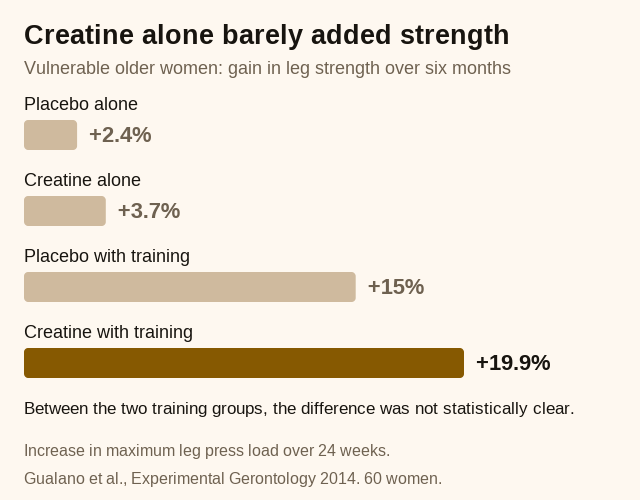
In the arms and legs, the lean mass of the group that took only creatine ended up a little above that of the placebo group, a result similar to that of the group that trained without the supplement. This increase without a matching gain in strength may be, at least in part, the water that creatine carries into the muscle, but the study did not measure this, so the explanation remains a hypothesis. Bone mass and the blood markers that show bone formation and bone loss did not change differently among the four groups.
In men, an American study from 1999 gave creatine for one month to volunteers over 60 who didn’t train. Arm strength, weight and the amount of lean mass stayed the same as with placebo, and the small signal of less leg fatigue was not confirmed when the authors looked at each group on its own.
The same USP group later followed postmenopausal women with osteopenia, the stage of weaker bone that comes before osteoporosis, without any training program. In the first study, with a low daily amount of creatine for one year, nothing changed in bone, lean mass or mobility tests. In the second, published in 2020 in the journal The Journals of Gerontology, the volunteers took a larger amount than in the first study, for two years, and once again bone, muscle mass, strength and the number of falls and fractures stayed the same as with placebo. The authors themselves wrote that the result knocks down the old idea that the supplement, on its own, strengthens bone or muscle in the long term.
A study from Texas A&M University, published in 2026, went the opposite way. The researchers ran a three-month trial in sedentary middle-aged adults, and the group that took creatine without training gained lean mass and strength compared with placebo. The groups were small, each participant chose whether or not to train, the amount of creatine was higher than in most research and the volunteers were younger than those in the other studies. A creatine manufacturer donated the supplement, and the lead researcher chairs that company’s scientific advisory board. Other groups need to repeat this finding, in people over 60, before it can weigh against the one- and two-year studies.
How much does creatine add to strength training in older adults?
In the trials pooled by the Canadian meta-analysis, older men and women did strength training two or three times a week and were randomly assigned to take creatine or placebo. With the supplement, the gain was about 1.4 kg more lean mass than with training and placebo, and strength on the bench press and leg press also went up more. The analysis came out in 2017 in the Open Access Journal of Sports Medicine (the authors declared no conflict of interest).
Looked at one by one, a little over half of the studies showed an advantage for creatine, and the rest found no difference, which helps explain why opinions on the subject clash so much. Because strength and muscle mass vary a lot from one older person to another, each small study struggles to see a modest effect, and the signal only appears when the results are added up.
The 2014 meta-analysis of older adults who trained, published in Medicine & Science in Sports & Exercise, also found more lean mass and more strength with creatine, plus a bigger improvement in the 30-second chair sit-to-stand test. A 2026 review in Frontiers in Nutrition confirmed the small gain in strength with moderate certainty, but found the effect on muscle mass and on function tests uncertain, and warned that the result cannot yet be extended to frail older adults or those who already have sarcopenia. In postmenopausal women, a 2026 meta-analysis in the Journal of the International Society of Sports Nutrition saw gains in lean mass and strength in the studies with training, and no measurable effect in the studies without training, which also used smaller amounts of creatine than the studies with training. In young men, another 2026 meta-analysis saw the same pattern, with a gain in lean mass only when strength training was added.
Does creatine protect older adults from fractures?
The studies done so far do not show that creatine strengthens bone. Without training, the two Brazilian trials of one and two years did not change bone density, and in the two-year one the number of falls and fractures also stayed the same. With training, the largest study in postmenopausal women, which I covered in detail in the post on creatine in menopause, did not raise bone density beyond what exercise already gave, and the 2026 meta-analysis in women at this stage reached the same conclusion.
Some studies with training saw small changes in bone area and thickness, which may matter somewhat for bone strength, but this is still far from showing fewer fractures. If you have osteopenia or osteoporosis, you need the bone treatment your doctor prescribes, and creatine does not replace it. Vitamin D, which many people take with bone in mind, also has its rules, and it makes a difference mainly for people who are deficient, as I explained when I wrote about when to take vitamin D.
Does creatine improve memory in older adults or help with Alzheimer’s?
The brain also uses creatine to produce energy, and this is the area where studies tested the supplement without training alongside it. A 2023 meta-analysis in Nutrition Reviews pooled trials in healthy people and saw better memory, larger in the subgroup of older participants. Shortly afterward, two researchers sent the same journal a letter pointing out that the analysis counted the same participants more than once, an error that can create an effect that doesn’t exist. A 2024 meta-analysis, which I cited when writing about menopause and older adults, found the opposite in the breakdown by age: the benefit was clearer in adults up to 60.
In 2026, a systematic review only of people aged 55 or older, also in Nutrition Reviews, found few studies on creatine, memory and thinking at this age. Only two were placebo-controlled trials, the rest estimated creatine from diet, and half were rated as having poor methodological quality. Almost all of them pointed to a favorable link, and the authors concluded that well-designed trials are still needed to confirm it.
In Alzheimer’s, the only study that gave creatine to people with the disease is an American pilot from 2025, with a small group of patients who took a high amount of creatine for about two months, all of them on the supplement and with no comparison group. The level of creatine in the brain went up and some thinking tests improved, which justifies a larger study. A 2026 review found no controlled trial in dementia and noted a rodent study in which memory got worse. Creatine is not a treatment for Alzheimer’s or for memory loss, and any new memory complaint in an older person deserves a medical assessment before any supplement.
Is creatine safe for older adults?
In research on older people, creatine was well tolerated. In the Canadian meta-analysis, some studies recorded stomach discomfort and others cramps, and no one left a study because of it. The studies that tracked blood and urine tests, for periods from a few weeks to one year, found no sign of kidney or liver injury. If you get check-ups, you should know that the supplement tends to raise the creatinine on your lab report a little, the number the doctor uses to keep an eye on the kidneys; mentioning that you take creatine before a blood draw keeps the result from being read as a kidney problem. The basics of how creatine works and the myths about kidneys, bloating and hair are in the post on creatine, kidneys, bloating and hair, and the details on the kidneys and creatinine are in the post on creatine and the kidneys.
A 2025 review of creatine in older adults, published in the Journal of the International Society of Sports Nutrition, pointed out, however, that almost all the safety information at this age comes from studies designed to measure muscle, with training, and that studies of creatine together with medicines and with the common diseases of old age are still missing. The Canadian authors themselves acknowledge that a few hundred older adults studied may be too few to spot a rare harmful effect. The same review cites a drug interaction database. According to it, some medicines taken with creatine may rise in the blood, and so may creatinine. Among them are cimetidine (for the stomach), trimethoprim (an antibiotic that comes combined with sulfamethoxazole in Bactrim) and probenecid (used for gout). Cimetidine and trimethoprim also raise creatinine on the test on their own, because they get in the way of its exit through the kidneys, and your doctor can only read the report correctly if they know everything you take.
With anti-inflammatory painkillers (NSAIDs), which already call for care with the kidneys in older adults even without a supplement, and with diuretics, the caution comes from reasoning: both affect the kidneys and the body’s water, and there are almost no studies of these combinations with creatine in older adults. Another thing to expect is the scale going up a little in the first weeks, from the water creatine holds in the muscle. If you already have heart failure or swell easily, talk to your cardiologist first, also as a precaution, since this situation has been little studied.
Who should talk to a doctor before taking creatine
Since creatine is sold without a prescription, it’s easy to start on your own. For most healthy older adults, the studies showed no contraindication. Some situations, though, call for a conversation before the first tub.
| Situation | Why it calls for care | What to bring to the visit |
|---|---|---|
| Kidney disease or low filtration on tests | Few studies in this situation, and creatinine goes up and muddles the test that monitors the kidneys | Recent blood and urine tests |
| Many medicines a day | There are almost no studies of creatine together with them, and some compete with creatinine for the same exit through the kidneys | The full list, including over-the-counter medicines |
| Heart failure or frequent swelling | Creatine holds water in the muscle and has been little studied in this condition | Your weight at home and your list of diuretics |
| Diabetes that has already affected the kidneys | The kidneys already need follow-up, and the creatinine test changes | Your latest kidney tests |
| Weakness that got worse quickly | It may be a disease, and not just age | When it started and what changed |
What is the best creatine for older adults?
Almost all the studies in older adults used creatine monohydrate, which the 2017 position stand of the International Society of Sports Nutrition names as the most studied form, with proven effect. The versions sold as something new have not proved better than it in the reviews that compared the forms, and many of them cost more. On the label, what matters is creatine monohydrate as the ingredient, preferably not mixed with stimulants or other compounds, which were not what the studies tested. Some studies combined creatine with protein, and it can be taken on the same day as whey.
The best-proven treatment for sarcopenia
The international guideline for sarcopenia, published in 2018 by a group of experts from the International Conference on Sarcopenia and Frailty Research (ICFSR), makes a strong recommendation for strength training as the treatment for age-related muscle loss. The same guideline makes a conditional recommendation for enough protein from food or supplements, makes no recommendation for vitamin D or hormones and says that for the other treatments there is still no firm evidence. The guideline does not assess creatine separately, and based on the studies cited here, it works as an aid that helps training pay off more.
In the trials in older adults, training was done two or three times a week, with machines or weights, a load that went up gradually and supervision by a professional. For someone who has never trained, this starts light and builds as the body responds, and workouts with moderate loads already bring results, as I explained in the post on how many sets and how much weight to use in strength training, which also covers the power to get up from a chair and climb stairs. Protein from food counts toward the same goal. When your meals don’t provide enough, whey helps fill the gap, and I have already explained how much whey to take a day.
For people who are already frail or afraid of falling, it’s worth adding balance exercises and everyday-task exercises to the program. A Cochrane review of older adults living at home, summarized in the British Journal of Sports Medicine, showed with high-certainty evidence that this type of exercise reduces falls, and the reduction is probably larger when it is combined with strength training.
To know whether your muscle is responding, strength in everyday tasks already tells you a lot, and bioimpedance estimates muscle mass over the months. People who are losing weight, through diet or medication, lose a little muscle along with it, and the strategies to hold on to that muscle are in the post on how to lose weight without losing muscle mass.
Signs that weakness isn’t just age
Age-related muscle loss is usually slow. The sarcopenia guideline suggests screening with walking speed or with a short questionnaire called SARC-F, which asks about strength, help with walking, getting up from a chair, climbing stairs and falls. On its own, the questionnaire misses some cases, and the doctor usually adds grip strength, the sit-to-stand test (chair stand test) and calf circumference. Some signs call for a medical assessment before any supplement:
- new difficulty getting up from a chair, climbing stairs or opening a jar;
- falls, or a fear of falling that makes you leave the house less;
- a slower or shorter step within a few months;
- unintended weight loss;
- weakness that started after a new medicine;
- sudden weakness on one side of the body, a drooping mouth or slurred speech, which call for the emergency room right away.
If you already take creatine, swelling in the legs, shortness of breath, much less urine than usual or severe muscle pain with dark urine are reasons to stop the supplement and seek care. Bring the tub or a photo of the label, along with your list of medicines, so the doctor can see what you took.
In practice
- If you are over 60 and don’t exercise, start with supervised strength training, two or three times a week, with a load that goes up gradually.
- Eat protein at every meal and top up with whey if food doesn’t cover it.
- If you want to add creatine, choose monohydrate, with nothing mixed in, and agree on it with your doctor, especially if you have kidney disease, a heart problem or take many medicines.
- Bring your full list of medicines to the visit and mention that you use creatine before blood tests.
- Don’t count on creatine for memory or bone: these are areas where the evidence doesn’t exist yet or hasn’t been confirmed.
- Track your strength in daily life and, if you want numbers, your muscle mass on bioimpedance.
Conclusion
Older adults can take creatine, and for most healthy people it is safe. Taken without training, however, it left strength, function and bone the same as placebo in the longest studies, and the signal for memory is still weak and full of caveats. Combined with strength training, it adds a little lean mass and strength to what training already gives. If you have kidney disease, heart failure or a long list of medicines, decide with your doctor, because these situations have barely been studied. Against sarcopenia, the treatment with the most evidence is strength training, and creatine comes in as a complement to it.
All the best!
G
Responsible physician: Dr. Gilberto Nering Junior, sports medicine physician, CRM-SP 160822, RQE 142486 (Sports Medicine, Brazil).
This text was not sponsored, is for information only and does not replace an individual assessment. Questions about the content: contact the clinic.
Cover photo: HowToGym on Unsplash, cropped.
Frequently asked questions about creatine for older adults
Are there contraindications to creatine for older adults?
For healthy older adults, the studies showed no contraindication, and creatine was well tolerated. If you have kidney disease, heart failure or diabetes that has already affected the kidneys, or take many medicines, talk to your doctor first, because these situations have barely been studied.
Can older adults take creatine and whey together?
Older adults can take both, and several studies in older adults gave creatine together with protein. Both work better when the person does strength training. Whey fills in the protein that food doesn’t provide.
Does creatine help older adults with Alzheimer’s?
There is no evidence yet that it helps, because the only study that gave creatine to people with Alzheimer’s is a 2025 pilot with few patients and no comparison group, and no controlled trial has been published. Creatine does not replace the treatment prescribed by the neurologist.
Does creatine prevent falls in older adults?
No study has shown that creatine prevents falls. In a two-year Brazilian trial of older women who didn’t train, the number of falls and fractures was the same with creatine and with placebo. Against falls, balance exercises and everyday-task exercises are the ones with evidence, preferably combined with exercises with load.
Can older adults take creatine monohydrate?
Yes, and it is the form used in almost all studies in older adults. The reviews that compared types of creatine found no advantage in the more expensive versions.
References
- Candow DG, Chilibeck PD, Forbes SC, et al. Creatine supplementation for older adults: focus on sarcopenia, osteoporosis, frailty and cachexia. Bone. 2022;162:116467. doi:10.1016/j.bone.2022.116467
- Candow DG, Ostojic SM, Chilibeck PD, et al. Creatine monohydrate supplementation for older adults and clinical populations. J Int Soc Sports Nutr. 2025;22(sup1):2534130. doi:10.1080/15502783.2025.2534130
- Chilibeck PD, Candow DG, Gordon JJ, et al. A 2-yr randomized controlled trial on creatine supplementation during exercise for postmenopausal bone health. Med Sci Sports Exerc. 2023;55(10):1750-1760. doi:10.1249/MSS.0000000000003202
- Chilibeck PD, Kaviani M, Candow DG, et al. Effect of creatine supplementation during resistance training on lean tissue mass and muscular strength in older adults: a meta-analysis. Open Access J Sports Med. 2017;8:213-226. doi:10.2147/OAJSM.S123529
- Chun J, Liu Y, Kibler GL, et al. Effects of creatine supplementation with and without exercise and diet intervention on body composition, cognitive function, and markers of health in middle-aged and older adults. J Int Soc Sports Nutr. 2026;23(sup1):2716273. doi:10.1080/15502783.2026.2716273
- Dent E, Morley JE, Cruz-Jentoft AJ, et al. International clinical practice guidelines for sarcopenia (ICFSR): screening, diagnosis and management. J Nutr Health Aging. 2018;22(10):1148-1161. doi:10.1007/s12603-018-1139-9
- Devries MC, Phillips SM. Creatine supplementation during resistance training in older adults: a meta-analysis. Med Sci Sports Exerc. 2014;46(6):1194-1203. doi:10.1249/MSS.0000000000000220
- Eckert I, Pascher E. Letter to the Editor: Double-counting due to inadequate statistics leads to false-positive findings in “Effects of creatine supplementation on memory in healthy individuals: a systematic review and meta-analysis of randomized controlled trials”. Nutr Rev. 2023;81(11):1495-1496. doi:10.1093/nutrit/nuac108
- Gu J, Li Y, Xiao J, et al. Creatine supplementation in young men under resistance versus non-resistance training: a systematic review and meta-analysis of strength, performance, and lean mass. Front Nutr. 2026;13:1800546. doi:10.3389/fnut.2026.1800546
- Gualano B, Macedo AR, Alves CR, et al. Creatine supplementation and resistance training in vulnerable older women: a randomized double-blind placebo-controlled clinical trial. Exp Gerontol. 2014;53:7-15. doi:10.1016/j.exger.2014.02.003
- Kreider RB, Jäger R, Purpura M. Bioavailability, efficacy, safety, and regulatory status of creatine and related compounds: a critical review. Nutrients. 2022;14(5):1035. doi:10.3390/nu14051035
- Kreider RB, Kalman DS, Antonio J, et al. International Society of Sports Nutrition position stand: safety and efficacy of creatine supplementation in exercise, sport, and medicine. J Int Soc Sports Nutr. 2017;14:18. doi:10.1186/s12970-017-0173-z
- Lobo DM, Tritto AC, da Silva LR, et al. Effects of long-term low-dose dietary creatine supplementation in older women. Exp Gerontol. 2015;70:97-104. doi:10.1016/j.exger.2015.07.012
- Marshall S, Kitzan A, Wright J, et al. Creatine and cognition in aging: a systematic review of evidence in older adults. Nutr Rev. 2026;84(2):333-344. doi:10.1093/nutrit/nuaf135
- Naddafha S, Antonio J, Kreider RB, et al. Creatine monohydrate for lean mass, strength, and bone density in postmenopausal women: a systematic review and meta-analysis. J Int Soc Sports Nutr. 2026;23(1):2668435. doi:10.1080/15502783.2026.2668435
- Prokopidis K, Giannos P, Triantafyllidis KK, et al. Effects of creatine supplementation on memory in healthy individuals: a systematic review and meta-analysis of randomized controlled trials. Nutr Rev. 2023;81(4):416-427. doi:10.1093/nutrit/nuac064
- Rawson ES, Wehnert ML, Clarkson PM. Effects of 30 days of creatine ingestion in older men. Eur J Appl Physiol Occup Physiol. 1999;80(2):139-144. doi:10.1007/s004210050570
- Sales LP, Pinto AJ, Rodrigues SF, et al. Creatine supplementation (3 g/d) and bone health in older women: a 2-year, randomized, placebo-controlled trial. J Gerontol A Biol Sci Med Sci. 2020;75(5):931-938. doi:10.1093/gerona/glz162
- Sherrington C, Fairhall N, Wallbank G, et al. Exercise for preventing falls in older people living in the community: an abridged Cochrane systematic review. Br J Sports Med. 2020;54(15):885-891. doi:10.1136/bjsports-2019-101512
- Smith AN, Choi IY, Lee P, et al. Creatine monohydrate pilot in Alzheimer’s: feasibility, brain creatine, and cognition. Alzheimers Dement (N Y). 2025;11(2):e70101. doi:10.1002/trc2.70101
- Whitford T, Donlon C, Pech A, et al. The cognitive effects of creatine supplementation in older adults and preclinical models of dementia: a scoping review. Ageing Res Rev. 2026;122:103317. doi:10.1016/j.arr.2026.103317
- Xu C, Bi S, Zhang W, et al. The effects of creatine supplementation on cognitive function in adults: a systematic review and meta-analysis. Front Nutr. 2024;11:1424972. doi:10.3389/fnut.2024.1424972
- Yao L, Yang D, Gao J. Effects of resistance training combined with creatine supplementation on muscle strength, physical function, and muscle mass in older adults: a systematic review and three-level meta-analysis. Front Nutr. 2026;13:1919884. doi:10.3389/fnut.2026.1919884