Also in: Português · Español · Italiano · 中文 · हिन्दी
Key Points
- True low testosterone is the sum of symptoms plus low test results, drawn the right way and repeated.
- The blood test should be drawn in the morning, fasting, and confirmed on another day.
- Excess weight, poor sleep, some medications and anabolic steroids lower testosterone, and treating the cause can fix it without hormones.
- Replacement mainly improves libido and sex life, and helps correct anemia caused by the lack of the hormone. Memory and diabetes do not improve.
- Men who want to have children soon should not use testosterone, because it shuts down sperm production.
A blood test with slightly low testosterone, together with tiredness and little drive to train, almost always brings the same question: do I need replacement?
It depends, and the test alone does not decide. To treat, I need two things together: symptoms that fit a lack of testosterone and confirmed low results. Before reaching for the hormone, it is also worth looking for the cause, because it can often be fixed. If your testosterone dropped after a steroid cycle, I wrote a post just about that: how long testosterone takes to come back after a cycle.
What Counts as Low Testosterone
The 2026 Brazilian guideline was written jointly by the Brazilian societies of endocrinology, urology and sexual medicine. It defines male hypogonadism, the medical name for low testosterone, as signs and symptoms plus a test that confirms the lack of the hormone, and one without the other does not make the diagnosis.
Some signs point more toward testosterone:
- lower sex drive;
- fewer spontaneous erections, such as morning ones, and trouble getting an erection;
- loss of facial and body hair;
- breast growth, called gynecomastia;
- hot flashes;
- a fracture after minor trauma;
- mild anemia with no other explanation.
Others are too common to point to one place: tiredness, low mood, irritability, trouble concentrating, poor sleep, less strength and more belly fat. They can come from testosterone, but also from short sleep, stress, depression, the thyroid, anemia or too much training with too little food.
That is why the same guideline recommends against testing testosterone in every man without symptoms.
How to Get the Blood Test Done the Right Way
Testosterone goes up and down during the day. It is highest in the morning and falls after you eat, especially sweets. A test drawn in the afternoon, after lunch, can come back low in someone with no problem at all.
The right way is to:
- have the blood drawn between 7 and 10 in the morning;
- be fasting;
- be away from an acute illness, such as a bad flu, or a flare-up of a chronic disease;
- be away from a race or a very long, exhausting workout, which can lower testosterone for a while;
- if it comes back low, repeat it on another day, under the same conditions, ideally about 4 weeks later.
Repeating makes a difference: researchers at the University of Michigan point out that about a third of men with one low result have normal values when the test is repeated.
The most commonly ordered test measures total testosterone. Most of it travels in the blood bound to proteins, mainly one called SHBG, and only about 2% is free to act. Obesity and diabetes lower SHBG, and then total testosterone can look low while free testosterone is normal. Age and some liver and thyroid diseases do the opposite.
What Number Separates Normal From Low Testosterone
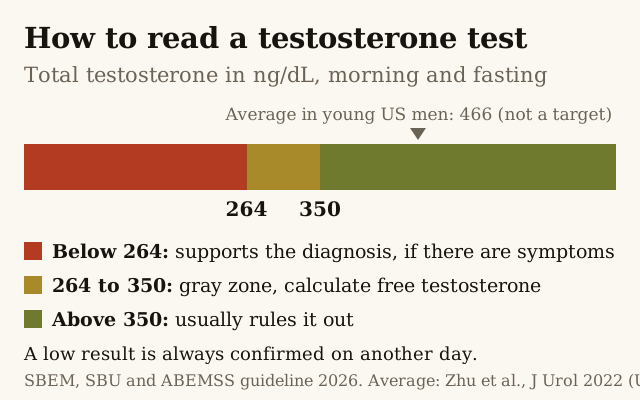
There is no single number, and each medical society uses its own cutoff. The Endocrine Society, in the United States, uses 264 ng/dL, the American Urological Association uses 300, and the European societies are close to 350.
The Brazilian guideline lays it out like this:
- below 264 ng/dL, with symptoms, the test supports the diagnosis;
- above 350 ng/dL, it usually rules it out;
- between 264 and 350 ng/dL there is a gray zone, and I calculate free testosterone from SHBG and albumin.
What About Low Testosterone in Young Men?
These cutoffs came from studies of older men. In 2022, US researchers analyzed testosterone in about 1,500 men aged 20 to 44 from a national US survey: the average was 466 ng/dL, and it fell a little with each year of age.
The authors proposed age-based cutoffs, higher for younger men. The idea makes sense, but with the method they chose one in three men would already count as “low”, each man had only one test and no one asked about symptoms. I use these values as a reference for discussion, never as a reason to prescribe hormones.
Before Treating Low Testosterone, Look for the Cause
Once a low result is confirmed, the next step is to find where the problem is. Testosterone is made in the testicle, under the control of two hormones from the pituitary, a gland at the base of the brain: LH and FSH. Measuring these two shows whether the failure is in the testicle or in the control signal.
When the control signal is low, the workup continues with prolactin, thyroid and iron. In some cases a pituitary MRI is added, especially in young men with very low testosterone, high prolactin, or a new headache and changes in vision.
The most common cause is what doctors call functional hypogonadism: the testicle and the pituitary work, but something from outside gets in the way. The most frequent causes are:
- excess weight, the main one;
- diabetes;
- poor sleep and sleep apnea;
- medications such as opioids (morphine, codeine, tramadol) and long-term corticosteroids;
- anabolic steroids, during and after use;
- very hard training with too little food, called relative energy deficiency in sport (RED-S);
- heavy alcohol and cannabis use;
- chronic diseases.
Losing Weight Raises Testosterone
In a review of 24 studies, losing weight raised testosterone in men with obesity: by about 80 ng/dL with diet and about 250 ng/dL with bariatric surgery, on average. The more weight a person lost, the more testosterone went up.
That is why the Brazilian guideline puts lifestyle change as the first treatment for men with overweight and functional low testosterone. The same guideline says replacement should not be used just to lose weight, control blood sugar or protect the heart. If this is your case, I wrote about how to lose weight without losing muscle.
What Replacement Improves
In the set of US studies called the TTrials, 790 men aged 65 or older, with low testosterone and symptoms, used testosterone gel or a gel without hormone for one year, without knowing which. According to a 2025 review, testosterone increased sexual activity by about 40% and desire by about 25%, with a small improvement in erections and mood and none in energy.
In TRAVERSE, the largest replacement study to date, anemia cleared in 45% of the men using testosterone after one year, compared with 34% in the placebo group.
In the studies, replacement did not improve:
- memory and thinking, in men without a diagnosed memory problem;
- diabetes prevention and blood sugar control;
- fractures. Bone density goes up with testosterone, but in TRAVERSE those who used it had slightly more fractures over about 3 years (3.5% versus 2.5%), so it does not replace osteoporosis medication.
According to the 2025 review, benefit is more likely the lower the testosterone, for example below 200 ng/dL. In men who are only slightly below the cutoff, especially with obesity, the gain tends to be smaller.
How Long It Takes to Work
Sex drive is usually the first to improve, in 3 to 6 weeks. Gains in lean mass and loss of fat appear after 3 to 4 months. If after about 6 months with testosterone at the right level nothing has improved, it is time to review the diagnosis and, often, to stop.
When Replacement Is Not Recommended
According to the Brazilian guideline, testosterone should not be started in men who have:
- breast cancer, which also occurs in men;
- known or suspected prostate cancer, including an abnormal PSA not yet evaluated by a urologist;
- plans to have children soon.
And it needs careful evaluation beforehand in men who have:
- hematocrit, a measure on the blood count, already high before starting;
- severe untreated sleep apnea;
- uncontrolled heart failure;
- a heart attack or stroke in the past 6 months;
- a past blood clot or embolism, or a known tendency to form clots;
- strong urinary symptoms from the prostate, which call for a urologist’s evaluation first.
Men Who Want to Have Children
This point catches many young men by surprise. Testosterone from outside switches off the pituitary’s control signal, and the testicle stops producing sperm. In healthy men, fertility usually comes back within 2 years after stopping, but not always.
For men with low testosterone who want to have children, there are medications that make the testicle itself do the work, such as clomiphene and hCG. They are prescription drugs, with follow-up tests, and are not meant to be used on your own. Before any treatment, it is worth getting a semen analysis.
Not for Gaining Muscle or Performance
Replacement is for men who lack the hormone. Since 2023, Brazil’s Federal Council of Medicine (CFM) has prohibited doctors from prescribing hormones for aesthetics, muscle gain or sports performance, and the Brazilian guideline points out that, in sport, this is doping. To gain muscle, what works is enough food and well-planned weight training.
For anyone who competes in events with doping control, testosterone is banned even with a prescription, as are clomiphene and hCG. An athlete with a confirmed lack of the hormone needs to apply for a therapeutic use exemption before starting.
Gel, Injections and What to Avoid
In Brazil, the approved forms are gel, applied to the skin every day, and injections into the muscle, short-acting or long-acting. Short-acting ones cause peaks and troughs: the hormone rises a lot in the first days and falls before the next dose, which can affect mood, energy and libido. The long-acting one keeps the level more stable. The choice of form is made with the doctor, case by case.
Gel users need to take one precaution: the hormone can pass to another person through skin contact. Women and children should not touch the area, and you should wash your hands after applying it and cover the area with clothing.
The Brazilian guideline does not recommend compounded hormone implants, capsules or gel. There are no studies showing how much hormone reaches the blood, and the implants often thicken the blood.
What Follow-Up Looks Like
Anyone on replacement needs regular tests. The Brazilian guideline recommends measuring testosterone and hematocrit at 3, 6 and 12 months of treatment and then once a year. The goal is to keep testosterone in the middle of the normal range, not at the top.
Hematocrit deserves attention because testosterone increases red blood cells. Blood that is too thick raises the risk of clots, and above 54% treatment is paused until it comes down. In TRAVERSE, the testosterone group also had slightly more pulmonary embolism. Pain and swelling in one leg, sudden shortness of breath or chest pain call for the emergency room or an ambulance right away (192 in Brazil; in other countries, call your local emergency number), without waiting for the next appointment.
The prostate is also part of follow-up, with PSA and a digital rectal exam at 3 and 12 months of treatment and, after that, as in screening for any man of the same age. Cholesterol and blood sugar are measured once a year.
Other possible effects are acne, hair loss, breast growth, swelling, worsening sleep apnea and smaller testicles. The heart is the question that comes up most about testosterone, and I will cover it in a separate post.
Do You Have to Use It Forever?
It depends on the cause. When the failure really is in the testicle or the pituitary, replacement is usually lifelong. When the cause is functional, such as weight, medication or sleep, it can be temporary: if the cause improves, it is worth trying to stop and repeating the tests to see if the body has started producing on its own again.
Conclusion
Low testosterone is diagnosed with symptoms and tests together, drawn in the morning, fasting, and repeated. Before the hormone, it is worth looking for the cause, because excess weight, poor sleep, medications and anabolic steroids are common and treatable. When the lack is real, replacement mainly improves sex life and anemia, and requires regular blood and prostate tests. For men who want to have children, it gets in the way.
Take care!
Responsible physician: Dr. Gilberto Nering Junior, sports medicine physician, CRM-SP 160822, RQE 142486 (Sports Medicine, Brazil).
This text was not sponsored, is for information only and does not replace an individual assessment. Questions about the content: contact the clinic.
Frequently Asked Questions About Low Testosterone
Is a testosterone of 300 low?
It depends on symptoms and on other tests, such as free testosterone. Under the Brazilian guideline, values between 264 and 350 ng/dL fall in a gray zone, and then it is worth calculating free testosterone. A single test never decides on its own.
What is the best time to test testosterone?
Between 7 and 10 in the morning, fasting. If the result comes back low, repeat it on another day, under the same conditions.
Does low testosterone cause fatigue?
It can, but fatigue has many other causes, such as short sleep, anemia, the thyroid and depression. In studies, replacement improved energy little or not at all. What improves most is libido.
Does testosterone replacement cause infertility?
It can, because testosterone from outside shuts down sperm production. In men who were fertile before, fertility usually comes back within 2 years after stopping, but not always. Men who want to have children should talk to their doctor before starting, since there are other options.
Are testosterone implants safe?
The 2026 Brazilian guideline does not recommend compounded implants. There are no studies that guarantee how much hormone reaches the blood, and they often thicken the blood.
References
- Bhasin S, Snyder PJ. Testosterone Treatment in Middle-Aged and Older Men with Hypogonadism. N Engl J Med. 2025;393(6):581-591. doi:10.1056/NEJMra2404637
- Conselho Federal de Medicina. Resolução CFM nº 2.333/2023. Diário Oficial da União, 11 abr. 2023. Text of the resolution (in Portuguese)
- Corona G, Rastrelli G, Monami M, et al. Body weight loss reverts obesity-associated hypogonadotropic hypogonadism: a systematic review and meta-analysis. Eur J Endocrinol. 2013;168(6):829-43. doi:10.1530/EJE-12-0955
- Hohl A, Lopes L, Ronsoni MF, et al. Care of Patients with Male Hypogonadism: A Joint Position Statement from the Brazilian Society of Endocrinology and Metabolism (SBEM), the Brazilian Society of Urology (SBU), and the Brazilian Association for Sexual Medicine and Health (ABEMSS). Int Braz J Urol. 2026;52(3):e20250610. doi:10.1590/S1677-5538.IBJU.2025.0610
- Pencina KM, Travison TG, Artz AS, et al. Efficacy of Testosterone Replacement Therapy in Correcting Anemia in Men With Hypogonadism: A Randomized Clinical Trial. JAMA Netw Open. 2023;6(10):e2340030. doi:10.1001/jamanetworkopen.2023.40030
- Snyder PJ, Bauer DC, Ellenberg SS, et al. Testosterone Treatment and Fractures in Men with Hypogonadism. N Engl J Med. 2024;390(3):203-211. doi:10.1056/NEJMoa2308836
- Snyder PJ, Bhasin S, Cunningham GR, et al. Effects of Testosterone Treatment in Older Men. N Engl J Med. 2016;374(7):611-24. doi:10.1056/NEJMoa1506119
- World Anti-Doping Agency. The 2026 Prohibited List: International Standard. In force since January 1, 2026. Accessed October 17, 2026. wada-ama.org
- Zhu A, Andino J, Daignault-Newton S, et al. What Is a Normal Testosterone Level for Young Men? Rethinking the 300 ng/dL Cutoff for Testosterone Deficiency in Men 20-44 Years Old. J Urol. 2022;208(6):1295-1302. doi:10.1097/JU.0000000000002928
{“@context”: “https://schema.org”, “@type”: “FAQPage”, “inLanguage”: “en”, “mainEntity”: [{“@type”: “Question”, “name”: “Is a testosterone of 300 low?”, “acceptedAnswer”: {“@type”: “Answer”, “text”: “It depends on symptoms and on other tests, such as free testosterone. Under the Brazilian guideline, values between 264 and 350 ng/dL fall in a gray zone, and then it is worth calculating free testosterone. A single test never decides on its own.”}}, {“@type”: “Question”, “name”: “What is the best time to test testosterone?”, “acceptedAnswer”: {“@type”: “Answer”, “text”: “Between 7 and 10 in the morning, fasting. If the result comes back low, repeat it on another day, under the same conditions.”}}, {“@type”: “Question”, “name”: “Does low testosterone cause fatigue?”, “acceptedAnswer”: {“@type”: “Answer”, “text”: “It can, but fatigue has many other causes, such as short sleep, anemia, the thyroid and depression. In studies, replacement improved energy little or not at all. What improves most is libido.”}}, {“@type”: “Question”, “name”: “Does testosterone replacement cause infertility?”, “acceptedAnswer”: {“@type”: “Answer”, “text”: “It can, because testosterone from outside shuts down sperm production. In men who were fertile before, fertility usually comes back within 2 years after stopping, but not always. Men who want to have children should talk to their doctor before starting, since there are other options.”}}, {“@type”: “Question”, “name”: “Are testosterone implants safe?”, “acceptedAnswer”: {“@type”: “Answer”, “text”: “The 2026 Brazilian guideline does not recommend compounded implants. There are no studies that guarantee how much hormone reaches the blood, and they often thicken the blood.”}}]}
{“@context”: “https://schema.org”, “@graph”: [{“@type”: “Organization”, “@id”: “https://clinicanering.com/#org”, “name”: “Clínica Nering”, “url”: “https://clinicanering.com”}, {“@type”: “Person”, “@id”: “https://clinicanering.com/#dr-gilberto”, “name”: “Dr. Gilberto Nering Junior”, “jobTitle”: “Sports Medicine Physician”, “identifier”: “CRM-SP 160822 / RQE 142486”, “worksFor”: {“@id”: “https://clinicanering.com/#org”}, “sameAs”: [“https://www.doctoralia.com.br/gilberto-nering-junior”, “https://www.instagram.com/clinica.nering”]}, {“@type”: “MedicalWebPage”, “@id”: “https://clinicanering.com/blog/en/sports-medicine/low-testosterone-when-to-treat/#webpage”, “url”: “https://clinicanering.com/blog/en/sports-medicine/low-testosterone-when-to-treat/”, “name”: “Low Testosterone: When to Treat and When Not To”, “inLanguage”: “en”, “datePublished”: “2026-11-16T09:00:00+00:00”, “dateModified”: “2026-11-16T09:00:00+00:00”, “author”: {“@id”: “https://clinicanering.com/#dr-gilberto”}, “reviewedBy”: {“@id”: “https://clinicanering.com/#dr-gilberto”}, “publisher”: {“@id”: “https://clinicanering.com/#org”}, “isPartOf”: {“@type”: “WebSite”, “name”: “Clínica Nering Blog”, “url”: “https://clinicanering.com/blog/”}}]}