Also in: Português · Español · Italiano · 中文 · हिन्दी
Main points
- Overtraining syndrome is performance that drops and stays low even after weeks of rest, together with fatigue that won’t go away, training that feels harder, poor sleep and low mood.
- It sits at the top of a ladder: normal training fatigue, functional overreaching (gone in days or a few weeks), non-functional overreaching (weeks to months) and, last, overtraining, which can last months or years.
- No test confirms overtraining. It is a diagnosis of exclusion: first, the doctor looks for anemia, iron deficiency, thyroid problems, low energy from eating too little (RED-S), infection and depression.
- Eating less, or less carbohydrate, than training demands showed up in the vast majority of overload studies that measured food, and it may be behind some of the cases.
- What to do: stop or cut training back a lot, get assessed and return gradually, guided by symptoms rather than by a set date.
Your usual workout has become hard, your running times got worse, you sleep badly, you are irritable and a week off didn’t fix it. This combination looks like the symptoms of overtraining, the syndrome in which the body stops recovering from the load and performance stays low for weeks or months. Other causes, though, from anemia to eating less than training demands, produce the same picture, and overtraining only gets that name after all of them have been ruled out.
Poor sleep is on the list of overtraining signs, but it doesn’t always come from it. In the post about training at night and sleep, the culprit was a hard session ending close to bedtime, and the fix was to change the time or the intensity. When nights are bad with or without training and come with falling performance and low mood, the explanation may be something else. To tell one situation from the other, I use here the 2013 European and American consensus on overtraining and a 2021 review that went back to check how much the athletes in overload studies were eating.
What are the symptoms of overtraining
The main sign of overtraining is a drop in performance in your sport that persists after weeks of rest. It comes with mood changes (irritability, low spirits, no desire to train) and, often, with fatigue that won’t go away, a feeling that training has become harder, and poor sleep. Repeated colds and flu may show up as well. No test confirms overtraining, and the diagnosis is only made after the doctor rules out the other causes of the same picture, such as anemia, iron deficiency, thyroid problems, too little energy from eating too little, infections and depression. Treatment is rest, a medical assessment and a gradual return to training.
What overtraining is and how it differs from overreaching
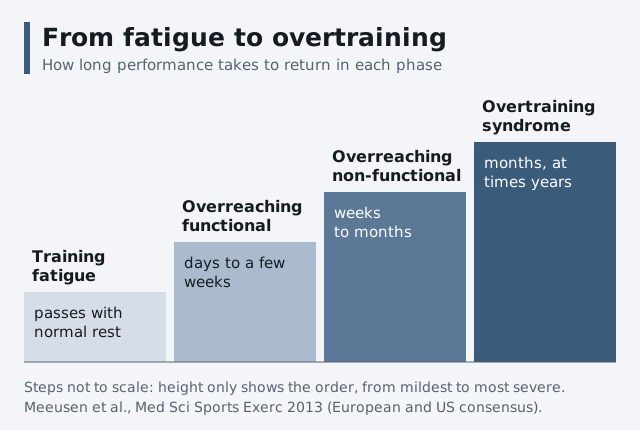
Overtraining is the syndrome in which performance drops and stays low even after weeks or months of rest. The 2013 consensus of the European College of Sport Science and the American College of Sports Medicine, published in Medicine & Science in Sports & Exercise, places this condition at the top of a four-step ladder. According to the document, what separates one step from the next is the time performance takes to come back; the type and length of training and the size of the drop are left out of that count.
At the bottom of the ladder is the fatigue everyone feels after a hard workout or a heavy week. It goes away with the rest that is already part of the routine, the body adapts to the load and, according to the consensus, every training program is built on this cycle.
On the second step is functional overreaching, when you push training on purpose for a short period, as in a week of concentrated training, and performance drops for a few days. With the right recovery, it comes back and may even end up better than before. The consensus says you can get out of this state in days or a few weeks and treats it as a normal stage of training.
If the overload continues, non-functional overreaching follows: performance stops improving or drops and only comes back after weeks or months. At this stage there are already signs of psychological strain, such as less drive and more fatigue, and changes in hormones. Recovery is complete, but it takes time and doesn’t bring the improvement the training was after.
At the top is overtraining syndrome, in which not even a long period of rest brings performance back, and full recovery can take months or, according to the consensus, even years. The authors chose the word syndrome as a reminder that training is not always the only cause.
Non-functional overreaching and overtraining usually produce the same symptoms and the same test findings. Given this overlap, the consensus admits that, often, the only way to know which of the two a person had is afterwards, by looking at how long they took to recover.
True overtraining is less common than it seems
Many people call any tired spell overtraining, but the syndrome is much less frequent. The 2021 review cites a survey of a group of 100 endurance athletes assessed by the team of Belgian researcher Romain Meeusen, in Brussels, who already arrived with falling performance and fatigue. Of these, only 15 were diagnosed with overtraining syndrome.
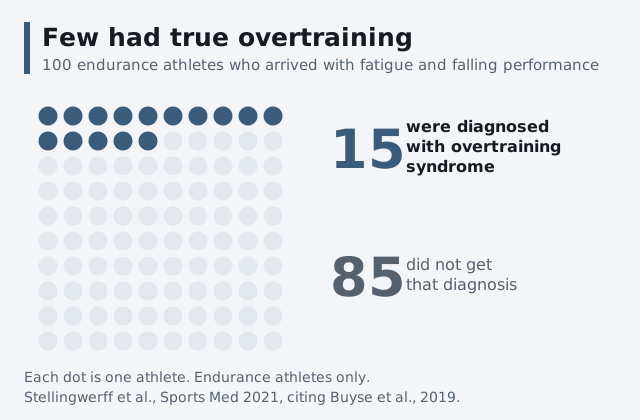
The group was made up only of endurance athletes, so this number doesn’t work as an estimate for people who train for fun. Even so, it is a reminder that fatigue with poor performance has several explanations, and many of them have their own treatment or pass faster than the syndrome. If you train for health and don’t compete, the difference between moving, training and competing helps you see where you fit.
How each overtraining symptom shows up
The consensus includes a checklist for doctors. At the top of that list are performance that drops for no clear reason, fatigue that persists, training that feels harder and poor sleep. The other signs appear in some people, and each one can have another cause.
Performance that drops and doesn’t come back, in running or strength training
The sign that defines the condition shows up as worse running times, weights that stop going up or go down in strength training, and more effort to do your usual workout. What sets it apart from a bad patch is how long it lasts, because the drop continues after days or weeks of light training or time off. Overtraining fatigue is also different from the heavy legs the day after a hard session: it stays even on rest days, and light training starts to feel hard.
Poor sleep
Sleep is on that list, and it was worse in the athletes with overtraining in a Brazilian study done at Unifesp (Federal University of São Paulo). It can be cause and consequence at the same time, since sleeping badly gets in the way of recovery and an overloaded body sleeps worse. A 2024 review, published in PLOS ONE, pooled studies of short overload in cyclists, rowers, triathletes, runners and swimmers. Sleep measured by a device got slightly worse, while the score the athletes themselves gave their sleep barely changed, which suggests you don’t always notice the decline. The authors warn that none of the studies was free of doubts about the method.
Loud snoring, pauses in breathing during the night and strong daytime sleepiness point to other problems, such as sleep apnea, that call for a specific assessment. A low sleep score on your watch after a full night in bed has its own causes, which I gathered in the post about a low sleep score.
Mood, irritability and low spirits
Changed mood is part of the definition of overtraining in the consensus. Irritability, low spirits, no desire to train and trouble concentrating are common. On mood questionnaires, athletes who are just tired change more in energy and fatigue, and those with signs of overtraining get worse mainly on the part that measures depression. That’s why it is on the list of things the doctor investigates, and the two can go together.
Colds and flu that keep coming back
Throat and nose infections are frequent in people who increase training a lot, and the consensus considers it likely that many of those diagnosed with overtraining have more infections. A viral infection that drags on, such as mononucleosis, also mimics overtraining, and the doctor needs to rule it out. Training hard with an infection can also raise the risk of heart complications, and the consensus advises stopping training or lowering the intensity while it lasts.
Heart rate and variability on your watch
Many people look at their watch hoping for confirmation. The consensus says resting heart rate does not change consistently in overtraining and that heart rate variability (the variation in time between one heartbeat and the next, which watches use as a recovery signal) gives results that don’t agree across studies. A 2016 meta-analysis, in Sports Medicine, showed that variability measured at rest tends to rise when training is going well and barely changed during overreaching phases, while the measurement taken right after training rose both with good adaptation and with overload. A good number on your watch, then, doesn’t guarantee you have recovered. Use the watch as a clue when your average changes for several days and you also feel worse, and leave the diagnosis to the assessment. I compared the accuracy of these devices when I wrote about which watch is most accurate.
Libido, periods and weight
A drop in sex drive and unintended weight loss point to too little energy, as do periods that become irregular or stop, in women, and a drop in testosterone, in men. In the Brazilian studies, libido was lower in the athletes with overtraining. This group of signs leads to RED-S, which shares almost all its symptoms with overtraining.
Overtraining or low energy (RED-S)?
RED-S, short for Relative Energy Deficiency in Sport, happens when you eat less than your training and the body’s basic functions require, and the full picture is in the post about RED-S and energy deficiency in sport. It and overtraining affect the same command center in the brain (the hypothalamus and the pituitary), have no test that confirms them on its own and share almost all their symptoms: falling performance, more infections, changed mood, worse sleep and changes in hormones. When the studies of the two conditions were compared, only bone was left out, because stress fractures and weak bone appeared in the RED-S studies and not in the overtraining ones.
In 2021, researchers from Canada, Australia, Belgium, France, Norway and Monaco, Meeusen himself among them, went back to the studies that induced overload in athletes and also measured what they ate. Of the 21 studies included in the analysis, 18 showed a drop in energy availability (what is left from food after subtracting what training burns) or in carbohydrate during the overload phase. The review was published in Sports Medicine (with no outside funding) and is the basis of this post.
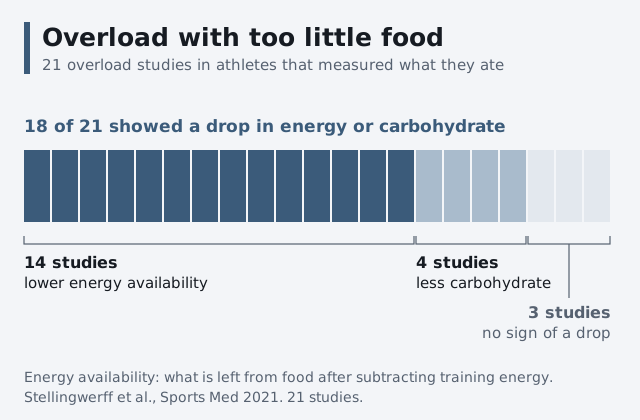
In the authors’ view, part of what these studies called overtraining may have been a lack of food for the size of the training load, and they treat this as a hypothesis. When training goes up a lot, hunger doesn’t always keep pace, and intense training can even reduce appetite right after the session. Without realizing it, the person starts eating less than they burn. The 2023 International Olympic Committee consensus on RED-S, published in the British Journal of Sports Medicine, cites this review and says an energy deficit has to be ruled out before anyone talks about overtraining.
In Brazil, endocrinologists Flavio Cadegiani and Claudio Kater, from Unifesp, in São Paulo, compared male athletes with overtraining, healthy athletes and people who didn’t train. The training reported by the two groups of athletes was similar, but those with the syndrome ate fewer calories, less carbohydrate and less protein, slept worse and spent more hours working or studying. The authors treat these factors as likely triggers. The groups were small and included only men, and the 2021 review points out that the researchers recorded food intake when the athletes already had the syndrome, so eating less may have been a consequence of training less. For now, these findings are clues that need confirmation.
If someone tells you your fatigue is adrenal fatigue, a name some practitioners and the media use for the exhaustion supposedly caused by long-term stress, know that the same two endocrinologists reviewed the studies on the subject in 2016. In BMC Endocrine Disorders, they concluded that adrenal fatigue does not exist as a disease.
Why overtraining is a diagnosis of exclusion
No blood test, exercise test or questionnaire confirms overtraining on its own. The consensus says the diagnosis can only be made by excluding every other explanation for the falling performance and changed mood, and that the name overtraining applies when none of them turns up. This is what doctors call a diagnosis of exclusion. Before getting there, the doctor looks into:
- iron deficiency, with or without anemia;
- gland disorders, such as thyroid, adrenal and diabetes;
- infections, including viral ones that drag on, such as mononucleosis and hepatitis, and inflammation of the heart muscle (myocarditis);
- too little energy from eating too little (RED-S) and eating disorders, such as anorexia and bulimia;
- depression and other mental health problems;
- injuries, asthma that began in adulthood, allergies and heart symptoms;
- training errors, such as volume or intensity that rose too much, training that is always the same and too many competitions;
- stress outside training: work, school, family, money and travel across time zones.
Since several of these problems have their own treatment, the assessment comes before concluding that it is overtraining. More than one cause can be present at the same time, such as too much training with too little food, or short sleep with stress at work.
How long does overtraining last?
Overtraining syndrome can last from months to years, and the milder overloads pass sooner: functional overreaching in days or a few weeks, non-functional in weeks or months. The time frames in the table come from the 2013 consensus and are approximate, because each person recovers at their own pace.
| Phase | Time for performance to return | What usually resolves it |
|---|---|---|
| Training fatigue | with normal rest | the rest that is already part of the routine |
| Functional overreaching | from days to a few weeks | a few days of light training or time off |
| Non-functional overreaching | from weeks to months | stopping or cutting training back a lot, eating and sleeping well |
| Overtraining syndrome | months, sometimes years | rest, medical assessment and a slow return |
The same Unifesp team followed athletes with the syndrome through three months of treatment, with more food, a break from training, better sleep and stress management. At the end, some had recovered, others only partly and others not yet, and the authors concluded that getting out of overtraining is as complicated as getting into it. The study was published in the International Journal of Sports Physiology and Performance, with a small group and no comparison with people who did not receive the treatment.
People who have had overtraining are also more likely to have it again. In a study of American college swimmers cited in the consensus, most of those who had the syndrome in their first season had it again in the following years. The review also notes that, in RED-S, the longer the problem lasts, the worse the recovery, and the authors think it likely that the same happens in overtraining, and on that basis they argue for acting early, while the signs are still mild.
What to do and how to treat overtraining
When performance drops, the urge is to train more to make up for it, and the consensus recommends the opposite. According to the document, overtraining is treated with rest. In milder overloads, cutting training back may be enough; in the syndrome, the break is bigger and longer. At the same time, see a doctor, preferably a sports medicine physician, to look into the other causes on the list above.
Eating enough is part of treatment. The document recommends more water, carbohydrate and calories during heavy training phases, without taking protein off the plate. An energy deficit, when present, is corrected mainly by eating more, sometimes together with less training, as the 2021 review points out. For sleep, the consensus rule is to sleep as much as you need to feel awake during the day, and that amount varies from person to person. Reducing whatever you can of the stress outside training (work, school, problems at home) also helps, because that stress adds to the stress of training.
How to recover and return to training after overtraining
No test shows that you have recovered, so, as the consensus authors advise, the return is guided by symptoms, and not by a date set on the calendar. A common way to start is with short, easy sessions at a conversational pace, like zone 2 in the training zones, increasing the load gradually while the body responds well.
Write down each day’s training, performance, sleep and mood. If fatigue starts to rise again or performance drops again, hold the load or go back a step. The consensus names monotonous training and too many competitions among the triggers of the problem, and cites a study in which athletes turned the days the coach had planned as easy into hard ones. Varying your sessions and keeping easy days easy helps prevent a relapse. Back-to-back competitions and big jumps in volume or intensity wait until performance has come back.
When fatigue calls for a prompt visit
Fatigue with worse performance that doesn’t improve after one or two weeks of light training is already worth a visit. Some signs call for faster care:
- chest pain, unusual shortness of breath, a racing heart or fainting during training: stop immediately and go to an emergency room;
- fever, a sore throat that won’t go away or swollen glands in the neck, which point to infection;
- unintended weight loss, periods that became irregular or stopped and a drop in sex drive, which point to too little energy;
- pain in a bone that gets worse with impact, which may be a stress fracture (the pain signs that call for stopping are in the post about pain when running);
- sadness that won’t go away, loss of interest in everything or thoughts of death: seek help now; in Brazil, the CVV helpline answers free of charge, at any hour, at 188.
In practice
- Look at the trend over weeks. A single bad workout is normal; what calls for attention is performance that drops and doesn’t come back after one or two weeks of light training.
- Stop trying to make up for it with more training. Cut the load back a lot or stop.
- Get assessed to rule out iron deficiency, anemia, thyroid problems, infection, energy deficit and depression.
- Eat in line with your training and sleep enough to feel awake during the day.
- Return gradually, guided by symptoms, writing down training, performance, sleep and mood.
- Once you are back, vary your training and avoid big jumps in volume or intensity.
Conclusion
The symptoms of overtraining are performance that doesn’t come back with weeks of rest, fatigue that persists, training that feels harder, poor sleep and low mood. It sits on the last step of a ladder that starts with normal training fatigue, and many people who feel this way are on an earlier step or have another cause, such as iron deficiency, thyroid problems, infection, depression or too little food for the training load. So the first response is to stop pushing, get assessed and return gradually, at the pace your body shows you.
All the best!
G
Responsible physician: Dr. Gilberto Nering Junior, sports medicine physician, CRM-SP 160822, RQE 142486 (Sports Medicine, Brazil).
This text was not sponsored, is for information only and does not replace an individual assessment. Questions about the content: contact the clinic.
Cover photo: Elisa Kennemer on Unsplash.
Frequently asked questions about overtraining
How can I tell overtraining from ordinary fatigue?
Ordinary fatigue goes away with a few days of rest or light training. In overtraining, the drop in performance continues even after weeks of rest and comes with fatigue that won’t go away, harder training, poor sleep and mood changes. The diagnosis is only made after the doctor rules out other causes, such as anemia, thyroid problems and infection.
What is the difference between overtraining and overreaching?
Overreaching is a shorter overload. In the functional kind, performance comes back in days or a few weeks; in the non-functional kind, in weeks or months. In overtraining, the drop lasts longer and full recovery can take months or years.
How long does it take to recover from overtraining?
Overreaching passes in days, weeks or a few months, depending on the phase, and overtraining syndrome can take months or even years to clear for good. The return to training is guided by symptoms, because no test shows that recovery is complete.
Can overtraining cause a fever?
Fever is not among the signs of overtraining in the European and American consensus. It points to an infection, which is more common in people who train hard and also mimics overtraining. A fever calls for a medical assessment and a break from training until you get better.
How can I prevent overtraining?
Increase training gradually, vary your sessions, make sure the days planned as easy stay easy, eat enough for the training you do and sleep well. Writing down training, performance, sleep and mood helps you notice early when your body is not keeping up.
References
- Bellenger CR, Fuller JT, Thomson RL, et al. Monitoring athletic training status through autonomic heart rate regulation: a systematic review and meta-analysis. Sports Med. 2016;46(10):1461-86. doi:10.1007/s40279-016-0484-2
- Buyse L, Decroix L, Timmermans N, et al. Improving the diagnosis of nonfunctional overreaching and overtraining syndrome. Med Sci Sports Exerc. 2019;51(12):2524-30. doi:10.1249/MSS.0000000000002084
- Cadegiani FA, Kater CE. Adrenal fatigue does not exist: a systematic review. BMC Endocr Disord. 2016;16(1):48. doi:10.1186/s12902-016-0128-4
- Cadegiani FA, Kater CE. Body composition, metabolism, sleep, psychological and eating patterns of overtraining syndrome: results of the EROS study (EROS-PROFILE). J Sports Sci. 2018;36(16):1902-10. doi:10.1080/02640414.2018.1424498
- Cadegiani FA, Kater CE. Novel causes and consequences of overtraining syndrome: the EROS-DISRUPTORS study. BMC Sports Sci Med Rehabil. 2019;11:21. doi:10.1186/s13102-019-0132-x
- Cadegiani FA, Silva PHL, Abrao TCP, et al. Novel markers of recovery from overtraining syndrome: the EROS-LONGITUDINAL study. Int J Sports Physiol Perform. 2021;16(8):1175-84. doi:10.1123/ijspp.2020-0248
- Meeusen R, Duclos M, Foster C, et al. Prevention, diagnosis, and treatment of the overtraining syndrome: joint consensus statement of the European College of Sport Science and the American College of Sports Medicine. Med Sci Sports Exerc. 2013;45(1):186-205. doi:10.1249/MSS.0b013e318279a10a
- Mountjoy M, Ackerman KE, Bailey DM, et al. 2023 International Olympic Committee’s (IOC) consensus statement on Relative Energy Deficiency in Sport (REDs). Br J Sports Med. 2023;57(17):1073-97. doi:10.1136/bjsports-2023-106994
- Murphy C, Svansdottir SA, Dupuy O, et al. Does overreaching from endurance-based training impair sleep: a systematic review and meta-analysis. PLoS One. 2024;19(5):e0303748. doi:10.1371/journal.pone.0303748
- Stellingwerff T, Heikura IA, Meeusen R, et al. Overtraining syndrome (OTS) and relative energy deficiency in sport (RED-S): shared pathways, symptoms and complexities. Sports Med. 2021;51(11):2251-80. doi:10.1007/s40279-021-01491-0