Also in: Português · Español · Italiano · 中文 · हिन्दी

Pain while running is scary, but not every pain is an injury, and not every pain should be ignored. The practical rule is this: muscle soreness that shows up and fades within a few days is usually normal adaptation. Pain in a bone, joint or tendon that lasts more than two or three days and gets worse even when you train less deserves attention. Telling the two apart keeps a minor case of shin splints from turning into a stress fracture and months off the road. Here is how to tell them apart.
Normal fatigue or injury: how to tell the difference
Pain is the best gauge of whether you are just tired or already getting hurt. A few signs help separate them:
- Adaptation soreness: that “good pain” the day after, spread over the muscles you used. It usually gets better on its own in 1 to 3 days (sometimes up to about 5). It is normal and part of the process.
- Injury pain: localized, in one specific spot, mainly in a bone, joint or tendon. It lasts more than two or three days and, worse, gets worse even when you cut back on training.
- The two-week limit: if the discomfort lasts more than two weeks, no matter how mild it seems, it is time to look into it.
Keep this difference in mind: a tired muscle complains and gets better. An injured bone, tendon or joint complains and keeps complaining.
The most common injuries in runners
A runner’s body suffers more in a few places, which take most of the impact. The most frequent complaints are:
- Knee: the champion of complaints. This includes the well-known “runner’s knee” at the front of the knee and the pain on the outside of the thigh that runs down to it.
- Shin splints: pain along the shin (the tibia), very common in people who are just starting or who increased their training too fast.
- Achilles tendon and calf: pain behind the ankle that gets worse when you accelerate and on hills.
- Plantar fasciitis: that pain in the sole of the foot, classic in the first steps of the morning.
- Stress fracture: the most serious one on the list. It is a tiny crack in the bone caused by too much repeated load, and it is exactly where ignored shin splints can end up.
Shin splints and the danger of ignoring them
They deserve a paragraph of their own, because they are the most common trap. Shin splints almost always show up in the same scenario: the person is excited, has just started running or increased volume and intensity all at once, and the bone has not had time to adapt to the load.
That is where the danger lies. Someone who feels the shin hurting and keeps going, thinking it will “run itself off”, can turn an annoying inflammation into a stress fracture, a much more serious injury that keeps you off the road for many months. The difference between a one-week scare and a six-month problem is often just the stubbornness of not stopping in time.
Should I stop running or can I keep going with pain?
When something hurts beyond normal muscle soreness, the best move is to pause and watch how the pain evolves. That does not mean you stop exercising: swapping running for swimming or cycling for a few days keeps your fitness and gives the injured spot a rest. Professionals call this cross-training.
About medication, an honest warning: anti-inflammatories and ice relieve the symptom, but they do not fix the cause. If you just mute the pain to keep running, you are trading a small problem today for a big one tomorrow. In practice, I see many people go back to training while still in pain, usually those who run without guidance. Masking the pain is not treating it.
What treatment looks like and how long it takes
If the injury is confirmed, recovery usually combines three things: a break from running (or a switch to something else) for as long as needed, physical therapy with strengthening and, in some cases, pain medication for a short time and always under guidance, with extra caution when the problem is in the bone (stress fracture), because anti-inflammatories can get in the way of healing. Surgery is rare for running injuries and is kept for exceptions.
Return time varies a lot depending on the injured tissue, and it helps to have a sense of it so you do not set the wrong expectations:
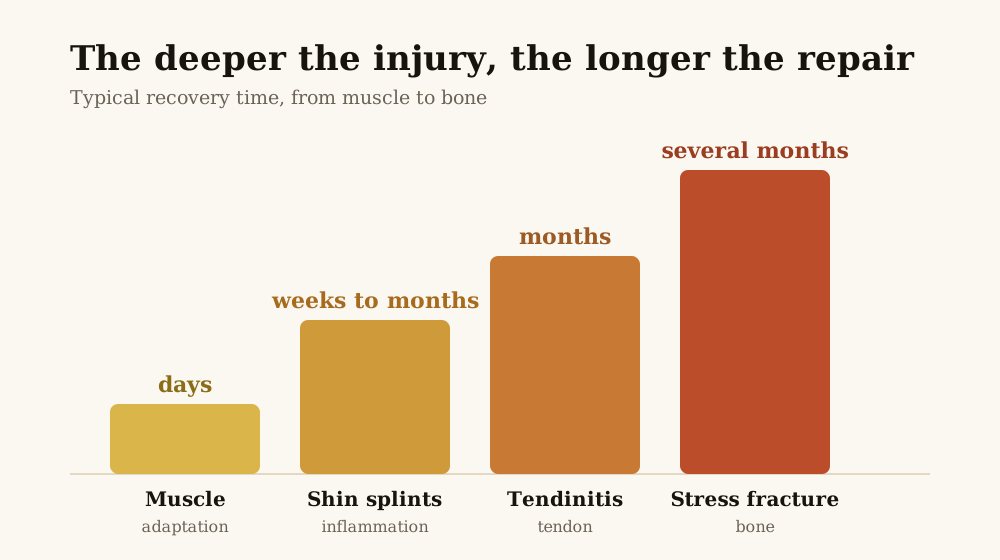
- Adaptation soreness: a few days.
- Shin splints: from a few weeks to a few months, depending on when you put on the brakes.
- Tendinitis: usually more stubborn, a few months, because tendons respond slowly and need gradually increasing load, not just rest.
- Stress fracture: this is a matter of months, sometimes several, because bone heals slowly.
Notice the pattern: the deeper the injury goes (from muscle to tendon to bone), the longer the repair. One more reason not to let a small pain become a big one. Once again, the rush to get back is the biggest enemy.
Strength training: the prevention almost nobody does
Here I speak as a sports medicine doctor, because this is a classic mistake. Many people think that to run better, you just need to run more. Not quite. Strong muscle is the shock absorber and stabilizer of your joints: it absorbs part of the impact that, without it, goes straight to the knee, the hip and the bone.
Runners who skip strength training leave their body unprotected exactly where the load is highest. Strength training does not compete with running; it holds running up. Strong legs, hips and core greatly reduce the risk of the overuse injuries I listed here. If all you do is run, this is probably the change with the biggest payoff you can make.
When to see a doctor
Get assessed if any of these apply:
- The pain does not go away on its own after a few days of rest.
- Persistent pain in a bone, joint or tendon, especially in one specific spot.
- Pain that lasts more than two weeks, even if mild.
- Signs of overtraining: muscle soreness that does not go away, falling performance and, a sign people underestimate, losing the desire to run.
And outside the list of injuries, a warning that can save your life: chest pain, unusual shortness of breath, dizziness or fainting during exercise are not something to wait on. In these cases, stop right away and get emergency care, instead of booking an appointment for next week.
How to lower your risk of getting hurt
Most running injuries come from getting the dose wrong, not from bad luck. To protect yourself:
- Increase training gradually. Raising volume and intensity slowly, and respecting rest, is rule number one. Rushing is the biggest cause of injury.
- Train strength. Strong muscle protects joints and tendons. Running does not replace strength training; quite the opposite.
- Look after your shoes. They have a lifespan (somewhere around 480 to 800 km, or 300 to 500 miles). A worn sole, lost cushioning and new pain are signs it is time to replace them.
- Get your gait and history checked. People with a significant problem in how their foot strikes the ground, or who have been injured before, benefit from individual guidance.
- Check your heart before you push the pace. Before more intense training, especially at an older age or with risk factors, a heart checkup helps spot risk and clear you for harder efforts more safely.
The bottom line
Running is one of the best things you can do for your body, but the body has a way of warning you when the dose is too much. The secret is learning to listen to pain: muscle soreness that gets better on its own is part of the game; pain that keeps coming back in a bone, tendon or joint is a message to stop and look into it.
When in doubt, do not bet on “it’ll run itself off”. A timely assessment with a sports medicine doctor is the difference between a few days of rest and months on the sidelines. Run a lot, and stay in one piece.
Happy running, and see you next time!
Responsible physician: Dr. Gilberto Nering Junior, CRM-SP 160822, RQE 142486 (Sports Medicine, Brazil). This text is for information only and does not replace an individual assessment.
Quick questions about running pain
Is muscle soreness after running an injury?
Usually not. Adaptation soreness is spread out and usually gets better on its own in 1 to 3 days. It becomes a concern when it is localized, in a bone or tendon, and keeps going for several days.
Can I run with pain?
Mild muscle soreness is fine. Pain in a bone, joint or tendon is not: then the right move is to pause, watch it and, if it does not improve, get assessed.
Do ice and anti-inflammatories solve it?
They relieve the symptom but do not treat the cause. Using them just to keep running is dangerous, because they hide a problem that keeps growing.
When should I see a doctor?
When the pain does not go away with rest, when it persists in a bone, joint or tendon, or when it lasts more than two weeks.
Do I need a checkup before I start running?
An assessment helps, and a heart checkup is recommended especially for people who plan to train harder, are older or have risk factors.
Sports medicine doctor or orthopedist?
Both treat this. The sports medicine doctor looks at the whole picture (performance, prevention, general health and a safe return to training); the orthopedist focuses on the musculoskeletal system. The choice depends on the case, and they often complement each other.
References
- Lauersen JB, Bertelsen DM, Andersen LB. The effectiveness of exercise interventions to prevent sports injuries: a systematic review and meta-analysis of randomised controlled trials. British Journal of Sports Medicine. 2014;48(11):871-877.
- Moen MH, Tol JL, Weir A, Steunebrink M, De Winter TC. Medial tibial stress syndrome: a critical review. Sports Medicine. 2009;39(7):523-546.
- Milner CE, et al. Biomechanics associated with tibial stress fracture in runners: a systematic review and meta-analysis. Journal of Sport and Health Science. 2023.
- Stellingwerff T, Heikura IA, Meeusen R, et al. Overtraining Syndrome (OTS) and Relative Energy Deficiency in Sport (RED-S): Shared Pathways, Symptoms and Complexities. Sports Medicine. 2021.