Also in: Português · Español · Italiano · 中文 · हिन्दी
Main points
- No study has found a way to stop Mounjaro with no regain at all, but the way you come off the drug changes how much weight comes back.
- In a 2026 study, people who moved to a lower dose of tirzepatide, instead of stopping altogether, kept off more weight than those whose injection was switched to placebo. Lowering the dose or stopping is a decision to make with your doctor.
- In a study with liraglutide, an older weight-loss injection, people who exercised during treatment were still exercising a year later. Those who only exercised kept their weight, and those who added exercise to the injection regained weight when they stopped, but ended up lighter than those who used the injection alone. Strength training also protects muscle.
- More protein and slowly digested carbohydrates held weight better in a study without medication, and getting enough sleep helps keep hunger in check. Weighing yourself often, with a regain limit agreed with your doctor, helps you notice the weight coming back early.
- People with diabetes or prediabetes need a plan for their blood sugar before stopping, because blood sugar starts rising again within the first weeks after stopping.
There is no way to stop taking Mounjaro without regaining a single kilo, but you can regain much less, and the way you come off the drug makes a difference. Until 2025, almost everything we knew about stopping came from studies in which people switched from the injection to a shot with no drug in it overnight. In 2026, two randomized trials tested other ways out, such as moving to a lower dose or switching the injection for a pill from the same family, and they help answer how to stop taking Mounjaro with less weight regain.
The most common reasons for quitting the injection are stomach and gut side effects, results below expectations and the price. These reasons, and what happens to weight and blood sugar after stopping, were pulled together by ten diabetes and obesity researchers from Italy, the United Kingdom, Australia and Germany (three authors are supported by the Italian Ministry of Health, and some of them consult for makers of these injections, such as Lilly). Their review came out in 2026 in Nature Reviews Endocrinology, and the authors conclude that studies designed to test ways of coming off are still missing. So here I add the newest studies and a few classic papers on keeping weight off after losing it.
What best holds the weight when you stop Mounjaro
In the studies, what held the weight best was staying on tirzepatide, the active ingredient in Mounjaro. Among those coming off the full dose, staying on a lower dose led to less regain than stopping altogether. In a study with liraglutide, an older weight-loss injection, people who exercised during treatment kept the habit afterward. Protein and slowly digested carbohydrates at meals, enough sleep, weighing yourself often and a regain limit agreed with your doctor round out the plan. Whether to lower the dose, how fast and when to stop are decisions for the doctor who follows you, and people with diabetes or prediabetes need a blood sugar plan before the last injection.
Why weight regain (rebound) is faster after the injection
While it works, tirzepatide mimics two gut hormones, GLP-1 and GIP, and turns down what the Nature Reviews Endocrinology review calls food noise, those thoughts about food that pop up several times a day. When the drug is gone, that noise usually comes back and finds the body still carrying the adaptations of weight loss, which I described when writing about the weight-loss plateau.
A review published in the BMJ in 2026 by researchers at the University of Oxford measured how fast that return happens across dozens of studies. After semaglutide and tirzepatide, weight came back faster than the average for weight-loss drugs, in kilos per month, partly because the loss had been larger, and the authors’ calculation projects a return to starting weight in about a year and a half. Overall, regain after the drugs was faster than after diet and exercise programs without medication, even when comparing weight losses of the same size. To explain the difference, the authors suggest that people who lose weight in a diet and exercise program spend months practicing how to deal with hunger and carry that learning forward. With the drug, changing habits becomes so easy that a person can reach the end of treatment without having practiced those skills, and those skills are what remain once the injection is gone.
There is also an explanation that applies to any weight loss, with or without an injection, and it lies in the fat tissue itself. A 2024 study published in Nature found, in fat samples from people who had lost a lot of weight and in mice, changes in the cells that were still there after the weight loss, a kind of memory of obesity, and the mice with this memory regained weight faster. How much this matters in people is not yet known.
Lower the dose, taper or stop all at once?
Stopping all at once is what happened in SURMOUNT-4, the study in which people who switched from tirzepatide to placebo regained a good part of their weight over the following year (the numbers are in the post about stopping weight-loss injections). In SURMOUNT-MAINTAIN, published in 2026 in The Lancet (paid for by Eli Lilly, the maker of Mounjaro), researchers compared ways of coming off the full dose of tirzepatide. Adults with obesity took the drug at the highest dose they could tolerate for 60 weeks. Then, for another year, they were randomly assigned to stay on it, lower the dose or switch the injection for placebo, without knowing which of the three they were getting. At the end, those on the lower dose were on average 16.6% below their starting weight, compared with 9.9% for those switched to placebo, and those who stayed on the full dose came out ahead of both.
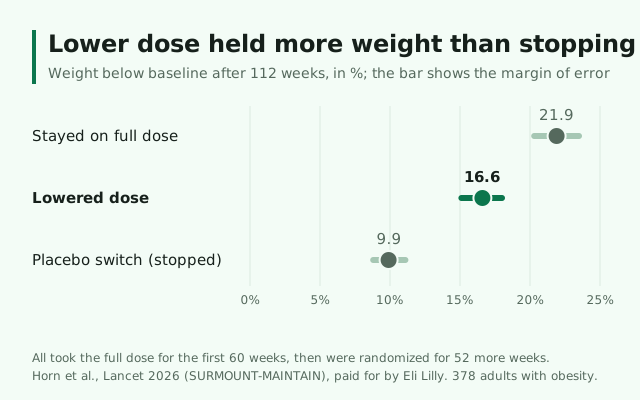
In the placebo group, most people regained so much weight that they had to go back on the drug before the study ended, which happened much less often on the reduced dose. The authors themselves wrote that lowering the dose may be an alternative to stopping, but that the response varies from person to person. The study did not test tapering, which means lowering the dose gradually until you reach zero: it compared staying on a lower dose with stopping. For anyone who wants to cut down until they come off the drug, there is still no study showing the best pace, and a 2026 review in Diabetes, Obesity and Metabolism points out that tested tapering schedules are lacking. The pace of the reduction and the dose at each step are for a conversation with your doctor, who will look at your weight, your health and your budget.
Another 2026 study, ATTAIN-MAINTAIN, published in Nature Medicine and also paid for by Lilly, tested switching the injection for a pill from the same family, orforglipron, in people who had lost weight on tirzepatide or semaglutide. Those who switched to the pill kept off more of the lost weight than those who switched to placebo. Since the study had no group that stayed on the injection, we can’t yet say whether the switch holds weight as well as staying on the shots.
Exercise that lasts after the drug
In the Danish study, carried out in Copenhagen, adults with obesity lost weight on a low-calorie diet and then spent a year in one of four groups: supervised exercise, liraglutide (an older injection from the same family as tirzepatide), both together, or placebo. The exercise program had two group classes a week, hard-paced stationary cycling followed by a circuit, plus two sessions on their own. One year after everything ended, the researchers asked how much each person was exercising. Those who had done the exercise program reported about four hours a week of moderate or vigorous activity, and those who had used only liraglutide, half an hour.
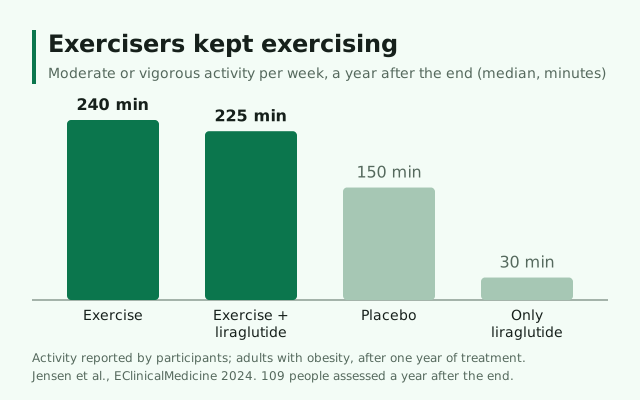
The exercise group kept its weight and body composition one year after finishing, while those who had used only the drug regained weight. Those who exercised along with the injection also regained weight when the drug stopped, but, over the two years combined, they ended up lighter than those who used only the injection, a difference that sat at the edge of statistical significance in the study. The simplest explanation, to me, is that the exercise habit continued after the program while the drug’s effect ended with it, which also explains why the group that had the injection regained some weight even while exercising. The study used liraglutide, not tirzepatide, and the authors of the review on stopping these injections found no other studies that tested exercise to hold weight after an injection. Even so, it is the best clue we have, and the kilos for each group are in the post about stopping weight-loss injections.
As for how much, the 2024 consensus of the American College of Sports Medicine (ACSM) supports exercise alongside drug treatment for obesity and says the effect on weight grows the more exercise a person does. The ACSM’s earlier position stand, from 2009, already noted that, after weight loss, people who do more than 250 minutes a week keep their weight off better, based on observational studies, which show association, not on randomized trials. That figure is close to the four hours of the Copenhagen exercise group. Starting from zero, getting there takes months, so it makes sense to begin while the drug is still holding hunger back and build up gradually, with the pace and type of training explained in the post on training zones.
Strength training comes in for a different reason. In a 2026 Australian study, published in Nature Medicine, adults who used tirzepatide with strength training three times a week lost about as much weight as those who used only the drug, but lost less lean mass and got stronger, while the group without training lost strength. Reaching the end of treatment with less muscle loss and more strength helps maintain your resting energy expenditure, and how to put that training together is in losing weight without losing muscle.
What to eat when hunger comes back
Without tirzepatide, feeling full depends more on what you eat. The study closest to this situation is DiOGenes, carried out in eight European countries with funding from the European Commission and published in 2010 in the New England Journal of Medicine. Adults who had lost weight on a low-calorie diet, without medication, were randomly assigned to five maintenance diets, none of them involving calorie counting. A little more protein and lower glycemic index carbohydrates (the ones that raise blood sugar more slowly) held weight better, and the diet with little protein and high glycemic index carbohydrates was the only one with clear regain.
In daily life, this can mean a protein source at every meal (eggs, meat, chicken, fish, yogurt or cheese), with vegetables filling a good part of the plate, for the fiber and the volume. Carbohydrates can be the slowly digested kind, such as beans, lentils, chickpeas, oats and whole fruit, in place of white bread, sweets and sugary drinks. If you can’t reach your protein target with food alone, you can use a supplement, such as whey protein, and the right amount for you is something to work out with a dietitian.
It also helps to have a plan for when the food noise returns. Keeping the meal rhythm that worked while you were on the injection, without long stretches without eating and with your snack already decided, keeps you from choosing food while hungry. Short sleep works against you, because it increases hunger (it’s in the post about sleep and fat loss). If the urge to eat turns into loss of control, with episodes of eating a lot in a short time, tell your doctor, because binge eating can be treated.
Weigh yourself often and agree on a limit
STOP Regain, published in 2006 in the New England Journal of Medicine, followed for a year and a half people who had lost a good amount of weight over the previous two years. Two groups received a program that taught them to weigh themselves every day and to act as soon as the scale went up, one in in-person meetings and the other online, and a third group received only newsletters every three months. At the end, the newsletter group had far more people regaining weight than the in-person group, with the online group in between, and those who started weighing themselves every day were less likely to regain weight.
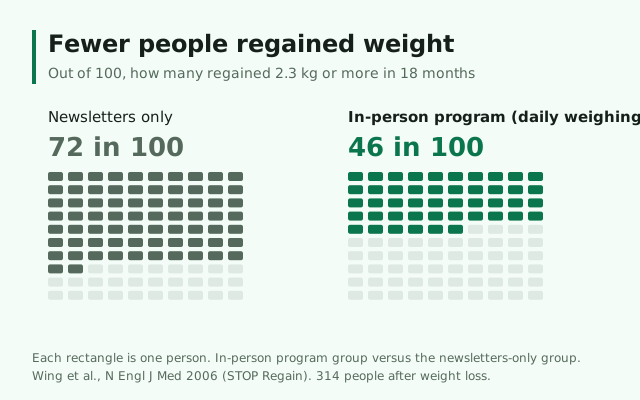
Agreeing with your doctor, before stopping, on how much regain means it’s time to review the plan keeps you from waiting for all the weight to come back before acting. An analysis of SURMOUNT-4 published in 2026 in JAMA Internal Medicine grouped people who stopped tirzepatide by how much weight they regained. In those who regained less than a quarter of the weight they had lost, waist size, the cholesterol that builds up in the arteries and blood insulin stayed close to where they were on the drug, and the greater the regain, the more these tests worsened.
A tape measure around the waist, once a month, complements the scale, and bioimpedance repeated after a few months separates fat from muscle in the weight that came back. If your weight goes past the agreed limit, going back on the drug is one of the options, and I described how that restart usually goes in the post about stopping weight-loss injections. The same review also notes that the English institute that sets health standards (NICE) recommends follow-up after stopping, but that there is little evidence that this support, on its own, holds the weight.
People with diabetes or prediabetes
For people who also use Mounjaro for type 2 diabetes, blood sugar usually gets worse soon after stopping, according to the review authors. HbA1c, the test that shows average blood sugar over the past few months, rises after the drug is gone, and in SURMOUNT-4, which only included people without diabetes, it rose too. In people who had prediabetes in SURMOUNT-1, the protection against diabetes that tirzepatide gave was almost entirely lost within four months off the drug, according to the same review.
That’s why people with diabetes need to agree with their doctor, before stopping, on how their blood sugar treatment will work. Treatment usually needs to be stepped up with other drugs, and the review authors suggest, when appropriate, those that don’t cause weight gain, such as metformin, instead of those that favor weight gain. Checking blood sugar more often in the following weeks helps catch the rise early, and people who had prediabetes need to repeat their tests after stopping.
On-and-off use has a cost too
Some people stop, regain weight, go back on the drug and then stop again, and the authors of the Nature Reviews Endocrinology review discuss this cycle. Ups and downs in weight and blood sugar are linked, in observational studies, to more heart and blood vessel problems and more diabetes complications. The authors suggest that cycles of starting and stopping the injection may carry this same risk, something no one has measured yet. They also bring up the emotional side, because the return of food noise can bring anxiety and frustration, and people who regain weight may struggle with body image and with stigma. All of this argues for deciding to stop calmly, together with your doctor, at a time when your weight is stable and your routine is organized.
What we know about each strategy
| Strategy | What the studies show | How much we know |
|---|---|---|
| Staying on the drug | holds the weight best | a lot: several randomized trials |
| Moving to a lower dose | kept off more weight than stopping and less than the full dose | one randomized trial, from 2026 |
| Switching to a pill from the same family | kept off more weight than placebo | one randomized trial, from 2026 |
| Tapering gradually until stopping | no comparative study yet | little |
| Exercise that becomes a habit | the habit continued; with the injection, ended lighter than the injection alone; without the injection, weight held steady | one randomized trial, with liraglutide |
| Strength training | protects muscle during treatment | one randomized trial, with tirzepatide |
| More protein and slowly digested carbohydrates | less regain after weight loss | one large randomized trial, without medication |
| Weighing yourself often | less regain | one randomized trial, from 2006 |
| Team support after stopping | recommended, no evidence that it holds the weight | little |
Signs the plan needs to change
Some signs call for contacting your doctor before your scheduled appointment. They apply both to people who have already stopped and to those who are lowering the dose:
- weight rising fast and going past the agreed limit;
- high blood sugar on home readings, or unusual thirst and urge to urinate, in people with diabetes;
- blood pressure rising on home readings in people with high blood pressure;
- episodes of uncontrolled eating, sadness or anxiety tied to food and weight;
- wanting to get pregnant, because the US prescribing information says to stop the drug during pregnancy and the plan for stopping needs to be agreed beforehand.
In practice
- Talk to your doctor before stopping and decide together whether to continue, lower the dose or stop, and when.
- Build exercise into your routine while you’re still on the drug, with strength training and aerobic activity, and keep it up after you stop.
- Build your meals around protein, vegetables and slowly digested carbohydrates, sleep well and have a plan for the moments when hunger comes back.
- Weigh yourself regularly, measure your waist and agree with your doctor on the regain limit that means it’s time to review the plan.
- If you have diabetes or prediabetes, leave the appointment with your blood sugar plan settled and check it more often in the first few months.
Conclusion
Of the ways to come off Mounjaro, the one with the most evidence today is staying on a lower dose instead of stopping altogether. In the study done with liraglutide, the exercise habit continued after treatment, and protein at meals and weighing yourself often reduced regain in people who had already lost weight. The decision to lower the dose, stop or continue should be made with your doctor, with a blood sugar plan for people with diabetes and a regain limit agreed before the last injection.
All the best!
G
Responsible physician: Dr. Gilberto Nering Junior, sports medicine physician, CRM-SP 160822, RQE 142486 (Sports Medicine, Brazil).
This text was not sponsored, is for information only and does not replace an individual assessment. Questions about the content: contact the clinic.
Cover illustration: feet on a digital scale with the weight on the display, generated by artificial intelligence.
Frequently asked questions about how to stop taking Mounjaro
How should I stop taking Mounjaro?
Together with the doctor who follows you, who decides whether it’s better to continue, move to a lower dose or stop, and when. In the studies, staying on a lower dose kept off more weight than stopping altogether, and people who already exercised during treatment kept the habit afterward.
Can I stop Mounjaro all at once?
Stopping all at once was the approach that let the most weight come back in the studies, and in people with diabetes blood sugar can rise soon after. Talk to your doctor first, because moving to a lower dose reduced regain in a 2026 study, and there is still no study showing the best pace for cutting down until stopping.
How do I avoid gaining weight after stopping Mounjaro?
No study has found a way to prevent all regain. In the studies, the people who lost less of their result were those who kept up the exercise they started during treatment, who ate more protein and slowly digested carbohydrates and who weighed themselves often, and getting enough sleep helps keep hunger in check. A regain limit agreed with your doctor helps you act early.
How much exercise should I do after stopping Mounjaro?
After weight loss, people who do more than 250 minutes of activity a week keep their weight off better, according to observational studies reviewed by the American College of Sports Medicine. Starting from zero, the safest approach is to begin while still on treatment and build up gradually, with strength training to protect muscle.
Is stopping Mounjaro harmful for people with diabetes?
Blood sugar usually rises after stopping, and the doctor needs to adjust treatment beforehand, usually with other diabetes drugs. People with prediabetes also need to repeat their tests, because the protection against diabetes is lost within a few months off the drug.
References
- Aronne LJ, Horn DB, le Roux CW, et al. Orforglipron for maintenance of body weight reduction: the double-blind, randomized phase 3b ATTAIN-MAINTAIN trial. Nat Med. 2026;32(7):2679-2687. doi:10.1038/s41591-026-04386-7
- Ceriello A, Prattichizzo F, Mastan Sheik Abdullah AR, et al. Causes and consequences of discontinuation of GLP1RAs or tirzepatide. Nat Rev Endocrinol. 2026;22(9):530-542. doi:10.1038/s41574-026-01258-5
- Donnelly JE, Blair SN, Jakicic JM, et al. American College of Sports Medicine Position Stand. Appropriate physical activity intervention strategies for weight loss and prevention of weight regain for adults. Med Sci Sports Exerc. 2009;41(2):459-471. doi:10.1249/MSS.0b013e3181949333
- Green DJ, Haynes A, Underwood DR, et al. Resistance exercise to attenuate lean mass loss during tirzepatide therapy for obesity: a randomized controlled trial. Nat Med. 2026. doi:10.1038/s41591-026-04752-5
- Hinte LC, Castellano-Castillo D, Ghosh A, et al. Adipose tissue retains an epigenetic memory of obesity after weight loss. Nature. 2024;636(8042):457-465. doi:10.1038/s41586-024-08165-7
- Horn DB, Aronne LJ, Wharton S, et al. Tirzepatide for maintenance of bodyweight reduction in people with obesity in the USA (SURMOUNT-MAINTAIN): a multicentre, double-blind, randomised, placebo-controlled trial. Lancet. 2026;407(10545):2305-2318. doi:10.1016/S0140-6736(26)00656-2
- Horn DB, Linetzky B, Davies MJ, et al. Cardiometabolic parameter change by weight regain on tirzepatide withdrawal in adults with obesity: a post hoc analysis of the SURMOUNT-4 trial. JAMA Intern Med. 2026;186(2):157-167. doi:10.1001/jamainternmed.2025.6112
- Jakicic JM, Apovian CM, Barr-Anderson DJ, et al. Physical activity and excess body weight and adiposity for adults. American College of Sports Medicine consensus statement. Med Sci Sports Exerc. 2024;56(10):2076-2091. doi:10.1249/MSS.0000000000003520
- Jensen SBK, Blond MB, Sandsdal RM, et al. Healthy weight loss maintenance with exercise, GLP-1 receptor agonist, or both combined followed by one year without treatment: a post-treatment analysis of a randomised placebo-controlled trial. EClinicalMedicine. 2024;69:102475. doi:10.1016/j.eclinm.2024.102475
- Larsen TM, Dalskov SM, van Baak M, et al. Diets with high or low protein content and glycemic index for weight-loss maintenance. N Engl J Med. 2010;363(22):2102-2113. doi:10.1056/NEJMoa1007137
- Shah E, AlShiab R, Abdo A, et al. Clinical management of weight regain and cardiometabolic consequences after discontinuation of GLP-1 receptor agonists. Diabetes Obes Metab. 2026;28(6):4546-4558. doi:10.1111/dom.70713
- West S, Scragg J, Aveyard P, et al. Weight regain after cessation of medication for weight management: systematic review and meta-analysis. BMJ. 2026;392:e085304. doi:10.1136/bmj-2025-085304
- Wing RR, Tate DF, Gorin AA, et al. A self-regulation program for maintenance of weight loss. N Engl J Med. 2006;355(15):1563-1571. doi:10.1056/NEJMoa061883