Also in: Português · Español · Italiano · 中文 · हिन्दी
Main points
- Short sleep does not stop weight loss, but it gets in the way of the diet. In a review of 41 trials, people who slept less ate on average 252.8 more calories per day.
- On a diet, short sleep can change where the lost weight comes from. In a small study, with 5.5 hours of sleep fat loss fell from 1.4 kg to 0.6 kg, and lean mass loss rose from 1.5 kg to 2.4 kg.
- Sleeping more may help: in a two-week trial, adults with overweight who started sleeping about 1.2 hours more per night ate 270 fewer calories per day than the control group.
- Quality counts along with hours. Waking up often at night and taking a long time to fall asleep were linked to less weight loss, and snoring with daytime tiredness calls for checking for sleep apnea.
Short sleep gets in the way of fat loss because it increases hunger and how much you eat and, during a diet, it can make a bigger share of the lost weight come from lean mass. The calorie deficit rule still holds: people who sleep little still lose weight if they eat less than they burn, and sleeping eight hours does not make anyone lose weight if they eat too much.
Sleep changes the calorie math
To lose fat, you need to burn more energy than you eat. Sleep does not change that rule, but it does affect the eating side.
A 2019 review pooled 41 trials in which healthy adults slept less than usual. On average, those who slept less felt hungrier, ate 252.8 more calories per day and gained 0.34 kg. On a diet designed to cut 300 or 400 calories a day, that difference can eat up a good part of the deficit.
A 2022 US study kept 12 young adults without obesity in hospital for three weeks, with food available freely. Over 14 days with only 4 hours for sleep, they ate more than during the 14 days with 9 hours, their energy expenditure did not change and their weight went up. Total body fat did not change significantly, but belly fat increased, including visceral fat, the kind that sits around the organs.
A moderate cut in sleep, repeated for weeks, already shows up on the scale. In a 2026 study of 95 adults, sleeping about 78 minutes less per night for six weeks increased weight by 0.45 kg and waist size by 0.52 cm. Sitting time also went up by 17 minutes a day.
Hunger, leptin and ghrelin
Leptin is the hormone that tells the brain there is stored energy and helps create a sense of fullness. Ghrelin does the opposite and increases hunger. The most repeated explanation is that short sleep lowers leptin, raises ghrelin, and that is why people eat more.
The studies do not confirm this explanation in such a simple way. In 44 adults in a Swedish study, one full night without sleep lowered leptin and raised ghrelin, and ghrelin rose more in people with obesity. But the review of 41 trials found no consistent effect of these two hormones across the studies, and in the 2026 study leptin actually went up with less sleep.
Another clue comes from the brain. In imaging studies, sleep deprivation changed how the brain responded to food cues in areas linked to reward and self-control. That may help explain why people who slept badly tend to eat more, even when the hormones change little.
Does short sleep slow your metabolism?
The studies do not support this idea. The 2019 review found no meaningful change in energy expenditure with less sleep, neither did the study of the 12 hospitalized adults, and a 2022 trial that increased sleep in adults with overweight, described further down, also saw no change in total daily expenditure.
What changes is how much you eat. If you want to know how much your body burns at rest, that can be measured with indirect calorimetry, and I explained the test in the post on metabolism.
Where the lost weight comes from
The scale shows how much weight you lost, not whether it was fat or lean mass. On a diet, the goal is for most of the lost weight to be fat and for lean mass, where your muscles are, to be preserved. Sleep seems to matter in exactly that split.
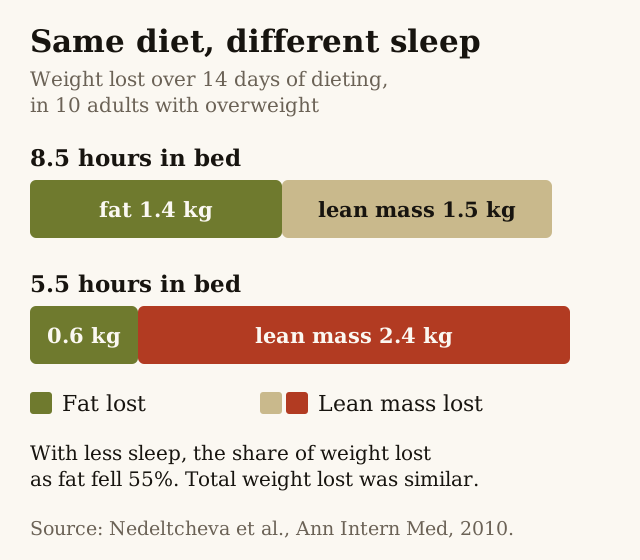
A 2010 study published in the Annals of Internal Medicine put 10 adults with overweight on the same diet for 14 days, twice: once with 8.5 hours in bed and once with 5.5 hours. The weight lost was similar, but the composition changed:
- With 8.5 hours, they lost 1.4 kg of fat and 1.5 kg of lean mass.
- With 5.5 hours, they lost only 0.6 kg of fat and 2.4 kg of lean mass.
With less sleep, the share of fat in the lost weight fell by 55%, lean mass loss rose by 60% and hunger increased.
A 2018 trial tested a more realistic cut. During 8 weeks of dieting, 36 adults with overweight or obesity were split into two groups, and one of them slept about 1 hour less on five nights a week, with free sleep on the other two. Both groups lost similar weight, but in the group that slept less, a smaller share of the lost weight was fat.
Both studies are small and short, and the 2026 one could not show a change in composition over six weeks. Even so, they point in the same direction. That is why, besides weight, it is worth tracking body composition with bioimpedance, which estimates over the months how much of the lost weight came from fat and how much from lean mass.
What about blood sugar?
Short sleep also affects insulin, the hormone that moves sugar from the blood into the cells. In the review of 41 trials, sleep deprivation reduced insulin sensitivity, meaning the body needed more insulin to handle the same amount of sugar.
This does not prevent fat loss when there is a calorie deficit. But people who sleep little are dieting in a less favorable metabolic environment.
Hours of sleep and sleep quality
The consensus of the US sleep medicine societies recommends that adults sleep 7 hours or more per night, on a regular schedule. In 2022, the American Heart Association began counting sleep as one of the eight pillars of heart health, along with diet, physical activity, weight, blood pressure, cholesterol, blood sugar and tobacco.
Time in bed and good sleep are different things. An 18-month weight loss program followed 156 adults with overweight and obesity, and average weight loss was 7.7 kg at 6 months. After that, it reached 8.4 kg at 12 months and stood at 7.1 kg at 18 months. Those whose sleep was less efficient, who woke up more often at night and who took longer to fall asleep lost less weight, even after accounting for how much they ate and exercised. Poor sleep was also linked to a lower chance of meeting the exercise target. Because it is an association study, it does not prove that poor sleep caused the smaller loss.
Does sleeping more help you lose weight?
A trial published in JAMA Internal Medicine in 2022 tested this outside the lab. It included 80 adults with overweight who slept less than 6.5 hours a night. Half received individual sleep hygiene coaching aimed at spending 8.5 hours in bed, and the other half kept their routine. No one got a diet or an exercise plan.
In two weeks, the coached group started sleeping about 1.2 hours more per night and ate 270 fewer calories per day than the control group. Energy expenditure did not change, and the group that slept more lost weight compared with the control group. The more people increased their sleep, the more their food intake dropped.
It lasted only two weeks, so it is not yet known how much of this holds up in the long run.
Does catching up on weekends make up for it?
In the 2018 trial, the group that slept less could sleep as much as they wanted on two nights a week and, on those days, slept about 1 hour more. Even so, they lost proportionally less fat than the group that slept normally all week.
In that study, the two longer nights were not enough to make up for the five short ones. It was not designed to test sleep recovery, so this still needs to be confirmed.
Snoring, sleep apnea and weight
When someone with overweight sleeps badly, it is worth thinking about obstructive sleep apnea, in which the throat closes several times during the night and sleep gets broken up. Excess weight makes apnea worse, and fragmented sleep can get in the way of weight loss.
Loud snoring, breathing pauses noticed by a bed partner, and tiredness and sleepiness during the day are warning signs. A simple questionnaire, STOP-Bang, helps with screening: in a review of 3,247 patients about to have surgery, it identified 85% of the people with apnea, but it also flagged many people who did not have it. So it is useful for showing who needs testing, and the diagnosis is made with a sleep study.
Treating weight also helps apnea. In two trials published together in the New England Journal of Medicine in 2024, in adults with obesity and moderate to severe apnea, tirzepatide (Mounjaro) reduced breathing pauses and drops during sleep by 20 to 24 more events per hour than placebo, after one year. I wrote about these medications in the post on weight-loss injections.
The main studies at a glance
| Study | Who took part | Duration | Result |
|---|---|---|---|
| 2019 review | 41 trials in healthy adults | Varied | With less sleep, 252.8 more calories per day and 0.34 kg more weight |
| 2022 study (in hospital) | 12 adults without obesity | 14 days with 4 hours of sleep | Ate more, same expenditure, more belly fat |
| 2026 study | 95 adults | 6 weeks with 78 minutes less per night | Weight 0.45 kg and waist 0.52 cm higher |
| 2010 study | 10 adults with overweight on a diet | 14 days with 5.5 hours in bed | Less fat and more lean mass in the weight lost |
| 2018 trial | 36 adults with overweight or obesity on a diet | 8 weeks, 1 hour less on 5 nights | Smaller share of the lost weight was fat |
| 2022 trial (sleeping more) | 80 adults with overweight | 2 weeks | About 1.2 hours more sleep and 270 fewer calories per day than the control group |
What to do in practice
- Treat sleep as part of your weight loss plan, along with food and training.
- Aim for 7 hours or more per night, at a similar time every day. In the 2022 trial that increased sleep, the coaching was individual, with the goal of spending 8.5 hours in bed.
- Avoid cutting sleep to train. An extra hour of training with an hour less of sleep can cost you in hunger.
- Track body composition, not just weight, to know whether the diet is taking off fat.
- If you snore, wake up tired or doze off during the day, get checked for apnea.
In the post on a low sleep score, I covered what most disrupts sleep day to day, such as alcohol, caffeine and late meals, and how to use the numbers from your watch.
Conclusion
Short sleep increases hunger and the urge to eat, worsens the insulin response and, in small studies done during dieting, made a bigger share of the lost weight come from lean mass. In one trial, sleeping more helped adults with overweight eat less, without any diet.
Sleep well, and see you next time!
Responsible physician: Dr. Gilberto Nering Junior, sports medicine physician, CRM-SP 160822, RQE 142486 (Sports Medicine, Brazil).
This text was not sponsored, is for information only and does not replace an individual assessment. Questions about the content: contact the clinic.
Cover photo: Greg Pappas on Unsplash.
Quick questions about sleep and weight loss
Does short sleep make you gain weight?
Short sleep increases hunger and the amount of food you eat. In a review of 41 trials, people who slept less ate on average 252.8 more calories per day and gained 0.34 kg. The weight gain comes mainly from that increase in eating.
How many hours do I need to sleep to lose weight?
The consensus of the US sleep medicine societies recommends 7 hours or more per night for adults. The studies do not set a specific number of hours for weight loss, but regularly sleeping less than that can get in the way of the diet.
Does sleeping more make you lose weight on its own?
It may help. In a trial of 80 adults with overweight, those who started sleeping about 1.2 hours more per night ate 270 fewer calories per day than the control group, without a diet, over two weeks. Weight loss still depends on a calorie deficit.
Does sleeping in on weekends make up for the week?
Not completely. In an 8-week trial, sleeping freely on two nights a week was not enough to make up for the other five short nights when it came to fat loss. The study was not designed to test sleep recovery.
Does snoring get in the way of weight loss?
Loud snoring with daytime tiredness can be a sign of sleep apnea, which fragments sleep and is linked to excess weight. It is worth checking, because apnea can be treated, and losing weight usually improves apnea.
References
- Covassin N, Singh P, McCrady-Spitzer SK, et al. Effects of experimental sleep restriction on energy intake, energy expenditure, and visceral obesity. J Am Coll Cardiol. 2022;79(13):1254-1265. doi:10.1016/j.jacc.2022.01.038
- Creasy SA, Ostendorf DM, Blankenship JM, et al. Effect of sleep on weight loss and adherence to diet and physical activity recommendations during an 18-month behavioral weight loss intervention. Int J Obes (Lond). 2022;46(8):1510-1517. doi:10.1038/s41366-022-01141-z
- Hwang M, Nagappa M, Guluzade N, et al. Validation of the STOP-Bang questionnaire as a preoperative screening tool for obstructive sleep apnea: a systematic review and meta-analysis. BMC Anesthesiol. 2022;22(1):366. doi:10.1186/s12871-022-01912-1
- Lloyd-Jones DM, Allen NB, Anderson CAM, et al. Life’s Essential 8: updating and enhancing the American Heart Association’s construct of cardiovascular health: a presidential advisory from the American Heart Association. Circulation. 2022;146(5):e18-e43. doi:10.1161/CIR.0000000000001078
- Malhotra A, Grunstein RR, Fietze I, et al. Tirzepatide for the treatment of obstructive sleep apnea and obesity. N Engl J Med. 2024;391(13):1193-1205. doi:10.1056/NEJMoa2404881
- Nedeltcheva AV, Kilkus JM, Imperial J, et al. Insufficient sleep undermines dietary efforts to reduce adiposity. Ann Intern Med. 2010;153(7):435-441. doi:10.7326/0003-4819-153-7-201010050-00006
- Tasali E, Wroblewski K, Kahn E, et al. Effect of sleep extension on objectively assessed energy intake among adults with overweight in real-life settings: a randomized clinical trial. JAMA Intern Med. 2022;182(4):365-374. doi:10.1001/jamainternmed.2021.8098
- van Egmond LT, Meth EMS, Engström J, et al. Effects of acute sleep loss on leptin, ghrelin, and adiponectin in adults with healthy weight and obesity: a laboratory study. Obesity (Silver Spring). 2023;31(3):635-641. doi:10.1002/oby.23616
- Wang X, Sparks JR, Bowyer KP, et al. Influence of sleep restriction on weight loss outcomes associated with caloric restriction. Sleep. 2018;41(5). doi:10.1093/sleep/zsy027
- Watson NF, Badr MS, Belenky G, et al. Recommended amount of sleep for a healthy adult: a joint consensus statement of the American Academy of Sleep Medicine and Sleep Research Society. Sleep. 2015;38(6):843-844. doi:10.5665/sleep.4716
- Zhu B, Shi C, Park CG, et al. Effects of sleep restriction on metabolism-related parameters in healthy adults: a comprehensive review and meta-analysis of randomized controlled trials. Sleep Med Rev. 2019;45:18-30. doi:10.1016/j.smrv.2019.02.002
- Zuraikat FM, Scaccia SE, Cochran JA, et al. Prolonged short sleep and its effect on body weight and composition: a pooled analysis of randomized trials. Ann Intern Med. 2026;179(8):1085-1093. doi:10.7326/ANNALS-25-01660