Also in: Português · Español · Italiano · 中文 · हिन्दी
Main points
- A good part of the day’s testosterone is released while you sleep, and just one week of short sleep already lowers the hormone a little.
- Excess body fat gets in the way of production, and losing weight makes testosterone go up.
- Eating too little and training too much also bring the hormone down, athletes included.
- In the studies, men who smoked cannabis did not have lower testosterone, but in one large study those who smoked more than once a week had fewer sperm.
- There is no proof that supplements and probiotics sold to raise testosterone work.
When someone finds out their testosterone is low, the first thought is usually replacement. Before that, it pays to look at your routine, because much of what brings testosterone down is part of daily life and can be fixed.
In this post I go through the most common suspects: sleep, weight, very restrictive diets, alcohol, cannabis and even the gut. For some the evidence is good, for others it is weak, and I tell you which is which. If you want to understand how true low testosterone is confirmed, I wrote about it in the post low testosterone: when to treat and when not to.
Short sleep, less testosterone
Most of the day’s testosterone is released during sleep, which is why poor sleep weighs so heavily. Sleep apnea and broken sleep are also linked to lower testosterone.
A University of Chicago study had 10 young, healthy men sleep 5 hours a night for a week, in the lab. Their sleep went from almost 9 hours to less than 5, daytime testosterone fell by 10% to 15%, and they felt less energetic with each passing day. The drop showed up mainly in the afternoon and evening, and cortisol, the stress hormone, did not change. For comparison, aging lowers testosterone by about 1% to 2% a year. And sleeping 5 hours is not rare: the study notes that at least 15% of American workers sleep that little.
The authors point out a detail I find important: low energy, low sex drive, trouble concentrating and sleepiness are symptoms of both low testosterone and short sleep. Sometimes the tiredness that looks hormonal is, first of all, about sleep.
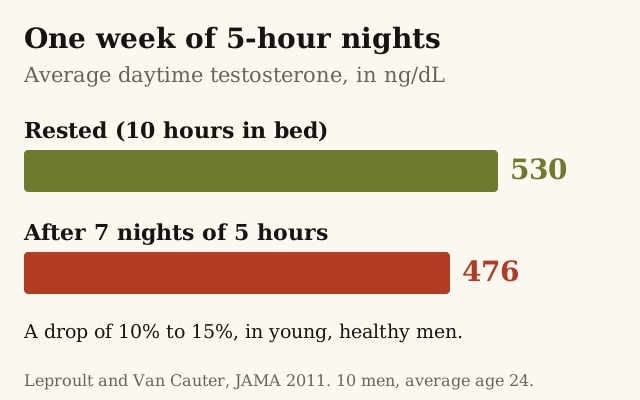
It was a small, short study, but it shows that one week of sleeping 5 hours is already enough to affect the hormone, even in young men. The values stayed well above the cutoff for low testosterone, and the study did not measure how long it takes to recover. If you snore loudly, wake up tired or someone has seen you stop breathing in your sleep, it’s worth getting checked for apnea. I also wrote about how short sleep gets in the way of losing fat and whether training at night hurts your sleep.
Weight: the most common cause
The 2026 Brazilian guideline on low testosterone says excess weight is the most common functional cause, meaning one where the testicle works but something from outside gets in the way. Excess fat turns part of the testosterone into estradiol, an estrogen that men also make, but that causes trouble when there is too much of it. According to the most widely accepted explanations, excess fat also brings inflammation and leptin resistance, which throw off the brain’s control of the testicle.
Losing weight reverses part of this. In a Japanese study, 44 men with overweight or obesity did 12 weeks of diet plus walking and jogging, lost 11 kg on average, and their testosterone rose from about 355 to 381 ng/dL. Blood pressure, cholesterol and insulin also improved.
The rise was modest in that study. In a review of 24 studies, it was bigger in men who lost more weight, and bigger still after bariatric surgery. That is why the Brazilian guideline puts weight loss ahead of the hormone for people with overweight and low testosterone. Just take care not to lose muscle along the way; I wrote about how to lose weight without losing muscle.
Eating too little and training too much
Here the problem is the opposite. When the body takes in less energy than it burns for a long time, it saves where it can, and making sex hormones is one of the functions it cuts back. The Brazilian guideline explains that, when energy is short, the brain reduces the pulses of the hormone that drives the testicle, and testosterone falls.
In sport this has a name, relative energy deficiency in sport (RED-S), and it shows up in runners, cyclists, fighters who cut weight and anyone who takes dieting to extremes. People who train a lot and eat little usually have other signs as well: tiredness that won’t go away, stress fractures and falling performance. In cyclists and swimmers, who train without impact, low testosterone combined with the lack of energy can also weaken the bones.
Exercise: does it help or hurt?
It depends on the dose. The Brazilian guideline says regular exercise, both aerobic and strength training, can raise testosterone and improves body composition and insulin sensitivity. The Japanese study above combined walking and jogging with diet, and testosterone went up, but since the two came together, there is no way to know how much came from each.
Exhausting, prolonged training, on the other hand, can lower testosterone for a while, because cortisol goes up. If you train, the message is to balance volume and rest, and not to live on the edge of exhaustion.
Alcohol and medications
The Brazilian guideline lists alcohol abuse among the causes of low testosterone that can improve when the habit changes. The same goes for some medications:
- opioids, such as morphine, codeine and tramadol;
- corticosteroids taken for a long time;
- anabolic steroids, during and after use, sometimes for years, as I explained in the post on low testosterone after a steroid cycle.
Never stop a medication on your own. Bring the list to your appointment, because sometimes it can be switched or adjusted.
What about cannabis?
In a Brazilian study of 153 men seeking infertility treatment in São Paulo, those who had smoked cannabis at least once a week for at least a year had testosterone similar to the others. They made up 27% of the group. The difference showed up in other hormones: lower estradiol, higher prolactin (a hormone that, when high, can lower sex drive) and more SHBG, the protein that carries testosterone in the blood.
In a Danish study of 1,215 young men, those who smoked cannabis had testosterone that was, if anything, slightly higher, similar to that of cigarette smokers. But those who smoked more than once a week had about 28% fewer sperm per milliliter of semen. When they also used other drugs, the drop was more than half.
So, in the studies we have, cannabis does not come across as a major villain for testosterone. The clearest warning is about fertility, and anyone trying to have children should take it into account. The Brazilian guideline lists cannabis abuse among the functional causes of low hormone levels, and these two studies do not settle the question.
Age matters too, but slowly
With age, total testosterone falls by about 1.6% a year and SHBG rises by about 1.3% a year, according to the Brazilian guideline. This means that, over time, less free testosterone is left to do its job.
It is a slow decline, but it adds up over the years. The guideline does not recommend testosterone replacement just because of age, without symptoms and without a test confirming the deficiency. Short sleep and excess weight also take a toll, and those you can change, so they are a good place to start.
The gut and testosterone
The trend right now is to say the gut controls hormones. A 2025 review pooled 10 studies, with about 36,000 men in total, and found a link between gut bacteria and testosterone. One group of bacteria, Ruminococcus, appeared more closely tied to the hormone than the others.
But these were observational studies (plus one lab study), which show association, not cause. The authors themselves say the field is in its early days and that there is no way to know which influences which, because weight, diet and habits change both at the same time. There is still no probiotic proven to raise testosterone.
Supplements to raise testosterone
The shelves are full of capsules that promise to raise testosterone. The 2026 Brazilian guideline says the evidence for these products is low and does not recommend routine use. It also asks that people who use them be told that the content varies from one product to another and that there are risks. Your money goes further on sleep, real food and training.
The suspects at a glance
| Suspect | What the studies show | Strength of the evidence |
|---|---|---|
| Excess weight | Testosterone rises when weight comes down | Strong: guideline and review of 24 studies |
| Eating too little and training too much | The brain turns down its signal to the testicle | Good: Brazilian guideline and International Olympic Committee consensus |
| Medications (opioids, corticosteroids, anabolic steroids) | Lower the body’s own production | Good: guideline |
| Short sleep | One week of 5-hour nights lowered it by 10% to 15% | Moderate: small study of 10 men |
| Too much alcohol | Listed among the causes that improve when the habit changes | Moderate: listed by the guideline |
| Cannabis | Testosterone was not lower, but there were fewer sperm | Weak for testosterone, worrying for fertility |
| Gut | A link in observational studies | Weak |
| Supplements | No proof of effect | Weak |
What really helps
Putting together what the studies show, the list is short:
- get enough sleep, and treat snoring and apnea if you have them;
- lose weight if you are overweight, without extreme diets;
- eat enough for the amount you train;
- train regularly, both strength and aerobic, without living on the edge of exhaustion;
- drink little alcohol;
- if you want to have children and smoke cannabis, stop;
- go over the medications you take with your doctor.
None of this works as fast as a hormone, but it goes after the cause.
When to see a doctor
Changing your routine is the first step, but some signs call for an assessment soon:
- lower sex drive and fewer morning erections;
- loss of facial and body hair;
- breast growth;
- hot flashes;
- a fracture after minor trauma;
- wanting to have children and not managing to.
In these cases, the right test and a search for the cause come before any decision. I explained this path in the post on when to treat low testosterone, and if you are thinking about replacement, you can also read whether testosterone replacement is bad for the heart.
If your testosterone came back low, it helps to arrive at the appointment with a few answers ready: how many hours you sleep, whether you snore, how much you weigh and how much you eat, how much you train, what you drink and which medications and supplements you take. Also bring the test, drawn in the morning while fasting; if it came back low, it needs to be repeated the same way. These answers help find the cause before any decision about replacement.
Conclusion
Of the everyday causes, excess weight has the strongest evidence for lowering testosterone, and losing weight makes the hormone go up. Short sleep and a very restrictive diet combined with hard training also bring it down, and all of these can be fixed. Alcohol and some medications are on the list too. In the studies, men who smoked cannabis did not have lower testosterone, but in one large study those who smoked more than once a week had fewer sperm. For the gut and for supplements, there is still no proof of effect.
Until next time, and take care!
Responsible physician: Dr. Gilberto Nering Junior, sports medicine physician, CRM-SP 160822, RQE 142486 (Sports Medicine, Brazil).
This text was not sponsored, is for information only and does not replace an individual assessment. Questions about the content: contact the clinic.
Cover photo: Hadi Samadzad on Unsplash.
Frequently asked questions about what lowers testosterone
Does short sleep lower testosterone?
Yes. In a study of young men, one week of sleeping 5 hours a night lowered daytime testosterone by 10% to 15%. Sleep apnea is also linked to lower testosterone.
Does losing weight raise testosterone?
In men with overweight or obesity, yes. Testosterone rises when weight comes down, and the rise is usually bigger in those who lose more. So weight loss is the first treatment for people with overweight and low testosterone.
Does cannabis lower testosterone?
Not clearly, in the studies we have. In a Danish study, men who smoked cannabis even had slightly higher testosterone, but those who smoked more than once a week had fewer sperm. The bigger warning is about fertility.
Does alcohol lower testosterone?
Alcohol abuse is among the causes of low testosterone listed by the Brazilian guideline, and the problem can improve when drinking goes down.
Do testosterone-boosting supplements work?
The 2026 Brazilian guideline says the evidence is low and does not recommend routine use. Sleep, weight, diet and training pay off more.
References
- Corona G, Rastrelli G, Monami M, et al. Body weight loss reverts obesity-associated hypogonadotropic hypogonadism: a systematic review and meta-analysis. Eur J Endocrinol. 2013;168(6):829-43. doi:10.1530/EJE-12-0955
- Gundersen TD, Jørgensen N, Andersson AM, et al. Association Between Use of Marijuana and Male Reproductive Hormones and Semen Quality: A Study Among 1,215 Healthy Young Men. Am J Epidemiol. 2015;182(6):473-81. doi:10.1093/aje/kwv135
- Hohl A, Lopes L, Ronsoni MF, et al. Care of Patients with Male Hypogonadism: A Joint Position Statement from the Brazilian Society of Endocrinology and Metabolism (SBEM), the Brazilian Society of Urology (SBU), and the Brazilian Association for Sexual Medicine and Health (ABEMSS). Int Braz J Urol. 2026;52(3):e20250610. doi:10.1590/S1677-5538.IBJU.2025.0610
- Kumagai H, Zempo-Miyaki A, Yoshikawa T, et al. Lifestyle modification increases serum testosterone level and decrease central blood pressure in overweight and obese men. Endocr J. 2015;62(5):423-30. doi:10.1507/endocrj.EJ14-0555
- Leproult R, Van Cauter E. Effect of 1 week of sleep restriction on testosterone levels in young healthy men. JAMA. 2011;305(21):2173-4. doi:10.1001/jama.2011.710
- Mountjoy M, Ackerman KE, Bailey DM, et al. 2023 International Olympic Committee’s (IOC) consensus statement on Relative Energy Deficiency in Sport (REDs). Br J Sports Med. 2023;57(17):1073-1097. doi:10.1136/bjsports-2023-106994
- Pakpahan C, Laurus G, Hartanto MC, et al. Potential relationship of the gut microbiome with testosterone level in men: a systematic review. PeerJ. 2025;13:e19289. doi:10.7717/peerj.19289
- Teixeira TA, Iori I, Andrade G, et al. Marijuana Is Associated With a Hormonal Imbalance Among Several Habits Related to Male Infertility: A Retrospective Study. Front Reprod Health. 2022;4:820451. doi:10.3389/frph.2022.820451