Also in: Português · Español · Italiano · 中文 · हिन्दी
Main points
- The indirect calorimetry device compares the air you breathe in with the air you breathe out and, using an old physiology equation, turns that difference into the calories your body burns at rest.
- You stay at rest, lying down, reclining or sitting, breathing through a mask, a mouthpiece or a clear hood, and the measurement itself usually takes less than half an hour.
- Preparation means fasting, no coffee, cigarettes or hard training beforehand and a rest period on arrival, because eating, using stimulants, training and arriving without resting all push the result up.
- The report gives your resting energy expenditure in calories per day and the respiratory quotient, which shows whether the body was burning more fat or more carbohydrate and helps check whether the measurement was good.
- The test makes the most sense when the number will guide a decision: people who don’t lose weight while eating little, people with severe obesity, people who have lost a lot of weight and athletes who seem to eat less than they burn.
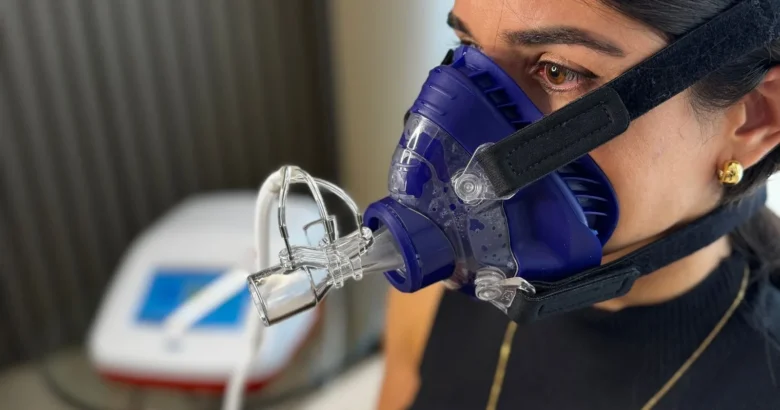
In an indirect calorimetry test, you rest in a quiet room, fasting, and breathe normally through a mask, a mouthpiece or a clear hood. Meanwhile, a device called a calorimeter analyzes the air going in and the air coming out. From the difference between the two, it works out how much oxygen your body used and how much carbon dioxide it produced, and an equation turns these values into the calories you burn at rest over 24 hours. Indirect calorimetry replaces the formula’s guess with your measured expenditure, and that number helps build the diet of people who want to lose weight or gain mass and helps investigate why someone eats little and doesn’t lose weight. There are no needles and no effort, and the measurement itself takes 10 to 25 minutes, after a rest period.
Whoever performs calorimetry follows a protocol built from the research: the review in which the US Academy of Nutrition and Dietetics gathered the studies on each detail of the measurement, from fasting to the type of mask, and answered the practical questions about the test. It came out in 2015 in the Journal of the Academy of Nutrition and Dietetics, updated the first version, from 2006, and guides this post. The test had come up in a few lines, with the preparation summed up in a list, in the post about how many calories you burn at rest. Here I take the test apart, from the air that becomes calories to what each number on the report means, with the studies that compared the mask with the hood, one device with another and the test with the formulas.
What indirect calorimetry is and what it measures
Indirect calorimetry measures two things in your breath, minute by minute: the oxygen your body consumes and the carbon dioxide it produces. With these two values, the device calculates your resting energy expenditure, the calories your body uses over 24 hours just to keep running, and the respiratory quotient, which shows whether the main fuel at that moment was fat or carbohydrate.
With this number, the diet math starts from your measured expenditure, and the formula, which sums up the average of a group of volunteers, is left only as a comparison. An international group of experts on the test, ICALIC, published a position paper in 2017 in Clinical Nutrition pointing out that calorimetry can be done both in hospitalized patients and in people seen at the office, and that formulas based on weight and height miss when applied to a single person.
How indirect calorimetry turns air into calories
Indirect calorimetry works because, to get energy from food, cells burn fat and carbohydrate, plus a little protein, with the help of oxygen, leaving carbon dioxide and water behind. The more energy the body uses, the more oxygen it consumes and the more gas it releases. That is where the name comes from: direct calorimetry measures the heat the body produces, inside a closed, expensive chamber used almost only in research; indirect calorimetry calculates the same energy from the gases you breathe.
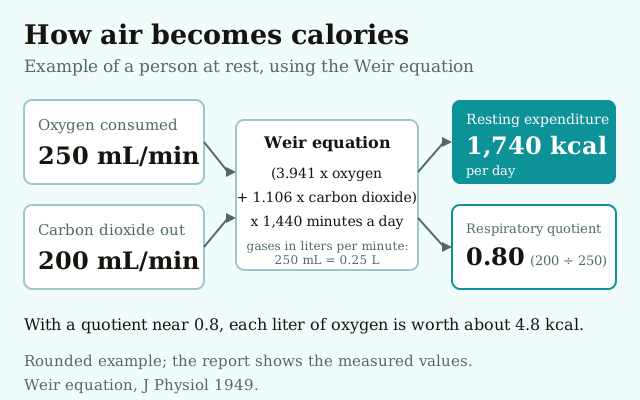
In 1949, the physiologist Weir published in the Journal of Physiology the equation still used today. It multiplies each gas by a fixed number and adds the results, and, with the quotient near 0.8, each liter of oxygen consumed is worth about 4.8 kcal. In the chart’s example, a person who consumes 250 mL of oxygen and releases 200 mL of carbon dioxide per minute burns about 1,740 kcal in 24 hours, with a quotient of 0.80.
The second gas goes into the equation because the value of each liter of oxygen shifts a little with the fuel: burning only carbohydrate, it yields about 7% more energy than burning only fat. A device that measures only oxygen and assumes a fixed quotient, like some handheld portable models, is exposed to part of that difference. A 2025 review of the devices used in adults with overweight and obesity found the handheld model it assessed, which measures only oxygen, unreliable, both when compared with reference devices and when the measurement was repeated, while the desktop devices repeated their own results well.
What the test is like, step by step
Each step of the test exists so that you are truly at rest when the measurement starts. The protocol below follows the 2006 and 2015 reviews on rest, collection and steady state, and each service adjusts the details to the device it uses:
- You arrive with the agreed preparation done, fasting and with no stimulants (I explain each item further down), and you tell the person running the test which medicines you take.
- You rest in a quiet room, with dim light and a comfortable temperature, lying down, reclining or sitting, depending on the device (the 2015 review recommends lying down). The 2006 review found that 10 to 20 minutes are enough to erase the effect of walking there, and the 2015 review recommends 30 minutes.
- The person running the test puts on the mask, the mouthpiece with a nose clip or the hood, a clear dome that covers the head, and checks that no air is leaking.
- You breathe normally, awake and still. The 2015 review asks that, during the rest before the measurement, you don’t move, read or listen to music. The same care applies during collection, and that includes your phone.
- The device discards the first 5 minutes, while your breathing settles. Then it looks for a 5-minute stretch in which both gases vary by less than 10%, the steady state, and that stretch is what becomes the 24-hour expenditure.
- The report comes out right after, with the numbers I explain further on.
The 2006 review found that 10 minutes of collection, with the first 5 thrown out, already gave a reliable value when the final stretch was steady. Adding the rest, the whole test usually fits in less than an hour. In 2020, a study in adults with overweight and obesity showed that most of them reached the steady stretch right at the start of collection. For those who don’t reach it, the authors concluded that slightly shorter steady stretches seem to work, because they gave values similar to those of the 5-minute stretch and closer to it than the formulas did.
Mask, mouthpiece or hood: does it change the result?
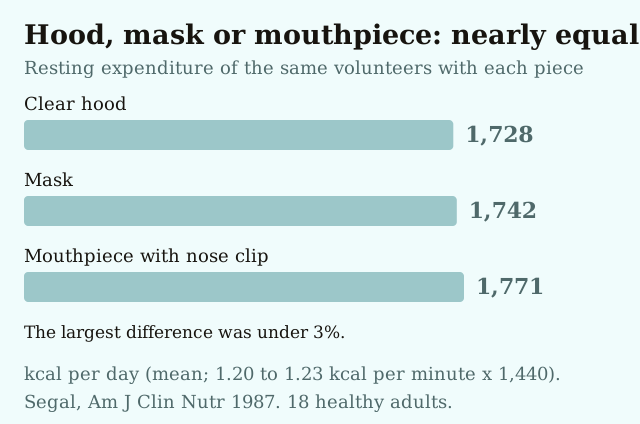
In healthy people, the piece barely moves the number. In a 1987 study published in the American Journal of Clinical Nutrition, adults without disease were measured with all three pieces, one after the other in random order, and the calculated expenditure came out similar with all three, with a difference of less than 3% between the lowest and the highest value.
In patients, the choice may matter more, as a 2022 study published in Clinical Nutrition suggests. It tested a new device with a hood and with a mask and compared both with another device used with a hood. With the hood, the values from the two devices were similar; with the mask, the measurement reached a steady state in fewer patients and came out high in men. What matters most for you is that the piece fits well, without leaks, and that the test is always repeated with the same piece and on the same device, so one result can be compared with the other.
How to prepare for the test and why each rule exists
Fasting comes first: at least 7 hours, because digesting food uses energy and raises the result. The test measures resting expenditure, so anything that speeds up the body in the hours before ends up in the number. The 2006 review already said that food, alcohol, caffeine and nicotine affect expenditure for a variable number of hours, and that moderate or vigorous exercise leaves a longer effect. The 2015 review set times for fasting and rest, gave only a minimum time for caffeine and nicotine, because no one knows how long their effect lasts, and admitted it did not know even that minimum for exercise. The other items in the table follow the 2006 review and the Italian study cited later, with an extra safety margin:
| What to do before | Why it matters |
|---|---|
| Fast for at least 7 hours | digesting food uses energy and raises the result |
| No coffee, black tea, energy drinks or other sources of caffeine from the day before, or for well over 4 hours | the effect of caffeine on expenditure lasts more than 4 hours |
| No cigarettes or other forms of nicotine for well over 2 hours | the effect of nicotine on expenditure lasts more than 2 hours and 20 minutes |
| No alcohol the day before | alcohol affects expenditure for hours, and the Italian study cited later asked for 24 hours without drinking |
| No hard training the day before or on the day of the test | the effect of exercise on expenditure lasts for hours, and no one knows for sure how many |
| Rest for 10 to 30 minutes before, lying down, reclining or sitting, depending on the device | erases the effect of walking, climbing stairs and driving to the test |
| Same time of day and same preparation when you repeat it | the test is valid at any time of day, but comparing two tests requires the same conditions |
Training is the item with the least certainty, and that is where the table’s safety margin counts the most. A test the morning after heavy strength training risks measuring that effect: in a small 2002 study, young men who trained hard still had resting oxygen consumption above their pre-training values in the next day’s measurements. That’s why I prefer at least one full day without hard training before the test, and a light walk to the site does no harm when there is time left to rest.
The 2015 review also warns that few of its conclusions rest on strong evidence. Studies on preparation are few and small, and almost all were done in healthy adults. The time limits are a reasonable compromise between what is known and what people can follow, and for anyone repeating the test, the most important thing is to keep the same preparation every time. Don’t stop a regular medicine on your own before the test, and tell the person running it, because other stimulants, such as some ADHD medicines, also affect expenditure.
What each number on the report means
The calorimetry report fits on one page. Only one of the numbers goes straight into the diet math, and the others show where it came from and whether the measurement was good:
- Resting energy expenditure, in kcal per day, is the main number: the calories your body burns over 24 hours at rest, awake and fasting.
- Oxygen consumption and carbon dioxide production, in mL per minute, are the device’s two measurements, and the other numbers come from them.
- The respiratory quotient is carbon dioxide divided by oxygen, and it shows whether the body is burning more fat or more carbohydrate at that moment.
- The predicted value is what a formula estimates for your weight, height, age and sex, and the percentage of measured over predicted shows whether you are close to what is expected for your body.
- The measurement curve shows the minutes of the test and the steady stretch used in the calculation, and helps you see whether your breathing settled.
- Whole-day expenditure and the calories for each activity, when they appear, are estimates, not measurements, much like the calorie count on a watch, which is often well off (I showed this in the post about which wearable is most accurate). The device multiplies resting expenditure by an activity factor, and this kind of factor tends to err on the high side.
How to read the respiratory quotient
Fasting and at rest, the quotient usually sits around 0.8 to 0.85, a sign of a mix of fat and carbohydrate. Near 0.7, the body is burning almost only fat, as after a long fast, and near 1.0, almost only carbohydrate, as right after a carbohydrate-rich meal. Values outside the range the body can produce, about 0.67 to 1.3, point to a measurement error, such as an air leak, and call for a new test; breathing too fast, from anxiety, can also shift the number.
A 2003 US study of long-term hospitalized patients, almost all on a ventilator, concluded that the quotient is not useful for fine-tuning the diet and that its safest use is to check whether the measurement was good. Outside the hospital the same caution applies: a quotient of 0.78 or 0.86 in a well-done test is neither good nor bad and, on its own, is no reason to change the diet.
The margin of error of the formula and of the test
For a single person, the formula misses by more than the test does. An Italian study from 2017, published in the International Journal of Obesity, compared the measured expenditure of patients with obesity with that of several well-known formulas. On the group average, some formulas came close to the measured value, but, person by person, even the best formulas came within 10% of the measured value in only about 55% of patients, and most of them failed in women with severe obesity.
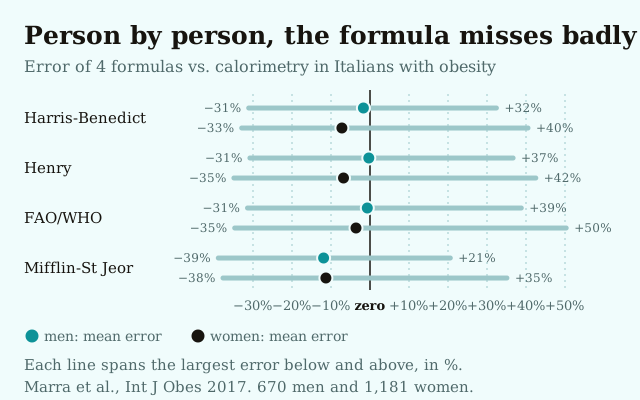
In men, the dot for three of the four formulas sits near zero, and the Mifflin-St Jeor dot sits to the left, because it underestimated even on average. In women, all four underestimated even on average. The ends of each line show the people for whom the formula missed the most, high and low, even for the formulas with the best average. With an expenditure of 2,000 kcal, a 30% error equals 600 kcal a day, more than the deficit of many diets.
Calorimetry has error too, just less: in a Spanish study from 2022, also in Clinical Nutrition, young adults took the test twice, one day apart, on four different desktop devices, and the same person’s result varied on average by 4% to 6% from one day to the next, depending on the device. The four devices, however, did not give the same number as each other. So compare only tests done on the same device, and treat a difference of a few percent between two of them as variation in the measurement itself.
Who the test makes sense for
The test is worth it when the number will change a decision. It helps even more when there is reason to think the formula will be wrong for you, as in these cases:
- People who eat little and don’t lose weight, or who stopped losing weight partway, as I described when I wrote about the weight-loss plateau. Measuring separates a truly low expenditure from a formula that got it wrong.
- People with obesity, especially severe obesity, for whom formulas miss more, and those who are going to have or have already had bariatric surgery.
- People about to start a diet or treatment with a weight-loss injection who want to start from a measured number.
- People who have already lost a lot of weight and want to know how much their body now burns, to adjust the plan without cutting too much.
- Athletes and active people who train a lot and seem to eat less than they burn, a condition I explained in the post on relative energy deficiency in sport.
- People with a lot or very little muscle for their weight, far from the average of the volunteers the formulas were built on.
- People who are losing weight and muscle because of an illness, when the body can burn much more or much less than the formula predicts.
For someone whose weight is stable and who won’t change their eating because of the result, the formula gives a good enough idea, and the test can wait. It also has limits: calorimetry does not measure fat or muscle, which is the job of bioimpedance, and it does not measure expenditure during exercise. For that, the same gas analysis is done on a treadmill or bike, in the test that measures VO2 max and training zones.
When to reschedule the test and when the result calls for a doctor
Indirect calorimetry carries no risk, because it uses no needles, radiation or effort, and the precautions are there so the result doesn’t mislead you. If you have a fever or an infection, reschedule, because a sick body burns more. If having something on your face makes you anxious, talk to the service beforehand: the hood doesn’t touch your mouth, but it covers your whole head; the mouthpiece leaves the rest of your face free and requires a nose clip. Pick the piece that bothers you least and always repeat with it.
An expenditure well below predicted calls for a medical evaluation when it comes with unusual tiredness, feeling cold, constipation, irregular periods or a drop in training performance, which can come from an underactive thyroid or from eating less than the body burns. An unexplained expenditure well above predicted also calls for evaluation when it shows up with weight loss, palpitations or tremor, which can come from an overactive thyroid. When the number is off from what was expected and there are no symptoms, the first step is to repeat the test under the same conditions.
In practice
- When you book, ask which piece the device uses (mask, mouthpiece or hood) and whether it measures oxygen and carbon dioxide or only oxygen.
- Follow the preparation: fast for at least 7 hours, no caffeine from the day before, no cigarettes for well over 2 hours, no alcohol the day before and no hard training the day before or on the day of the test.
- Arrive early enough to rest for 10 to 30 minutes and, during the measurement, stay awake, still and off your phone.
- On the report, look first at resting expenditure and how far it is from predicted, then at the respiratory quotient; a quotient outside the body’s range calls for a repeat.
- Keep the report and, at the next test, ask for the same device and the same piece, at the same time of day and with the same preparation.
- Use the number together with your body composition and what you actually eat to build the diet with whoever follows your case, without losing muscle along the way (I explained how in the post on losing weight without losing muscle).
Conclusion
Indirect calorimetry takes your resting energy expenditure from your own breathing, using the equation Weir published in 1949. The test is done at rest, without pain, and what weighs most on the result is the preparation: fasting, no stimulants, no hard training beforehand and a good rest. The report gives your resting expenditure and respiratory quotient and, even though it varies by a few percent from one day to the next, it comes closer to your expenditure than the formulas do. It’s worth booking when the result will change your diet or help explain why your weight stalled.
All the best!
G
Responsible physician: Dr. Gilberto Nering Junior, sports medicine physician, CRM-SP 160822, RQE 142486 (Sports Medicine, Brazil), in charge of the clinic’s indirect calorimetry test.
This text was not sponsored, is for information only and does not replace an individual assessment. Questions about the content: contact the clinic.
Cover photo: indirect calorimetry test at Clínica Nering, the clinic’s own image.
Frequently asked questions about indirect calorimetry
What is indirect calorimetry used for?
Indirect calorimetry is used to measure how many calories your body burns at rest, instead of estimating it with a formula. The device analyzes the air going into and out of your lungs while you rest and, from the difference in oxygen and carbon dioxide, calculates your 24-hour expenditure and respiratory quotient. The number helps build your diet and investigate why someone eats little and doesn’t lose weight.
How is the indirect calorimetry test done?
You arrive fasting and with no stimulants, rest for 10 to 30 minutes lying down, reclining or sitting, and then breathe normally through a mask, a mouthpiece or a clear hood. The device discards the first few minutes and uses a steady stretch of breathing to calculate expenditure. There are no needles and no effort.
How long does indirect calorimetry take?
The measurement itself takes 10 to 25 minutes, depending on the device and how long your breathing takes to become steady. Adding the rest beforehand, the whole test usually fits in less than an hour.
How do you read indirect calorimetry results?
Look first at resting energy expenditure, in calories per day, and how far it is from the value predicted for your body. Then check the respiratory quotient, the carbon dioxide produced divided by the oxygen consumed: the closer to 0.7, the more fat the body is using, and the closer to 1.0, the more carbohydrate. When fasting it usually sits near 0.8, and values outside the range the body can produce suggest a measurement error and call for a new test.
Who should have indirect calorimetry?
The test makes the most sense for people who will use the number in a decision: those who eat little and don’t lose weight, people with obesity, those about to have bariatric surgery, those who have lost a lot of weight and athletes who seem to eat less than they burn. For someone with a stable weight and no diet goal, the formula is usually enough.
References
- Alcantara JMA, Galgani JE, Jurado-Fasoli L, et al. Validity of four commercially available metabolic carts for assessing resting metabolic rate and respiratory exchange ratio in non-ventilated humans. Clin Nutr. 2022;41(3):746-754. doi:10.1016/j.clnu.2022.01.031
- Bruce W, Law L, Chen E, et al. Validity and reliability of resting energy expenditure measured by indirect calorimetry in adults with overweight and obesity: a rapid systematic review. Obes Surg. 2025;35(10):4492-4507. doi:10.1007/s11695-025-08220-w
- Compher C, Frankenfield D, Keim N, et al. Best practice methods to apply to measurement of resting metabolic rate in adults: a systematic review. J Am Diet Assoc. 2006;106(6):881-903. doi:10.1016/j.jada.2006.02.009
- Dupertuis YM, Delsoglio M, Hamilton-James K, et al. Clinical evaluation of the new indirect calorimeter in canopy and face mask mode for energy expenditure measurement in spontaneously breathing patients. Clin Nutr. 2022;41(7):1591-1599. doi:10.1016/j.clnu.2022.05.018
- Fullmer S, Benson-Davies S, Earthman CP, et al. Evidence analysis library review of best practices for performing indirect calorimetry in healthy and non-critically ill individuals. J Acad Nutr Diet. 2015;115(9):1417-1446.e2. doi:10.1016/j.jand.2015.04.003
- Marra M, Cioffi I, Sammarco R, et al. Prediction and evaluation of resting energy expenditure in a large group of obese outpatients. Int J Obes (Lond). 2017;41(5):697-705. doi:10.1038/ijo.2017.34
- McClave SA, Lowen CC, Kleber MJ, et al. Clinical use of the respiratory quotient obtained from indirect calorimetry. JPEN J Parenter Enteral Nutr. 2003;27(1):21-26. doi:10.1177/014860710302700121
- Oshima T, Berger MM, De Waele E, et al. Indirect calorimetry in nutritional therapy. A position paper by the ICALIC study group. Clin Nutr. 2017;36(3):651-662. doi:10.1016/j.clnu.2016.06.010
- Popp CJ, Butler M, Curran M, et al. Evaluating steady-state resting energy expenditure using indirect calorimetry in adults with overweight and obesity. Clin Nutr. 2020;39(7):2220-2226. doi:10.1016/j.clnu.2019.10.002
- Schuenke MD, Mikat RP, McBride JM. Effect of an acute period of resistance exercise on excess post-exercise oxygen consumption: implications for body mass management. Eur J Appl Physiol. 2002;86(5):411-417. doi:10.1007/s00421-001-0568-y
- Segal KR. Comparison of indirect calorimetric measurements of resting energy expenditure with a ventilated hood, face mask, and mouthpiece. Am J Clin Nutr. 1987;45(6):1420-1423. doi:10.1093/ajcn/45.6.1420
- Weir JB. New methods for calculating metabolic rate with special reference to protein metabolism. J Physiol. 1949;109(1-2):1-9. doi:10.1113/jphysiol.1949.sp004363