
Also in: Português · Español · Italiano · 中文 · हिन्दी
Main points
- In most cases you can train in the morning after training at night, as long as the two sessions don’t ask the same muscle for maximal strength.
- By the next morning, your endurance, the muscle’s immediate energy and the water lost in sweat are back; muscle glycogen and strength after a heavy workout take longer than one night.
- In a study of cyclists, twelve hours of recovery eating a lot of carbohydrate were not enough to refill muscle glycogen.
- Heavy legs at night go well with an arm workout or easy cardio in the morning; sets taken until no more reps will come (for strength) and long, hard rides (for glycogen) are what take longest to wear off.
- A dinner with carbohydrate and protein and an earlier bedtime help; soreness that changes the way you walk, a usual load that won’t move and a resting heart rate above your normal call for an easy session or a day off.
If you finished training at nine at night and the next session is set for seven in the morning, that leaves about ten hours between them, and almost all of it goes to showering, dinner and sleep. Most of the time you can train at night and in the morning the next day, and what decides it is what each session asks of the same muscle: heavy legs at night followed by an arm workout or a walk in the morning usually goes well, while taking the same muscle to its limit in both sessions is the pairing that weakens the second workout most.
If you worry that the evening workout will ruin your sleep, the answer is in the post on training at night and sleep, and in most studies that did not happen. The question here is about the next morning. By the time the alarm goes off, the body has rebuilt part of what it used and left the rest for later, and how much is left over depends on the previous day’s workout, on dinner and on how many hours you slept.
Can you train at night and then the next morning?
Yes, and many people who train twice a day do it as a routine. A gap of 10 to 14 hours is enough to recover from almost all the fatigue of a moderate workout. What often does not come back in time is the strength of a muscle that took a heavy load or went to failure (until not a single more rep would come) the night before, and glycogen, the sugar stored inside the muscle, after a long, intense run or ride. The way around it is to change one thing between the two sessions: the muscle you work, the type of training or the intensity.
How long each part of fatigue takes to pass
Some of the fatigue from training passes within minutes or a few hours. The muscle’s immediate energy, which powers the first seconds of each set, is restored in minutes; it is the same reserve that a creatine supplement helps fill. Heart rate and breathing return to normal shortly after an ordinary workout. The water lost in sweat comes back as you drink and eat, and liver glycogen, which keeps blood sugar up overnight, refills within a few hours when you eat plenty of carbohydrate, as the Dutch study described further down shows.
Muscle glycogen moves more slowly: even with a lot of carbohydrate, it takes close to a day to come back fully after a workout that emptied the store, and longer when the food is low in carbohydrate. The strength of a muscle that worked hard and the soreness that shows up the next day can take one to three days, depending on the load, the volume and how used you are to that exercise.
A Norwegian study from 2000, published in the European Journal of Applied Physiology, measured this return of strength in athletes used to heavy loads. Each one did two leg workouts on separate days, one with maximal load for few reps and one with moderate load, and had their strength tested several times over the following hours. After the moderate workout, everything was back to normal within a few hours. After the heavy one, strength rose quickly at first, then stopped improving and, on some measures, dropped again, and only returned to normal 33 hours after the workout. The researchers did not test evening training, but if you count the hours, this flat stretch falls on the next morning for someone who trains in the early evening.
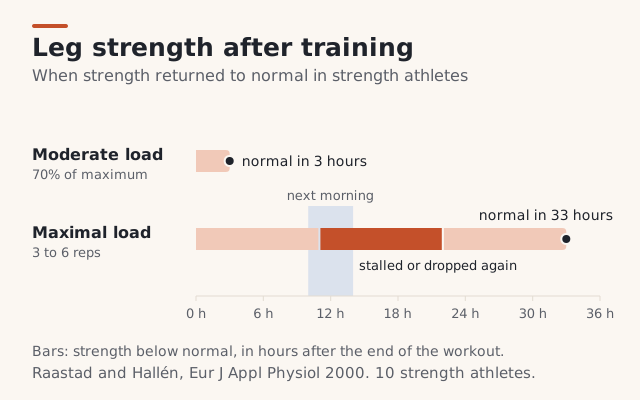
The study was small and included only men, but other studies have also seen strength slow to return after heavy training. Spanish researchers compared sets taken to failure with sets that stopped at half the possible reps, with the same total number of reps on the bench press and the squat, and failure left the muscle slower to recover the next day and the day after. The sets that stopped early left the muscle ready sooner for a new workout. In an American study with sets done until not a single more rep would come, performance was still below normal the next day and came back on the second day, with large differences from one person to another.
How much glycogen comes back by the next morning
Even with a lot of carbohydrate, twelve hours were not enough to refill muscle glycogen in a study from Maastricht University, in the Netherlands. The researchers emptied the stores of young, well-trained cyclists with sprints on the bike to exhaustion and followed them to the end of that period, using a magnetic resonance scanner that measures glycogen without a needle and biopsies of the thigh muscle. On one day, the cyclists fasted, with only water or tea. On the other, they had sugary drinks several times in the first hours and then ate plates of pasta, an amount of carbohydrate far greater than on an ordinary day for them. The work came out in 2025 in The Journal of Physiology (funded by a nutrition center linked to a sugar manufacturer, the same company that made the sugar in the drinks).
Without food, muscle glycogen did not rise at all. With all that food, the liver refilled within a few hours, but the muscle reached only about 70% of what it had before by the end of the twelve hours. By the authors’ calculations, it would take close to a full day for the muscle to get back to where it started.
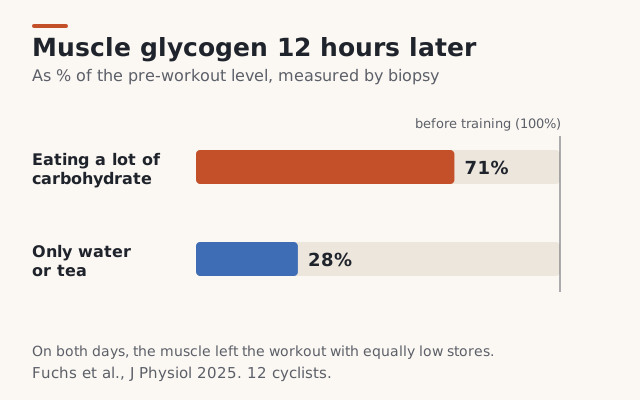
The cyclists spent the whole recovery awake in the lab, getting a drink every half hour. In real life, between the evening and morning workouts there is a dinner and a whole night without eating, and the muscle will probably reach the morning with less glycogen than theirs did. This matters more if you are doing a long or intense run, ride or swim in the morning, sessions that depend on this store. Going by the measurements gathered in a 2015 Dutch review, an ordinary strength training session uses a smaller share of glycogen than that workout to exhaustion did. So people who do strength training in both sessions tend to feel this shortfall less than those who ride or run hard.
What to eat after the evening workout
A 2018 Australian review, published in Sports Medicine, pooled the studies in which volunteers did a second bout of exercise a few hours after the first. Eating carbohydrate with water between the two improved performance in the second bout compared with drinking water alone. Adding protein brought no extra gain when the carbohydrate was already enough, but the authors point out that protein is still recommended for muscle recovery. The gaps in these studies were short, a few hours, and none tested a night in between; even so, it makes sense to apply the same logic to dinner.
Starting to eat soon after training also counts. In a classic study of cyclists, putting off carbohydrate until later made glycogen come back more slowly early in recovery. Once the first hours have passed, what matters most is the total carbohydrate until morning, and the type of food or the timing of each bite matters less, according to the group that reviewed in 2017 what is known about glycogen replenishment.
If you train again early, the dinner after that session can include rice, pasta, potatoes, cassava, bread or fruit along with meat, chicken, fish, eggs or dairy, and as much water as you like. If you are not hungry, you can start with something easier, like yogurt with fruit, milk with oats or a sandwich, and whey protein helps when food doesn’t cover your protein. In a 2014 study, drinking a lot of alcohol after a strength and cycling session reduced protein building in the muscle, even with protein taken alongside. The study tested many drinks, not one glass, but on the night between two workouts the recovery dinner is better without alcohol.
How to pair the evening workout with the morning one
Strength at night and strength in the morning
The 2011 exercise guideline from the ACSM, the American College of Sports Medicine, calls for two to three days of rest between two strength workouts of the same muscle group and suggests a split routine by muscle group for people who train more often during the week: one group in one session, another in the next. With this split, someone who trains four or five times a week reaches the frequency that the ACSM’s 2009 strength training guideline suggests for more experienced lifters without working the same muscle on consecutive days.
Legs at night and chest, back or shoulders in the morning, for example, is a combination that works well. The same muscle in both sessions only fits if one of them is light: few sets, moderate load, far from failure, more about practicing the movement than chasing a record. The ACSM’s new strength training guideline, from 2026, showed that training a muscle more or fewer times a week gave similar muscle growth when the total number of sets was the same. Based on that result, there is no expected gain from working a muscle again within less than a day just to grow more. The post on sets, load and frequency in strength training covers this result in detail.
Cardio at night and strength in the morning
Canadian researchers tested this in men who cycled in hard intervals or at a steady pace and then did leg press and bench press after gaps ranging from a few hours to a full day. With short gaps, the legs did fewer reps on the leg press, and with a day in between performance was the same as on the day they did not cycle. The bench press did not change in any case. The authors concluded that the drop lasts up to 8 hours and stays in the muscles that did the cycling, and the work came out in the Journal of Strength and Conditioning Research.
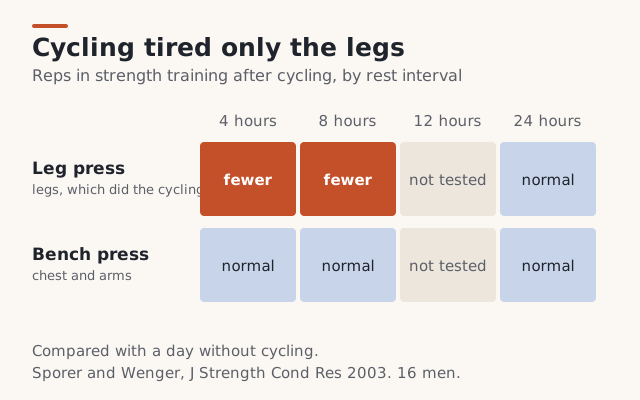
Twelve hours, the usual gap between night and morning, were left out of the study and fall between the gap that still hurt performance and the one that no longer did. A review that pooled studies of cardio done before strength training showed that cycling cuts leg strength more than running does, and suggested that longer, harder cardio cuts it more than short, easy cardio. That review measured strength right after the cardio, not the next morning; still, someone who rode hard and long at night will probably struggle more with a heavy leg workout early on than someone who ran easy and briefly.
Strength at night and cardio in the morning
Easy cardio in the morning, such as walking, an easy bike ride or running at a conversational pace, usually sits well after a strength workout the night before. The post on training zones and zone 2 shows how to find that pace. Intervals and long runs with legs still heavy from the previous day’s squats tend to come out lower in quality and go better on another day.
One hard, one easy
The combination that causes the fewest problems is one hard session and one easy one. Since failure delays recovery, stopping each set one or two reps before you can’t do any more, in the evening session, already helps the early workout. In the first week of a new program, soreness and strength loss are greater than in the following weeks, because the muscle is not yet used to that exercise, and this is the worst phase for back-to-back night and morning sessions with the same group. Strength and power tend to be higher in the late afternoon and evening, according to a review on time of day and performance. It makes sense, then, to leave the harder session for the evening and use the morning one for easy training or a different muscle group.
| Evening workout | Next morning’s workout | How it usually goes |
|---|---|---|
| Heavy legs | Chest, back or shoulders | Fine |
| Heavy legs to the limit | Heavy legs again | Strength still low; go light or train another group |
| Intervals or a long ride | Heavy legs | May perform worse; change the group or the day |
| Strength training, any group | Walking, cycling or an easy run | Fine |
| Easy or short run | Strength training | Fine |
| Long, intense endurance session | Another long, intense session | Low glycogen; carbohydrate at dinner and a slower pace |
The short night between the two workouts
Training again early often means waking up before your usual time. A 2022 review in Sports Medicine, which pooled dozens of studies on short sleep and physical performance, showed that waking up earlier than usual and staying up all night were the kinds of short night that hurt performance the most. Going to bed later and waking at the usual time had a less consistent effect. The same authors found that the drop showed up more in tests done in the afternoon and barely showed up in those done in the morning, and that it grew with the number of hours awake before the effort.
Putting the two findings together, someone who wakes up earlier and trains right away tends to lose little that morning, because the cost of waking early showed up more when the effort came hours later. What counts is repeating the short night, since sleep is part of recovery. A 2015 review on sleep and sport described that short maximal efforts often hold up after a bad night, but performance in the person’s own sport, attention and reaction time get worse. The same review points out that worse, shorter sleep can upset the body’s automatic control, such as heart rhythm, in a way similar to overtraining.
As I wrote in the post on workout timing and sleep, early training only adds up if you go to bed earlier, and the previous day’s hard workout needs to end well before bedtime; that post says how long before. Part of the heaviness in the morning comes from the hour itself, since strength is lower early in the day on average, and in the first minutes after waking up the body and mind still run more slowly; warming up calmly before you load the bar helps with both. If the night was short, a midday nap makes up part of the sleep, as long as it doesn’t disturb the following night. Insomnia is the exception: there, going to bed earlier and napping tend to keep the problem going, and treatment takes a different path.
Signs that your body has not recovered
No single test tells you whether you’re ready to train again. A 2018 international consensus on recovery in sport recommends tracking recovery systematically, because the response to training varies a lot from person to person and, in the same person, from week to week. When the alarm goes off, be wary if you notice:
- muscle soreness that changes the way you walk, climb stairs or get up from a chair;
- pain in a joint or tendon, not just in the muscle;
- your usual load feeling heavier than normal, or reps that won’t come even in the first sets;
- a warm-up that doesn’t loosen you up, even when done calmly;
- a waking heart rate above your normal and, if you wear a watch, heart rate variability (HRV) below your average;
- worse sleep than usual on the night between the two workouts, or a lack of desire to train that is unusual for you.
With any of these signs, swap the hard workout for an easy one, change the muscle group or take the day off. If you use a watch to track recovery, I explained how to read the sleep score and variability in the post on a low sleep score even after 8 hours of sleep. Fatigue, falling performance and mood changes that drag on for weeks, even with rest, go beyond recovery from one workout to the next and into overtraining, a topic that will get its own post.
When to get checked
Two hard workouts in a row, especially with a new exercise, many reps or a lot of the lowering phase of the lift, can go beyond ordinary muscle damage and lead to exertional rhabdomyolysis, a muscle injury that can affect the kidneys. A 2017 review on the subject calls for every health professional to recognize the basic signs, and you can spot them too: dark urine, the color of cola, along with severe muscle pain, swelling and weakness. That combination calls for the emergency room the same day. Taking anti-inflammatories on your own and drinking little water during those days raises the risk to the kidneys.
Also seek care if you have chest pain, unusual shortness of breath, palpitations or fainting during training, the same warning signs as in the post on sudden death in sport. Localized pain that started during a set and doesn’t improve, or that gets worse as the days go by, may be an injury and needs assessment before the next hard workout; I described how each type of muscle injury progresses in the post on muscle injury and return to sport.
In practice
- Before you schedule the morning workout, look at what you did the night before and change the muscle, the type of training or the intensity.
- If one of the sessions is going to be hard, keep the other easy, and stop one or two reps short of failure in the evening session.
- After the evening workout, have an early dinner with carbohydrate and protein, drink water and save alcohol for another day.
- Protect your sleep by going to bed earlier instead of cutting hours in the morning, and finish hard training well before bedtime.
- In the morning, warm up calmly and use the first sets as a test: if your usual load won’t move, switch to an easy workout.
- Dark urine with severe muscle pain means a trip to the emergency room; pain in a joint or tendon needs assessment before you train hard again.
Conclusion
Training at night and again the next morning fits into most people’s routine, as long as you don’t ask the same muscle for strength it hasn’t recovered yet. Endurance and water come back overnight; what lags behind is the muscle that went to its limit or used up its glycogen store in a long session. When in doubt, the first sets of the morning show whether it’s a day for heavy loads or for easy training.
All the best!
G
Responsible physician: Dr. Gilberto Nering Junior, sports medicine physician, CRM-SP 160822, RQE 142486 (Sports Medicine, Brazil).
This text was not sponsored, is for information only and does not replace an individual assessment. Questions about the content: contact the clinic.
Cover photo: Logan Weaver on Unsplash.
Frequently asked questions about training at night and in the morning
Can I train at night and then the next morning?
In most cases, yes, as long as you don’t repeat heavy training for the same muscle, and take extra care if the evening sets went to failure. Switch the muscle group or keep one of the two sessions easy.
How many hours should there be between workouts?
The gap between strength workouts depends on what you trained: a moderate workout is recovered from in a few hours, while the strength of a muscle that trained heavy can take one to three days. The American exercise guideline talks about two to three days between two strength workouts of the same muscle group. Between night and morning, 10 to 14 hours is enough for a moderate workout or one for a different muscle group.
Can I train the same muscle two days in a row?
Yes, if one of the workouts is easy, with few sets and far from failure. Two hard workouts in a row for the same muscle usually perform worse on the second day, and training the muscle more often brought no extra growth when the weekly total of sets was the same.
Can I train twice a day?
You can, if you’re healthy and already used to training, as long as the sessions differ from each other and you get enough food and sleep. What usually causes trouble is piling up hard workouts for the same muscle without rest for several days.
Can I run in the morning after training legs at night?
An easy run, at a conversational pace, usually goes well. Intervals and long runs with legs still heavy tend to perform worse and are better left for another day.
References
- American College of Sports Medicine. American College of Sports Medicine position stand. Progression models in resistance training for healthy adults. Med Sci Sports Exerc. 2009;41(3):687-708. doi:10.1249/MSS.0b013e3181915670
- Burke LM, van Loon LJC, Hawley JA. Postexercise muscle glycogen resynthesis in humans. J Appl Physiol (1985). 2017;122(5):1055-1067. doi:10.1152/japplphysiol.00860.2016
- Craven J, McCartney D, Desbrow B, et al. Effects of acute sleep loss on physical performance: a systematic and meta-analytical review. Sports Med. 2022;52(11):2669-2690. doi:10.1007/s40279-022-01706-y
- Currier BS, D’Souza AC, Singh MAF, et al. American College of Sports Medicine Position Stand. Resistance training prescription for muscle function, hypertrophy, and physical performance in healthy adults: an overview of reviews. Med Sci Sports Exerc. 2026;58(4):851-872. doi:10.1249/MSS.0000000000003897
- Fuchs CJ, Veeraiah P, Hermans WJH, et al. Carbohydrate intake of 10 g/kg body mass rapidly replenishes liver, but not muscle glycogen contents, during 12 h of post-exercise recovery in well-trained cyclists. J Physiol. 2025. doi:10.1113/JP289115
- Fullagar HH, Skorski S, Duffield R, et al. Sleep and athletic performance: the effects of sleep loss on exercise performance, and physiological and cognitive responses to exercise. Sports Med. 2015;45(2):161-186. doi:10.1007/s40279-014-0260-0
- Garber CE, Blissmer B, Deschenes MR, et al. American College of Sports Medicine position stand. Quantity and quality of exercise for developing and maintaining cardiorespiratory, musculoskeletal, and neuromotor fitness in apparently healthy adults: guidance for prescribing exercise. Med Sci Sports Exerc. 2011;43(7):1334-1359. doi:10.1249/MSS.0b013e318213fefb
- Ivy JL, Katz AL, Cutler CL, et al. Muscle glycogen synthesis after exercise: effect of time of carbohydrate ingestion. J Appl Physiol (1985). 1988;64(4):1480-1485. doi:10.1152/jappl.1988.64.4.1480
- Kellmann M, Bertollo M, Bosquet L, et al. Recovery and performance in sport: consensus statement. Int J Sports Physiol Perform. 2018;13(2):240-245. doi:10.1123/ijspp.2017-0759
- Knaier R, Qian J, Roth R, et al. Diurnal variation in maximum endurance and maximum strength performance: a systematic review and meta-analysis. Med Sci Sports Exerc. 2022;54(1):169-180. doi:10.1249/MSS.0000000000002773
- Knuiman P, Hopman MT, Mensink M. Glycogen availability and skeletal muscle adaptations with endurance and resistance exercise. Nutr Metab (Lond). 2015;12:59. doi:10.1186/s12986-015-0055-9
- Markov A, Chaabene H, Hauser L, et al. Acute effects of aerobic exercise on muscle strength and power in trained male individuals: a systematic review with meta-analysis. Sports Med. 2022;52(6):1385-1398. doi:10.1007/s40279-021-01615-6
- McCartney D, Desbrow B, Irwin C. Post-exercise ingestion of carbohydrate, protein and water: a systematic review and meta-analysis for effects on subsequent athletic performance. Sports Med. 2018;48(2):379-408. doi:10.1007/s40279-017-0800-5
- McLester JR, Bishop PA, Smith J, et al. A series of studies: a practical protocol for testing muscular endurance recovery. J Strength Cond Res. 2003;17(2):259-273. PubMed 12741861
- Meeusen R, Duclos M, Foster C, et al. Prevention, diagnosis, and treatment of the overtraining syndrome: joint consensus statement of the European College of Sport Science and the American College of Sports Medicine. Med Sci Sports Exerc. 2013;45(1):186-205. doi:10.1249/MSS.0b013e318279a10a
- Morán-Navarro R, Pérez CE, Mora-Rodríguez R, et al. Time course of recovery following resistance training leading or not to failure. Eur J Appl Physiol. 2017;117(12):2387-2399. doi:10.1007/s00421-017-3725-7
- Parr EB, Camera DM, Areta JL, et al. Alcohol ingestion impairs maximal post-exercise rates of myofibrillar protein synthesis following a single bout of concurrent training. PLoS One. 2014;9(2):e88384. doi:10.1371/journal.pone.0088384
- Raastad T, Hallén J. Recovery of skeletal muscle contractility after high- and moderate-intensity strength exercise. Eur J Appl Physiol. 2000;82(3):206-214. doi:10.1007/s004210050673
- Rawson ES, Clarkson PM, Tarnopolsky MA. Perspectives on exertional rhabdomyolysis. Sports Med. 2017;47(Suppl 1):33-49. doi:10.1007/s40279-017-0689-z
- Sporer BC, Wenger HA. Effects of aerobic exercise on strength performance following various periods of recovery. J Strength Cond Res. 2003;17(4):638-644. PubMed 14636098