Also in: Português · Español · Italiano · 中文 · हिन्दी
Main points
- Mounjaro can come with hair loss: in the studies that got tirzepatide approved for obesity, it showed up in about 5% of the people who took the drug, much more often in women.
- According to dermatology reviews, the most likely cause is telogen effluvium, the diffuse shedding that starts a few months after rapid weight loss, and it tends to pass once your weight levels off.
- In the two large approval studies, nobody taking tirzepatide stopped the drug because of their hair, and stopping on your own is not the first step.
- Supplements only help when a test shows you are low in iron, vitamin D or another nutrient; without a proven deficiency, there is no evidence of benefit.
- A round bald patch, a red or sore scalp, a receding hairline or thinning crown, or shedding that does not improve as the months go by calls for a dermatologist.
If you started Mounjaro two or three months ago and now see more hair in the shower drain and on your brush, the most likely explanation for this hair loss is the weight loss itself. The medical name is telogen effluvium. A big change in the body, such as losing a lot of weight in a short time, pushes a batch of hairs into the resting phase at the same time, and those hairs come out together about three months later. The shedding usually eases once your weight levels off and does not leave you bald, but sometimes it shows up alongside low iron, a thyroid problem or pattern hair loss that was already starting, and those causes need their own treatment.
The link between GLP-1 injections and hair loss shows up in side effect reports, but it is weak, according to the review a Canadian team, including a dermatologist who specializes in hair, did of everything published up to July 2025. Only a small share of the articles were usable, and most of the data came from those reports, which count cases without a well-built comparison group. The review came out in 2026 in the International Journal of Dermatology, with no outside funding, and it is my starting point for this post. The authors stated plainly that these data do not prove cause and effect and listed the possible explanations: rapid weight loss, hormonal changes, the stress of treating a chronic disease and a shortage of some nutrient when appetite drops.
Does Mounjaro really cause hair loss?
Yes. The US label for tirzepatide, the active ingredient in Mounjaro, lists hair loss among the common side effects. In the two large approval studies, it showed up in about 5 in 100 people who took the drug for almost a year and a half, compared with 1 in 100 in the group that got placebo (an injection with no drug). The label itself ties this shedding to weight loss, and it was much more common in women. No one taking tirzepatide quit treatment because of their hair. For dermatology reviews, the most likely cause is telogen effluvium, which appears months after weight loss begins and improves when the weight stops dropping fast. If the shedding starts, the first step is to talk to the doctor who oversees your treatment, without stopping the injection on your own, and to check iron, thyroid and vitamin D. Volume usually becomes visible again 6 to 12 months after the trigger has passed.
How many people lose hair on tirzepatide
The most reliable numbers come from the two studies that got tirzepatide approved for obesity in the United States: SURMOUNT-1, in adults without diabetes, and SURMOUNT-2, in adults with type 2 diabetes. Both lasted 72 weeks, had a placebo group and were funded by Eli Lilly, the manufacturer. The label for Zepbound (the name tirzepatide was given for obesity in the United States) combines the two studies in one table, and the chart shows what happened to people’s hair in groups of 100.
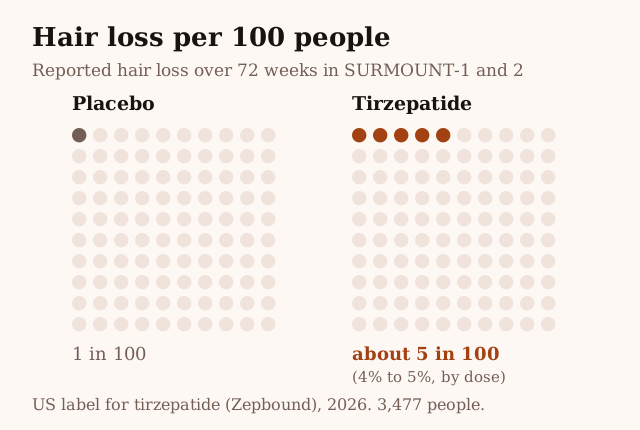
For every 100 people who take tirzepatide, only a few more notice shedding than would without the drug. The label counts who reported hair loss, but it gives no scalp exam or how much hair fell out, so these numbers do not separate mild shedding from the frightening kind. In the study that compared tirzepatide with semaglutide (the drug in Ozempic and Wegovy), published in 2025 in the New England Journal of Medicine, hair loss was a little more common with tirzepatide, which also led to more weight loss. The drug’s other effects, with how often each one happens, are in the post on Mounjaro side effects, and what is known about years of use is in the post on whether Mounjaro is harmful in the long run.
What the large medical records study showed
Outside the studies that brought the drug to market, two researchers from the dermatology department at Case Western Reserve University, in Cleveland, used a network of electronic medical records. They compared adults who got semaglutide or tirzepatide with adults who took metformin and had never used the injections. The authors matched the two groups for age, sex, weight, diabetes, thyroid disease, iron deficiency and other conditions that also cause hair loss. The work came out in 2026 in the Journal of the American Academy of Dermatology, with no declared conflict of interest. People on the injections had almost two and a half times the risk of getting a diagnosis of effluvium in their records. At six months of follow-up the difference was not yet clear, and by the one-year count it was there.
The authors think the drug may play some role beyond weight loss, because the average weight of both groups dropped little over the follow-up. Still, a medical records study shows an association and does not prove cause, and they list the limits themselves: they depend on the code the doctor entered, they did not examine the scalp and they did not measure how severe the shedding was. Even alopecia areata, an autoimmune hair loss in patches, showed up more in the injection group, and in my reading this suggests part of the difference may come from factors this kind of study cannot separate.
Why hair falls out months after starting the injection
Each hair spends years growing, then rests for about three months and then falls out, pushed by the new hair growing in the same spot. At any given moment, the vast majority of hairs are growing and only a small share are resting, so losing 50 to 150 hairs a day is normal, according to the review on hair loss published in 2026 in the Cleveland Clinic Journal of Medicine.
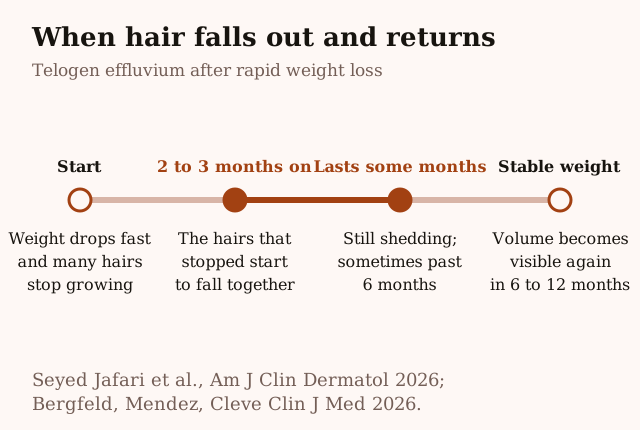
When the body goes through a strong stress, such as surgery, a high fever, childbirth or a diet that takes off a lot of weight in a short time, a large batch of hairs leaves the growth phase too early. They rest for the usual three months and fall out all together, and this delay explains why the shedding shows up two to three months after the trigger, when you no longer connect one thing to the other.
Rapid weight loss is the trigger most often cited in the reviews on the injections. After bariatric surgery, which also takes off a lot of weight in a few months, almost half of patients report hair loss, according to a 2025 meta-analysis (a study that pools several studies) published in Obesity Surgery. With Mounjaro, hunger goes down, and if you eat little protein, few calories or end up low in iron, zinc or vitamin D, you have one more reason to lose hair.
The Canadian review mentions other explanations still under study, such as changes in insulin and in growth factors similar to it, which act on the follicle (the root of the hair), and the stress of dealing with a chronic disease. Dermatology reviews also raise the hypothesis that the drug acts on the fat that sits under the skin and surrounds the follicle, but a 2026 review in the American Journal of Clinical Dermatology points out that no human study has tested the role of the GLP-1 receptor in hair growth. For now, fast weight loss remains the explanation with the most support.
Hair loss on Mounjaro in women and in men
With the two label studies combined, among those who took tirzepatide, women reported hair loss far more than men, as the chart shows. On placebo, the gap between the sexes was there too, with much smaller numbers.
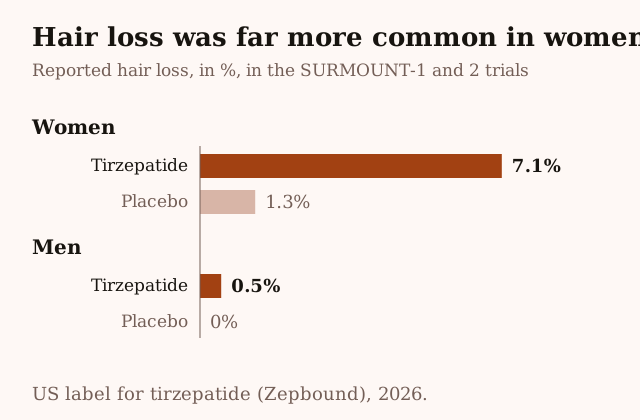
The label does not explain the difference between women and men, and the Cleveland Clinic Journal of Medicine review notes that women seek help for hair loss more often and suffer more from it. In women, the shedding is usually diffuse and temporary.
Hair thinning on the top of the head deserves more attention, because effluvium sometimes unmasks female pattern hair loss that was already starting, and irregular periods, extra facial hair or acne you did not have before call for a hormone workup. Insulin resistance can raise male hormones in women and favor this type of hair loss.
In men, the usual worry is pattern hair loss that starts at the temples and the crown, which depends on family genes and testosterone and does not reverse on its own. In the large study of American medical records, a pattern hair loss diagnosis also showed up more among people on the injections. Going the other way, the Canadian review describes the case of a man with pattern hair loss and insulin resistance whose hair improved after he started tirzepatide, and some researchers raise the hypothesis that controlling blood sugar helps certain types of hair loss. A single case is no promise, and if your hairline has receded since the injection, a dermatologist can tell the two apart and treat the pattern hair loss if that is what it is.
How long the shedding lasts and when hair grows back
Telogen effluvium shedding usually lasts a few months and, according to the American Journal of Clinical Dermatology review, sometimes goes past six. The new hair is already growing under the one that falls out, but it takes time to gain length and add volume, and the Cleveland Clinic Journal of Medicine review mentions 6 to 12 months for the improvement to become visible after the trigger has passed. With the injection, the trigger is the phase of fast weight loss, and the reviews expect recovery once the weight stops dropping fast, even if you stay on the drug.
While the shedding lasts, each hair that falls is one that had already stopped growing, and the follicle stays alive to make another in its place. Effluvium leaves no scar or permanent bald patch. Pattern hair loss (the hereditary kind) and the types of hair loss that inflame the scalp work differently, which is why they need a diagnosis.
First steps when your hair starts falling out
The first step is to talk to the doctor who oversees your treatment, not to stop the injection on your own. The American Journal of Clinical Dermatology review and the Skin Appendage Disorders meta-analysis, both from 2026, say that, in general, there is no need to stop the drug because of effluvium. Your doctor may hold off on the next dose increase or let the weight come off more slowly, and stopping only comes up when the shedding is heavy, slow to pass or weighs on you a lot. In the meantime, a few habits help your hair and your treatment:
- Ask for tests before blaming the injection. The reviews suggest a complete blood count, ferritin (your iron stores), vitamin D and a thyroid test, since low iron and an out-of-balance thyroid cause hair loss on their own.
- Eat protein at every meal, even when you are not very hungry. Meat, chicken and fish also bring iron that the body absorbs better than iron from plants. When your appetite disappears, eggs, yogurt, soup and other easy foods help, as in the ideas I gathered for days of nausea on Mounjaro.
- Do strength training, which helps you keep muscle while the fat comes off, as I explained in the post on losing weight without losing muscle.
- Drink water throughout the day, as the American Journal of Clinical Dermatology review recommends.
- Make use of haircuts, styling, hair color and products that hide the scalp while the volume comes back, as the Cleveland Clinic Journal of Medicine review suggests.
What to take for Mounjaro hair loss
There is no evidence that supplements help effluvium in people who are not short of anything. The Cleveland Clinic Journal of Medicine review says the benefit of zinc, biotin and vitamin D without a deficiency is unclear and that routine use is not backed by good evidence. Iron comes in when ferritin and the blood count show a shortage, and taking iron without a test often causes nausea and constipation without helping people who do not need it. Vitamin D follows the same logic, as I described in the post on when to take vitamin D supplements, and the doctor decides on replacement, with the test result in hand.
Biotin, sold as the hair vitamin, has one more problem. At the usual amounts in supplements, it can throw off some blood tests that use biotin in the lab reaction, thyroid hormone tests among them, and a study in JAMA of healthy adults found altered results after one week of use. If you take biotin, tell your doctor before your blood is drawn. Too much vitamin A, found in some supplements, is also on the list of causes of hair loss.
There are specific drugs for hair loss, and prescribing them is up to the dermatologist, after examining your scalp and knowing whether the case is effluvium, pattern hair loss or something else. For the effluvium that comes with weight loss, which usually passes on its own, the Cleveland Clinic Journal of Medicine review does not routinely recommend drugs to stimulate hair growth when the trigger is known and reversible.
Can you prevent hair loss on Mounjaro?
I found no study that tested a strategy to prevent hair loss in people on the injection, so there is no guarantee. The reviews suggest removing what raises the risk. The main thing is to avoid losing weight too fast, so raising the dose step by step, as agreed with your doctor, makes sense for your hair too. Eating enough protein and calories, drinking water and correcting any iron or vitamin D deficiency before you start round out the list.
If you have had effluvium before, after another diet, surgery or an illness, or if pattern hair loss runs in your family, you can talk about it before you start. Starting with your tests in order makes it easier to understand what happened if the shedding comes. If you are thinking of quitting the drug to get your hair back, keep in mind that, without the injection, much of the weight you lost tends to come back, and the numbers on what happens when you stop a weight-loss injection are in another post.
Expected shedding or a sign of another cause
Dermatology reviews describe a typical way weight-loss effluvium shows up, and hair loss with another cause usually gives different signs in where the hair falls, on the scalp and in the nails. When an item in the last column appears, the shedding deserves a closer look.
| What you notice | Fits weight-loss effluvium | Needs a checkup |
|---|---|---|
| Where it falls | All over the head | Round bald patch, receding hairline or thinning crown |
| When it started | 2 to 3 months after the weight began to drop | Unrelated to the weight loss |
| Scalp | Normal | Red, flaking, itchy, painful or with sores |
| How long it lasts | Improves in a few months | More than six months without improvement |
| Nails | Normal | Thin and curved upward, like a spoon (a sign of low iron) |
Signs that call for a dermatologist
The doctor who manages your injection can usually handle diffuse shedding that starts months after rapid weight loss. See a dermatologist when you notice a round bald patch or patches, when your scalp turns red, flakes, itches or hurts, when your hairline and crown thin out or when the shedding goes past six months without improving. The American Journal of Clinical Dermatology review also points to the specialist when the diagnosis is unclear or when there is suspicion of a type of hair loss that destroys the root of the hair and leaves a permanent bald patch.
In practice
- Remember that effluvium shedding usually shows up two to three months after your weight starts to drop and eases once it levels off.
- Talk to your doctor before stopping the injection; they may hold off on the next dose increase.
- Ask for a complete blood count, ferritin, vitamin D and a thyroid test, and say so if you take biotin.
- Eat protein at every meal, drink water and do strength training.
- Take supplements only when a test shows a deficiency, with guidance.
- See a dermatologist if you have a bald patch, an inflamed scalp, a receding hairline or shedding for more than six months.
Conclusion
Mounjaro can come with hair loss, and, according to the reviews, the most likely cause is the telogen effluvium that follows rapid weight loss: it appears months after you start, it is diffuse, it leaves no bald patch and it eases when the weight stops dropping fast. In the label studies, few people had hair loss and nobody stopped the drug over it. Eating enough protein, correcting any nutrient deficiency a test shows and agreeing on the pace of the dose with your doctor all help, and when the shedding looks like something else, I suggest seeing a dermatologist (obviously one with an RQE, the specialist registration in Brazil).
All the best!
G
Responsible physician: Dr. Gilberto Nering Junior, sports medicine physician, CRM-SP 160822, RQE 142486 (Sports Medicine, Brazil).
This text was not sponsored, is for information only and does not replace an individual assessment. Questions about the content: contact the clinic.
Cover photo: comb with loose strands of hair, photo by Kier in Sight Archives on Unsplash, cropped.
Frequently asked questions about Mounjaro and hair loss
What should I do if Mounjaro makes my hair fall out?
Talk to the doctor who oversees your treatment before stopping the injection, because the shedding usually passes once your weight levels off. Ask for iron, vitamin D and thyroid tests and eat protein at every meal. If you get a bald patch or an inflamed scalp, or the shedding goes past six months, see a dermatologist.
Does hair grow back after Mounjaro hair loss?
In telogen effluvium, the type of hair loss the reviews point to as the most likely, the follicle stays alive and the hair grows back. The improvement usually becomes visible six months to a year after the weight stops dropping. Pattern hair loss (the hereditary kind) is different and does not reverse on its own.
Do men also lose hair on Mounjaro?
They can, but in the approval studies hair loss was reported far more often by women. In men, the main question is whether the shedding is effluvium or pattern hair loss at the temples and crown, and the dermatologist is the one who tells them apart.
Do I need to stop Mounjaro if my hair falls out?
No, in most cases. In the label studies, nobody taking tirzepatide stopped the drug because of their hair, and the reviews recommend first adjusting your diet, correcting deficiencies and, if needed, holding off on the next dose increase. The decision to stop is made with your doctor.
Does Ozempic also cause hair loss?
Yes, hair loss also shows up with semaglutide, the drug in Ozempic and Wegovy. In the study that put the two drugs side by side for 72 weeks, tirzepatide had a little more hair loss and also led to greater weight loss.
References
- Aronne LJ, Horn DB, le Roux CW, et al. Tirzepatide as compared with semaglutide for the treatment of obesity. N Engl J Med. 2025;393(1):26-36. doi:10.1056/NEJMoa2416394
- Bergfeld WF, Mendez D. Shedding: an updated guide to a common cause of hair loss. Cleve Clin J Med. 2026;93(10):616-622. doi:10.3949/ccjm.93a.26008
- Branyiczky MK, Lowe MS, McMullen E, et al. Effects of GLP-1 receptor agonists on hair loss and regrowth: a systematic review. Int J Dermatol. 2026;65(5):1030-1032. doi:10.1111/ijd.70133
- Eli Lilly and Company. Zepbound (tirzepatide) injection: prescribing information. Indianapolis: Eli Lilly; 2026. DailyMed
- Herrera HO, Bordeaux JS. Risk of new-onset hair loss with semaglutide and tirzepatide: a TriNetX cohort study. J Am Acad Dermatol. 2026;94(6):1826-1827. doi:10.1016/j.jaad.2026.02.042
- Li D, Radulescu A, Shrestha RT, et al. Association of biotin ingestion with performance of hormone and nonhormone assays in healthy adults. JAMA. 2017;318(12):1150-1160. doi:10.1001/jama.2017.13705
- Seyed Jafari SM, Caro G, Lipner SR, et al. The impact of GLP-1 receptor agonists on hair: beneficial effects or adverse outcomes? Am J Clin Dermatol. 2026;27(3):579-586. doi:10.1007/s40257-026-01021-6
- Taghizadeh N, Salhab H, Alirezaei A, et al. Hair loss and metabolic and bariatric surgery: an updated systematic review and meta-analysis. Obes Surg. 2025;35(6):2370-2380. doi:10.1007/s11695-025-07903-8
- Viquez Burboa GU, Flores Guillén MÁR, Duardo González VS. GLP-1 receptor agonists and alopecia: a systematic review and meta-analysis of incidence, risk, subtypes, and mechanisms. Skin Appendage Disord. 2026. doi:10.1159/000553070
- Zarabian N, Farah M, Stines A, et al. The role of glucagon-like peptide-1 receptor agonists in hair loss: clinical evidence and proposed mechanisms. Dermatol Surg. 2026;52(6S):S67-S71. doi:10.1097/DSS.0000000000005176