Also in: Português · Español · Italiano · 中文 · हिन्दी
Main points
- Protein taken before bed is digested during the night and helps muscle rebuild while you sleep.
- In the studies with young adults, a protein snack before bed brought more muscle and strength, but the people who got the protein also ate more protein overall.
- In a small study with the same daily protein total, taking it at night or during the day gave similar results.
- In a study of active older adults, protein after training and before bed added no gain in muscle or strength.
- What matters most is your total protein for the day, and a bedtime snack is a practical way to round out that total.
You’ve probably heard that taking protein before bed, preferably casein, is the secret for anyone who wants to build muscle. The idea makes sense: that’s seven or eight hours without food, and muscle keeps working the whole time. But what the studies show is a bit different from the marketing, and understanding it will help you decide whether this snack is worth it in your case.
The short answer
Protein before bed works like one more protein meal. It is well digested during sleep and increases muscle building overnight. The bigger muscle gain shows up when this snack raises your total protein for the day. When that total is already good, timing seems to matter little.
What happens to muscle during the night
Muscle lives in a constant back-and-forth: it breaks down a little all the time and rebuilds when amino acids, the building blocks of protein, arrive. After a meal with protein, building wins. In the hours that follow, with no food, breakdown takes the lead again.
The night is the longest fast of the day. A group of researchers at Maastricht University, in the Netherlands, has been studying this period for years and showed that muscle building during the night is held back by a lack of amino acids in the blood.
In one of the first studies, young men trained at eight in the evening, had a recovery drink right after and, half an hour before bed, drank a beverage with either casein or no protein. The casein was digested and absorbed normally during sleep, and muscle building through the night was about 22% higher, even with the recovery drink everyone had already taken. For anyone who trains late, the bedtime snack works almost like an extension of the post-workout meal.
What the studies show
Knowing that muscle builds more over one night is not the same as knowing whether, after months, you end up with more muscle. That’s what training studies are for.
In young adults
In the most cited study, young men did 12 weeks of weight training. Half had a protein snack every night before bed, and the other half took a calorie-free placebo. The protein group gained more strength and had a larger increase in thigh muscle.
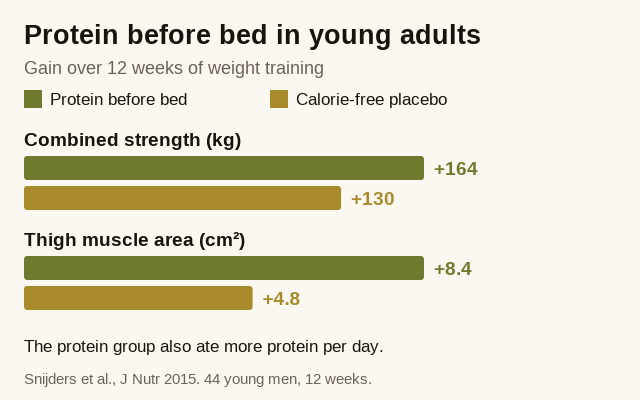
The catch is that the protein group also ate more protein per day, so there’s no way to tell whether the gain came from the timing or simply from eating more protein. A 2021 review that pooled these studies pointed out exactly this problem.
When the daily total is the same
A smaller study tested this question another way. The participants trained for ten weeks and all took the same casein, with the same amount of protein per day. The only difference was the timing: some took it during the day, others before bed. Both groups gained muscle and strength in a similar way. It had few participants, so the result doesn’t settle the question on its own.
This fits with an analysis of more than 20 studies on protein timing around training. What best explained muscle gain was the total protein eaten, not the moment it was taken.
In older adults
With age, muscle responds less to protein, so the idea of an extra snack at night looked even more promising for people over 60. In a study of older men, muscle building during the night only went up with the larger serving of casein, not with the smaller one.
But when the same team followed active older adults through 12 weeks of weight training, protein after training and before bed brought no more muscle or strength than a placebo with the same calories. And the protein group got extra protein every night. Why this didn’t add up is still unclear; one hypothesis is that these active men were already eating enough. For an older person who eats little protein during the day, raising the total is still the first step, and a bedtime snack can help with that.
Almost all of these studies were done in men, and there is much less data on protein timing in women.
Your daily total comes before timing
For people who train and want to gain or keep muscle, the International Society of Sports Nutrition recommends somewhere between 1.4 and 2 grams of protein per kilo of body weight per day, split into meals across the day. Protein before bed counts as one of those meals.
How you spread it out matters too. The same society suggests a serving of protein every three or four hours. Many people eat almost no protein at breakfast and pack it all into lunch and dinner. In that case, adding eggs, yogurt or cheese to breakfast can be worth as much as the bedtime snack, and it’s sometimes easier to keep up.
If you don’t know yet how much you need, I explained the math in the post on whey protein. And if your goal is to lose weight, protein becomes even more important for holding on to muscle, as I showed in the post on losing weight without losing muscle.
Casein, whey or food?
Casein is the most studied protein before bed because it is digested slowly and releases amino acids through the night. You’ll find it in milk, yogurt and cheese, and it also comes as a powder.
Whey is digested faster, but it also works as a protein source. A 2026 Brazilian analysis, which pooled studies on 13 types of protein supplement in people doing weight training, placed whey among the ones that added strength and lean mass on top of training; casein powder on its own did not stand out from placebo. Timing was not the focus of that analysis.
If you don’t consume dairy, you have options too. In a Maastricht study, pea protein stimulated muscle building as much as milk protein, in the same amount. Other plant sources, such as soy and tofu, also count.
In practice, food does the job. Some options that usually provide a good amount of protein:
- plain or high-protein yogurt;
- cottage cheese or ricotta;
- milk or a higher-protein dairy drink;
- eggs;
- a whey or casein shake, when that’s more practical.
| Source | What the studies show | Examples |
|---|---|---|
| Casein | Digested slowly, increases muscle building overnight; as a powder on its own, it did not stand out from placebo in a 2026 analysis | Milk, yogurt, cottage cheese, casein powder |
| Whey | Digested quickly, added strength and lean mass on top of training; in a small study, it improved sleep compared with a carbohydrate drink | Whey powder, high-protein dairy drinks |
| Plant protein | In the same amount, pea protein stimulated muscle as well as milk protein | Pea protein, soy, tofu |
What about sleep?
A common worry is that eating before bed will disrupt your sleep. In a small 2026 study of people who did weight training, whey taken before bed even improved sleep compared with a carbohydrate drink with the same calories. With casein, that improvement didn’t show up. Since it had few participants, the result still needs to be confirmed.
Another 2021 review found no meaningful effect of casein before bed on metabolism or on hunger the next day. And, as I wrote in the post on diet myths, eating at night doesn’t make you gain weight by itself: what counts is your total calories for the day. If sleep is a weak spot for you, it’s also worth reading whether training at night hurts your sleep.
Who benefits most from a bedtime snack
- People who can’t hit their protein target at their other meals.
- People who train at night and have a small or early dinner.
- People who are losing weight and want to protect muscle without eating a lot.
- People who have a long gap between dinner and bedtime.
Precautions
If you have kidney disease, talk to your doctor before increasing your protein. If you’re lactose intolerant, you can use lactose-free milk and yogurt, or plant proteins. If you have reflux, lying down right after eating can make it worse, so leave a gap or choose something light. And if your goal is to lose weight, the snack counts toward your daily calories: go for lean options with no sugar.
In practice
- Work out how much protein you need per day and see whether you already get there.
- If you don’t, spread it better across your meals and use a bedtime snack to make up the difference.
- Aim for 30 to 40 grams of protein in the bedtime snack, the range cited by the International Society of Sports Nutrition.
- Choose a source you like and tolerate: food does the job, and supplements come in for convenience.
- Keep up your strength training, because without it very little of the extra protein turns into muscle.
Conclusion
If you already eat enough protein during the day, the bedtime snack is optional. If you don’t, the snack is one of the easiest ways to get there, along with a more substantial breakfast, and always together with strength training.
Until the next post, everyone!
Responsible physician: Dr. Gilberto Nering Junior, sports medicine physician, CRM-SP 160822, RQE 142486 (Sports Medicine, Brazil).
This text was not sponsored, is for information only and does not replace an individual assessment. Questions about the content: contact the clinic.
Cover photo: Joanna Stołowicz on Unsplash.
Frequently asked questions about protein before bed
Does protein before bed help you build muscle?
It helps when it raises your total protein for the day. In a small study where the total was the same, taking protein at night or during the day gave similar results. A bedtime snack is a practical way to reach the amount you need.
Is casein better than whey before bed?
Casein is digested more slowly and is the most studied option before bed, but whey also works as a protein source. Yogurt, cottage cheese, milk and eggs work too. What matters most is your total protein for the day.
How much protein should I have before bed?
The International Society of Sports Nutrition mentions 30 to 40 grams before bed. The right amount depends on how much you already eat during the rest of the day, on your weight and on your goal.
Does protein before bed make you gain weight?
Not by itself. What counts is your total calories for the day. If you’re losing weight, include the snack in your count and go for lean options, such as plain yogurt or cottage cheese.
Do older adults need protein before bed?
Not necessarily. In a study of active, healthy older adults, protein after training and before bed brought no more muscle or strength. For people who eat little protein during the day, a bedtime snack can help them reach the amount they need.
References
- Aussieker T, Kredig N, Wasserfurth P, et al. Presleep Whey but Not Casein Protein Ingestion Improves Sleep Quality After Resistance Exercise When Compared With an Isocaloric Control in Resistance Trained Individuals. Int J Sport Nutr Exerc Metab. 2026;36(5):481-490. doi:10.1123/ijsnem.2025-0205
- Dela Cruz J, Kahan D. Pre-Sleep Casein Supplementation, Metabolism, and Appetite: A Systematic Review. Nutrients. 2021;13(6):1872. doi:10.3390/nu13061872
- Drummond MDM, Ferreira MHL, Silva RAD, et al. Which Protein-Based Dietary Supplements Most Effectively Enhance Fat-Free Mass and Strength Gains in Healthy Adults Undergoing Resistance Training? A Network Meta-Analysis. Transl Sports Med. 2026;2026:5557511. doi:10.1155/tsm2/5557511
- Holwerda AM, Overkamp M, Paulussen KJM, et al. Protein Supplementation after Exercise and before Sleep Does Not Further Augment Muscle Mass and Strength Gains during Resistance Exercise Training in Active Older Men. J Nutr. 2018;148(11):1723-1732. doi:10.1093/jn/nxy169
- Joy JM, Vogel RM, Shane Broughton K, et al. Daytime and nighttime casein supplements similarly increase muscle size and strength in response to resistance training earlier in the day: a preliminary investigation. J Int Soc Sports Nutr. 2018;15(1):24. doi:10.1186/s12970-018-0228-9
- Jäger R, Kerksick CM, Campbell BI, et al. International Society of Sports Nutrition Position Stand: protein and exercise. J Int Soc Sports Nutr. 2017;14:20. doi:10.1186/s12970-017-0177-8
- Kouw IW, Holwerda AM, Trommelen J, et al. Protein Ingestion before Sleep Increases Overnight Muscle Protein Synthesis Rates in Healthy Older Men: A Randomized Controlled Trial. J Nutr. 2017;147(12):2252-2261. doi:10.3945/jn.117.254532
- Pinckaers PJM, Smeets JSJ, Kouw IWK, et al. Post-prandial muscle protein synthesis rates following the ingestion of pea-derived protein do not differ from ingesting an equivalent amount of milk-derived protein in healthy, young males. Eur J Nutr. 2024;63(3):893-904. doi:10.1007/s00394-023-03295-6
- Reis CEG, Loureiro LMR, Roschel H, et al. Effects of pre-sleep protein consumption on muscle-related outcomes: A systematic review. J Sci Med Sport. 2021;24(2):177-182. doi:10.1016/j.jsams.2020.07.016
- Res PT, Groen B, Pennings B, et al. Protein ingestion before sleep improves postexercise overnight recovery. Med Sci Sports Exerc. 2012;44(8):1560-1569. doi:10.1249/MSS.0b013e31824cc363
- Schoenfeld BJ, Aragon AA, Krieger JW. The effect of protein timing on muscle strength and hypertrophy: a meta-analysis. J Int Soc Sports Nutr. 2013;10(1):53. doi:10.1186/1550-2783-10-53
- Snijders T, Res PT, Smeets JS, et al. Protein Ingestion before Sleep Increases Muscle Mass and Strength Gains during Prolonged Resistance-Type Exercise Training in Healthy Young Men. J Nutr. 2015;145(6):1178-1184. doi:10.3945/jn.114.208371
- Trommelen J, van Loon LJC. Pre-Sleep Protein Ingestion to Improve the Skeletal Muscle Adaptive Response to Exercise Training. Nutrients. 2016;8(12):763. doi:10.3390/nu8120763