
Also in: Português · Español · Italiano · 中文 · हिन्दी
Main points
- In the trials where one group took vitamin D and another took a placebo, weight, body fat and waist circumference ended up the same: on average, the supplement made people neither gain nor lose weight.
- People with obesity tend to have lower vitamin D on the blood test because it spreads through a larger body and much of it is stored in fat.
- Genetic studies show that excess weight pulls vitamin D down, while a lack of it barely affects weight.
- When a person loses weight, blood vitamin D goes up along with it, and it rises more in those who lose more weight.
- Testing and replacing vitamin D make sense when there is a reason other than weight, such as bariatric surgery, weak bones or a gut that absorbs poorly, always with medical guidance.
Taking vitamin D doesn’t make you gain or lose weight: in the trials with the supplement, people who took it ended up weighing the same as people who took a placebo. For anyone asking whether vitamin D causes weight gain or whether a lack of it makes you put on weight, genetics completes the answer. Researchers in London pooled genetic data from tens of thousands of adults in several countries to test which way the relationship between weight and vitamin D runs. People who had inherited genes that push weight up had lower vitamin D in the blood, and people who had inherited genes that keep vitamin D low did not weigh more because of it: excess weight lowers vitamin D a little, and the effect in the opposite direction, if it exists, is small.
Some people started taking the supplement and began to distrust the scale, and others got a test showing low vitamin D and think it explains the extra weight. In the post on when it is worth supplementing vitamin D, I covered the test, the ranges on the lab report and replacement in general. Here the subject is weight: what studies measured in people who took the capsule, what happens to the test result when you lose weight, and when the test and replacement make sense for someone who is overweight.
Does vitamin D make you gain or lose weight?
According to the studies, vitamin D does neither. In the trials where one group took the supplement and another took a capsule with nothing in it (the placebo), weight, body fat and waist circumference ended up the same in both groups, including in a subgroup of VITAL, one of the largest trials ever done with this vitamin, which measured the body by DXA scan. A lack of vitamin D does not show up as a cause of weight gain either. The link the studies find runs the other way: people with more fat tend to have a lower vitamin D result on the test, because it is diluted in a larger body, and the number goes up when the person loses weight. Replacing vitamin D makes sense when there is a deficiency or a clear reason for it, and the supplement has no role in weight loss.
Why people with obesity have less vitamin D on the test
A group of researchers in Bahia, Brazil, pooled in a meta-analysis (a study that combines the results of many others) the research on obesity and vitamin D that only observed people, without giving anyone anything. The work was published in Obesity Reviews. Vitamin D deficiency was 35% more common in people with obesity than in people with normal weight, and the difference showed up at all ages, near or far from the equator and whatever cutoff was used to define deficiency.
VITAL, the American trial that tested vitamin D in older adults, measured the vitamin in thousands of participants before any capsule. When the researchers sorted these people by weight category, the number dropped a little with each category from overweight upward, as the chart shows.
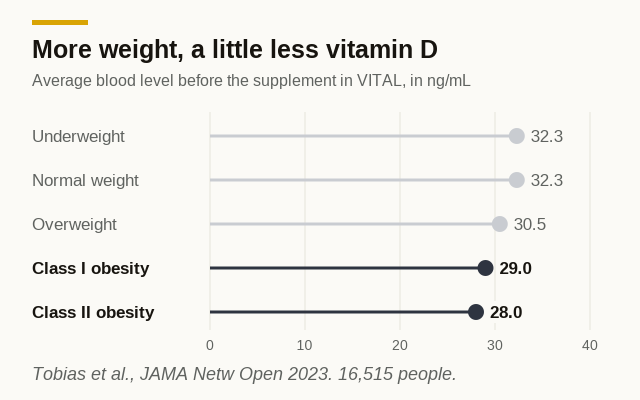
With the scale starting at zero, you can see that obesity takes a few points off the test, a long way from a steep fall. A small drop like this can push more people below the deficiency cutoff on the lab report, one possible explanation for the finding of the Bahia meta-analysis. In the same data, after randomization, the capsule raised the vitamin less in people with overweight or obesity, and this matters again when it comes to replacement.
Where the vitamin D goes in people with more fat
A bone research group at the University of Sheffield, in England, traced the path vitamin D takes in the body of people with obesity, and this post leans on that work. The review was published in Current Opinion in Endocrinology, Diabetes and Obesity, and in it Jennifer Walsh and colleagues explain that vitamin D dissolves in fat and spreads through the blood, fat, muscles and liver. In people with obesity, all of these compartments are larger. The same amount of vitamin, made in the skin or swallowed in a capsule, spreads through a larger volume, and the part that stays in the blood, which is what the test measures, goes down. The authors call this volumetric dilution, similar to a spoonful of sugar that sweetens a cup well and is barely noticeable in a jug.
The Sheffield group arrived at this explanation after testing the others in a study of their own (paid for with public research funding from England’s health ministry), with adults with and without obesity. The amount of vitamin D in the diet was similar in both groups, so was sun exposure, the protein that carries the vitamin in the blood was the same, and the body used up the vitamin at the same rate. In some parts of the world, people with obesity go out in the sun less, and that adds to it. In the English studies, though, sun exposure was the same, and the blood number was lower all the same.
An older American experiment, published in 2000 in the American Journal of Clinical Nutrition, showed vitamin D leaving the blood soon after it was made. The researchers placed healthy white adults, with and without obesity, in an ultraviolet light booth, the same kind of light in sunshine that makes the skin produce the vitamin. The skin of both groups had the same raw material and responded the same way when the researchers tested it in the lab. Even so, one day after the light, blood vitamin D rose 57% less in people with obesity, and the authors attributed the difference to vitamin deposited in fat.
An old idea is that fat traps vitamin D and never gives it back. For the English group, dilution better explains what shows up in the studies. The gap between people with and without obesity grows in summer, because the sun raises everyone’s vitamin D and raises it less in those with the larger volume. And when a person with obesity stops the supplement, the level may fall more slowly, because the vitamin stored in fat returns little by little to the blood.
Does a lack of vitamin D make you gain weight?
Observational studies, which only compare who has what, cannot say what came first, the fat or the low vitamin D. To separate the two, researchers in London used the genes of adults from several countries in a method called Mendelian randomization. The genes you get from your parents are drawn by chance before birth and do not change with what you eat or how much sun you get, so they work like a lottery run by nature. The study, published in PLoS Medicine, tested both directions at the same time.
The genes that increase weight came along with lower vitamin D in the blood. The genes that keep vitamin D low did not come along with higher weight, and this result was repeated in a much larger genetic database, from an international consortium on body measurements. The authors concluded that higher weight leads to reduced vitamin D and that an effect in the opposite direction, if there is one, should be small, and the English review reads it the same way: low vitamin D is probably a consequence of obesity. The supplement trials point the same way. If a lack of vitamin D made you gain weight, correcting the lack should make weight drop, and that did not happen in the trials in the next section, including those that gave the vitamin along with a diet.
Researchers still debate whether the low vitamin D of people with obesity is a true deficiency. A serious lack of vitamin D weakens bone, because the gut starts to absorb less calcium. In adults with obesity, however, bone tends to be denser on DXA (the X-ray scan that measures bone density) and renews more slowly than in adults with normal weight, the opposite of what you would expect from someone with a deficiency. One hypothesis of the Sheffield group is that the body’s total store is fine, kept in fat, and that only the blood number is diluted. The other is that the deficiency exists and that the extra weight offsets the effect on bone, through the greater load on the skeleton and hormones linked to fat. In children with obesity, the picture changes, and bone tends to be more fragile.
What the supplement trials showed about weight and fat
VITAL followed older American adults who took vitamin D or placebo for years. In a Boston subgroup, the researchers measured the body by DXA, a low-dose X-ray scan that separates fat, muscle and bone, at the start and two years later. I compared this scan with the devices used in clinics in the post on bioimpedance. The result, published in the Journal of Clinical Endocrinology & Metabolism, was no difference in weight, body mass index, waist circumference, total or regional fat, or lean mass. The effect did not change between men and women or with the starting vitamin D level. The only difference was a small improvement in the body fat percentage of those with normal weight, which did not show up in those who were overweight.
A meta-analysis published in Nutrition Reviews pooled the randomized trials in which adults took vitamin D, alone or with calcium, for at least three months, and in which weight was measured. Neither vitamin D alone nor vitamin D with calcium changed weight, body mass index or body fat. The chart shows the average difference for each comparison and the margin of error around it.
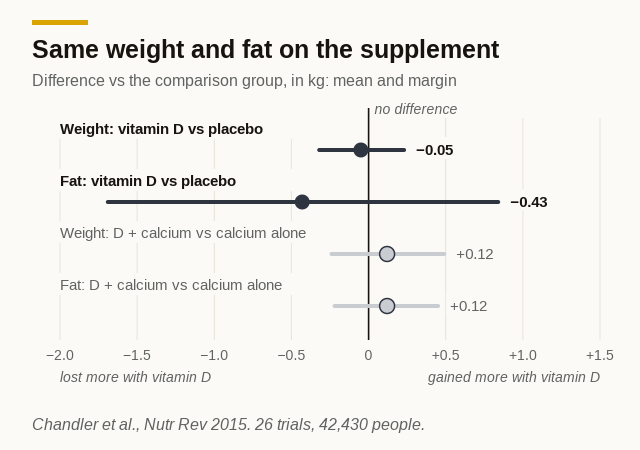
The zero line marks the result where the supplement and the comparison come out the same, and every margin crosses it. For weight, the middle values sit grams away from zero; for fat, the point for vitamin D alone falls a little to the left, with a margin so wide that it fits both a small loss and a small gain. Another meta-analysis, published in Obesity Reviews one year earlier, separated only the trials without a diet, to see the effect of the vitamin alone, and also found no change in weight or fat. In 2024, an analysis done with the data of each participant tested calcitriol, the active form of the vitamin, which the body produces in the kidney, and weight, waist circumference and fat stayed the same as with placebo.
A Seattle trial, published in the American Journal of Clinical Nutrition, tested whether vitamin D helps people who are already dieting, in postmenopausal women with overweight or obesity and vitamin D below the ideal level. All of them joined a one-year diet and exercise program, and randomization decided who would take the vitamin and who would take placebo. Weight loss was practically the same in both groups, as was the loss of waist circumference and fat. The women in the vitamin group who reached a level considered sufficient in the blood lost a little more, but that comparison was not randomized and may reflect other differences between them that the study did not control for. A review by researchers in Beirut, which pooled trials in people with obesity, on a diet and after bariatric surgery, also saw no effect of vitamin D on weight.
In all of these studies, people who took the capsule weighed the same as people who did not, which holds both for anyone afraid of gaining weight and for anyone hoping for help losing it. On the idea that a supplement solves what food and routine don’t, I left a few points in the post on myths about fad diets and supplements.
What happens to vitamin D when you lose weight
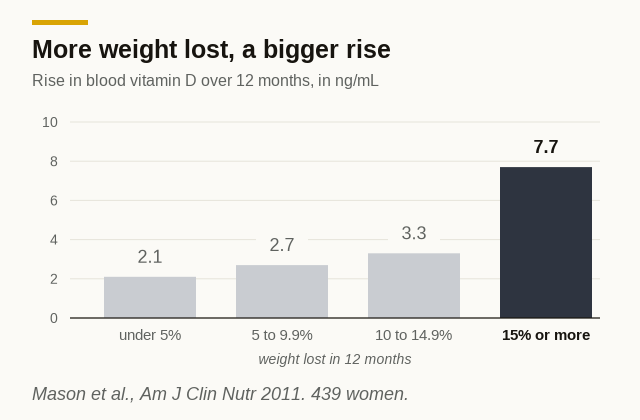
If fat dilutes vitamin D, losing fat should concentrate the vitamin again, and the same Seattle group tested this before the capsule trial. Postmenopausal women with overweight or obesity were randomly assigned to diet, exercise, both together or no change, and followed for one year. In the comparison between the randomized groups, vitamin D did not change clearly. The difference appeared when the researchers sorted the women by how much weight each one lost: the more weight a woman lost, the more the vitamin rose, and in the group that lost the most it rose 7.7 ng/mL in one year.
A Canadian study of sedentary men with fat built up around the belly measured fat by CT scan before and after one year of changes in diet and exercise. Blood vitamin D tracked the fat inside the belly: the more that fat went down, the bigger the rise in the vitamin, as the dilution idea predicts.
With bariatric surgery, the curve is different. Vitamin D deficiency is already common before the operation in people with severe obesity, and the team usually tests and corrects the vitamin during the preparation. According to the Sheffield review, it tends to rise in the first month after the operation, probably because the volume for dilution shrinks, and then falls over the years, especially after surgeries that reduce absorption, such as gastric bypass. Bone also loses mass after bypass, even with supplements, and keeping vitamin D at a good level may help slow that loss, along with calcium, protein and physical activity. People who have had bariatric surgery need their own follow-up, with tests and supplements set by the surgical team.
However you lose weight, take care to lose fat without losing muscle, as I explained in losing weight without losing muscle. And if your weight stalls halfway, vitamin D is unlikely to explain it, since not even the capsule sped up weight loss in the studies; the most common causes are in the post on the weight loss plateau.
Do people who are overweight need a vitamin D test or replacement?
Having obesity, with no other reason, does not call for a routine vitamin D test. The 2024 guideline from the Endocrine Society, the American endocrinology society, looked for trials showing a benefit from testing vitamin D in adults with obesity, found none and therefore suggests against routine testing in this group, as in the general population. In the post on when to supplement vitamin D, obesity appears on the list of reasons to consider the test; under the 2024 guideline, it is not enough by itself and needs to come with another reason.
The test starts to make sense when weight comes with one of these situations: bariatric surgery, a disease that interferes with absorption in the gut, osteoporosis or a fracture from a minor fall, kidney or liver disease, medicines that affect the vitamin, or almost no sun exposure. Bone pain and muscle weakness with no explanation also count. If the result comes back low while you are losing weight, remember that the number tends to rise on its own as you lose fat, without skipping treatment of a confirmed deficiency, and you and your doctor agree on when to repeat the test.
Once deficiency is confirmed and replacement is indicated, weight comes into play. In the VITAL data, the same capsule raised vitamin D less in people who were overweight, and the Beirut review saw the same thing in the obesity trials. The Sheffield group explains that, with more volume to fill, people with obesity need more vitamin to reach the same number in the blood, especially during the correction phase; for maintenance, the review says the need should be similar to that of people with normal weight. You and your doctor decide the dose, how long to take it and when to repeat the test, based on your case. Taking high-dose vitamin D on your own, hoping to lose weight, has no support in the studies and carries risk: in excess, the vitamin raises blood calcium and overloads the kidneys, as I described when talking about when to supplement vitamin D.
| Question | What the studies showed | Type of study |
|---|---|---|
| Does the supplement cause weight gain? | Weight, fat and waist circumference the same as with placebo | Randomized trials and meta-analyses |
| Does the supplement cause weight loss? | No, not even with diet and exercise | Randomized trials and meta-analyses |
| Does a lack of it cause weight gain? | Weight brings the vitamin down; the reverse barely shows up | Genetics (Mendelian randomization) |
| Why is it low in obesity? | It is diluted in a larger body and stored in fat | Experiments and review |
| Does losing weight raise the result? | Yes, more in those who lose more weight | Follow-up studies |
| Does obesity call for routine testing? | No, only with another reason | 2024 guideline |
Signs that call for a visit, with or without a vitamin D test
Get checked if any of these signs appear, whether or not you have had a vitamin D test. Each one has causes that go beyond the vitamin, and the visit helps find the one that matters in your case:
- bone pain or muscle weakness with no explanation;
- a fracture after a minor fall or an ordinary effort, or pain at one spot on a bone that gets worse with training;
- bariatric surgery without regular follow-up, or diarrhea that doesn’t go away;
- rapid weight gain with no change in diet or routine;
- use of a high-dose supplement on your own, without a test or medical guidance.
With weight gain that appears for no apparent reason, for example, the doctor looks into causes other than the vitamin. With high doses taken on your own, the test shows whether the vitamin has gone too high.
In practice
- If you take vitamin D under medical guidance, you don’t need to worry about your weight: in the trials, those who took it ended up with the same weight as those who took placebo.
- Don’t use vitamin D to lose weight, because, with or without a diet, it did not increase weight loss in the studies.
- If your test came back low and you carry extra weight, keep in mind that fat dilutes the vitamin and that the number usually goes up when you lose weight.
- Get a vitamin D test when there is a reason other than weight, such as bariatric surgery, a gut that absorbs poorly, weak bones or medicines that affect it.
- With a confirmed deficiency, follow guided replacement; people with obesity usually need more vitamin to reach the same level, and the doctor sets the dose at the visit.
- To lose weight, put your effort into what the studies support: food, movement, good nights of sleep and, when indicated, medical treatment of obesity.
Conclusion
Vitamin D doesn’t make you gain or lose weight: in the trials, those who took it ended up with the same weight, the same fat and the same waist circumference as those who took placebo. There is a relationship between the two, and it runs from weight to the vitamin, because extra fat dilutes vitamin D and lowers the test number, and losing weight makes that number go up. For people who are overweight, testing and replacing depend on there being another reason, which comes from your health history.
All the best!
G
Responsible physician: Dr. Gilberto Nering Junior, sports medicine physician, CRM-SP 160822, RQE 142486 (Sports Medicine, Brazil).
This text was not sponsored, is for information only and does not replace an individual assessment. Questions about the content: contact the clinic.
Cover photo: Kristīne Kozaka on Unsplash.
Frequently asked questions about vitamin D and weight
Does vitamin D cause weight gain in children?
In a trial with schoolchildren in South Africa, the children who took vitamin D for three years grew the same as those who took placebo and ended up with the same body mass index, and their measured body fat was also the same. In babies and children, vitamin D is used to protect bone, and the pediatrician decides whether to give it and how much.
Does low vitamin D cause weight gain or make it harder to lose weight?
In the studies, low vitamin D did not show up as a cause of weight gain, and replacing the vitamin did not increase weight loss. In a trial with women who had vitamin D below the ideal level and followed a diet and exercise program, those who took vitamin D lost the same weight as those who took placebo, and in another study by the same group the vitamin rose as the women lost weight.
Does vitamin D help you lose weight and belly fat?
No. In the VITAL substudy that measured the body by DXA scan, those who took vitamin D for two years ended up with the same waist circumference and the same fat as those who took placebo. When belly fat goes down with diet and exercise, it is the vitamin D on the test that tends to rise.
Do people with obesity need to take more vitamin D?
Only people with a deficiency or another reason for it need replacement. In those cases, since the vitamin spreads through a larger body, people with obesity usually need more to reach the same blood level, and the doctor sets the dose.
Does vitamin D drop after bariatric surgery?
It usually goes up in the first month, when weight falls quickly, and drops in the following years, especially after gastric bypass, which reduces absorption. For that reason, people who have had the surgery get tests and take supplements with follow-up from the team.
References
- Bassatne A, Chakhtoura M, Saad R, et al. Vitamin D supplementation in obesity and during weight loss: a review of randomized controlled trials. Metabolism. 2019;92:193-205. doi:10.1016/j.metabol.2018.12.010
- Chandler PD, Wang L, Zhang X, et al. Effect of vitamin D supplementation alone or with calcium on adiposity measures: a systematic review and meta-analysis of randomized controlled trials. Nutr Rev. 2015;73(9):577-593. doi:10.1093/nutrit/nuv012
- Chou SH, Murata EM, Yu C, et al. Effects of vitamin D3 supplementation on body composition in the VITamin D and OmegA-3 TriaL (VITAL). J Clin Endocrinol Metab. 2021;106(5):1377-1388. doi:10.1210/clinem/dgaa981
- Demay MB, Pittas AG, Bikle DD, et al. Vitamin D for the prevention of disease: an Endocrine Society clinical practice guideline. J Clin Endocrinol Metab. 2024;109(8):1907-1947. doi:10.1210/clinem/dgae290
- Gangloff A, Bergeron J, Pelletier-Beaumont E, et al. Effect of adipose tissue volume loss on circulating 25-hydroxyvitamin D levels: results from a 1-year lifestyle intervention in viscerally obese men. Int J Obes (Lond). 2015;39(11):1638-1643. doi:10.1038/ijo.2015.118
- Mason C, Xiao L, Imayama I, et al. Effects of weight loss on serum vitamin D in postmenopausal women. Am J Clin Nutr. 2011;94(1):95-103. doi:10.3945/ajcn.111.015552
- Mason C, Xiao L, Imayama I, et al. Vitamin D3 supplementation during weight loss: a double-blind randomized controlled trial. Am J Clin Nutr. 2014;99(5):1015-1025. doi:10.3945/ajcn.113.073734
- Middelkoop K, Micklesfield L, Stewart J, et al. Influence of vitamin D supplementation on growth, body composition, pubertal development and spirometry in South African schoolchildren: a randomised controlled trial (ViDiKids). BMJ Paediatr Open. 2024;8(1):e002495. doi:10.1136/bmjpo-2024-002495
- Oussaada SM, Akkermans I, Chohan S, et al. The effect of active vitamin D supplementation on body weight and composition: a meta-analysis of individual participant data. Clin Nutr. 2024;43(11):99-105. doi:10.1016/j.clnu.2024.08.031
- Pathak K, Soares MJ, Calton EK, et al. Vitamin D supplementation and body weight status: a systematic review and meta-analysis of randomized controlled trials. Obes Rev. 2014;15(6):528-537. doi:10.1111/obr.12162
- Pereira-Santos M, Costa PR, Assis AM, et al. Obesity and vitamin D deficiency: a systematic review and meta-analysis. Obes Rev. 2015;16(4):341-349. doi:10.1111/obr.12239
- Tobias DK, Luttmann-Gibson H, Mora S, et al. Association of body weight with response to vitamin D supplementation and metabolism. JAMA Netw Open. 2023;6(1):e2250681. doi:10.1001/jamanetworkopen.2022.50681
- Vimaleswaran KS, Berry DJ, Lu C, et al. Causal relationship between obesity and vitamin D status: bi-directional Mendelian randomization analysis of multiple cohorts. PLoS Med. 2013;10(2):e1001383. doi:10.1371/journal.pmed.1001383
- Walsh JS, Bowles S, Evans AL. Vitamin D in obesity. Curr Opin Endocrinol Diabetes Obes. 2017;24(6):389-394. doi:10.1097/MED.0000000000000371
- Wortsman J, Matsuoka LY, Chen TC, et al. Decreased bioavailability of vitamin D in obesity. Am J Clin Nutr. 2000;72(3):690-693. doi:10.1093/ajcn/72.3.690