
Also in: Português · Español · Italiano · 中文 · हिन्दी
Main points
- Competitive bodybuilders died in numbers that the study authors themselves considered high for young, athletic men, and the most common cause was sudden cardiac death.
- The risk is concentrated in professionals, who died several times more often than amateurs in the first study to count these deaths in an organized way.
- The few autopsies made public showed an enlarged heart with a thick wall, a pattern linked to anabolic steroid use.
- Competition week, with water cutting and diuretics, and mental health problems stand out as factors that raise the risk.
- Strength training is good for your health; the risk seems to come from the drugs, the extreme diet and the dehydration of top-level bodybuilding, and the studies still can’t separate how much each one weighs.
Every time a well-known bodybuilder dies before the age of 50, the same argument comes back on social media. Some people say the sport has turned into Russian roulette, and others point out that people die young in every profession and that the press only covers the famous cases. For decades the debate ran on guesswork, because no one had counted these deaths in an organized way, athlete by athlete.
In 2025, a group of sports medicine physicians and cardiologists from the University of Padua, in Italy, along with colleagues from other countries, did that count. They listed the men who took the stage at hundreds of competitions of the international bodybuilding federation (IFBB) between 2005 and 2020 and checked, name by name, who had died and from what. The work came out in the European Heart Journal, the journal of the European Society of Cardiology, and the authors stated that they received no funding from anyone to do it. The studies of anabolic steroid users in Denmark and of strength athletes in Finland, which come up further on, help explain why so many of these men died of heart problems.
Do bodybuilders die younger?
Everything points to yes, and the highest risk is in the professional bodybuilder. In the Italian study, professionals died several times more often than amateurs over the same period, and the most frequent cause was sudden death of cardiac origin, in men who were usually still in their 40s. The few autopsies (the examination of the body after death to find the cause) showed an enlarged heart with a thick wall, and anabolic steroid use was confirmed or reported in some of the cases. The study does not prove that anabolic steroids alone caused the deaths, but the data from Denmark, with users caught by anti-doping testing, and from Finland, with athletes suspected of use, point in the same direction.
How the researchers counted the deaths
The team gathered the results of 730 IFBB competitions and arrived at more than 20,000 different male athletes, after removing repeated names. Each athlete was searched for name by name on the internet, with a standardized set of keywords, up to July 2023. Two physicians checked every death they found, cross-checking several sources to confirm who the athlete was and how he died, and they used the autopsy report when one existed.
The deaths were split into two groups. Sudden death is one that happens unexpectedly, in a person who seemed well, and within it the authors separated traumatic deaths (accidents, violence) from those that came from the heart. The other deaths, from already known diseases such as cancer or COVID, went into the second group. The researchers also calculated the risk only for those who were still competing, meaning those who had been on stage in the previous year. The method has a weakness, which the authors themselves acknowledge: the death of a little-known athlete, with no news online, may have been missed, so the real number of deaths is probably higher than the one they found.
What these athletes died of
Sudden cardiac death, when the heart suddenly stops, came ahead of any other cause, and the authors believe that some of the deaths with no known cause also came from the heart. Some collapsed on stage during the championship, some died while training and some died in the hours or days after an event.
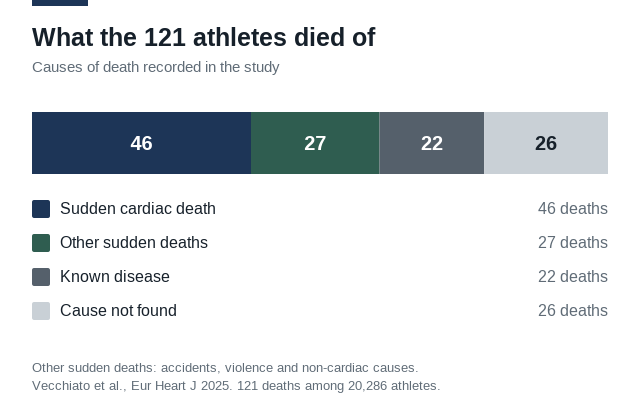
Few athletes, all of them professionals, had their autopsy made public, and the finding was the same each time: a heart larger than normal and a thick wall in the left ventricle, the chamber that pumps blood to the whole body. Some also had blocked heart arteries, and one had scarring in the heart muscle. In the few tests that looked for drugs in the body, most found anabolic steroids.
Among the traumatic deaths there were traffic accidents, homicide and suicide, and the authors draw attention to these athletes’ mental health. Among the diseases there were cancer, COVID complications and kidney failure; the kidneys suffer from dehydration, diuretics and anabolic steroids, and they get more overloaded when the diet goes overboard on protein during this period.
Why professionals run a higher risk
Among professionals, 2.8% died during follow-up, against 0.4% of amateurs, and sudden cardiac death weighed more in the elite group. In the small group that competed in the main category of Mr. Olympia, the most important championship in the world, the proportion of deaths was even higher.
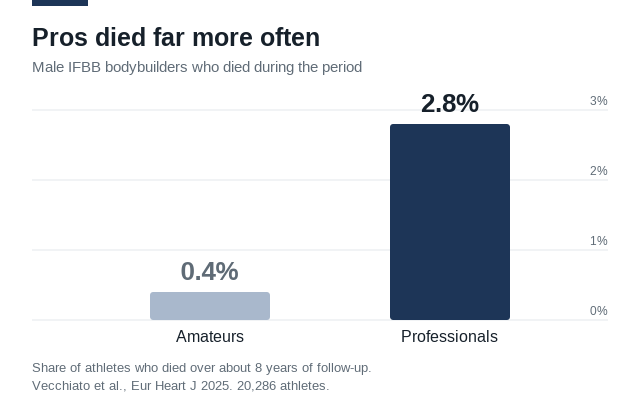
The study did not measure drug use athlete by athlete, so it can’t say how much each factor weighed. Even so, the physique of a professional today is hard to reach without chemical help, because it requires more muscle mass and less fat than the body usually sustains, and, by the authors’ own estimate, the vast majority of male competitive bodybuilders use anabolic steroids. It is also likely that professionals compete more often, go through more prep cycles and spend more years exposing the heart to this environment, something the study did not get to measure.
The division the athlete competes in also changed the risk. In classic physique, which has a weight limit for height and rewards a less extreme physique, sudden cardiac death was less common than in traditional bodybuilding, with no weight limit, which supports the idea that the risk grows along with the size the athlete tries to reach.
Where anabolic steroids come in
Anabolic steroids are the synthetic form of testosterone and of substances similar to it. At doses far above the body’s natural production, they make the heart muscle grow along with the rest, but this growth is different from what happens to a marathon runner’s heart. The wall thickens, the chamber gets stiffer and the heart relaxes less well between one beat and the next. Over time, scarring can appear in the heart muscle, and that is the ground where serious arrhythmias start (beats out of rhythm that can stop the heart). I explained this mechanism in more detail when I wrote about the difference between using anabolic steroids and testosterone replacement prescribed by a doctor.
Besides acting on the heart muscle, anabolic steroids lower good cholesterol, raise bad cholesterol, increase the number of red blood cells (the blood gets thicker), tend to raise blood pressure and speed up plaque buildup in the arteries. These effects raise the risk of heart attack and thrombosis (a clot that blocks a vessel), and years of all of them adding up help explain what the autopsies showed.
Anabolic steroid users in the studies
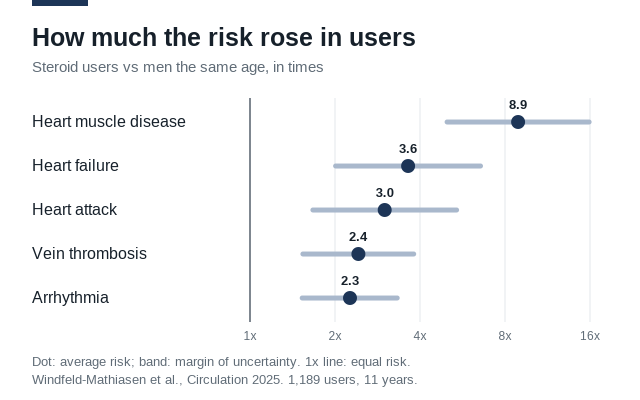
In Denmark, researchers followed for more than a decade the men caught by gym anti-doping testing and compared them with a group dozens of times larger of men the same age from the general population. The anabolic steroid users had three times more heart attacks, as well as more heart failure (the heart loses strength to pump), arrhythmia and thrombosis; the study came out in Circulation, from the American Heart Association. A letter from the same group, published in JAMA in 2024, had already shown that these men also died more often than those who did not use them.
Finnish researchers had seen the same signal much earlier. They followed for more than a decade powerlifting athletes (squat, bench press and deadlift) who had ranked among the best in the country in the late 1970s and early 1980s, with suspected anabolic steroid use (International Journal of Sports Medicine, 2000). The risk of dying in that period was 4.6 times higher than that of men the same age, with suicide and heart attack among the causes.
In Sports Medicine, an American review from 2023 asks for caution in reading these numbers. Elite athletes, in general, live longer than the population, and bodybuilding mixes several factors at once: anabolic steroids, other drugs, extreme diet, dehydration and body image problems. Their conclusion is that anabolic steroids are probably the main culprit, but that data are still lacking to measure the exact weight of each thing.
Competition week
The Italian study recorded deaths on stage, in training and in the days after a championship, and the authors point to the final stretch of prep as a risky period. In this phase, many athletes make a big cut in calories, cut water, take salt out of their food and use diuretics so the muscle looks drier on stage. A diuretic makes the kidney flush out water and also salts such as potassium and magnesium, which the heart needs to keep the right rhythm. Anyone who tries to make up for it with a potassium supplement or a diuretic that holds on to potassium can fall into the opposite extreme, with potassium too high, which also disrupts the heart rhythm. In someone who already has an enlarged, stiff heart, this swing in salts and the drop in blood volume make a dangerous combination for arrhythmia.
Insulin, growth hormone and doping
Some athletes also use insulin and growth hormone in this period, and insulin, without enough food, can drop blood sugar to the point of causing fainting or seizures. Not all of these substances show up in the tests that look for drugs in the body, and none of them was measured systematically in the study, which is why the authors treat this period as high risk without being able to separate the weight of each drug. Anyone who competes in a sport with doping control also runs the risk of a ban, because anabolic steroids, diuretics, insulin and growth hormone are on the prohibited list of the World Anti-Doping Agency (WADA), in and out of competition.
Why it differs from sudden death in other sports
Sudden death in these bodybuilders differs from what usually happens in athletes under 35 in other sports, where the most common cause is an inherited heart disease the person didn’t know they had. Above that age, blocked arteries take the lead in most sports. The bodybuilders who had sudden cardiac death were, on average, in their 40s, but the autopsy reports pointed more to a thick, enlarged heart than to a blocked artery, and the authors noted that the risk of sudden death was similar between athletes in the open category, which has no age limit, and the masters, over 40, although the masters died twice as often when all causes are added together. I described how screening works in other sports in the post about sudden death in sport and the tests before training.
Mental health counts too
The authors pay special attention to deaths from suicide and violence, above all in the youngest athletes and in professionals. Some of the people who get into bodybuilding have a difficult relationship with their own body, to the point of never feeling big enough, a condition called muscle dysmorphia. Anabolic steroid use worsens mood in some people, and the phase of stopping, when the body’s own testosterone is switched off, usually comes with low mood, lack of motivation and even depression. I wrote about this phase in the post on low testosterone after the cycle.
On top of that, the culture of the sport tolerates and sometimes encourages using several drugs at the same time, including recreational ones. For this reason the study asks federations to offer psychological assessment along with the heart assessment.
Limits of the Padua count
The study only included athletes from one federation. Many bodybuilders compete in federations that run no doping control at all, and they were left out. The authors also report that the IFBB holds thousands of competitions a year and that the most recent report from the World Anti-Doping Agency (WADA) recorded only a few dozen samples from the sport, minimal control for a sport of that size.
| What the study shows | What it can’t show |
|---|---|
| Competitive bodybuilders had many deaths for their age, a good share of them sudden | How many used anabolic steroids and in what amount |
| Professionals run a much higher risk than amateurs | Whether the difference comes only from the drugs or also from diet and dehydration |
| Sudden cardiac death leads the causes | What happens to people who do strength training without competing |
| The autopsies made public show an enlarged, thickened heart | Whether heart screening tests would prevent these deaths |
Studies on the effect of heart screening in bodybuilding are also missing, a gap the Padua team acknowledges. An ECG, an exercise stress test and an echocardiogram (heart ultrasound) can show an enlarged heart or an arrhythmia, but no one has yet measured how many deaths these tests would prevent in this sport.
What about people who just lift weights?
People who do strength training to get stronger and healthier are not in the same risk group. Strength training lowers overall mortality, protects bone, helps control blood sugar and blood pressure, and maintains muscle mass over the years. The Italian study describes the risk of a specific environment, the top-level stage, where the pursuit of an extreme physique comes together with drugs, diet and dehydration.
The amateurs in the study died less often than the professionals, but that doesn’t make use safe for people who don’t compete. Many amateurs also use anabolic steroids, and the Danish studies, done with gym-goers, show the risk in this group. If you use or have used them, tell your doctor and get the follow-up I explained in the post on when testosterone comes back after the cycle.
Heart and mind warning signs that call for a doctor
Fainting during exertion and chest pain with shortness of breath call for the emergency room right away or SAMU (Brazil’s public emergency ambulance service), at 192. In other cases, anyone who uses or has used anabolic steroids, or is preparing to compete, should book a medical assessment soon if they have:
- shortness of breath out of proportion to the effort, or that appears when lying down;
- chest pain or tightness that comes and goes, during training or at rest;
- palpitations, a racing heart or a heart beating out of rhythm;
- near fainting or strong dizziness, especially in competition week;
- swelling in the legs and quick weight gain with no explanation;
- high blood pressure in home readings;
- a case of sudden death or serious heart disease in a relative under 40;
- persistent sadness, unusual irritability or thoughts of hurting yourself.
If thoughts of hurting yourself come up, don’t wait for the appointment: CVV (Brazil’s free 24-hour emotional support line) answers by phone at 188, free of charge, at any hour. The emergency room also handles this kind of emergency.
In practice
- If you compete or are thinking about competing, know that the risk of dying early in bodybuilding is real and grows with the level of competition.
- If you use or have used anabolic steroids, tell your doctor, without fear of judgment, because it changes the tests they will order.
- Get a heart assessment before competing, with an ECG and an echocardiogram, and repeat it in the following years if you have used anabolic steroids.
- Stay away from water cutting and diuretics to dry out, which raise the risk of arrhythmia in the week when the heart is most vulnerable.
- Pay attention to your mental health, and seek help if your body never seems good enough or if your mood collapses after you stop.
- If your goal is health, do strength training regularly, eat well and sleep well.
Conclusion
The first study to count bodybuilders’ deaths in an organized way found a number of deaths that the authors considered high for young men, unlike what is seen in elite athletes from other sports, who live longer than the population. The risk was higher among professionals, sudden cardiac death led the causes and the autopsies made public showed enlarged, thickened hearts. The Danish studies, with users caught in gyms, and the Finnish one, with athletes suspected of use, point the same way, with more heart attacks, heart failure and deaths than in the comparable population. The researchers ask federations and doctors to work together to set up heart and mental health assessments for those who compete.
All the best!
G
Responsible physician: Dr. Gilberto Nering Junior, sports medicine physician, CRM-SP 160822, RQE 142486 (Sports Medicine, Brazil).
This text was not sponsored, is for information only and does not replace an individual assessment. Questions about the content: contact the clinic.
Cover photo: Nikola Gladovic on Unsplash.
Frequently asked questions about bodybuilders and early death
Do bodybuilders die younger than other athletes?
The data suggest they do, unlike elite athletes in other sports, who tend to live longer than the population. Among competitive bodybuilders, sudden cardiac death shows up often and early, and the heart leads the causes of these deaths.
Why do so many bodybuilders die suddenly?
The most common cause is sudden cardiac death. The few autopsy reports made public describe an enlarged heart, with a thick wall and, in one case, with scarring, fertile ground for serious arrhythmias, and the use of anabolic steroids, diuretics and dehydration close to competition raises that risk.
Are anabolic steroids to blame for bodybuilders’ deaths?
Anabolic steroids are the main suspect, because studies of users caught by anti-doping testing show more heart attacks, heart failure and deaths. In bodybuilding, however, anabolic steroids come together with other drugs, extreme diets and dehydration, and the studies still can’t separate the weight of each factor.
Do people who lift weights without anabolic steroids also run this risk?
The studies don’t show this risk in people who only train, and strength training lowers mortality and protects health. The risk in the study is tied to the top-level competition environment, with drugs, water cuts and extreme diets, and not to the training itself.
Which heart tests should someone who has used anabolic steroids get?
The doctor usually orders an ECG, an echocardiogram, blood pressure, cholesterol and a complete blood count, to see the size and strength of the heart, the fat in the blood and whether the blood has become thicker. In people who used them for many years, an assessment of the heart arteries may also be added.
References
- Pärssinen M, Kujala U, Vartiainen E, et al. Increased premature mortality of competitive powerlifters suspected to have used anabolic agents. Int J Sports Med. 2000;21(3):225-227. doi:10.1055/s-2000-304
- Smoliga JM, Wilber ZT, Robinson BT. Premature death in bodybuilders: what do we know? Sports Med. 2023;53(5):933-948. doi:10.1007/s40279-022-01801-0
- Vecchiato M, Ermolao A, Da Col M, et al. Mortality in male bodybuilding athletes. Eur Heart J. 2025;46(30):3006-3016. doi:10.1093/eurheartj/ehaf285
- Windfeld-Mathiasen J, Heerfordt IM, Dalhoff KP, et al. Cardiovascular disease in anabolic androgenic steroid users. Circulation. 2025;151(12):828-834. doi:10.1161/CIRCULATIONAHA.124.071117
- Windfeld-Mathiasen J, Heerfordt IM, Dalhoff KP, et al. Mortality among users of anabolic steroids. JAMA. 2024;331(14):1229-1230. doi:10.1001/jama.2024.3180