
Also in: Português · Español · Italiano · 中文 · हिन्दी
Main points
- Among teenagers, about 1 in 100 has already used anabolic steroids to gain muscle; among boys, the figure is much higher.
- It is almost never about sport: the strongest push is the wish to look muscular and the struggle with one’s own image in the mirror.
- In a body that is still growing, the drug can close the growth plate early and stall height, as well as disrupt puberty and hormones.
- Most get the product without seeing a doctor and hide what they feel, so the harm runs unchecked.
- It can be stopped early: the wish to quit is reason enough to seek help, and the recovery can be handled without judgment.
An Australian study surveyed 5,071 teenagers aged 11 to 19 at thirteen schools in Sydney and the Newcastle region and asked, anonymously, who had ever used anabolic steroids to look more muscular. A little more than 1 in 100 said yes. The figure looks small, but it carries two messages that worry me more than the number itself: among those who used, most got the product without a prescription, and the use went hand in hand with these young people’s struggle with their own body image. The survey was published in Nutrients and is the basis for this post.
When a teenager uses anabolic steroids, the story almost never starts in sport. It starts in front of the mirror, in the struggle with one’s own image. So, beyond the Australian study, I bring in a meta-analysis that pooled research from around the world to say how many use, another that measured how many ever talk to a doctor, and the sports medicine guidelines that describe what the drug does to a body that is still forming.
How often do teenagers use anabolic steroids?
They do, and earlier than most parents imagine. In the Australian study, 52 of the 5,071 teenagers (1.1%) said they had used anabolic steroids at some point in life to gain muscle. That is lower than the 2.3% to 2.4% in earlier surveys in the same country, and the authors themselves think the real number may be higher: the study was done inside schools, and admitting an illegal drug in front of classmates is not easy, so the true figure is probably above what was measured.
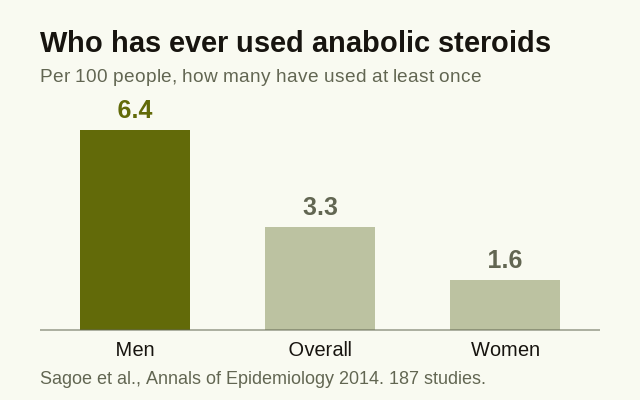
Pooling 187 studies from several countries, a meta-analysis reached an average of 3.3% of people who have used anabolic steroids at some point in life. The gap between boys and girls is wide: about 6 in 100 men against fewer than 2 in 100 women. Adolescence fits right into this count, because it is when the body changes fast and the urge to speed up results speaks loudest.
Who is most at risk of using
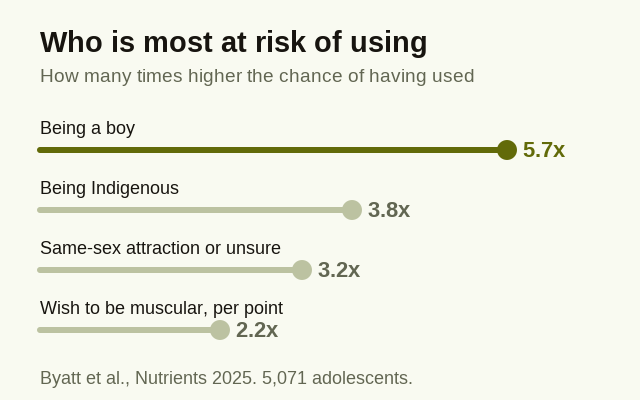
The Australian study did not stop at counting heads. It looked at who uses, and the picture it drew is clear. Being male weighs heavily: a boy’s chance of having used was almost 6 times higher than a girl’s. Indigenous youth and teenagers who are attracted to the same sex, or unsure about it, also showed more use, probably because they carry more pressure about their bodies and less room to ask for help.
Stronger than any demographic trait was the drive to be muscular. Each extra point on that measure raised the chance of use, and this was the only factor, along with a weight-control behavior, that held up when the researchers adjusted for everything at once. Anabolic steroid use in adolescence has less to do with the sport a young person plays and more with how much they suffer over their own body.
Why it is rarely about sport
In many people’s minds, anabolic steroids are for athletes chasing a medal. At this age, the push comes from somewhere else. The trigger is usually dissatisfaction with appearance, that feeling of never being big enough, which psychiatrists call muscle dysmorphia. Pope et al., in an article in JAMA, describe body image disorders as one of the main drivers of anabolic steroid use among men, above the wish to perform better in sport.
The Australian study reinforced this kinship in a way few people connect. Anabolic steroid use went along with behaviors typical of eating disorders, such as making oneself vomit or using laxatives to control weight, and with binge eating. The authors suggest looking at anabolic steroid use within the same spectrum as eating disorders: in both cases, the person is willing to use extreme methods to shape the body into the ideal they see on screens. Anyone caring for a teenager with an unhealthy relationship with food or the mirror needs to keep anabolic steroids on the radar.
This pressure already reaches teenagers as entertainment. In GTA VI, in one of the missions, the character is handed a syringe of anabolic steroids and the game only asks whether she accepts or declines. Accept, and the character becomes more muscular and trains better, with no further consequence. In a real teenager, the harm I see in the liver, or in the height that stops growing, does not come with the option to decline later.
Why the harm is greater in adolescence
An adult who uses anabolic steroids has already finished growing; a teenager has not. The same drug lands in a body under construction, and some of the changes it causes cannot be undone.
The one most specific to this age is height. Long bones grow from a cartilage at their ends, the growth plate (epiphyseal plate), which closes only at the end of puberty. Anabolic steroids are close relatives of the male hormone, and an excess of it speeds up bone maturation and can close that plate ahead of time. The American College of Sports Medicine guideline warns that use before or during puberty hastens this closure, with a loss of final height. A young person may trade a few permanent centimeters for a peak of muscle that, unlike the height, goes away once they stop.
The rest follows the list of anabolic steroid risks at any age, only in a more vulnerable body. The drug shuts down the natural production of testosterone, shrinks the testicles and drives down sperm formation. When the young person stops, that testosterone can take months to return, and this stretch of low hormone comes with low mood and sadness, something I go into in the text on the return of testosterone after a cycle. Part of the hormone also converts into estrogen and can create breast tissue in a boy, gynecomastia, which sometimes clears only with surgery. On top of that come severe acne on the back and shoulders and strain on the liver and kidneys.
In a girl, anabolic steroids masculinize: they deepen the voice, increase body hair, change the clitoris and throw the menstrual cycle off. Much of this stays for good, even after stopping. And there is the mental side, still forming at this stage: irritability, outbursts of anger in those already prone to it, mood swings and dependence. In some samples of users, up to a third develop dependence on the substance, and stopping abruptly can bring a sharp drop in mood.
Why this goes unnoticed
A teenager who uses anabolic steroids almost never comes to me because of that; they show up with another complaint, if at all. Two numbers explain why. In the Australian study, among those who used, 62% got the product without a doctor’s prescription, online, through someone at the gym, on the side. And, reviewing 36 studies with more than 10,000 users, Amaral and colleagues found that only a minority see a health professional: among teenagers, just 17 in 100. The rest hide it, out of shame or because they think the doctor will not understand.
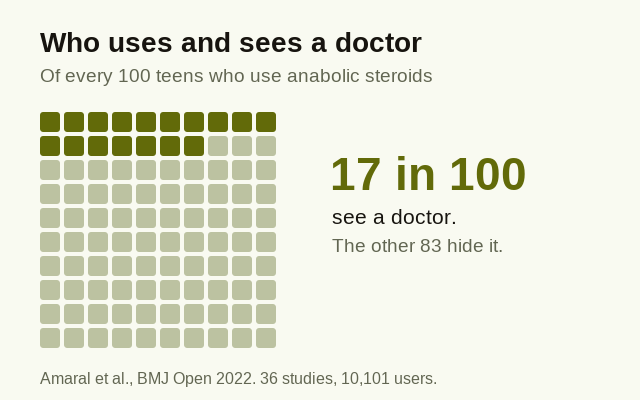
That silence worries me more than the anabolic steroids themselves. With no one keeping watch, the side effect shows up late, the young person slips away with a vial and a syringe at the bottom of the backpack, and the parent only finds out when the harm is already done.
Warning signs for parents and coaches
No single sign settles the diagnosis, but a cluster of them calls for a conversation. I pay attention when I see:
- Muscle gain that is too fast, beyond what training and age can explain, sometimes with stretch marks on the shoulders.
- Severe acne that appeared suddenly, mainly on the back and shoulders.
- A change in mood: more irritability, a short fuse, swings that were not there before.
- Obsession with the mirror, with weight and with shape, extreme diets or episodes of self-induced vomiting.
- Vials, ampoules, syringes or capsules of unknown origin, and secrecy around supplements.
How to lower the risk and where to find help
If you are a teenager and you are using, or thinking about using, the safest thing is not to start. If you have already started, a few habits lower the danger until you can stop. Never share a needle, syringe or vial with anyone, because that brings in the risk of HIV and hepatitis. Do not mix it with other gym drugs or with alcohol. And do not carry this alone: the body at this age gives signs that can be corrected early, if someone is watching.
If you are a parent or a coach and you suspect something, the worst move is a lecture, because the young person already expects it and hides the use to avoid hearing it. Coming with a question instead of an accusation, and booking a visit where they can speak without fear of punishment, opens more doors. In the office we can order the right tests, measure what the hormone is doing and build a plan for stopping that takes care of the drop in testosterone and of the mood, instead of leaving the body to cope on its own.
Conclusion
The number is less frightening than the context. A little more than 1 in 100 teenagers has used anabolic steroids, almost always out of suffering over the body and almost always without seeing a doctor. In a body that is still growing, this can cost height, hormones and mental health, and some of it does not come back. If you use, or if you are a parent who has just found out, come and see me: the wish to stop is reason enough for us to sit down and handle the recovery calmly, without judgment and without a lecture.
All the best!
G
Responsible physician: Dr. Gilberto Nering Junior, sports medicine physician, CRM-SP 160822, RQE 142486 (Sports Medicine, Brazil).
This text was not sponsored, is for information only and does not replace an individual assessment. Questions about the content: contact the clinic.
Cover photo: Zhang liven on Unsplash.
Frequently asked questions about anabolic steroids in adolescents
What is the most common age to start using anabolic steroids?
Use tends to appear around the middle of adolescence, together with the peak of body dissatisfaction. The Australian study included young people aged 11 to 19, with an average of 14, and the literature shows that the first contact comes earlier than once thought. That is why it helps to talk about the subject early, and not after your child is already training hard at the gym.
Do anabolic steroids really hold back growth?
Yes. An excess of male hormone speeds up bone maturation and can close the growth plate ahead of time, the cartilage at the ends of the bones that sets final height. In a teenager who has not finished growing, this means trading permanent centimeters for a muscle gain that fades afterward.
Do girls use anabolic steroids too?
They do, in far smaller numbers than boys. The problem is that the effects in a girl include masculinizing changes, such as a deeper voice, more body hair and a disrupted menstrual cycle, and several of them do not return to normal after stopping. The pressure for a toned body is rising among girls too, so this is not only a boys’ topic.
Is a gym supplement the same thing as an anabolic steroid?
No. Whey, creatine and caffeine are food supplements, with studied safety. An anabolic steroid is a hormone, a controlled medicine, with effects throughout the body. The mix-up is dangerous, because some products sold as supplements, especially online, can come contaminated with hormones with no warning on the label.
My child used anabolic steroids, now what?
See a doctor without turning the visit into a courtroom. We can assess what the drug has already done, order the right tests and build a plan for stopping that takes care of the drop in testosterone and of the mood. The earlier, the smaller the harm, and the simple fact that they agree to talk is already a good start.
References
- Byatt D, Bussey K, Croft T, Trompeter N, Mitchison D. Prevalence and Correlates of Anabolic-Androgenic Steroid Use in Australian Adolescents. Nutrients. 2025;17(6):980. doi:10.3390/nu17060980.
- Sagoe D, Molde H, Andreassen CS, Torsheim T, Pallesen S. The global epidemiology of anabolic-androgenic steroid use: a meta-analysis and meta-regression analysis. Ann Epidemiol. 2014;24(5):383-398. doi:10.1016/j.annepidem.2014.01.009.
- Amaral JMX, Kimergard A, Deluca P. Prevalence of anabolic steroid users seeking support from physicians: a systematic review and meta-analysis. BMJ Open. 2022;12(7):e056445. doi:10.1136/bmjopen-2021-056445.
- Bhasin S, Hatfield DL, Hoffman JR, Kraemer WJ, Labotz M, Phillips SM, Ratamess NA. Anabolic-Androgenic Steroid Use in Sports, Health, and Society. Med Sci Sports Exerc. 2021;53(8):1778-1794. doi:10.1249/MSS.0000000000002670.
- Kersey RD, Elliot DL, Goldberg L, Kanayama G, Leone JE, Pavlovich M, Pope HG. National Athletic Trainers’ Association Position Statement: Anabolic-Androgenic Steroids. J Athl Train. 2012;47(5):567-588. doi:10.4085/1062-6050-47.5.08.
- Pope HG, Khalsa JH, Bhasin S. Body Image Disorders and Abuse of Anabolic-Androgenic Steroids Among Men. JAMA. 2017;317(1):23-24. doi:10.1001/jama.2016.17441.