Also in: Português · Español · Italiano · 中文 · हिन्दी
Main points
- No federal law in Brazil sets a minimum age for the gym, and no medical society turns age into a mandatory rule: what counts more is that the child follows instructions, has good balance and trains with a qualified adult nearby.
- A child who is ready for an organized sport, in general at around age 7 or 8, is usually ready for some strength training, starting with body weight, resistance bands or light loads.
- Studies of supervised training show no injury to the growth plate and no loss of height; most injuries in children come from a dropped weight, a pinched finger and equipment used without guidance.
- A minor’s contract goes through the parents, and in the state of São Paulo, Brazil, the law requires written permission from the parents to sign up children and younger teenagers.
- Uncontrolled high blood pressure or seizures, some heart diseases and symptoms during exercise call for a medical evaluation before the first session.
With close supervision, a child can start strength training at around age 7 or 8, once they follow instructions and are ready for an organized sport, always with their own body weight, resistance bands or light loads at first. The age at which a child can start going to the gym, though, depends on two questions that usually get mixed together: the child’s body and the contract with the gym. On the body side, no medical society fixes a required age. The American Academy of Pediatrics (AAP) accepts body-weight exercises from the age at which a child starts a sport. The National Strength and Conditioning Association (NSCA), the American association of strength and conditioning professionals, is the source of that age: in its view, a child who is ready for organized sport is ready for some kind of strength training, and the Sociedade Brasileira de Pediatria (the Brazilian Society of Pediatrics) talks about starting a gradual program at age 8. On the contract side, here in Brazil, the minimum age comes from each gym’s rules, and the parents sign for anyone who is a minor.
The benefits of strength training in childhood and what fits each age range are in the post where I answered whether kids can do weight training. This post takes the questions that come up at sign-up: what the child needs to be able to do first, whether the growth plate is at risk, where the injuries of kids who start early come from, what the gym has to offer, what Brazilian law says and who should see a doctor first.
What is the minimum age to start strength training?
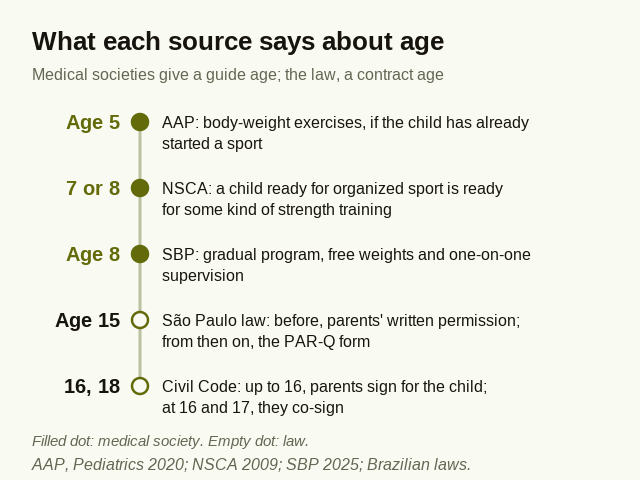
None of the sources I use here makes age a requirement for strength training, which at the gym means weight training, and all of them ask for signs of readiness. The AAP report, published in the journal Pediatrics and reaffirmed in 2024, says it is hard to name a starting age, because each child develops at their own pace. If a child joins a sport at age 5, body-weight exercises at that age are acceptable, such as frog jumps, bear crawls and hopping on one foot. The NSCA position statement, published in 2009 in the Journal of Strength and Conditioning Research, says there is no minimum age, as long as the child is ready, in body and mind, to follow the coach’s instructions and handle the effort of a training program. A 2009 review in the journal Sports Health also asks that the child have good balance and a sense of where their own body is, which in general appears at the same age cited by the NSCA.
In Brazil, a 2025 document from the Department of Endocrinology of the Sociedade Brasileira de Pediatria (SBP) talks about gradual programs that can start at age 8, with free weights instead of fixed machines and one-on-one supervision. These ages mark the start of training guided by someone who teaches, and the SBP itself writes that a child or teenager should not move around freely in a weight room.
Readiness matters more than the date of birth
The AAP separates training age, the time the child has already put into formal strength training, from technical competence, which combines how much they lift, the quality of the movement and the emotional maturity to train. Two 10-year-olds can be at very different points on these two measures, and the professional builds the program from them.
The NSCA’s 2016 position statement on long-term athletic development asks that training also follow biological age, the stage of puberty the child is in, as well as calendar age. As a reference, the NSCA’s 2009 position statement calls a child anyone who does not yet have the signs of puberty, which can last until close to age 11 in girls and 13 in boys, and each one gets there in their own time; at sign-up, the age on the ID does not show what stage the body is in. A 13-year-old boy who has not yet entered puberty and another who already has an adult’s body do not do the same training.
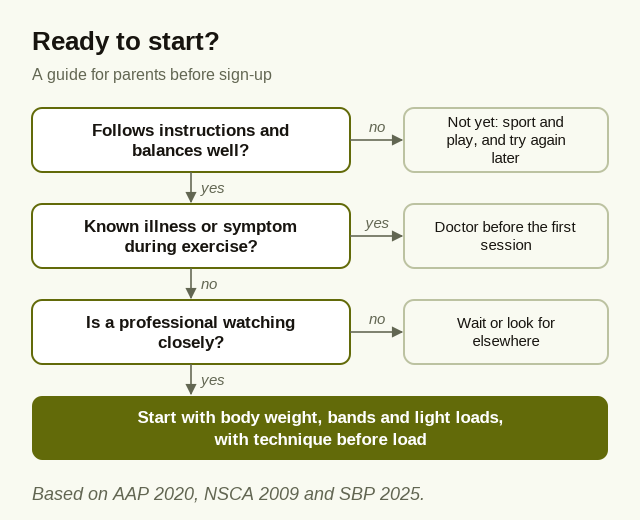
Readiness shows in simple things that the coach sees in the first sessions: the child listens to the explanation and repeats the movement the way they saw it, obeys when told to stop, balances on one foot and gets through the whole session without dropping the technique halfway. A child who is not there yet gains strength by running, jumping and climbing on playground equipment, and that play counts as physical activity, as I explained when I set out the difference between physical activity, exercise and sport.
What the growth plate is and why it worries people
Anyone who fears that weight training will get in the way of growth is thinking of one specific tissue, the growth cartilage. The NSCA position statement explains that it sits in three places in the growing body: in the plates near the ends of the long bones, in the cartilage that lines the joints and at the points where the large tendons attach to the bone. This cartilage is still turning into bone and is weaker than the tissue around it, so it stands up less well to repeated impact. An injury there can keep the child away from training, hurt a lot and, in some cases, get in the way of that bone’s growth.
This fear grew out of case reports from the 1970s and 1980s, with growth cartilage injuries in children and teenagers who lifted weights. The NSCA says most of those injuries came from wrong technique, lifts with the maximum load or the lack of a qualified adult supervising. Up to that position statement, no study that followed young people in a strength training program had reported an injury to this cartilage, and the NSCA also notes that a child’s cartilage before puberty may even be more resistant to this kind of force than a teenager’s.
The AAP draws attention to a different risk, near the tendons. Explosive contractions, like those of a jump or a sprint start, pull hard on the point where the tendon attaches to the bone and, until close to the end of growth, can tear off a small piece of that bone, what is called an avulsion fracture. This pull also happens in sport and in play, and in strength training the jumps and explosive movements come in little by little, after the technique is solid.
Does going to the gym stunt growth?
The studies that measured height say no. A 2006 review published in the Clinical Journal of Sport Medicine, by the researcher Robert Malina, gathered 22 training programs with weights and machines in children before and at the start of puberty and saw no effect on height or weight. With supervision and few trainees per instructor, Malina considered the programs relatively safe and without harm to growth and maturation.
The SBP document reaches the same conclusion from a Brazilian meta-analysis of school-age children, in which strength training did not get in the way of height growth, and the AAP says the same of well-designed programs. The SBP adds a caveat for rare cases: a teenager with severe short stature who does strength training should have their growth curve followed closely by the pediatrician.
Where injuries come from in kids who start early
A sample of American emergency rooms records the visits linked to weights and weight training equipment in a national system, and these data show how children get hurt. A 2009 study, also in the Journal of Strength and Conditioning Research, split the injuries by age and saw that, between ages 8 and 13, two thirds of the injuries were to the hand and the foot, most often described as a dropped weight or a pinched finger. In this group, fractures made up a larger share, and sprains and strains, more common in adults, a smaller one. For the authors, most injuries in young people come from accidents that can be avoided with more supervision and stricter safety rules.
Another survey of American emergency rooms, published in 2010 in the American Journal of Sports Medicine, found the same pattern: in those aged up to 12, the hand accounted for a share of the injuries about twice as large as in older people. Overall, the most common cause was a weight falling on the person using it.
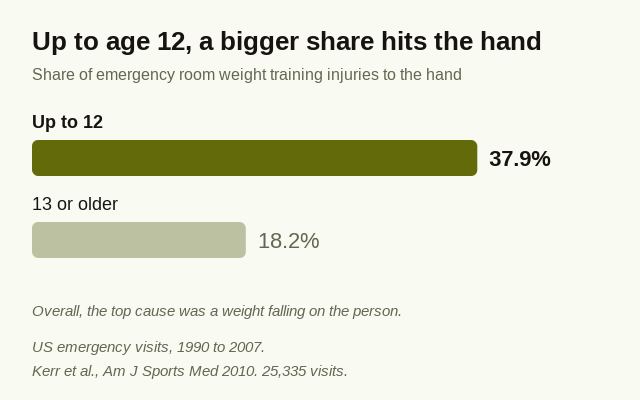
For the AAP, most of the injuries recorded in emergency rooms happen with home equipment, without supervision and with risky behavior, in contrast with what appears in the studies of supervised training. The NSCA even cites a fatal case, of a boy who died when the bench press barbell rolled off the rack and fell on his chest. A 2025 analysis, with the most recent data from this same emergency room system, saw injuries in children and teenagers go up in unsupervised sports centers and go down in schools, where the setting has more rules.
What to ask for in the first sessions
The AAP report describes a start with little or no load, until the child masters the technique of each exercise. The load goes up only when the form of the movement holds, and the professional corrects on the spot, during the set. The session starts with a dynamic warm-up, works all the muscle groups, including those of the trunk, and can combine strength, jumps, balance and agility in one session. The 2014 international consensus on youth strength training asks for the same: a qualified coach and a load that only goes up when the technique allows. When the teenager already has solid technique and an adult’s body, the training gets closer to the adult rules I described when I wrote about sets, load and frequency in strength training.
The SBP asks that, during the growth years, maximal strength exercises be left out, those with a load so high that only a few repetitions are possible. For the same period, it does not recommend supplements, except in specific cases, considers the use of hormones, such as anabolic steroids, contraindicated, and asks parents to pay attention when a teenager gains muscle too fast.
The Guia de Atividade Física para a População Brasileira, the physical activity guide of Brazil’s Ministry of Health, already puts muscle and bone strengthening in the routine of those aged 6 to 17, on at least three days a week, within the daily hour of activity. This strengthening can happen at the gym, at a sports club, at school or at home, with the same care at the start.
A good gym for a child: equipment and coach
If you are going to sign your child up at a regular gym, remember that it was set up for adults, and the AAP asks for equipment that fits the child’s size and technical level. The NSCA records studies with child-sized and adult-sized machines, free weights, resistance bands and body weight, always with exercises that fit the child’s body, and the SBP prefers free weights to fixed machines for starting out. Safety also depends on an adequate number of trainees per instructor, according to the AAP, and the SBP asks for one-on-one supervision at the start. The coach who looks after the weight room and helps many adults at the same time cannot give that attention, and a time slot with close guidance, from someone experienced with children, works better.
Under Brazil’s Law 9.696, of 1998, physical education is the work of a professional registered with the Conselho Regional de Educação Física (CREF), the regional council that registers physical education professionals in Brazil, and parents can check this CREF registration. The AAP also asks that training take place in a setting that is safe, welcoming and free of any abuse.
Age for sign-up: law, contract and state rules
No Brazilian federal law sets a minimum age to join a gym, and the age appears in each gym’s rules, which change from one gym to another. If the front desk asks for your signature on your child’s sign-up, the explanation is in Brazil’s Civil Code: anyone under 16 is represented by the parents in contracts, and anyone aged 16 or 17 signs together with them, which the law calls assistance.
States and cities can have their own law. In the state of São Paulo, Brazil, the law that regulates gyms, updated in 2018, requires written permission from a parent or guardian to sign up anyone under 15. From 15 to 69, the law asks for the physical activity readiness questionnaire, the PAR-Q, and from 70 on it requires a medical certificate. The same law requires the gym to have a physical education professional as its technical supervisor. Outside São Paulo, check the law of your state and your city and read the gym’s rules before you sign.
| Question | Answer | Where it comes from |
|---|---|---|
| Is there a national minimum age in Brazil? | No | No federal law sets one |
| Who sets the sign-up age? | Each gym’s rules | Contract |
| Can a minor sign alone? | No: up to 16, the parents sign for the child; at 16 and 17, they sign together | Brazil’s Civil Code |
| Under 15 in São Paulo | Written permission from the parents | São Paulo state law |
| From 15 to 69 in São Paulo | PAR-Q questionnaire | São Paulo state law |
| Who can run the training | A physical education professional registered with the CREF | Federal Law 9.696 |
Who needs a medical evaluation before starting
For the apparently healthy child, the NSCA says a medical exam before strength training is not mandatory. It recommends the evaluation for those with signs or symptoms that suggest disease and for those who already have a known disease; the Sports Health review prefers an exam before any program. The AAP sees the routine visit to the pediatrician as a good time to talk about starting and to go over the family history, the medicines and the old injuries.
According to the AAP, uncontrolled seizures and some heart diseases call for a talk with the doctor before the first session. If the child has complex congenital heart disease, a pediatric cardiologist guides the training, and epilepsy that is well controlled with medicine does not prevent training. Uncontrolled high blood pressure, in which exercises with body weight alone will do until the appointment, and earlier cancer treatment with anthracyclines also call for that talk. I went into these cases in the post on weight training in children, along with those in which the AAP advises against strength training, such as hypertrophic cardiomyopathy.
Chest pain, fainting and other warning signs in training
The Brazilian sports cardiology guideline lists signs that call for stopping and getting an evaluation before going on: fainting or near fainting during exercise, chest pain or tightness, shortness of breath out of proportion to the effort, a racing heart with dizziness. A family history of sudden death or of inherited heart disease also calls for an evaluation before starting. These signs and what goes into the evaluation are explained in who needs a checkup before training.
Pain that does not go away at one spot on the bone, such as just below the knee or at the heel, or pain that makes the child limp also calls for an evaluation before training continues. The textbook Clinical Sports Medicine, by Brukner and Khan, explains that during the growth spurt the points where the tendon attaches to the bone get inflamed with overload and that the growth plate, weaker than the ligaments, can be injured where an adult would have only a sprain.
Follow-up after the start
The SBP asks for ongoing pediatric evaluation, throughout the whole period of training, to check that the child keeps growing and gaining weight properly. Growth below what is expected can point to too much training or too little food for the amount of exercise, a condition I explained in the post on energy deficiency in sport.
For teenagers from age 15, the PAR-Q questions in the São Paulo state law, in Brazil, work as a checklist: has a doctor ever mentioned a heart problem, is there chest pain during exercise, dizziness or fainting, a bone or joint problem that gets worse with exercise, use of medicine for blood pressure or the heart. If the answer is yes to any of them, talk to the doctor before increasing activity.
In practice
- Before sign-up, watch whether the child follows instructions, balances well and gets through a whole session paying attention; if not yet, keep up the sport and the play and try again later on.
- Take the child with a known illness or with a symptom during exercise to the doctor before the first session, and keep the routine visits to the pediatrician to follow height and weight.
- At the gym, ask who will work with your child, whether the professional is registered with the CREF, the Brazilian council for physical education professionals, and has experience with children, how many people they coach at the same time and whether the equipment adjusts to the child’s size.
- Read the gym’s rules and sign the contract as the person responsible; in the state of São Paulo, Brazil, signing up anyone who has not yet turned 15 requires the parents’ signed permission.
- Ask for a start with body weight, resistance bands and light loads, with technique before load, and leave maximal strength and supplements out of this stage.
- At home, do not let the child use a barbell, weight plates or weight training equipment without an adult who knows how to guide them.
Conclusion
The answer to what age a child can start going to the gym comes more from the child’s readiness than from the calendar: a child who already follows instructions and is ready for an organized sport, in general at around age 7 or 8, can start guided strength training with body weight, resistance bands or light loads. Studies show no growth plate injury and no loss of height with supervised training, and children’s injuries come, for the most part, from accidents with loose weights and the lack of an adult nearby. In Brazil, sign-up follows the gym’s rules and the parents’ signature, and a child with a known illness or a symptom during exercise sees the doctor first.
All the best!
G
Responsible physician: Dr. Gilberto Nering Junior, sports medicine physician, CRM-SP 160822, RQE 142486 (Sports Medicine, Brazil).
This text was not sponsored, is for information only and does not replace an individual assessment. Questions about the content: contact the clinic.
Cover photo: Sgt. Christian M. Garcia, U.S. Marine Corps, on Wikimedia Commons (public domain), cropped.
Frequently asked questions about what age to start the gym
Is there a minimum age to go to the gym?
Under Brazilian federal law, no, and the medical societies do not set a required age either. Each gym sets the age in its rules, and strength training can start when the child follows instructions, in general at around age 7 or 8, with close supervision.
At what age can you go to the gym on your own?
In Brazil, anyone under 18 needs the parents on the contract: up to 16, they sign for the child, and at 16 and 17 they sign together with them, as Brazil’s Civil Code requires. For a child, training without a professional alongside is not recommended either, since at this stage unsupervised accidents cause most of the injuries. The SBP, the Brazilian Society of Pediatrics, points out that neither a child nor a teenager should move around freely in a weight room.
Can a 12-year-old go to the gym?
Yes, if the gym accepts the sign-up and a professional is watching closely, with technique before load. At age 12 many children are entering puberty, so the training follows the stage of the body and each child’s experience more than age. In the state of São Paulo, Brazil, sign-up at this age requires the parents’ signed permission.
Can the growth plate get injured at the gym?
The studies that followed young people in supervised training programs did not report injury to the growth cartilage. The old cases came from poor technique, maximum load and lack of supervision, and an avulsion fracture, near the tendons, can happen in jumps and sprint starts in sport or at the gym.
Does a minor need a medical certificate to go to the gym?
In the state of São Paulo, Brazil, the law does not ask for a certificate before age 70: anyone under 15 needs written permission from the parents, and anyone from 15 to 69 answers a readiness questionnaire. Elsewhere, the local law and the gym’s rules apply, and a medical evaluation is recommended for those with a known illness or symptoms during exercise.
References
- Brasil. Lei nº 9.696, de 1º de setembro de 1998. Dispõe sobre a regulamentação da Profissão de Educação Física e cria os respectivos Conselho Federal e Conselhos Regionais de Educação Física. Brasília: Presidência da República; 1998. Planalto
- Brasil. Lei nº 10.406, de 10 de janeiro de 2002. Institui o Código Civil. Brasília: Presidência da República; 2002. Planalto
- Brukner P, Clarsen B, Cook J, et al. Brukner & Khan’s Clinical Sports Medicine: Injuries. 5th ed. Sydney: McGraw-Hill Education; 2017.
- Dahab KS, McCambridge TM. Strength training in children and adolescents: raising the bar for young athletes? Sports Health. 2009;1(3):223-6. doi:10.1177/1941738109334215
- Dumith SC, Prazeres Filho A, Cureau FV, et al. Atividade física para crianças e jovens: Guia de Atividade Física para a População Brasileira. Rev Bras Ativ Fís Saúde. 2021;26:e0214. doi:10.12820/rbafs.26e0214
- Faigenbaum AD, Kraemer WJ, Blimkie CJ, et al. Youth resistance training: updated position statement paper from the national strength and conditioning association. J Strength Cond Res. 2009;23(5 Suppl):S60-79. doi:10.1519/JSC.0b013e31819df407
- Ghorayeb N, Stein R, Daher DJ, et al. The Brazilian Society of Cardiology and Brazilian Society of Exercise and Sports Medicine Updated Guidelines for Sports and Exercise Cardiology – 2019. Arq Bras Cardiol. 2019;112(3):326-368. doi:10.5935/abc.20190048
- Kerr ZY, Collins CL, Comstock RD. Epidemiology of weight training-related injuries presenting to United States emergency departments, 1990 to 2007. Am J Sports Med. 2010;38(4):765-71. doi:10.1177/0363546509351560
- Lloyd RS, Cronin JB, Faigenbaum AD, et al. National Strength and Conditioning Association Position Statement on Long-Term Athletic Development. J Strength Cond Res. 2016;30(6):1491-509. doi:10.1519/JSC.0000000000001387
- Lloyd RS, Faigenbaum AD, Stone MH, et al. Position statement on youth resistance training: the 2014 International Consensus. Br J Sports Med. 2014;48(7):498-505. doi:10.1136/bjsports-2013-092952
- Malina RM. Weight training in youth-growth, maturation, and safety: an evidence-based review. Clin J Sport Med. 2006;16(6):478-87. doi:10.1097/01.jsm.0000248843.31874.be
- Maroun R, Daher M, Boufadel P, et al. Epidemiology of weightlifting injuries in the pediatric population: 20-year assessment of nationwide emergency department visit data. J Sports Med Phys Fitness. 2025;65(9):1185-93. doi:10.23736/S0022-4707.25.16182-3
- Myer GD, Quatman CE, Khoury J, et al. Youth versus adult “weightlifting” injuries presenting to United States emergency rooms: accidental versus nonaccidental injury mechanisms. J Strength Cond Res. 2009;23(7):2054-60. doi:10.1519/JSC.0b013e3181b86712
- São Paulo (Estado). Lei nº 10.848, de 6 de julho de 2001, atualizada pela Lei nº 16.724, de 22 de maio de 2018. Dispõe sobre o registro e funcionamento de estabelecimentos de ensino e prática de modalidades esportivas. São Paulo: Assembleia Legislativa; 2018. Alesp
- Sociedade Brasileira de Pediatria, Departamento Científico de Endocrinologia. O impacto do esporte e da atividade física sobre o crescimento e o desenvolvimento. Documento Científico nº 204. Rio de Janeiro: SBP; 2025. SBP
- Sociedade Brasileira de Pediatria. Qual a melhor idade para realizar atividades de musculação? Rio de Janeiro: SBP; 2017. SBP
- Stricker PR, Faigenbaum AD, McCambridge TM, et al. Resistance Training for Children and Adolescents. Pediatrics. 2020;145(6):e20201011. doi:10.1542/peds.2020-1011