Also in: Português · Español · Italiano · 中文 · हिन्दी
Main points
- An hour of regular strength training burns about 3.5 kcal per kilo of body weight, and the number rises with effort, with how many sets fit into the hour and with the type of workout, getting much higher in heavy, intense training.
- Exercises that move a lot of muscle, such as squats and the leg press, burn more than those for smaller muscles, such as the dumbbell fly, and a circuit with short rests burns more than a traditional workout.
- Your body keeps burning a little more after the workout, but that extra is usually small next to what the session itself burns.
- Smartwatches get strength training calories badly wrong, sometimes too high and sometimes too low.
- If you want to lose weight, the biggest help from strength training is the muscle it holds on to during a diet, which keeps your resting energy expenditure up, more than the calories of the hour.
A 70 kg adult burns about 250 kcal in an hour of regular strength training, with rests between sets, and around 420 kcal in a heavy, hard session, while someone who weighs 100 kg goes from 350 to 600 kcal in the same time. These numbers come from the table that researchers and health guidelines have used for decades to estimate the energy cost of physical activities. According to it, how many calories an hour of weight training burns depends on your weight and on the way you train. The values already include what your body would burn sitting still, and measurements made from breathing, in the lab, came out in this range, lower than what some watches show at the end of a workout.
The table is called the Compendium of Physical Activities. For more than 30 years, a group of researchers has gathered the studies that measured the cost of each activity with equipment and turned the results into a number that is simple to use. The third update came out in 2024 in the Journal of Sport and Health Science (the paper declares no funding, and the authors report no conflict of interest), with more than a thousand activities, most with measured energy cost, in adults aged 19 to 59, and the math in this post starts from it.
How many calories 1 hour of weight training burns for your weight
You can do the math on a phone calculator. The compendium gives each activity a value called MET, which compares its energy cost with that of sitting at rest. Since 1 MET is roughly 1 kcal per kilo of body weight per hour, you just multiply the MET by your weight and by the hours of training. For strength training, the 2024 table lists three main values: 3.5 MET for a regular workout, with several exercises of 8 to 15 repetitions, 5 MET for squats and deadlifts, and 6 MET for heavy, intense training, such as bodybuilding and powerlifting.
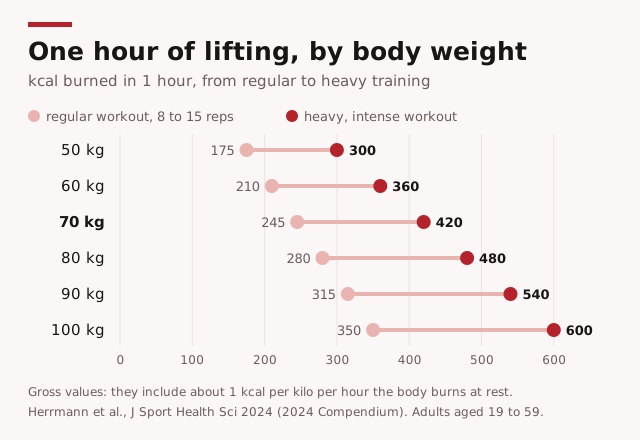
The chart shows the gross number, which includes what you would burn sitting on the couch during that same hour. That is the resting burn I explained in how many calories you burn at rest, where I also showed that exercise counts for less of your daily total than people imagine. To find out what the workout added, subtract 1 kcal per kilo: for someone who weighs 70 kg, an hour of regular strength training adds about 175 kcal on top of rest, and a heavy hour, about 350. The authors warn that the table is a starting point and does not give each person’s exact value, because age, sex, height and body composition change the number. For people aged 60 or older, there is a separate table with its own values.
With a mask on their faces, study volunteers burned amounts in this range. In Norway, researchers measured from breathing the energy cost of women with overweight, with an average weight of 84 kg, in a session of almost an hour, and the result was close to 300 kcal both in a group class with a light barbell and many repetitions and in a heavy-load workout. The study came out in 2020 in Frontiers in Physiology (funded by the sports school that ran it). The value varied a lot from one woman to another and was well below what the company that created the class advertises.
What makes strength training burn more or less
Your weight and the number of sets
Heavier people burn more doing the same activity, because they carry more body with each movement, and the compendium cites a study in which women with obesity burned more than lean women on the same walk. More sets also add up. In a 2016 American study, three sets of the same five exercises burned much more than a single set, and the burn per minute was the same in both workouts, because the difference came from the extra time spent working.
Rest between sets
In an hour of strength training, a good part of the time is rest. In the Norwegian women’s heavy workout, almost half the session was rest between sets, and in a Korean study on watches, the session of just over half an hour had only a few minutes of effort and the rest was seated rest. Shorter rests raise the burn per minute, but change the total of a given set of exercises very little. A group in Niterói, Brazil, led by researcher Paulo Farinatti, compared rests of 1 and 3 minutes between identical sets and found a similar total burn, counting recovery after the exercise. Short rests raise the session’s burn when they let you fit more sets into the same hour.
Does leg day burn more?
Yes, leg day burns more. In the same Niterói study, five sets of leg press burned about 70% more than five sets of dumbbell fly (the exercise where you open your arms to work the chest), counting recovery, because the leg exercise puts much more muscle to work and also leaves a bigger burn after the set. In the 2024 table, squats and deadlifts are rated higher than a regular workout. Exercises that move large muscle groups at once, such as squats, deadlifts, leg press, bench press and rows, weigh more in your energy expenditure than those that isolate a single muscle, such as the fly.
Light, heavy or circuit training
When the exercises come one after another, with short rests, in a circuit, the burn per hour goes up. The compendium gives 7.5 MET to an intense kettlebell circuit with minimal rest, more than twice a regular workout. Choosing between a light weight with many reps and a heavy weight with few changes less: the Norwegian women burned about the same in both formats, and another American study from 2002, done in women, showed that with the same total work, the heavy load burned the same during the workout and a little more during recovery.
Does weight training burn more than the treadmill?
Minute for minute, the treadmill usually burns more. In the 2024 table, brisk walking on a treadmill, between 5.6 and 6.3 km/h, is rated 4.8 MET, above regular strength training, and running at around 10 km/h is rated 9.3 MET, far more than the heaviest strength workout. The difference comes from the rests, because on the treadmill you move the whole time, and in strength training much of the hour is rest.
| One hour of each activity | MET | kcal for a 70 kg person |
|---|---|---|
| Regular strength training, 8 to 15 reps | 3.5 | 245 |
| Squats and deadlifts | 5.0 | 350 |
| Heavy, intense strength training | 6.0 | 420 |
| Intense kettlebell circuit with short rests | 7.5 | 525 |
| Treadmill walking, 5.6 to 6.3 km/h | 4.8 | 336 |
| Running at about 10 km/h | 9.3 | 651 |
If you look at the whole day, the gap shrinks, as a University of Colorado study published in 2002 in Medicine & Science in Sports & Exercise showed. The researchers kept a group of men without obesity for 24 hours in a closed room that measures energy use from breathing, on three different days: one with no exercise, one with cycling and one with 70 minutes of circuit strength training. Cycling burned more during the session, but the daily total was similar on the two exercise days, both well above the day at rest. In the hours after exercise, energy use and fat burning were the same on all three days.
To burn more in the same hour, you can combine strength training with aerobic exercise, at the intensity I explained in the post on training zones, or do circuit training on some days. For weight loss, the strongest reason to lift is the muscle it holds on to while you eat less.
The burn after the workout (EPOC) and how much it adds
After the last set, your body keeps using more oxygen than at rest for a while, and this extra burn usually adds little. Physiologists call it EPOC, the English acronym for excess post-exercise oxygen consumption. This energy goes to restoring oxygen and the muscle’s quick energy reserve, clearing lactate from the blood, bringing down temperature and heart rate, and starting to repair the fibers. That is where the idea comes from that strength training keeps you burning calories for two days.
A 2006 Australian review, published in the Journal of Sports Sciences, pooled the studies that measured this burn and found that it exists and yields few calories: even after long, intense exercise, it comes to 6% to 15% of the exercise’s energy cost. For a session that burned 300 kcal above rest, that would be somewhere between 20 and 45 kcal. The authors note that there were few studies on strength training and the relationship was still uncertain, and that body weight is controlled, above all, by what exercise burns while it happens.
In studies of strength training alone, the result changed depending on who was training. In a small group of young men, a heavy circuit to failure kept oxygen use above normal for more than a day. In sedentary young people with overweight, a single full-body session kept the resting metabolism about 5% above normal for three days, in a small study, and one set per exercise had the same effect as three.
In men used to training, neither a heavy workout of normal volume nor one of double volume kept resting metabolism above normal over the next two days, and in the closed room in Colorado the hours after strength training burned the same as those of the rest day. These are small studies with results that do not agree with each other, and researchers still do not really know what this long effect depends on. A 2024 review in Sports Medicine, which gathered the studies on the energy cost of strength training, considers this prolonged effect probably small and partly linked to repairing the muscle damaged by training.
Why your watch gets strength training calories wrong
The watch estimates energy use, rather than measuring it, with a formula that combines heart rate, wrist movement and the data you entered, and each brand uses its own. This calculation works better for continuous effort, such as walking and cycling, where heart rate and oxygen use rise together. In strength training, heart rate and blood pressure go up with the effort of holding the load, and oxygen use follows a different pace. On top of that, the wrist stays almost still while the hand grips the bar. The researchers who tested the watches blame the error on this mix.
The Korean watch study, published in 2026 in the journal Bioengineering, tested four models in young men, in a session of bench press, rows, squats and deadlifts. The mask measured 140 kcal, two watches showed more than twice that and a third, almost twice. The fourth got the group average right and was well off for each person.
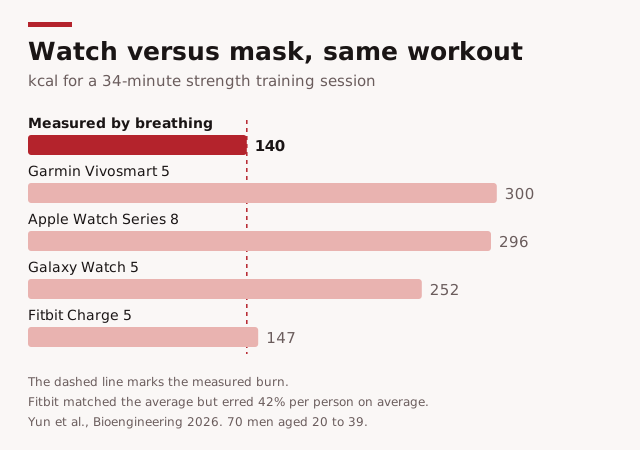
In another study by the same team, published in the journal Sensors, with a different group of men and a similar workout, the error went the other way, with three of the four watches showing much less than the mask. Since the error follows no rule, you cannot subtract a fixed percentage from the number on the screen.
The 2024 Sports Medicine review points out that even the mask misses part of the energy use, the part that comes from pathways that do not use oxygen, and that this part grows in heavy sets and near failure. Even so, the authors say that outside the lab the MET table tends to be the most practical option. The limits of each brand are in the post on which wearable is most accurate. Use your watch to track heart rate, which it measures much better than calories, and not to decide how much to eat.
Where strength training really helps with weight loss
On calories per hour, strength training usually loses to running and lands close to brisk walking. Its advantage shows up during a diet: muscle that works against a load gets the signal to stay, and the body tends to keep it even when eating less.
At the University of Alabama at Birmingham, researcher Gary Hunter’s team put dozens of premenopausal women with overweight on a diet until they reached a normal weight, losing about 12 kg. One group did strength training, another did aerobic exercise and another did not exercise, and the work came out in 2008 in the journal Obesity. Only the strength training group finished the diet without losing lean mass (the sum of muscles, organs, bones and water, where muscle is the part that training protects) and with resting energy expenditure preserved. In the other two, lean mass dropped and the resting burn dropped with it.
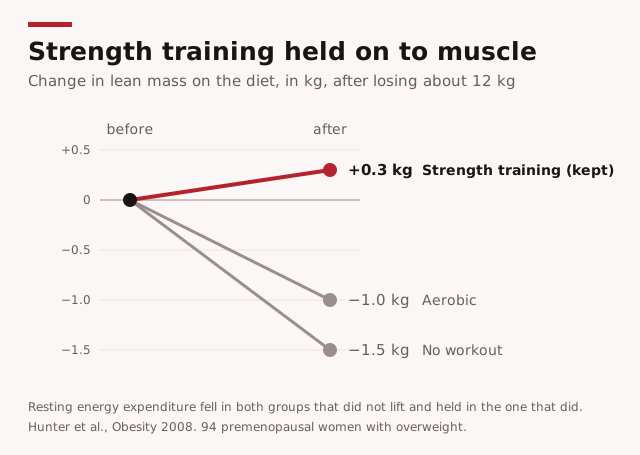
A smaller 1999 study tested the same thing on a very restrictive liquid diet, with 800 kcal a day, the kind done only under medical supervision. Those who walked, cycled or climbed stairs lost lean mass and started burning less at rest over the day, and those who did strength training on ten machines kept their lean mass and resting energy expenditure. A 2022 review in Obesity Reviews, which pooled the studies in people with overweight and obesity, found the same pattern: strength training combined with a diet took off fat and kept lean mass, across different ages and in both sexes.
Lean mass is the biggest driver of resting energy expenditure, which runs 24 hours a day, every day. Protecting this muscle on a diet protects your energy use and your strength, and that is why I consider strength training a fixed part of any diet, with enough protein, as I detailed in the post on losing weight without losing muscle. Even a short workout helps. In a University of Kansas study, sedentary young people with overweight did one set of each exercise, three times a week, in sessions of a few minutes, and after six months the energy use measured during sleep had gone up.
The number on the screen also gets in the way of a diet, because if you add up the watch’s calories and eat back what it showed, you can undo your deficit, and the scale stops moving. This and other reasons for the scale to stall are in the post on the weight loss plateau.
When to get checked before pushing your workouts
Training heavier and with shorter rests to burn more calls for a body that is ready. Get checked before increasing the load or the pace if you feel chest pain or tightness, unusual shortness of breath, dizziness, fainting or a racing heart during effort. If you have uncontrolled high blood pressure, heart disease, diabetes with advanced damage to the retina, a herniated disc or an abdominal wall hernia, or joint pain that gets worse with each workout, you need a plan adjusted to your case, and in several of these situations the advice is not to hold your breath during the set.
Very strong muscle pain and dark urine, the color of cola, in the days after a workout well beyond your usual call for a trip to the emergency room the same day. This can be rhabdomyolysis, a serious muscle injury that can damage the kidneys, and it shows up more often in people who start or return to training with high volume all at once.
In practice
- To estimate your energy use, multiply your weight by 3.5 for an hour of regular strength training, by 5 for a workout built around squats and deadlifts, and by 6 for a heavy, intense workout.
- To find out what the workout added on top of rest, subtract 1 kcal per kilo of body weight per hour from that result.
- If you want to burn more in the same hour, focus on exercises for large muscles, add sets gradually and keep rests short without losing technique or load, or do circuit training on some days of the week.
- Do not eat back your watch’s calories or use that number to compare workouts; to estimate your energy use, use the math in item 1.
- On a diet, keep up strength training at least twice a week, working the large muscle groups, as the World Health Organization recommends, and with enough protein.
- Track your strength, your measurements and your body composition, with bioimpedance, instead of workout calories.
Conclusion
An hour of strength training burns about 175 to 600 kcal in adults weighing 50 to 100 kg, and your number depends on your weight, the load, the rests and the exercises you choose. The burn left over for after the workout adds little, and watches are too far off in this kind of training to serve as a guide. For weight loss, strength training counts for the muscle and the resting energy expenditure it holds on to during a diet, an effect that works every hour of the day, including the ones you spend far from the gym.
All the best!
G
Responsible physician: Dr. Gilberto Nering Junior, sports medicine physician, CRM-SP 160822, RQE 142486 (Sports Medicine, Brazil).
This text was not sponsored, is for information only and does not replace an individual assessment. Questions about the content: contact the clinic.
Cover photo: Paweł Bulwan on Unsplash.
Frequently asked questions about strength training calories
How many calories does 1 hour of weight training burn?
An hour of strength training burns about 3.5 kcal per kilo of body weight in a regular workout and about 6 kcal per kilo in a heavy, intense workout. For someone who weighs 70 kg, that comes to 245 to 420 kcal, counting what the body would burn at rest.
How many calories does a leg workout burn?
A leg workout burns more than exercises for smaller muscles, because it puts more muscle to work. In a Brazilian study, five sets of leg press burned about 70% more than five sets of dumbbell fly, a chest exercise, and the 2024 compendium gives squats and deadlifts a higher value than a regular workout.
Does weight training burn more calories than the treadmill?
Minute for minute, the treadmill usually burns more, because there are no rests between sets. Over the whole day the gap narrows, and strength training has the advantage of holding on to muscle during a diet, which protects your resting metabolism.
Does strength training keep burning calories after the workout?
Strength training keeps your body burning a little more for a few hours and, in some small studies, for up to a few days, through a small rise in resting metabolism. In most studies, this extra burn stays well below what the session itself burned, and in a study of men used to training it did not even show up the next day.
Does my watch get strength training calories right?
Watches get strength training calories quite wrong. In a 2026 study of 70 men, two watches showed more than twice the energy use measured by breathing and a third came close to twice. In another study by the same group, most watches showed less. Use your watch for heart rate and the MET table to estimate calories.
References
- Abboud GJ, Greer BK, Campbell SC, et al. Effects of load-volume on EPOC after acute bouts of resistance training in resistance-trained men. J Strength Cond Res. 2013;27(7):1936-41. doi:10.1519/JSC.0b013e3182772eed
- Bryner RW, Ullrich IH, Sauers J, et al. Effects of resistance vs. aerobic training combined with an 800 calorie liquid diet on lean body mass and resting metabolic rate. J Am Coll Nutr. 1999;18(2):115-21. doi:10.1080/07315724.1999.10718838
- Bull FC, Al-Ansari SS, Biddle S, et al. World Health Organization 2020 guidelines on physical activity and sedentary behaviour. Br J Sports Med. 2020;54(24):1451-1462. doi:10.1136/bjsports-2020-102955
- Farinatti PT, Castinheiras Neto AG. The effect of between-set rest intervals on the oxygen uptake during and after resistance exercise sessions performed with large- and small-muscle mass. J Strength Cond Res. 2011;25(11):3181-90. doi:10.1519/JSC.0b013e318212e415
- Heden T, Lox C, Rose P, et al. One-set resistance training elevates energy expenditure for 72 h similar to three sets. Eur J Appl Physiol. 2011;111(3):477-84. doi:10.1007/s00421-010-1666-5
- Herrmann SD, Willis EA, Ainsworth BE, et al. 2024 Adult Compendium of Physical Activities: a third update of the energy costs of human activities. J Sport Health Sci. 2024;13(1):6-12. doi:10.1016/j.jshs.2023.10.010
- Hunter GR, Byrne NM, Sirikul B, et al. Resistance training conserves fat-free mass and resting energy expenditure following weight loss. Obesity (Silver Spring). 2008;16(5):1045-51. doi:10.1038/oby.2008.38
- Kirk EP, Donnelly JE, Smith BK, et al. Minimal resistance training improves daily energy expenditure and fat oxidation. Med Sci Sports Exerc. 2009;41(5):1122-9. doi:10.1249/MSS.0b013e318193c64e
- LaForgia J, Withers RT, Gore CJ. Effects of exercise intensity and duration on the excess post-exercise oxygen consumption. J Sports Sci. 2006;24(12):1247-64. doi:10.1080/02640410600552064
- Lee TH, Jun DU, Bae JY, et al. Comparative validity of smartwatch-derived heart rate and energy expenditure during endurance and resistance exercise. Sensors (Basel). 2026;26(8):2526. doi:10.3390/s26082526
- Lopez P, Taaffe DR, Galvão DA, et al. Resistance training effectiveness on body composition and body weight outcomes in individuals with overweight and obesity across the lifespan: a systematic review and meta-analysis. Obes Rev. 2022;23(5):e13428. doi:10.1111/obr.13428
- Melanson EL, Sharp TA, Seagle HM, et al. Resistance and aerobic exercise have similar effects on 24-h nutrient oxidation. Med Sci Sports Exerc. 2002;34(11):1793-800. doi:10.1097/00005768-200211000-00016
- Mitchell L, Wilson L, Duthie G, et al. Methods to assess energy expenditure of resistance exercise: a systematic scoping review. Sports Med. 2024;54(9):2357-2372. doi:10.1007/s40279-024-02047-8
- Mookerjee S, Welikonich MJ, Ratamess NA. Comparison of energy expenditure during single-set vs. multiple-set resistance exercise. J Strength Cond Res. 2016;30(5):1447-52. doi:10.1519/JSC.0000000000001230
- Rustaden AM, Gjestvang C, Bø K, et al. Similar energy expenditure during BodyPump and heavy load resistance exercise in overweight women. Front Physiol. 2020;11:570. doi:10.3389/fphys.2020.00570
- Schuenke MD, Mikat RP, McBride JM. Effect of an acute period of resistance exercise on excess post-exercise oxygen consumption: implications for body mass management. Eur J Appl Physiol. 2002;86(5):411-7. doi:10.1007/s00421-001-0568-y
- Thornton MK, Potteiger JA. Effects of resistance exercise bouts of different intensities but equal work on EPOC. Med Sci Sports Exerc. 2002;34(4):715-22. doi:10.1097/00005768-200204000-00024
- Yun JH, Ko JM, Lee TH. Criterion validity of smartwatches for measuring heart rate and energy expenditure during resistance exercise. Bioengineering (Basel). 2026;13(10):1099. doi:10.3390/bioengineering13101099