Also in: Português · Español · Italiano · 中文 · हिन्दी
Main points
- Heavy strength training improves performance in people who run and cycle, even without raising VO₂ max.
- The gain comes from using less energy and tiring less at the same pace.
- Moderate weights with many reps did not show the same effect on running economy.
- In triathletes, heavy training made the Achilles tendon and the knee tendon stiffer.
- A few sessions a week are enough, scheduled away from your hardest running or cycling workouts.
Strength training for runners and cyclists is still surrounded by myths. Many people stay away from the gym for fear of gaining weight, getting “tight” or showing up tired for their runs and rides. Those who do lift often choose light weights and lots of reps, thinking that is what goes with endurance.
The short answer
It’s worth it, and the weight needs to be heavy. In several studies, strength training with heavy loads, usually twice a week, improved running and cycling performance. It doesn’t raise VO₂ max. What improves is economy, meaning how much energy you use to hold a given pace. Moderate weights with many reps did not show the same effect, and the muscle that grows is mainly in the thighs, where it helps on the bike.
Why strength helps endurance athletes
Think about a car’s fuel consumption. Two cars can have the same engine, but the one that uses less fuel per kilometer goes further on the same tank. In running and cycling, this “economy” matters as much as the size of the engine, which is your VO₂ max.
The most widely accepted explanation is that a stronger muscle uses a smaller share of its maximum strength in each stride or pedal stroke. The body then recruits fewer fibers and takes longer to call on the fast-twitch fibers, which tire first, and this reserve shows up at the end of a long race.
The tendon plays a part too. In running, the Achilles tendon works like a spring: it stores energy when your foot hits the ground and gives it back at push-off. A stiffer tendon tends to return this energy better.
What the studies in runners show
In 2024, a group of researchers published two reviews on strength training in middle- and long-distance runners. In the first, training with heavy loads, at least 80% of the most a person can lift, improved performance in time trials and time to exhaustion. Combining more than one type of strength training had an even bigger effect.
No type of strength training changed VO₂ max: the engine stayed the same, and the car started using less fuel.
The second review looked specifically at running economy. Heavy training improved economy, with a larger effect at faster paces and in fitter runners. Jumps (plyometrics) helped at slower paces, up to about 12 km/h. Moderate weights with many reps and static exercises, where you just hold a position, did not improve economy compared with running alone.
And in cycling
In cycling, the best-known studies come from Norwegian researchers. In one of them, well-trained cyclists kept up their riding and added heavy leg strength training twice a week for 12 weeks.
In the final test, they rode for about three hours at an easy pace and then did five minutes all-out.
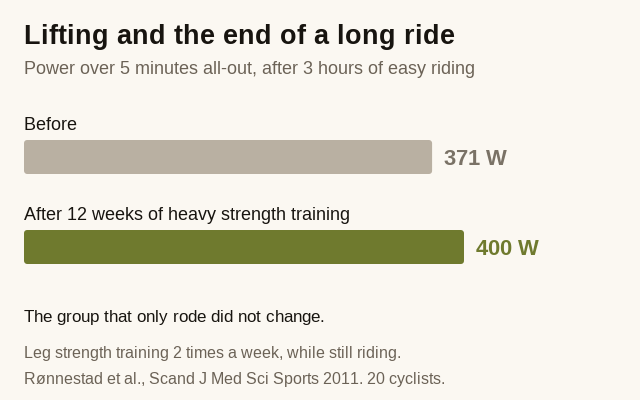
The strength training group went from 371 to 400 watts in those final five minutes, while the group that only rode did not change. In the last hour of the long ride, the cyclists who lifted also had lower heart rate, lactate and perceived effort.
In another study by the same group, female cyclists did 11 weeks of heavy strength training and improved their power in a 40-minute all-out test. A 2021 review concluded that men and women gain about the same from strength training.
What happens in the tendon
A German study from 2025 followed well-trained male triathletes. Some of them added heavy leg strength training to their routine, and swimming, cycling and running volume stayed the same in both groups.
In the strength training group, the Achilles tendon became 39% stiffer, the knee tendon also became stiffer and squat strength went up. In the group that simply kept up their usual training, squat strength did not change.
Running and cycling economy did not change in this study. The authors point out that the study was designed to measure the tendon and may not have had enough people to show a difference in performance. They also suggest that a stiffer tendon may protect against injury, but that was outside what the study measured. If you already have tendon pain, I wrote a post on Achilles tendon pain.
Does strength training help prevent injuries?
A 2014 review pooled randomized trials of exercise programs to prevent sports injuries. Strength training cut injuries the most, to less than a third. Stretching did not reduce them.
One caveat: these studies mix several sports, and few were done only with runners or cyclists. Even so, it makes sense for runners, because many running injuries, such as shin splints, show up when the load rises faster than the body can handle.
“Will I get heavy and slow?”
This is the most common fear. The thigh muscle does grow, but in the studies with male and female cyclists this came with better cycling, not with a loss of performance.
Among the female cyclists in the Norwegian study, those who gained the most thigh muscle improved the most in the 40-minute test. The 2021 review even says that cyclists should aim for this increase in thigh muscle, contrary to what many people think.
What if you run for your health?
Most of these studies were done with trained athletes, and it’s fair to ask whether the results apply to people who run for their health or are training for their first half marathon. In the 2024 review on performance, the effect of strength training on performance was similar in men and women, at different ages and at different fitness levels, and previous experience with strength training didn’t change the result either. For running economy, the gain was a little larger in fitter runners.
For amateurs, there is also a benefit that goes beyond the stopwatch: over the years, strength and muscle mass decline little by little. So the World Health Organization’s physical activity guidelines call for muscle strengthening at least twice a week for every adult, on top of aerobic exercise. The two weekly sessions I describe here do both jobs at once.
Heavy weights or lots of reps?
| Type of training | What the studies show |
|---|---|
| Heavy weights (few reps, close to your max) | Improves economy and performance |
| Jumps (plyometrics) | Improves economy at slower paces |
| Combining methods | Largest effect on running performance |
| Moderate weights with many reps | Did not improve economy |
| Static exercise (isometrics) | Did not improve economy |
| Stretching | Did not reduce injuries |
Heavy, here, means a load that only allows a few good reps, and you only work up to it after learning the movement. I explained how to choose the load in the post on how many sets and how much weight to use in strength training.
How to fit it into your week
In the cycling studies, strength training meant two sessions a week, with four leg exercises and 3 sets with a weight that only allowed 4 to 10 reps. In practice, this is what I recommend:
- two sessions a week during the base phase, away from races;
- a few leg exercises, such as squats, leg press, lunges and calf raises;
- 3 to 4 sets with a weight that allows 4 to 10 reps;
- at least 2 minutes of rest between sets, until you feel recovered for the next one;
- end each set with one or two reps left in the tank; you don’t need to go to failure;
- if you run at an easy pace, a few simple jumps also help, once you’ve learned to land with control.
During the racing season, one session a week usually keeps the gains. In a Norwegian study, cyclists who kept one weekly session during 13 weeks of competition held on to their strength and thigh muscle and even improved their performance.
For the calves, do the exercise with your knee straight and also with your knee bent, because each position works a different part of the muscle. If you’ve never done strength training, start with a few weeks of lighter weights to learn the technique, ideally with a qualified trainer, and only then increase the load. In the first sessions, next-day muscle soreness is usually worse and eases over the following weeks, so don’t start strength training in the week of an important long workout.
To keep it from getting in the way of your running or cycling, leave at least one day between leg strength training and the hardest workout of the week. Another option is to lift on the same day as the hard workout, after it, and keep the next day easy, with a run or ride in zone 2.
In the week of your main race, cut the volume of your leg training, but avoid going weeks without strength training, because the strength you’ve built starts to drop when training stops altogether. That week your eating changes too, as I explained in the post on carb loading before a race.
When to get checked
Get checked before you start or increase the load if you have:
- joint or tendon pain that gets worse with exercise;
- a recent injury that hasn’t been treated yet;
- back pain that runs down into your leg;
- uncontrolled high blood pressure or heart disease.
In most cases, back pain doesn’t rule out heavy training, and I explained this in the post on low back pain and strength training. If the pain shows up while you run, it’s also worth reading about when running pain calls for a doctor.
In practice
- Add two strength training sessions a week during the base phase.
- Focus on leg exercises, with a weight that allows only a few good reps.
- Start lighter if you’re a beginner and increase the load gradually.
- Keep leg strength training apart from your hardest running or cycling workout.
- During the racing season, keep at least one session a week.
- In the week of your main race, ease off on leg training.
Conclusion
Heavy strength training is one of the simplest ways to improve performance if you run or cycle, because it makes the body use less energy and tire less at the same pace, even without changing VO₂ max. Start with technique and add weight gradually; as a bonus, your tendons get stiffer, and studies across several sports point to fewer injuries.
Thanks, everyone, and see you next time!
Responsible physician: Dr. Gilberto Nering Junior, sports medicine physician, CRM-SP 160822, RQE 142486 (Sports Medicine, Brazil).
This text was not sponsored, is for information only and does not replace an individual assessment. Questions about the content: contact the clinic.
Cover photo: Victor Freitas on Unsplash.
Frequently asked questions about strength training for runners and cyclists
Does strength training hurt your running?
No, as long as it fits well into your week. Studies show that heavy strength training improves running economy and performance. The thing to watch is not doing heavy leg training the day before your hardest workout.
How many times a week should runners do strength training?
Twice a week during the base phase is what most studies used. During the racing season, once a week is enough to help keep the strength you’ve gained.
Should runners lift light or heavy weights?
Heavy, after learning the technique. Heavy weights improved running economy; lots of reps with moderate weights did not show this effect.
Does strength training make cyclists heavier?
The thigh muscle usually grows a little, and in the studies with cyclists this gain came along with better cycling. Among the female cyclists studied, those who gained the most thigh muscle improved the most.
Does strength training prevent running injuries?
In a review covering several sports, strength training cut injuries to less than a third. There are few studies with runners alone, but strengthening your legs and tendons helps your body handle the training load.
References
- Bull FC, Al-Ansari SS, Biddle S, et al. World Health Organization 2020 guidelines on physical activity and sedentary behaviour. Br J Sports Med. 2020;54(24):1451-1462. doi:10.1136/bjsports-2020-102955
- Jacobs MW, Feuerbacher JF, Mersmann F, et al. Maximal strength training improves muscle-tendon properties and increases tendon matrix remodulation in well-trained triathletes. Sci Rep. 2025;15(1):27333. doi:10.1038/s41598-025-12721-0
- Lauersen JB, Bertelsen DM, Andersen LB. The effectiveness of exercise interventions to prevent sports injuries: a systematic review and meta-analysis of randomised controlled trials. Br J Sports Med. 2014;48(11):871-877. doi:10.1136/bjsports-2013-092538
- Llanos-Lagos C, Ramirez-Campillo R, Moran J, et al. Effect of strength training programs in middle- and long-distance runners’ economy at different running speeds: a systematic review with meta-analysis. Sports Med. 2024;54(4):895-932. doi:10.1007/s40279-023-01978-y
- Llanos-Lagos C, Ramirez-Campillo R, Moran J, et al. The effect of strength training methods on middle-distance and long-distance runners’ athletic performance: a systematic review with meta-analysis. Sports Med. 2024;54(7):1801-1833. doi:10.1007/s40279-024-02018-z
- Rønnestad BR, Hansen EA, Raastad T. In-season strength maintenance training increases well-trained cyclists’ performance. Eur J Appl Physiol. 2010;110(6):1269-1282. doi:10.1007/s00421-010-1622-4
- Rønnestad BR, Hansen EA, Raastad T. Strength training improves 5-min all-out performance following 185 min of cycling. Scand J Med Sci Sports. 2011;21(2):250-259. doi:10.1111/j.1600-0838.2009.01035.x
- Vikmoen O, Ellefsen S, Trøen Ø, et al. Strength training improves cycling performance, fractional utilization of VO2max and cycling economy in female cyclists. Scand J Med Sci Sports. 2016;26(4):384-396. doi:10.1111/sms.12468
- Vikmoen O, Rønnestad BR. A comparison of the effect of strength training on cycling performance between men and women. J Funct Morphol Kinesiol. 2021;6(1):29. doi:10.3390/jfmk6010029