Also in: Português · Español · Italiano · 中文 · हिन्दी
Main points
- Achilles tendon pain usually comes from overload, and the main treatment is loading exercise, done for at least 12 weeks.
- In one study, two types of tendon exercise worked equally well, and the improvement lasted.
- Shock waves and hyaluronic acid injections around the tendon are options for when exercise alone does not solve the problem. In my practice, they are added alongside exercise.
- In a small study, hyaluronic acid relieved pain more than shock waves, but it was not compared with exercise.
- In the most common form, tendinopathy in the middle of the tendon, PRP was no better than a saline injection or a sham needle procedure in two studies.
- Avoid corticosteroid injections into the tendon, and tell your doctor about the pain if you are prescribed certain antibiotics, such as ciprofloxacin.
The first step in the morning hurts behind the heel. In the first few minutes of a run the pain shows up, then seems to fade, and the next day it comes back stronger. Runners know this Achilles tendon pain well, and most of the time it is tendinopathy, which many people call tendinitis.
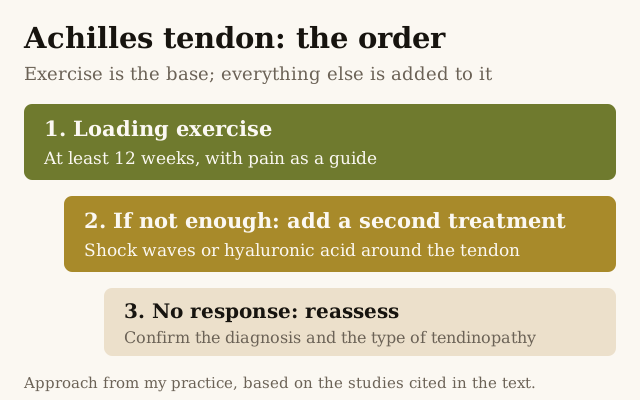
To treat Achilles tendon pain, the option with the most studies behind it is loading exercise, done for at least 12 weeks. Shock waves and injections come in when exercise alone is not enough. In this post I show what the studies say about each option, including PRP, and what to avoid.
What Achilles tendinopathy is
The Achilles tendon connects the calf to the heel and is the strongest tendon in the body. Even so, it suffers from overload. A 2025 review estimated that problems in this tendon affect about 6% of people and up to half of elite long-distance runners at some point in their lives.
Tendinopathy appears when the tendon takes more load than it can handle: a quick increase in running volume, a lot of hill or jump training, a sudden change of shoes or surface. Age, some medications and other diseases also play a part. Inside, the tendon becomes thicker and disorganized, and new blood vessels grow into it.
Achilles tendinopathy has two main types. Treatment changes a little between them, depending on where the pain is:
- in the middle of the tendon, a few centimeters above the heel, where it often becomes thicker;
- at the insertion, right where the tendon attaches to the heel bone.
Typical signs are stiffness on waking, pain at the start of exercise that improves midway and gets worse afterward, and pain when the tendon is squeezed. If your running pain shows up somewhere else in the leg, I have written about running pain and about shin splints.
Exercise comes first
The main treatment for Achilles tendon pain caused by overload is load, as long as it is well dosed. The tendon responds to exercise by becoming stronger and more organized. Complete rest relieves pain for a while, but it does not prepare the tendon to return to sport. The US physical therapy guideline for this tendinopathy, revised in 2018, makes loading exercise the foundation of treatment.
A 2015 Danish study compared two types of exercise in 58 people who had had pain in the middle of the tendon for more than three months. One group did the classic eccentric exercise, lowering the heel slowly off the edge of a step, twice a day. The other did heavy, slow strength training at the gym, three times a week.
After 12 weeks, both groups had much less pain and better function, and the tendon even looked less thick on ultrasound. The improvement held after a year, with no difference between the groups. Strength training had a practical advantage: people stuck to the program more, 92% of sessions versus 78% in the eccentric group. So you can pick the type of exercise that fits your routine best, as long as you do it regularly and with progressive load.
What the exercise usually looks like
The program is built case by case. Even so, it usually follows a few principles:
- calf raises, on one or both legs, first on the floor and then off the edge of a step;
- slow movement, especially on the way down;
- a gradual increase in load, with a backpack or a machine at the gym;
- mild pain during exercise is usually accepted, as long as it does not get worse the next day;
- cutting back on running and jumping, without stopping them completely, while the tendon recovers.
In insertional tendinopathy, the exercise is usually adapted to avoid lowering the heel below the level of the step. In that position, the tendon gets pressed against the bone.
Can you keep running?
Many people think they have to stop running until the pain is gone. A 2007 Swedish study tested this in 38 people with Achilles tendinopathy. All of them did the same tendon exercise program. Half kept running and jumping, guided by pain, and the other half stopped those activities for six weeks.
After a year, both groups had improved a lot, with no difference between them. Staying active, with the pain under control, showed no harm.
The study’s rule works in everyday life too. It has three parts:
- during running or exercise, pain can reach 5 on a scale of 0 to 10;
- after training, it should be back to its earlier level by the next morning;
- pain and stiffness must not get worse from one week to the next.
If the pain goes past that limit, make the next session lighter, with less volume or at an easy pace, like zone 2. If it stays within the limit, you can keep the load or raise it gradually.
Most people get better with exercise alone
The same Swedish researchers from the 2007 study followed 34 patients treated with exercise alone for five years. By the end, 80% had fully recovered from the initial injury, although some had a new episode later. Another 20% still had symptoms, and only two had sought other treatment. Fear of movement was linked to a poorer recovery of calf endurance, which fits with the idea of keeping the tendon in use, with pain as a guide. The study had no comparison group, but it suggests that, with patience, most people with Achilles tendon pain do not need an injection or a device.
Shock waves
Shock waves are pressure pulses that a device applies to the skin over the tendon. Treatment usually involves a few sessions, one a week.
A 2015 review pooled 20 studies on shock waves in tendinopathies of the hip, knee and ankle. In the middle of the Achilles tendon, shock waves gave results similar to eccentric exercise in the short term, and combining the two seemed better than exercise alone. In insertional tendinopathy, shock waves did better than eccentric exercise.
The authors add caveats: the studies were small, used different devices, intensities and numbers of sessions, and several had flaws in how the groups were randomized. Their conclusion was that shock waves deserve consideration mainly when other non-surgical treatments have not worked.
Hyaluronic acid around the tendon
Hyaluronic acid is better known as a treatment for knee osteoarthritis, but it can also be injected around the tendon, without going into it. A 2017 study done in several countries compared two of these injections with three weekly shock wave sessions in 62 adults who had had pain in the middle of the tendon for at least six weeks. Hyaluronic acid reduced pain more than shock waves at 4 weeks and at 3 and 6 months, with the biggest difference at 3 months, and it also improved function more. There were no serious side effects in either group.
It was a single study, with 62 people and only this type of pain. It compared hyaluronic acid with shock waves, not with exercise, which is still the main treatment.
What about PRP for the Achilles tendon?
PRP, made from your own blood, is another injection many people look for when a tendon hurts, and I explained how it is prepared in the post what PRP is and what it is used for. In the middle of the Achilles tendon, the studies showed no advantage. In a 2010 Dutch study, 54 people did eccentric exercise and received an injection of either PRP or saline, and at 24 weeks the improvement was the same in both groups.
In a 2021 British study of 240 people, a PRP injection into the tendon was no better than a sham needle procedure, with nothing injected into the tendon, after 6 months. PRP also caused more discomfort at the injection site. PRP preparations vary a lot, as I showed in the post on types of PRP, but for now the studies do not support PRP for this type of tendinopathy.
What to avoid
Some things can make the Achilles tendon worse. Watch out for these four:
- Corticosteroid injections into the tendon: I avoid them in and around the Achilles, because they relieve pain only briefly and can weaken the tendon.
- Some antibiotics: fluoroquinolones, such as ciprofloxacin and levofloxacin, increase the risk of tendon rupture.
- Stopping everything at once: complete rest brings relief, but the tendon hurts again when the load returns, so it is better to adjust the load.
- Going all out as soon as the pain improves: the tendon takes longer to get strong than the pain takes to go away.
In a study of more than 700,000 people who took fluoroquinolones, the risk of rupturing the Achilles was almost three times higher while they were taking the drug. In absolute numbers this risk is low, but it rises sharply when corticosteroids are taken at the same time, and women and people over 60 are also more likely to rupture a tendon. If you already have tendon pain and are given this prescription, tell your doctor, because the antibiotic can usually be switched. If the tendon starts to hurt while you are taking it, follow the package leaflet: stop the medication and talk to your doctor the same day.
How long Achilles tendon pain takes to go away
Achilles tendinopathy does not get better overnight. The exercise programs in the studies last 12 weeks, and many people need more time than that to run without pain again. The 2025 review points out that treatment can take a long time and fails fairly often.
It helps to agree on small goals with whoever is guiding your recovery, one at a time. A common sequence has four steps:
- Walk without pain.
- Do the exercises with load.
- Jog.
- Return to full training.
When Achilles tendon pain needs a quick assessment
Get care the same day if you feel a loud snap behind the heel, as if someone had kicked your leg, or if you suddenly cannot stand on the toes of one foot. Even if you can still walk, this may be a tendon rupture, which needs prompt assessment and treatment.
It is also worth getting checked if the tendon swells a lot or becomes red and hot, if the pain shows up at rest or at night, or if you do not improve after a few weeks of well-done exercise. In these cases, ultrasound helps confirm the diagnosis and see the size of the injury.
How to treat Achilles tendon pain: the summary
Achilles tendon pain is usually overload, and the treatment with the most studies behind it is loading exercise, done patiently for at least 12 weeks. Shock waves and hyaluronic acid around the tendon can help when exercise is not enough, and in my practice they are added alongside exercise. Corticosteroids in the tendon and some antibiotics call for caution.
| Treatment | What the studies showed | When it comes in |
|---|---|---|
| Loading exercise (eccentric or heavy, slow strength training) | Pain and function improved in 12 weeks, and the improvement lasted a year | First, always |
| Keep running with pain up to 5 out of 10 | Same result as stopping running for 6 weeks | Alongside exercise |
| Shock waves | Similar to eccentric exercise in the middle of the tendon and better at the insertion, in small studies | When exercise is not enough |
| Hyaluronic acid around the tendon | Relieved pain more than shock waves, in a study of 62 people | When exercise is not enough |
| PRP | Same as saline or a sham needle procedure, in two studies | Not supported by the studies |
| Corticosteroids in the tendon | Short relief and a risk of weakening the tendon (the approach I follow) | Avoid |
Happy running, and be patient with that tendon!
Responsible physician: Dr. Gilberto Nering Junior, sports medicine physician, CRM-SP 160822, RQE 142486 (Sports Medicine, Brazil).
This text was not sponsored, is for information only and does not replace an individual assessment. Questions about the content: contact the clinic.
Cover photo: Felix Yu on Unsplash.
Quick questions about the Achilles tendon
How do you treat Achilles tendinitis?
The main treatment is loading exercise, such as calf raises done slowly and with progressive load, for at least 12 weeks. Shock waves and hyaluronic acid around the tendon come in when exercise alone is not enough.
Do shock waves work for the Achilles tendon?
The studies show benefit, especially for pain near the heel, and the review recommends considering them when other treatments have not worked. The studies are still small and use different protocols.
Does hyaluronic acid work for the Achilles tendon?
In a study of 62 adults, two injections around the tendon relieved pain more than shock waves for up to 6 months. It is only one study, and it did not compare the injections with exercise.
Does PRP work for the Achilles tendon?
Two studies found no advantage in tendinopathy in the middle of the tendon. PRP had the same result as a saline injection in one study and as a sham needle procedure in another, with 240 people.
Can Achilles tendinitis be cured?
Most of the time, Achilles tendinitis gets completely better. In a study that followed 34 people treated with exercise alone for five years, 80% recovered fully, although some had a new episode later.
Can I get a corticosteroid injection in the Achilles tendon?
I do not recommend corticosteroid injections in the Achilles. Corticosteroids relieve pain only briefly and can weaken the tendon.
How long does Achilles tendon pain take to get better?
The exercise programs in the studies last 12 weeks, and many people need more time to run without pain again.
References
- Beyer R, Kongsgaard M, Hougs Kjær B, et al. Heavy Slow Resistance Versus Eccentric Training as Treatment for Achilles Tendinopathy: A Randomized Controlled Trial. Am J Sports Med. 2015;43(7):1704-11. doi:10.1177/0363546515584760
- de Vos RJ, Weir A, van Schie HT, et al. Platelet-rich plasma injection for chronic Achilles tendinopathy: a randomized controlled trial. JAMA. 2010;303(2):144-9. doi:10.1001/jama.2009.1986
- Kearney RS, Ji C, Warwick J, et al. Effect of Platelet-Rich Plasma Injection vs Sham Injection on Tendon Dysfunction in Patients With Chronic Midportion Achilles Tendinopathy: A Randomized Clinical Trial. JAMA. 2021;326(2):137-144. doi:10.1001/jama.2021.6986
- Lynen N, De Vroey T, Spiegel I, et al. Comparison of Peritendinous Hyaluronan Injections Versus Extracorporeal Shock Wave Therapy in the Treatment of Painful Achilles’ Tendinopathy: A Randomized Clinical Efficacy and Safety Study. Arch Phys Med Rehabil. 2017;98(1):64-71. doi:10.1016/j.apmr.2016.08.470
- Mani-Babu S, Morrissey D, Waugh C, et al. The effectiveness of extracorporeal shock wave therapy in lower limb tendinopathy: a systematic review. Am J Sports Med. 2015;43(3):752-61. doi:10.1177/0363546514531911
- Martin RL, Chimenti R, Cuddeford T, et al. Achilles Pain, Stiffness, and Muscle Power Deficits: Midportion Achilles Tendinopathy Revision 2018. J Orthop Sports Phys Ther. 2018;48(5):A1-A38. doi:10.2519/jospt.2018.0302
- Persson R, Jick S. Clinical implications of the association between fluoroquinolones and tendon rupture: The magnitude of the effect with and without corticosteroids. Br J Clin Pharmacol. 2019;85(5):949-959. doi:10.1111/bcp.13879
- Silbernagel KG, Brorsson A, Lundberg M. The majority of patients with Achilles tendinopathy recover fully when treated with exercise alone: a 5-year follow-up. Am J Sports Med. 2011;39(3):607-13. doi:10.1177/0363546510384789
- Silbernagel KG, Thomeé R, Eriksson BI, et al. Continued sports activity, using a pain-monitoring model, during rehabilitation in patients with Achilles tendinopathy: a randomized controlled study. Am J Sports Med. 2007;35(6):897-906. doi:10.1177/0363546506298279
- Traweger A, Scott A, Kjaer M, et al. Achilles tendinopathy. Nat Rev Dis Primers. 2025;11(1):20. doi:10.1038/s41572-025-00602-9