Also in: Português · Español · Italiano · 中文 · हिन्दी
Main points
- Cherry juice and pomegranate seem to reduce muscle soreness a little in the days after a hard workout.
- Less soreness is not the same as faster recovery. In a large review, no supplement of this kind clearly improved strength or the blood markers of muscle damage and inflammation.
- Another review, of athletes only, found better strength recovery with cherry juice. The studies disagree, and confidence in these results ranges from low to moderate.
- These supplements make more sense at specific times, such as competition weeks, than every day.
- High doses of vitamins C and E, taken daily, may blunt part of the adaptation to training.
You did a tough leg workout on Monday and, by Wednesday, walking down the stairs became a challenge. Almost everyone who trains knows this soreness. And for people who want to get back to training quickly, there is no shortage of promises of fast recovery: capsules, powders, juice concentrates.
One of the best known among runners and athletes is tart cherry juice, made from a variety called Montmorency. In 2026 two large reviews came out on it and on similar supplements, and they did not reach exactly the same conclusion. In this post I explain what each one showed and when it makes sense to spend money on it.
The day-after soreness
This soreness has a name: delayed onset muscle soreness. It shows up a few hours after a workout that is new or harder than usual, gets worse the next day and is usually strongest one to three days later. Exercises in which the muscle works while lengthening, such as running downhill or the lowering phase of a squat, are the ones that cause this kind of soreness the most.
What happens inside is small damage to the muscle fibers, followed by inflammation that is part of the repair. For a few days, besides the soreness, the muscle loses some strength. In the blood, substances rise such as CK, which leaks from the damaged fibers, and CRP, a marker of inflammation.
To make sense of the studies, it helps to separate these parts. Recovery includes the soreness going away, strength coming back, the damage healing and the inflammation settling, and a supplement can affect one of these without affecting the others.
What polyphenols are
Polyphenols are plant substances that give color and part of the flavor to fruits, vegetables, teas and cocoa. Anthocyanins, for example, give cherries, blackberries, blueberries and grapes their purple or dark red color. Flavanols are found in cocoa and tea.
The idea of using them for recovery comes from their antioxidant and anti-inflammatory effects. Since hard training causes inflammation and oxidative stress in the muscle, the reasoning is that they could reduce this damage and speed the return to normal. A 2019 review concluded that more than 1,000 mg of polyphenols per day, for at least three days before and after the effort, improves recovery. The problem is that labels rarely state the amount of polyphenols.
The theory makes sense; the question is how big the effect is in real life.
The review with 30 studies
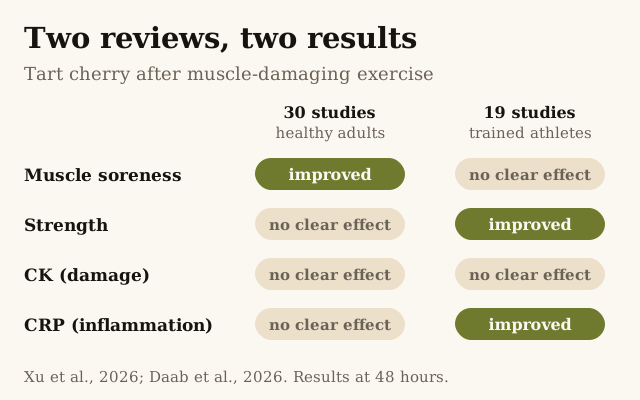
The review published in 2026 in the journal Frontiers in Nutrition pooled 30 randomized studies (in which a draw decides who takes the supplement), with 595 healthy adults, and compared eight types of polyphenol-rich supplements with placebo after exercise designed to damage the muscle. The main result was measured 48 hours later.
Only pomegranate and cherry juice reduced muscle soreness at 48 hours. Cherry was the only one that also reduced soreness at 24 and 72 hours. But none of the supplements clearly improved strength recovery or lowered CK or CRP.
The authors rated the confidence in these results as low, for the most part. In their view, these supplements help relieve soreness, not speed up the recovery of the muscle as a whole.
Another review, another result
Also in 2026, a review published in Sports Medicine Open looked only at cherry juice in trained athletes, pooling 19 studies. Here the result was almost the opposite: the juice helped strength come back faster and lowered CRP up to 48 hours later, but did not reduce soreness or CK.
The authors themselves add caveats. The studies were very different from one another, and some of the positive results changed when a single study was removed from the analysis. Confidence in the results ranged from very low to moderate.
An older review, from 2021, with 14 studies on cherry, had found a small effect on soreness and a moderate effect on strength recovery. And a large 2024 review, which brought together 53 meta-analyses (analyses that combine the results of several studies) on supplements for muscle damage, concluded with moderate certainty that polyphenols and anthocyanins reduce muscle soreness.
In the same review, other supplements also showed some effect on soreness or CK, almost always with moderate certainty.
Why the studies disagree
When serious reviews reach different conclusions, there are usually good reasons:
- one review included healthy adults in general, and the other only trained athletes, who may respond differently;
- juice, concentrate, capsule and powder contain very different amounts of polyphenols, and each study used its own dose and duration;
- running downhill, jumping and a heavy set of weight training cause different kinds of damage;
- the studies are small: in the 30-study review, the average was 20 people per study, and with studies that small each one carries a lot of weight in the results.
Reading the two reviews together, what we can say is that there is a likely effect on soreness, a possible effect on strength in athletes, and a lot of uncertainty in between.
Less soreness does not mean recovered
Soreness is the part you feel, but it is not the only measure of recovery. If a supplement takes the soreness away while strength has not yet returned, the muscle may not be ready for another hard session for the same muscle group.
The reverse is also true: some muscle soreness after a new workout is not a sign that something went wrong, nor that you need a supplement. It tends to fade as the body gets used to that type of exercise.
When soreness deserves attention
Delayed onset muscle soreness is a nuisance, but it gets better on its own within a few days. Seek care if the pain is much stronger than expected for the workout, if the muscle becomes very swollen and hard, if your urine turns dark, the color of tea or cola, or if there is severe weakness. These signs may point to a more serious muscle injury. In that case, go to an emergency room. Pain in one specific spot that started suddenly during training is also not delayed onset soreness and should be examined.
The warning about high-dose antioxidants
If antioxidants help recovery, many people assume more antioxidants help more. A 2014 Norwegian study shows why it is not that simple.
The researchers gave vitamin C (1,000 mg) and vitamin E (235 mg) per day, or placebo, to 54 young people over 11 weeks of aerobic training, mostly running. Fitness improved equally in both groups. But inside the muscle, the signs of adaptation to training, linked to the formation of new mitochondria, increased in the placebo group and did not increase in the vitamin group.
The most accepted explanation is that part of the stress of training works as a signal for the body to adapt. Blocking this signal too much, every day, may get in the way of the gain you are after. The cherry and pomegranate studies measured recovery over a few days, not adaptation over months, so we cannot yet say whether they have the same effect.
When it may be worth it
Putting it all together, I see room for these supplements in specific situations:
- a race week or a tournament with games on consecutive days, when there is no time to recover the normal way;
- a workout or race that you know will cause a lot of soreness, such as a marathon or a run with a lot of downhill;
- athletes who already take care of sleep, nutrition and training load and want fine-tuning.
Outside of that, for people who train for health or are in a phase of building fitness, I see no reason to use them every day.
If you do use them, the studies that worked usually started a few days before the effort and continued for a few days after, rather than a single dose on the day. And food counts too: red and purple fruits, grapes, cocoa and tea are dietary sources of polyphenols, with no need for a supplement.
Precautions before you buy
- Cherry juice has a lot of sugar and calories. People with diabetes or prediabetes, or who are trying to lose weight, need to account for this, and it is worth checking the calories per serving on the label.
- Check that the product is tart cherry juice or concentrate, and not a sweetened drink with little fruit. Most studies used tart cherry juice or concentrate. And the fresh cherries usually sold in markets, as in Brazil, are sweet cherries, not the tart ones from the studies.
- If you take a long-term medication, talk to your doctor before starting any supplement.
The basics come first
No supplement makes up for a bad night’s sleep, too little protein or a sudden jump in training load. Sleeping well, eating enough protein through the day, replacing carbohydrate after long sessions and increasing load gradually do more for recovery than any juice. If you want a supplement with more studies behind it, I wrote about creatine beyond the gym.
Before spending on a recovery supplement, it is worth looking at your whole routine.
Conclusion
Cherry juice and pomegranate seem to ease muscle soreness a little after hard workouts. Whether they also speed up the return of strength, the studies still disagree. For most people, they fit into competition weeks rather than a daily habit. And high-dose antioxidant vitamins, every day, may get in the way of adapting to training.
Cheers, and train well!
Responsible physician: Dr. Gilberto Nering Junior, sports medicine physician, CRM-SP 160822, RQE 142486 (Sports Medicine, Brazil).
This text was not sponsored, is for information only and does not replace an individual assessment. Questions about the content: contact the clinic.
Cover photo: Joanna Kosinska on Unsplash.
Quick questions about cherry juice and recovery
Does cherry juice help muscle recovery?
It seems to reduce muscle soreness a little after hard workouts. Whether it also helps strength come back faster, the 2026 reviews disagree.
What is the difference between muscle soreness and recovery?
Soreness is what you feel. Recovery also includes strength coming back and blood markers of damage and inflammation going down. A supplement can ease soreness without changing the rest.
How did the studies use cherry juice?
Usually for a few days before the effort and a few days after, rather than a single dose on race day.
Can I take vitamin C every day to recover faster?
High daily doses of vitamins C and E blunted signs of training adaptation inside the muscle in an 11-week study. Fitness improved equally in both groups, so there was no gain, and there may be harm. It is not worth it.
Is it worth drinking cherry juice every day?
For most people, no. It fits better at specific times, such as competitions with little rest between one effort and the next.
References
- Bowtell J, Kelly V. Fruit-Derived Polyphenol Supplementation for Athlete Recovery and Performance. Sports Med. 2019;49(Suppl 1):3-23. doi:10.1007/s40279-018-0998-x
- Daab W, Bouzid MA, Nassis GP, et al. Effects of Tart Cherry Juice Supplementation on Recovery from Exercise-Induced Muscle Damage in Athletes: A Systematic Review and Meta-Analysis. Sports Med Open. 2026;12(1). doi:10.1186/s40798-026-00993-3
- Hill JA, Keane KM, Quinlan R, et al. Tart Cherry Supplementation and Recovery From Strenuous Exercise: A Systematic Review and Meta-Analysis. Int J Sport Nutr Exerc Metab. 2021;31(2):154-167. doi:10.1123/ijsnem.2020-0145
- Paulsen G, Cumming KT, Holden G, et al. Vitamin C and E supplementation hampers cellular adaptation to endurance training in humans: a double-blind, randomised, controlled trial. J Physiol. 2014;592(8):1887-901. doi:10.1113/jphysiol.2013.267419
- Talebi S, Mohammadi H, Zeraattalab-Motlagh S, et al. Nutritional interventions for exercise-induced muscle damage: an umbrella review of systematic reviews and meta-analyses of randomized trials. Nutr Rev. 2024;82(5):639-653. doi:10.1093/nutrit/nuad078
- Xu KX, Chang J, Wu YJ, et al. Comparative effects of plant-derived anthocyanin- and flavanol-rich supplements on recovery outcomes after exercise-induced muscle damage: a systematic review and network meta-analysis. Front Nutr. 2026;13:1857527. doi:10.3389/fnut.2026.1857527
{“@context”: “https://schema.org”, “@type”: “FAQPage”, “inLanguage”: “en”, “mainEntity”: [{“@type”: “Question”, “name”: “Does cherry juice help muscle recovery?”, “acceptedAnswer”: {“@type”: “Answer”, “text”: “It seems to reduce muscle soreness a little after hard workouts. Whether it also helps strength come back faster, the 2026 reviews disagree.”}}, {“@type”: “Question”, “name”: “What is the difference between muscle soreness and recovery?”, “acceptedAnswer”: {“@type”: “Answer”, “text”: “Soreness is what you feel. Recovery also includes strength coming back and blood markers of damage and inflammation going down. A supplement can ease soreness without changing the rest.”}}, {“@type”: “Question”, “name”: “How did the studies use cherry juice?”, “acceptedAnswer”: {“@type”: “Answer”, “text”: “Usually for a few days before the effort and a few days after, rather than a single dose on race day.”}}, {“@type”: “Question”, “name”: “Can I take vitamin C every day to recover faster?”, “acceptedAnswer”: {“@type”: “Answer”, “text”: “High daily doses of vitamins C and E blunted signs of training adaptation inside the muscle in an 11-week study. Fitness improved equally in both groups, so there was no gain, and there may be harm. It is not worth it.”}}, {“@type”: “Question”, “name”: “Is it worth drinking cherry juice every day?”, “acceptedAnswer”: {“@type”: “Answer”, “text”: “For most people, no. It fits better at specific times, such as competitions with little rest between one effort and the next.”}}]}
{“@context”: “https://schema.org”, “@graph”: [{“@type”: “Organization”, “@id”: “https://clinicanering.com/#org”, “name”: “Clínica Nering”, “url”: “https://clinicanering.com”}, {“@type”: “Person”, “@id”: “https://clinicanering.com/#dr-gilberto”, “name”: “Dr. Gilberto Nering Junior”, “jobTitle”: “Sports Medicine Physician”, “identifier”: “CRM-SP 160822 / RQE 142486”, “worksFor”: {“@id”: “https://clinicanering.com/#org”}, “sameAs”: [“https://www.doctoralia.com.br/gilberto-nering-junior”, “https://www.instagram.com/clinica.nering”]}, {“@type”: “MedicalWebPage”, “@id”: “https://clinicanering.com/blog/en/supplements/does-cherry-juice-help-recovery/#webpage”, “url”: “https://clinicanering.com/blog/en/supplements/does-cherry-juice-help-recovery/”, “name”: “Cherry Juice and Muscle Recovery: Does It Work?”, “inLanguage”: “en”, “datePublished”: “2026-10-20T09:00:00+00:00”, “dateModified”: “2026-10-20T09:00:00+00:00”, “author”: {“@id”: “https://clinicanering.com/#dr-gilberto”}, “reviewedBy”: {“@id”: “https://clinicanering.com/#dr-gilberto”}, “publisher”: {“@id”: “https://clinicanering.com/#org”}, “isPartOf”: {“@type”: “WebSite”, “name”: “Clínica Nering Blog”, “url”: “https://clinicanering.com/blog/”}}]}