Also in: Português · Español · Italiano · 中文 · हिन्दी
Main points
- PRP is made from your own blood and injected into the knee. Since July 2026, Brazil’s Federal Council of Medicine (CFM) has allowed its use in knee osteoarthritis as a complementary treatment.
- In most studies, it relieved pain and improved function more than saline, corticosteroids and hyaluronic acid, with the most consistent benefit in the first year. Not every study agrees.
- The people who benefit most have mild to moderate osteoarthritis and have already tried exercise and other measures without enough improvement. In advanced osteoarthritis, the result is usually small.
- PRP does not rebuild cartilage and does not replace exercise, weight loss or surgery when surgery is indicated.
- The effect fades over the years, and the treatment may need to be repeated.
Knee pain is one of the most common complaints among people who play sports, and also among people who just want to climb stairs without suffering. Much of that pain comes from osteoarthritis, the wearing down of the joint’s cartilage. In the post on what PRP is, I explained how it is made and where it has the most research behind it. The knee is the most studied use of PRP. The most common questions are whether it works, for whom, how long it lasts and how it compares with other injections.
What happens in a knee with osteoarthritis
Cartilage is the smooth layer that covers the ends of the bones and lets the joint glide without friction. In osteoarthritis, this layer gradually wears away. The bone underneath reacts, small bone spurs form, and the membrane lining the joint becomes inflamed. This combination is what causes the pain, swelling and stiffness, especially when you get up after sitting.
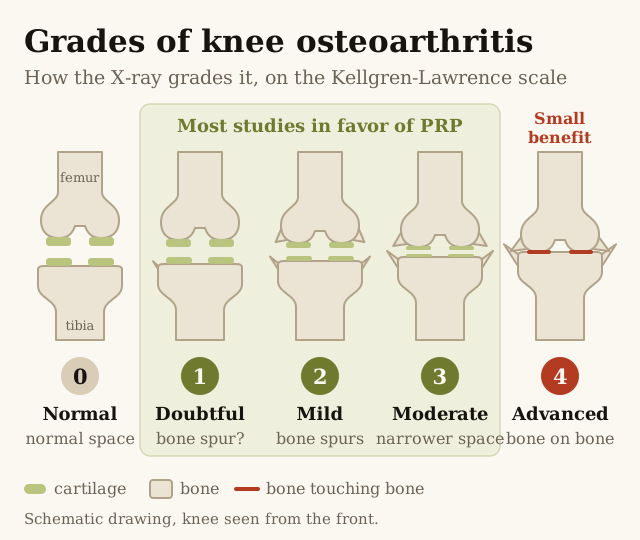
The X-ray shows what stage the osteoarthritis is at, and that makes a big difference to the result of PRP. The scale used is called Kellgren-Lawrence and goes from 0 to 4:
- grade 0: no signs of osteoarthritis;
- grade 1: doubtful changes;
- grade 2: mild osteoarthritis, with small bone spurs;
- grade 3: moderate osteoarthritis, with the space between the bones narrowing;
- grade 4: advanced osteoarthritis, with the space almost gone.
How PRP works inside the knee
Platelets store substances that signal repair and control inflammation, called growth factors. In PRP, these platelets reach the knee far more concentrated than they are in blood. The idea is that they calm the inflammation in the joint and improve the environment the cartilage lives in.
In a Chinese trial of 610 patients, the knee fluid of those who received PRP had, six months later, fewer inflammatory substances than that of those who received saline. This helps explain the improvement in pain. Recovering cartilage that has already been lost is another story, and that is where the treatment’s biggest limits are.
What the studies show
A 2026 review pooled 62 trials with almost 5,000 patients. PRP relieved pain and improved function more than hyaluronic acid, corticosteroids and saline at six months, and stayed ahead of hyaluronic acid and corticosteroids at twelve months. The authors themselves point out that the studies differ a lot from one another and that the certainty of the evidence ranges from moderate to very low.
The studies do not all agree: in 2021, an Australian trial published in JAMA, called RESTORE, compared three PRP injections with three saline injections in 288 people with mild to moderate osteoarthritis. After one year, pain had dropped by almost the same amount in both groups. The Chinese trial of 610 patients found the opposite: greater improvement with PRP at every assessment, up to five years later.
When well-designed studies reach opposite results, something in the preparation or in the patients is changing the response. One explanation that comes up strongly in recent studies is the number of platelets. A 2025 meta-analysis found that more concentrated PRP relieved pain to a noticeable degree up to a year later, while less concentrated PRP did not reach that level. Each preparation system delivers a different number of platelets, and this is worth asking your doctor about.
How long the effect lasts
PRP does not work right away, the way a corticosteroid does. Improvement usually appears over a few weeks and becomes clearer between the third and sixth month. In the reviews, it is most consistent up to 12 months, which is as far as most studies followed patients.
Some studies followed patients for longer. In an Indian group of 78 patients who had three injections, the improvement in pain and function held for four years, but at six years the results had returned close to the starting point. People with grade 3 osteoarthritis got worse sooner than those with grade 1 or 2.
A 2026 Chinese study compared, five years later, people with early osteoarthritis who had a course of PRP along with usual care and people who had usual care alone, with exercise, weight control and other treatments, such as anti-inflammatories or hyaluronic acid. At five years, the two groups were similar.
PRP brings relief for a while and does not solve the problem for good. The rest of the treatment remains the foundation in the long term, and the injection may need to be repeated after some time.
PRP, hyaluronic acid or corticosteroid?
These are the three most widely used injections for knee osteoarthritis. Each one has a role, which differs in how fast it works, how long it lasts and the best time to use it.
| PRP | Hyaluronic acid | Corticosteroid | |
|---|---|---|---|
| How it works | Platelets from your blood, which calm inflammation | Improves joint lubrication | Powerful anti-inflammatory |
| When it starts working | Over weeks | Over weeks | Within a few days |
| How long it lasts | Most consistent up to 12 months in studies | A few months | A few weeks |
| Best use | Mild to moderate osteoarthritis, after exercise and other measures | An option for mild to moderate osteoarthritis | Flare-ups of pain and swelling |
Compared with hyaluronic acid, PRP had a small advantage. A 2026 review of 21 trials found a difference in pain only at 12 months, and in function at every time point. Hyaluronic acid is still a good option, and the choice depends on the case.
Compared with corticosteroids, the difference is timing. A corticosteroid relieves pain faster and has a place during flare-ups. The 2024 European consensus on knee injections concluded that PRP gives a longer effect and seems to carry less risk of complications.
Who tends to benefit most
In 2024, experts from a European knee society and an international cartilage society analyzed 216 different scenarios of patients with osteoarthritis and decided in which ones PRP makes sense. They concluded that it is appropriate in people up to age 80, with grade 0 to 3 osteoarthritis, who have already tried other treatments without enough improvement. It was not considered appropriate as a first treatment, or in grade 4 osteoarthritis. Putting the consensus together with the studies, the profile that usually responds best looks like this:
- mild to moderate osteoarthritis, grades 1 to 3, with better results in the milder grades;
- someone who has already done exercise, strengthening and load adjustment and still has pain;
- a weight closer to the healthy range, because excess weight counted slightly against PRP in the six-year Indian study.
Losing weight helps the knee with or without PRP, and if you are losing weight and the scale has stalled, I wrote about the weight loss plateau. In grade 4 osteoarthritis, when almost no cartilage is left, the benefit is usually small, and the conversation starts to include other options, including an orthopedic surgeon’s assessment of surgery. Some situations rule out PRP, such as a knee infection, active cancer, very low platelets and a clotting disorder that has not been corrected. If you take an anticoagulant or aspirin, do not stop it on your own. This is reviewed before the treatment is recommended.
How it is done in practice
The decision starts at the consultation, with a knee exam and a recent X-ray. An MRI comes in when another injury is suspected, such as in the meniscus or a ligament.
The regimen most used in studies with good results is three injections. In a Turkish trial of 237 patients, three injections gave better results than a single one at 6 and 12 months. The interval between them ranges from one week to one month, and the number of sessions is decided case by case.
On the day, blood is drawn and spun in a centrifuge, and the PRP is injected into the knee. In the first few days, mild pain and swelling are common. I wrote a post just about care before and after PRP, covering what to do about anti-inflammatories, aspirin and training.
What PRP does not do
PRP does not rebuild cartilage that has already been lost. The Chinese trial saw less cartilage loss on MRI with PRP, but the Australian RESTORE trial saw no difference, so protection of the joint cannot be promised. The CFM resolution prohibits presenting PRP as a cure, as guaranteed regeneration or as a substitute for indicated surgery.
The foundation of treatment for osteoarthritis stays the same. The American College of Rheumatology guideline gives a strong recommendation for exercise and, for people above a healthy weight, for losing weight, which takes load off the knee with every step. Strengthening the thigh and hip is usually the core of the training. The same American guideline, from 2019, recommends against PRP in osteoarthritis because preparations differ so much; the 2024 European consensus and the CFM resolution, which are more recent, accept PRP in selected cases. When it is indicated, it comes in as a complement to that plan. Collagen, another treatment many people look for when their knee hurts, has its own post: does collagen work for osteoarthritis?.
What Brazil’s CFM says
CFM Resolution 2.464/2026 allows PRP as a complementary treatment for knee osteoarthritis, as long as it is done by a physician, only with the patient’s own blood and with a signed consent form that explains the benefits, limits, alternatives and risks. It also prohibits mixing PRP with stem cells, bone marrow or fat outside of research.
Conclusion
PRP for the knee has more studies in favor than against, especially in mild to moderate osteoarthritis and with a preparation that delivers a good number of platelets. The improvement appears within weeks, is most consistent in the first year and fades over the years. It can help as a complement to exercise and weight control, and it does not rebuild cartilage. Some studies still found no benefit, which is why the decision is made case by case.
Take good care of that knee, and until next time!
Responsible physician: Dr. Gilberto Nering Junior, sports medicine physician, CRM-SP 160822, RQE 142486 (Sports Medicine, Brazil).
This text was not sponsored, is for information only and does not replace an individual assessment. Questions about the content: contact the clinic.
Cover photo: Anna Auza on Unsplash.
Quick questions about PRP in the knee
Is PRP for the knee allowed in Brazil?
Yes. Since July 2026, CFM Resolution 2.464/2026 has allowed PRP as a complementary treatment for knee osteoarthritis, done by a physician, with the patient’s own blood and with a consent form.
How long does the effect of PRP in the knee last?
In studies, the benefit is most consistent up to 12 months. In some, the improvement lasted years but faded over time, and the treatment may need to be repeated.
Is PRP better than hyaluronic acid?
Recent reviews show a small advantage for PRP, clearer for knee function and for pain after one year. Hyaluronic acid is still a valid option, and the choice depends on the case.
Does PRP regenerate cartilage?
There is no guarantee: one trial saw less cartilage loss with PRP and another saw no difference. The goal of treatment is to improve pain and function, and the CFM prohibits promising regeneration.
Does PRP work in advanced osteoarthritis?
In grade 4 osteoarthritis, the benefit is usually small, and the 2024 expert consensus on who should have PRP did not consider it appropriate at that grade. In these cases, other options come into the conversation.
References
- Bennell KL, Paterson KL, Metcalf BR, et al. Effect of intra-articular platelet-rich plasma vs placebo injection on pain and medial tibial cartilage volume in patients with knee osteoarthritis: the RESTORE randomized clinical trial. JAMA. 2021;326(20):2021-2030. doi:10.1001/jama.2021.19415
- Bensa A, Previtali D, Sangiorgio A, et al. PRP injections for the treatment of knee osteoarthritis: the improvement is clinically significant and influenced by platelet concentration: a meta-analysis of randomized controlled trials. Am J Sports Med. 2025;53(3):745-754. doi:10.1177/03635465241246524
- Centeno CJ, Berger DR, Pelle AJ, et al. Autologous platelet-rich plasma versus hyaluronic acid, corticosteroids or saline for knee osteoarthritis: can blood draw volume serve as a proxy for platelet dose? A systematic review and meta-analysis. Int Orthop. 2026;50(5):981-997. doi:10.1007/s00264-026-06782-7
- Chu J, Duan W, Yu Z, et al. Intra-articular injections of platelet-rich plasma decrease pain and improve functional outcomes than sham saline in patients with knee osteoarthritis. Knee Surg Sports Traumatol Arthrosc. 2022;30(12):4063-4071. doi:10.1007/s00167-022-06887-7
- Conselho Federal de Medicina. Resolução CFM nº 2.464, de 2 de julho de 2026. Regulamenta o uso de plasma rico em plaquetas como procedimento médico adjuvante no tratamento de condições osteomusculares específicas. Diário Oficial da União. 15 jul 2026; Seção 1:70. Texto da resolução
- Islam MSU, Hussain A, Huda N, et al. Long-Term Efficacy of Intra-Articular Platelet-Rich Plasma in Knee Osteoarthritis: A 6-Year Follow-up of a Prospective Cohort. J Orthop Res. 2026;44(1):e70139. doi:10.1002/jor.70139
- Kolasinski SL, Neogi T, Hochberg MC, et al. 2019 American College of Rheumatology/Arthritis Foundation guideline for the management of osteoarthritis of the hand, hip, and knee. Arthritis Care Res (Hoboken). 2020;72(2):149-162. doi:10.1002/acr.24131
- Kon E, de Girolamo L, Laver L, et al. Platelet-rich plasma injections for the management of knee osteoarthritis: The ESSKA-ICRS consensus. Recommendations using the RAND/UCLA appropriateness method for different clinical scenarios. Knee Surg Sports Traumatol Arthrosc. 2024;32(11):2938-2949. doi:10.1002/ksa.12320
- Laver L, Filardo G, Sanchez M, et al. The use of injectable orthobiologics for knee osteoarthritis: a European ESSKA-ORBIT consensus. Part 1: blood-derived products (platelet-rich plasma). Knee Surg Sports Traumatol Arthrosc. 2024;32(4):783-797. doi:10.1002/ksa.12077
- Yu Q, Wen C, Liu J. Five-year real-world outcomes of short-course leukocyte-poor PRP versus standard conservative therapy in early-stage knee osteoarthritis. PLoS One. 2026;21(4):e0344749. doi:10.1371/journal.pone.0344749
- Yurtbay A, Say F, Çinka H, et al. Multiple platelet-rich plasma injections are superior to single PRP injections or saline in osteoarthritis of the knee: the 2-year results of a randomized, double-blind, placebo-controlled clinical trial. Arch Orthop Trauma Surg. 2022;142(10):2755-2768. doi:10.1007/s00402-021-04230-2
- Zhong C, Wang K, Hu X, et al. Platelet-rich plasma provides small but superior short-term pain relief and functional improvement compared with hyaluronic acid for the treatment of knee osteoarthritis: a systematic review and meta-analysis. Arthroscopy. 2026. doi:10.1002/arj.70520