
Also in: Português · Español · Italiano · 中文 · हिन्दी
Main points
- Compared with a placebo injection, stem cell injections in the knee may relieve pain a little and improve function a little for a few months, but confidence in these results is low.
- What is sold as “stem cells” for the knee is usually a bone marrow or fat concentrate. In one study, the bone marrow concentrate had very few stem cells.
- There is no good proof that they make cartilage grow back.
- In a US survey of 896 websites selling this treatment, almost all contained some misleading information.
- In Brazil, the Federal Council of Medicine (CFM) prohibits mixing PRP with stem cells, bone marrow or fat outside approved research or a specific regulation.
“Regenerate your cartilage.” “Avoid surgery.” “Run again without pain.” If you have knee pain or an injury that won’t heal, you have probably seen ads like these, almost always with the words stem cells somewhere in them. The promise is tempting, and the price is usually high.
In studies, stem cells in the knee relieved osteoarthritis pain a little for a few months compared with placebo, with low confidence, and there is no good proof that they make cartilage grow back. In this post I explain what actually goes into the syringe in these treatments, what the studies show in the knee and what the Brazilian rules say.
What a stem cell is
Stem cells are cells that do not yet have a defined function and can give rise to other types of cells. The ones most used in orthopedics are called mesenchymal cells, which live in small numbers in bone marrow, fat and other tissues.
There is, in fact, an established stem cell treatment: bone marrow transplantation, used for decades in leukemia and other blood diseases. It uses another type of stem cell, the blood stem cell, in a very controlled setting. A lot of advertising leans on that prestige to sell something quite different.
The idea behind the treatment is appealing: put these cells into the joint so that they turn into new cartilage or, at least, release substances that reduce inflammation, a promise similar to that of PRP. In people, the results are much more modest than the theory promises, and the 2025 Cochrane review says it is still not clear by what mechanism the cells would work in osteoarthritis.
What really goes into the syringe
The treatments sold under this name vary. In general, they use one of these products:
- bone marrow concentrate, drawn with a needle from the pelvic bone and centrifuged;
- processed fat, removed by a small liposuction and treated to separate a mix of cells;
- products made from placenta, umbilical cord or amniotic fluid, sold ready-made by companies.
A 2021 study analyzed, cell by cell, the bone marrow concentrate used in 15 orthopedic patients. Using the international criteria for identifying mesenchymal stem cells, the researchers found 1 in every 9 million cells. Other counting methods give different numbers, and there is still no consensus on how to count them. The authors recommended that the stem cell dose in these products be treated as a rough estimate or as unknown. In my reading, calling this a “stem cell injection” is an exaggeration.
What the studies show about stem cells in the knee
The best answer comes from a Cochrane review published in 2025, which pooled 25 randomized studies (in which a random draw decides who gets each treatment) with 1,341 people with knee osteoarthritis. In eight of these studies, the cells were compared with a placebo injection (without the active treatment), which is the fairest comparison. In those studies:
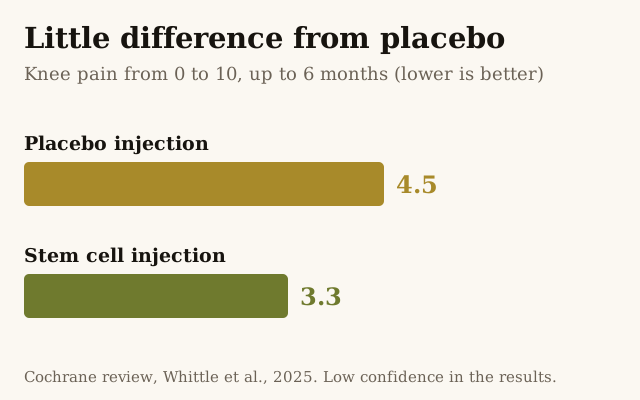
- pain improved a little: on a 0 to 10 scale, it was 4.5 with placebo and about 1.2 points lower with the cells, up to six months later;
- knee function also improved a little;
- the authors rated their confidence in these results as low, and were uncertain about quality of life and safety.
A 2025 review of ten studies, which compared the cells with other knee injections, reached a similar conclusion: bone marrow and fat cells relieved pain a little more than other injections, but knee function barely improved. Another review, also from 2025, with eight studies, was more optimistic and found improvement in pain and function for up to a year. The studies, however, are small and very different from one another. In the Cochrane review, all were done in knee osteoarthritis, in people with an average age between 51 and 66, so they say nothing about sports injuries to tendons, muscles or ligaments.
| 2025 review | Studies | What it found |
|---|---|---|
| Cochrane | 25 studies, 8 against placebo | Slightly less pain than with placebo up to 6 months, with low confidence |
| Hohmann and colleagues | 10 studies against other injections | Less pain, no meaningful improvement in function |
| Cao and colleagues | 8 studies | Better pain and function up to 1 year, in small studies that differ from one another |
Why do so many people say they got better?
People who had the treatment often say their knee got better, and they are not lying. But there are a few explanations for this that have nothing to do with the cells:
- osteoarthritis pain comes and goes: many people seek treatment during a worse phase, and the improvement that follows would have happened anyway;
- the placebo effect of an injection can be large: in a 2015 analysis of 149 knee osteoarthritis studies, a placebo injection into the knee relieved pain more than a placebo pill. In a 2008 experiment with healthy volunteers, the same fake pill relieved the pain of mild electric shocks more when people thought it was expensive;
- the treatment may come with other changes, such as rest, physical therapy and weight loss, which help on their own.
That is why the comparison with placebo carries so much weight. In the Cochrane review, stem cells came out only slightly ahead of placebo, with low confidence, far from the promise of a “new knee.”
Do they make cartilage grow back?
This is the big promise of the advertising, and it is where the proof is weakest. The authors of the Cochrane review remain uncertain about the effect of stem cells on osteoarthritis progression seen on imaging. Today there is no good proof that a stem cell injection makes worn knee cartilage grow back, and anyone who promises that is promising more than the studies have shown.
What stem cell ads promise
A 2020 US study analyzed 896 websites of clinics selling stem cells for bone, muscle and joint problems. Almost 96% of them had at least one piece of misleading information, with an average of almost five per site. These ranged from basic errors about what a stem cell is to promises of results without proof. Another study, from 2024, analyzed 300 companies in the United States that sold placenta and umbilical cord products as stem cells, without approval, for various diseases and injuries. Both studies are from the United States, but they are a warning for ads here in Brazil too, especially those that promise new cartilage or an end to surgery.
What about safety?
The Cochrane review found few serious side effects reported, but points out that every joint injection carries a small risk of infection. In addition, removing the bone marrow or fat is an extra procedure, with its own risks. And not enough is known yet about long-term risks, especially with cells from another person, such as umbilical cord cells.
The risk of infection rises when the product is prepared outside health regulations. If after an injection the knee becomes hot, swollen and very painful, or if you have a fever, get medical care the same day.
Stem cell treatment in Brazil: what the CFM says
CFM Resolution 2.464/2026, which regulates PRP, prohibits mixing into PRP any stem cells, bone marrow concentrate, stromal vascular fraction (a preparation made from fat) or microfragmented fat. The exception is formally approved clinical research or a specific regulation for it. In the text explaining the resolution, the CFM says these products are different from PRP and need their own regulatory review. So the resolution covers PRP and does not authorize injecting stem cells, bone marrow or fat on their own, which depend on their own rules.
If someone offers “PRP boosted with stem cells” outside an approved study, and without a specific regulation that allows it, that is outside the rules. On PRP itself, I wrote a post about the types of PRP, which shows how one preparation differs from another.
What to ask before accepting a “regenerative” treatment
Before you say yes, ask whoever offers the treatment these five questions. Write down the answers:
- What exactly will be injected, and where does it come from?
- Is this part of research approved by an ethics committee?
- Which studies show results for my problem, and compared with what?
- What happens if it does not work, and how much will it cost in total?
- What are the risks, including those of the procedure to remove the bone marrow or fat?
If the answers to these questions are vague, be suspicious. A serious treatment has a clear answer to each of them.
Real research vs. paid “research”
Stem cells for the knee are still a research topic, and taking part in a serious study may make sense for some people. But it helps to know how to recognize a real study.
Serious clinical research goes through an ethics committee, has a detailed consent form that explains the risks and what is being tested, and is usually registered in public study databases. In Brazil, Resolution 466/2012 of the National Health Council requires all research involving people to go through an ethics committee and to have a free and informed consent form. In general, there is a comparison group and a plan for measuring results.
Be suspicious when the “study” charges a lot for the treatment, does not explain what you will be compared with, promises results before starting or does not say who approved the research. In these cases, it is very likely a sale under another name.
What has the most proof in the knee
For knee osteoarthritis, what has the most studies behind it is still the basics done well: muscle strengthening, weight control and adapted physical activity. The international osteoarthritis guideline (OARSI, 2019) names education about the disease and structured exercise, with or without weight control, as the core treatment. When that is not enough, your doctor may discuss options such as hyaluronic acid and PRP for the knee, the latter within the indications allowed by the CFM, both with more limited proof than exercise.
Are stem cell injections for the knee worth it?
The words stem cells show up in a lot of advertising, but the bone marrow concentrate that was studied had very few of these cells. In the studies, stem cell injections in the knee relieved pain a little for a few months, with low confidence, and there is no good proof that they make cartilage grow back. In Brazil, mixing these products into PRP outside approved research or a specific regulation is prohibited by the CFM. Before paying a lot for a promise, it is worth asking what actually goes into the syringe.
Take good care of that knee, and be wary of miracles!
Responsible physician: Dr. Gilberto Nering Junior, sports medicine physician, CRM-SP 160822, RQE 142486 (Sports Medicine, Brazil).
This text was not sponsored, is for information only and does not replace an individual assessment. Questions about the content: contact the clinic.
Cover photo: Yassine Khalfalli on Unsplash.
Quick questions about stem cells
Do stem cell injections in the knee work?
Compared with placebo, they may relieve pain a little and improve function a little for up to six months, but confidence in these results is low. The studies were done in knee osteoarthritis, in people with an average age between 51 and 66.
Do stem cells regenerate cartilage?
There is no good proof that they regenerate cartilage. The authors of the 2025 Cochrane review remain uncertain about the effect of stem cells on osteoarthritis progression.
What goes into a stem cell injection?
Usually, bone marrow or fat concentrate. In one study, the bone marrow concentrate had 1 mesenchymal stem cell in every 9 million cells, by international criteria.
Is PRP with stem cells allowed in Brazil?
CFM Resolution 2.464/2026 prohibits mixing PRP with stem cells, bone marrow or fat outside formally approved clinical research or a specific regulation. Without those exceptions, offering “PRP with stem cells” is outside the rules.
How much does a stem cell injection in the knee cost?
There is no reference price: each place charges its own, and the cost is usually high. Before paying, ask what exactly will be injected, whether the treatment is part of research approved by an ethics committee and how much it will cost in total, including the removal of bone marrow or fat.
What are the risks of a stem cell injection?
Every joint injection carries a small risk of infection, and removing bone marrow or fat is an extra procedure. Long-term risks are not yet well known.
References
- Bannuru RR, McAlindon TE, Sullivan MC, et al. Effectiveness and Implications of Alternative Placebo Treatments: A Systematic Review and Network Meta-analysis of Osteoarthritis Trials. Ann Intern Med. 2015;163(5):365-72. doi:10.7326/M15-0623
- Bannuru RR, Osani MC, Vaysbrot EE, et al. OARSI guidelines for the non-surgical management of knee, hip, and polyarticular osteoarthritis. Osteoarthritis Cartilage. 2019;27(11):1578-1589. doi:10.1016/j.joca.2019.06.011
- Brasil. Conselho Nacional de Saúde. Resolução nº 466, de 12 de dezembro de 2012. Aprova as diretrizes e normas regulamentadoras de pesquisas envolvendo seres humanos. Diário Oficial da União. 13 jun 2013; Seção 1:59. Text of the resolution (in Portuguese)
- Cao M, Ou Z, Sheng R, et al. Efficacy and safety of mesenchymal stem cells in knee osteoarthritis: a systematic review and meta-analysis of randomized controlled trials. Stem Cell Res Ther. 2025;16(1):122. doi:10.1186/s13287-025-04252-2
- Conselho Federal de Medicina. Resolução CFM nº 2.464, de 2 de julho de 2026. Regulamenta o uso de plasma rico em plaquetas como procedimento médico adjuvante no tratamento de condições osteomusculares específicas. Diário Oficial da União. 15 jul 2026; Seção 1:70. Text of the resolution (in Portuguese)
- Hohmann E, Keough N, Stokes D, et al. Adipose- and bone marrow-derived stromal cells reduce pain in patients with knee osteoarthritis but do not substantially improve knee functionality: an updated systematic review and meta-analysis. Eur J Orthop Surg Traumatol. 2025;35(1):214. doi:10.1007/s00590-025-04322-4
- Kingery MT, Schoof L, Strauss EJ, et al. Online Direct-to-Consumer Advertising of Stem Cell Therapy for Musculoskeletal Injury and Disease: Misinformation and Violation of Ethical and Legal Advertising Parameters. J Bone Joint Surg Am. 2020;102(1):2-9. doi:10.2106/JBJS.19.00714
- Ruoss S, Walker JT, Nasamran CA, et al. Strategies to Identify Mesenchymal Stromal Cells in Minimally Manipulated Human Bone Marrow Aspirate Concentrate Lack Consensus. Am J Sports Med. 2021;49(5):1313-1322. doi:10.1177/0363546521993788
- Turner L, Wang JC, Martinez JR, et al. US businesses engaged in direct-to-consumer marketing of perinatal stem cell interventions following the Food and Drug Administration’s enforcement discretion era. Cytotherapy. 2024;26(4):393-403. doi:10.1016/j.jcyt.2024.01.001
- Waber RL, Shiv B, Carmon Z, et al. Commercial features of placebo and therapeutic efficacy. JAMA. 2008;299(9):1016-7. doi:10.1001/jama.299.9.1016
- Whittle SL, Johnston RV, McDonald S, et al. Stem cell injections for osteoarthritis of the knee. Cochrane Database Syst Rev. 2025;4(4):CD013342. doi:10.1002/14651858.CD013342.pub2