Also in: Português · Español · Italiano · 中文 · हिन्दी
Main points
- When you lose weight, part of what comes off is lean mass, and that happens with diet, with weight-loss injections or with surgery.
- Losing some lean mass is expected. The concern is greater for people who are older, who already have little muscle or who lose weight very fast.
- Exercise protects the most, especially strength training: in the studies, exercise prevented almost half of the lean mass loss during dieting.
- Eating enough protein helps, but on its own it probably falls short. It works better combined with training.
- The scale does not show what you are losing. Bioimpedance, strength and body measurements help you keep track.
When people start losing weight, they usually look only at the scale. But the number on the scale lumps everything together: fat, water, muscle and even what is inside your gut. Losing 10 kg can be a great result, or it can hide a loss of muscle that you will miss later on.
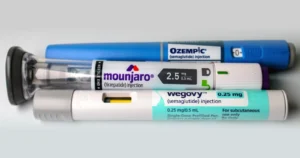
This question has become more common with weight-loss injections, which make people lose a lot of weight in a short time. In the post about what happens when you stop the injections, I mentioned in passing how to protect muscle during treatment. Here I go into detail on how to lose weight without losing muscle mass: how much muscle is lost in the process, when that is a concern and what to do to preserve it.
Are lean mass and muscle the same thing?
A 2024 review on these injections points out that lean mass is everything that is not fat: muscle, organs, bones, blood and body water, including the water held inside fat tissue itself. Muscle is the largest part of it, but not the only one, so the two terms are not synonyms.
Body composition tests, such as bioimpedance and whole-body DXA scans, measure lean mass as a whole. When the result shows a drop in lean mass, part of that drop is water and tissue that went along with the fat.
People with obesity usually have more muscle than a lean person. The quality of that muscle, however, tends to be worse, with more fat infiltrated between the fibers. According to the same review, part of the lean mass lost during weight loss is therefore an expected adaptation to a lighter body.
How much muscle mass is lost when you lose weight
In the studies with weight-loss injections, the share of lost weight that was lean mass ranged from 15% or less up to about 60%, depending on the drug, the group studied and any related diseases. The math changes with how and how much weight is lost, and also with who is losing it.
The SURMOUNT-1 study measured the body composition of people who took tirzepatide, the active ingredient in Mounjaro, for almost a year and a half. About 75% of the weight lost was fat and 25% was lean mass. In the group that received placebo and lost weight only with diet and physical activity advice, the proportion was the same.
Per kilo lost, the injection did not take more lean mass than diet did. But the total loss was much larger, and so was the amount of lean mass lost. I compared how much weight each drug takes off in the post on which weight-loss injection works best.
With semaglutide, the active ingredient in Ozempic and Wegovy, the numbers help explain the difference between lean mass and muscle. In the STEP 1 study, out of an average of 13.6 kg lost, 5.3 kg was lean mass, almost 40% of the total. Since muscle is roughly half of lean mass, the loss of actual muscle was estimated at about 20% of the weight lost. A 2026 review that pooled 7 studies of injections of this kind pointed the same way: on average, participants lost almost 2 kg more lean mass than those who received placebo, but the proportion of lean mass in the body went up, because fat fell proportionally more.
Is losing lean mass always bad?
For most people, losing a little lean mass does no harm: a 2017 review concluded that losing weight through diet reduces muscle mass without making strength worse. The ability to do everyday things, like walking, climbing stairs and carrying weight, often even improves, probably because the person loses fat.
With the injections, short and medium-term studies also showed that grip strength was preserved, even with the drop in lean mass. On top of that, MRI scans suggest that muscle quality tends to improve, with less infiltrated fat.
In some groups the picture changes: in older people with diabetes who used semaglutide for longer, observational studies saw a drop in strength and faster muscle loss. For those who already have little reserve, losing muscle can make a difference to balance, the risk of falls and independence.
Who needs extra care
Some people lose muscle more easily when they lose weight. The 2025 joint advisory from US medical societies on these injections lists who needs closer attention to muscle during weight loss:
- older age;
- women in perimenopause or after menopause;
- men with low testosterone;
- people who are sedentary or have never done strength training;
- people who eat little protein, which is common with the injections, since they take away appetite;
- large and fast weight loss.
None of these conditions rules out losing weight, but in these cases looking after muscle starts along with the treatment. Strength training and protein come in from the start, and strength is tracked more closely.
Does losing weight more slowly help?
Lean mass loss also depends on the size of the calorie cut and how fast the weight drops. The 2025 US advisory points out that bone takes a hit too. Large and fast losses, of 14% of body weight or more in 3 to 4 months, are linked to significant bone loss. More moderate and slower losses seem to preserve bone better.
There is no single pace that works for everyone. What I recommend is a pace you can sustain with training and protein on track, without rushing to hit a number on the scale and without panicking in the weeks when your weight stalls, as I explained when I wrote about the weight loss plateau.
Strength training: what protects the most
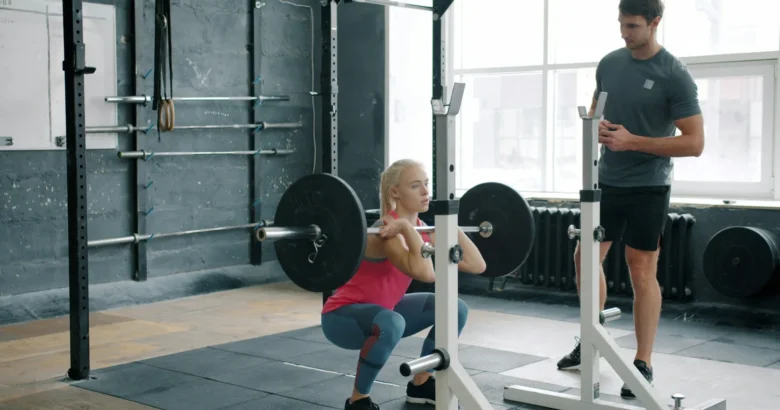
If I had to choose a single thing to protect muscle during weight loss, it would be strength training, and the studies back that choice, especially when strength work comes together with aerobic exercise. A 2026 review pooled 34 studies in which people with overweight or obesity dieted, with or without exercise. Those who trained preserved almost 1 kg more lean mass, which prevented almost half of the expected loss. Mixed training, with strength and aerobic work, had the largest effect, followed by strength training. Aerobic exercise alone helped less.
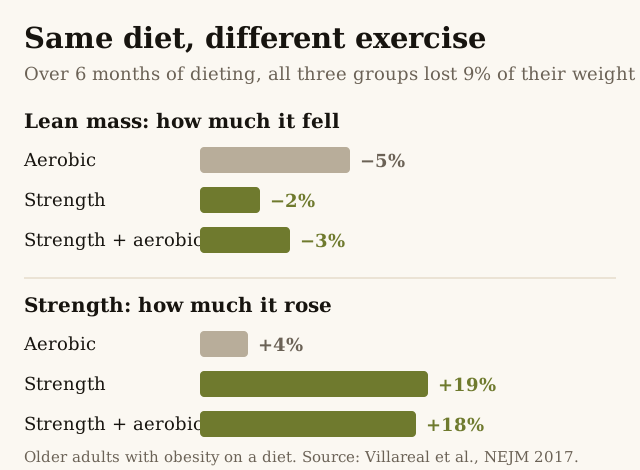
The LITOE study, in older adults with obesity, compared three groups on the same diet, each with a different type of exercise. In 6 months, all three lost about 9% of their weight. Those who did only aerobic exercise lost 5% of their lean mass and gained only 4% in strength. Those who did strength training, alone or with aerobic exercise, lost 2 to 3% of their lean mass and became 18 to 19% stronger. The group that combined both improved the most in overall physical capacity.
During treatment with the injections, the same US advisory suggests strength training at least 3 times a week and at least 150 minutes of moderate aerobic activity a week. Nobody needs to start at that volume. If you are sedentary and have heart disease, kidney disease or diabetes, or you feel chest pain or shortness of breath on exertion, get a medical assessment before you start training. My priorities are that the load goes up gradually, that training works the large muscle groups and that it stays regular for months. Aerobic exercise is still important for the heart and for fitness, as I explained in the post about VO₂ max.
Protein: it helps, but it is not enough on its own
While dieting, eating more protein than the minimum recommendation helps hold on to lean mass. A 2020 review of diet studies showed, on average, about 0.4 kg more lean mass preserved with more protein. The gain is small and shows up more when the person also trains.
The minimum recommendation for adults is 0.8 g of protein per kilo of body weight per day. The 2025 US advisory cites higher targets during weight loss, of 1.2 to 1.6 g per kilo per day. In people with obesity, doing this math with current body weight can overestimate the need, which is why the calculation has to be individual. Overdoing it is not good either: the same document advises avoiding 2 g per kilo per day or more for long periods, because of the risk of harmful health effects. People with kidney disease should not increase their protein on their own: in that case, the amount is set with the doctor. The US authors also warn that increasing protein without doing strength training is probably not enough to preserve muscle.
With the injections, the hard part is often eating enough. To reach your protein for the day even with little hunger, it helps to:
- start the meal with the protein, before the rest of the plate;
- spread protein across the day instead of packing it all into dinner;
- keep practical foods on hand, such as eggs, plain yogurt, low-fat cheeses, chicken and fish;
- when food is not enough, consider whey protein, which I explained in the post about whey protein.
What about creatine?
Creatine is one of the most studied supplements for muscle. In a review of 22 studies in people with an average age of 57 to 70 who did strength training, those who took creatine gained about 1.4 kg more lean mass and got stronger than those who took placebo.
These studies were not done during weight loss, but they show that creatine adds to the effect of training. In all of them, people were training. If you have kidney disease, talk to your doctor before taking it. I wrote more about it in this post about creatine.
How to tell if you are losing muscle mass
The scale only shows total weight. A 2026 consensus statement on these injections from European obesity and dietitian organizations proposes monitoring everyone with simple measures, such as weight, waist and a strength test, and saving bioimpedance or DXA for those at higher risk or who start to feel weak. To find out what is coming off, it helps to follow this order:
- Before you start, a baseline: weight, body measurements (waist, arm and thigh), strength and, when indicated, bioimpedance, which estimates fat, lean mass and water.
- At the following checks, bioimpedance repeated under the same conditions, so one result can be compared with the other. I ask for the same time of day, fasting, no training beforehand and similar hydration.
- Strength, tracked through the progress of your training loads or through tests such as grip strength and the sit-to-stand test.
- How you manage day to day: climbing stairs, carrying shopping bags, getting up from the floor.
If your weight drops and your strength drops with it, review the plan. The loss may be too fast, protein may be too low or training may not be enough.
Conclusion
Losing weight takes some lean mass with it, whether through diet or the injections, and for most people that does not make strength worse. Age, a small muscle reserve and very fast loss raise the risk. To lose weight without losing muscle mass, what helps most is exercise, especially strength training, with enough protein across the day. And besides the scale, keep an eye on bioimpedance and strength. Here are the numbers from each study I mentioned:
| Study | What it tested | What it showed |
|---|---|---|
| SURMOUNT-1 (tirzepatide) | injection vs. placebo, almost a year and a half | 75% of the weight lost was fat and 25% lean mass, in both groups |
| STEP 1 (semaglutide, 2021) | injection | of 13.6 kg lost, 5.3 kg was lean mass; muscle, about 20% of the weight lost |
| Review of 7 injection studies (2026) | injection vs. placebo | almost 2 kg more lean mass lost, but with a higher proportion of lean mass in the body at the end |
| Review of 34 studies (2026) | diet with and without exercise | exercise preserved almost 1 kg of lean mass, almost half of the loss |
| LITOE (2017), older adults with obesity | diet with aerobic exercise, strength training or both | with strength training, loss of 2 to 3% of lean mass and 18 to 19% more strength |
| Protein review (2020) | more protein than the minimum while dieting | about 0.4 kg more lean mass |
| Review of 22 creatine studies (2017) | creatine with strength training, average age 57 to 70 | about 1.4 kg more lean mass |
Enjoy your training, and take good care of that muscle!
Responsible physician: Dr. Gilberto Nering Junior, sports medicine physician, CRM-SP 160822, RQE 142486 (Sports Medicine, Brazil).
This text was not sponsored, is for information only and does not replace an individual assessment. Questions about the content: contact the clinic.
Cover photo: Vitaly Gariev on Unsplash.
Quick questions about losing weight without losing muscle mass
Does all weight loss take muscle with it?
Almost always, part of the weight lost is lean mass, which includes muscle, water and other tissues. In SURMOUNT-1, with tirzepatide, it was about a quarter of the weight lost, the same proportion as in people who lost weight without the drug.
Do weight-loss injections make you lose more muscle than dieting?
In the tirzepatide study, the proportion per kilo lost was similar to that of people who lost weight without the drug. Since the total loss is larger, the amount of lean mass lost is also larger, so strength training and protein matter during treatment.
Is there a medication to lose weight without losing muscle mass?
Weight-loss injections do not protect muscle: in SURMOUNT-1, with tirzepatide, the share of lost weight that was lean mass was the same as in people who lost weight without the drug. According to the 2024 review on these injections, drugs designed to preserve muscle during weight loss are still being studied, and what protects muscle today, with or without injections, is strength training with enough protein.
How much protein should I eat to avoid losing muscle?
The 2025 US advisory cites targets of 1.2 to 1.6 g per kilo per day during weight loss, but the calculation has to be individual, especially in people with obesity. The dietitian adjusts the amount.
Does protein alone protect muscle?
It helps, but on its own it is probably not enough to hold on to muscle. The effect is greater when protein comes together with regular strength training.
How can I tell if I am losing muscle?
The scale alone does not show what is coming off. Bioimpedance repeated under the same conditions, changes in strength and body measurements help you keep track.
References
- Cava E, Yeat NC, Mittendorfer B. Preserving Healthy Muscle during Weight Loss. Adv Nutr. 2017;8(3):511-519. doi:10.3945/an.116.014506
- Chilibeck PD, Kaviani M, Candow DG, et al. Effect of creatine supplementation during resistance training on lean tissue mass and muscular strength in older adults: a meta-analysis. Open Access J Sports Med. 2017;8:213-226. doi:10.2147/OAJSM.S123529
- Deller M, Weiershaus J, Held S, et al. Effects of Calorie Restriction With and Without Strength, Endurance or Mixed Training on Fat-Free and Skeletal Muscle Mass in Overweight or Obese Individuals: A Systematic Review With Pairwise Meta-Analysis and Network Meta-Analysis of Randomized Controlled Studies. Diabetes Obes Metab. 2026;28(8):6810-6823. doi:10.1111/dom.70873
- Dobbie LJ, Tolvanen L, Alves D, et al. Nutritional, functional, and psychological considerations for incretin-based therapies in adults: an EASO, EFAD, and ECPO Consensus Statement. Lancet Diabetes Endocrinol. 2026;14(9):754-777. doi:10.1016/S2213-8587(26)00122-1
- Hudson JL, Wang Y, Bergia RE, et al. Protein Intake Greater than the RDA Differentially Influences Whole-Body Lean Mass Responses to Purposeful Catabolic and Anabolic Stressors: A Systematic Review and Meta-analysis. Adv Nutr. 2020;11(3):548-558. doi:10.1093/advances/nmz106
- Laverde LP, Muñoz-Velandia OM, Alfonso D, et al. Effect of GLP-1 receptor agonists at doses for obesity management on muscle health: systematic review and meta-analysis of randomized controlled trials (RCTs). Int J Obes (Lond). 2026;50(8):1638-1646. doi:10.1038/s41366-026-02118-y
- Look M, Dunn JP, Kushner RF, et al. Body composition changes during weight reduction with tirzepatide in the SURMOUNT-1 study of adults with obesity or overweight. Diabetes Obes Metab. 2025;27(5):2720-2729. doi:10.1111/dom.16275
- Mozaffarian D, Agarwal M, Aggarwal M, et al. Nutritional priorities to support GLP-1 therapy for obesity: a joint Advisory from the American College of Lifestyle Medicine, the American Society for Nutrition, the Obesity Medicine Association, and The Obesity Society. Am J Clin Nutr. 2025;122(1):344-367. doi:10.1016/j.ajcnut.2025.04.023
- Neeland IJ, Linge J, Birkenfeld AL. Changes in lean body mass with glucagon-like peptide-1-based therapies and mitigation strategies. Diabetes Obes Metab. 2024;26 Suppl 4:16-27. doi:10.1111/dom.15728
- Prokopidis K. Glucagon-like peptide-1 receptor agonists and muscle strength changes in older adults: Risks beyond muscle mass reductions. Br J Pharmacol. 2026. doi:10.1111/bph.70355
- Villareal DT, Aguirre L, Gurney AB, et al. Aerobic or Resistance Exercise, or Both, in Dieting Obese Older Adults. N Engl J Med. 2017;376(20):1943-1955. doi:10.1056/NEJMoa1616338
- Wilding JPH, Batterham RL, Calanna S, et al. Once-Weekly Semaglutide in Adults with Overweight or Obesity. N Engl J Med. 2021;384(11):989-1002. doi:10.1056/NEJMoa2032183