
Also in: Português · Español · Italiano · 中文 · हिन्दी
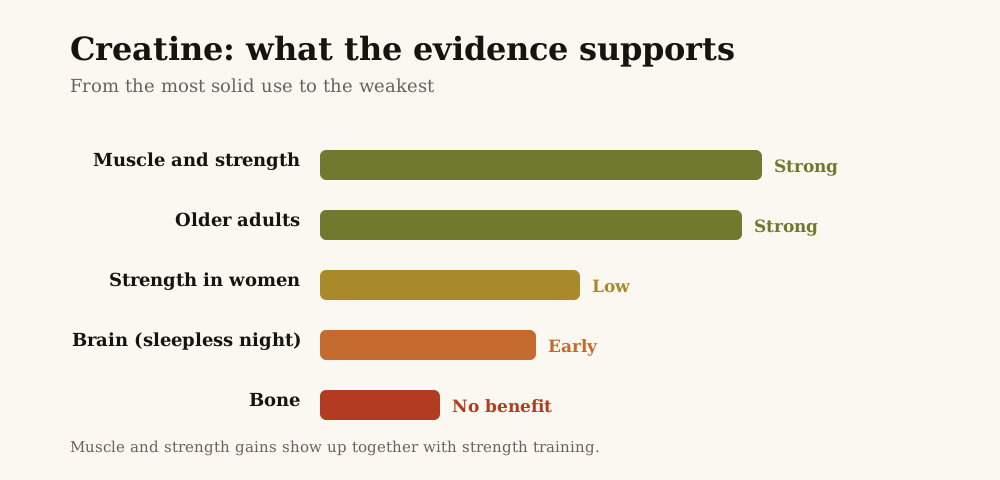
Creatine stopped being a “gym bro thing” a long time ago. In recent years, research has gone after other uses, like the brain, women’s health and aging, and along with the good findings came a lot of hype. The most solid use is still building muscle and strength, with well-documented benefit in older adults. In women the gain seems small and the evidence is still low certainty. For the brain there are early results, in sleep deprivation and at high doses, and for bone the evidence is weak. The basics, how it works and the classic myths are in my basic guide to creatine.
The quick basics (for newcomers)
Creatine is a compound the body uses to restore energy quickly inside cells. The studied and recommended form is creatine monohydrate, 3 to 5 grams a day, taken continuously. It has decades of research behind it and a good safety record in healthy people.
| Use | What the studies show | Strength of evidence |
|---|---|---|
| Muscle and strength | More muscle and strength gains alongside training | Strong |
| Older adults | With resistance training, more muscle and strength than training alone | Strong |
| Women who train | Possible small gain in strength, power and lean mass | Low |
| Brain | Better mental performance after a sleepless night, at a high dose | Early |
| Bone | No gain in bone density beyond training over 2 years | No proven benefit |
Creatine and the brain: real promise or hype?
The logic makes sense. The brain also uses creatine to produce energy, and when that energy drops, as after a night without sleep, topping up creatine could help mental performance.
In 2024, a study published in Scientific Reports gave a single dose of 0.35 g of creatine per kilogram of body weight to people who had stayed awake all night. For someone weighing 70 kg (about 154 lb), that is roughly 25 grams at once. With creatine, they did better on cognitive tests and had faster processing speed than with placebo.
This was a lab experiment, with a dose far above what people use day to day. There is no recommended creatine dose for the brain, and copying the study dose at home makes no sense. No capsule makes up for a bad night’s sleep either.
A 2026 survey of 2,178 users of a supplement app, who reported on their own experience, showed how big this bet on the brain has become. Improving the brain was the most common goal (68% of users), and 64% of the people with that goal noticed no brain benefit.
Creatine for women
For decades, almost all creatine research was done in men. The fears that stuck around don’t hold up: creatine does not “masculinize” you and does not make you fat. The number on the scale may go up a little at first, because of the water that moves into the muscle.
A 2026 meta-analysis pooled 34 studies of women who train, with 692 participants in total. The authors found a possible, small effect on some measures of strength, power, high-intensity performance and lean mass. The certainty of the evidence was low for performance and body composition, and very low for the overall result, because the studies differ a lot from one another. You can use it, with adjusted expectations.
In the 2026 user survey, women reported more side effects and noticed less benefit than men, and raising the dose made less difference for them. These are questionnaire answers, which show how users perceive it and do not prove cause, and two of the authors work for the app company. Even with these caveats, the finding reinforces that dose and expectations for women should be discussed case by case.
In menopause, the hormonal drop speeds up the loss of muscle and bone, which is why interest in creatine has grown at this stage. In the largest trial in postmenopausal women, which lasted two years, creatine plus training did not increase strength beyond what training already provided. Lean mass rose a little more only in the analysis of those who completed the study, and the women taking creatine became slightly faster at walking 80 meters. It is a plausible use, still without strong proof.
Creatine and aging
As we age, we lose muscle, a process called sarcopenia. Along with the muscle go strength and independence for everyday tasks.
For this group the evidence is strong. A 2014 meta-analysis showed that in older adults, creatine combined with strength training produces more gains in muscle and strength than training alone. This effect appeared in studies that combined creatine with resistance training, although not every study finds a strength gain, like the postmenopausal women study mentioned above. For an older person who already trains, it is a cheap way to get more out of the same workout.
What about bone?
There is no proof that creatine strengthens bone, even though marketing keeps repeating it.
The same two-year study of 237 postmenopausal women, all in a resistance training and walking program, measured bone. Creatine did not increase bone density beyond what training already provided. There was only a favorable signal in one measure of strength at the femoral neck. In theory, stronger muscle helps balance and protects against falls, but that has not yet been shown with creatine.
Other uses under study
A 2012 review titled “In sickness and in health” gathered reports of creatine benefit in muscle diseases, neurodegenerative diseases, cancer, rheumatic diseases and type 2 diabetes. These are lines of research, not treatment indications. Be wary of anyone selling creatine as a cure for everything.
How to take it for these goals
- Dose: creatine monohydrate, 3 to 5 grams a day, every day. There is no special dose for the brain.
- Loading phase: optional. It only speeds up the effect, and with the fixed dose you reach the same point in a few weeks.
- Timing: makes no meaningful difference. What counts is taking it every day.
- Training: the proven effect on muscle shows up together with strength training.
In the user survey, people who knew more about creatine reported a better experience and more satisfaction. It is an association, and it does not prove that being better informed changes the result.
To track whether it is working on muscle, bioimpedance shows your muscle mass over time.
Who should be careful
In healthy people, creatine has a good safety record, and the fear that it harms the kidneys has not been confirmed in studies (I explained this in detail in my basic guide to creatine). Some groups should talk to their doctor first:
- People with kidney disease or reduced kidney function, people with diabetes or high blood pressure, and anyone who often takes medicines that strain the kidneys, such as anti-inflammatories. There is no proof of harm in these cases, but the kidneys already need monitoring, and creatine raises creatinine, one of the blood tests used to keep an eye on them.
- Pregnant and breastfeeding women, because there is little specific data.
Since creatine can raise blood creatinine without any kidney problem, tell your doctor you take it when you have blood work done.
Conclusion
If you are older and do resistance training, creatine is worth considering. If you are a woman who trains, you can use it knowing the expected gain is small. If your goal is the brain or bone, there is no basis yet to take it for that reason. In every case, the result depends on the training.
If you want to know whether it makes sense in your case, that is part of my sports medicine consultation in São José dos Campos, Brazil.
Take care, and see you next time!
Responsible physician: Dr. Gilberto Nering Junior, CRM-SP 160822, RQE 142486 (Sports Medicine, Brazil). This text was not sponsored, is for information only and does not replace an individual assessment.
Quick questions
Does creatine improve memory and the brain?
In a lab study, a single high dose improved the mental performance of sleep-deprived people. The evidence is still early, there is no recommended dose for the brain, and creatine does not replace sleep.
Can women take creatine?
Yes. A 2026 meta-analysis of women who train showed a possible, small gain in strength and lean mass, with low-certainty evidence. Creatine does not masculinize, and the weight that goes up at first is water in the muscle.
Is creatine good for older adults?
Yes. Combined with strength training, it helps build more muscle and strength than training alone, which protects independence.
Does creatine strengthen bones?
There is no proof of that. In the largest study, which lasted two years, creatine did not increase bone density beyond what training already provided.
Do I need a loading phase?
It is not required. Taking 3 to 5 grams a day continuously leads to the same result in a few weeks.
Which creatine should I buy?
Monohydrate, the most studied form. “Premium” and more expensive versions have no proven advantage.
References
- Burridge J, Boolani A, Zhang Z, Glenn JM. Real-world creatine supplementation: a large-scale cross-sectional study of use, knowledge, and experiences. J Int Soc Sports Nutr. 2026;23(1):2702952. doi:10.1080/15502783.2026.2702952
- Chilibeck PD, Candow DG, Gordon JJ, et al. A 2-yr randomized controlled trial on creatine supplementation during exercise for postmenopausal bone health. Med Sci Sports Exerc. 2023;55(10):1750-1760. doi:10.1249/MSS.0000000000003202
- Devries MC, Phillips SM. Creatine supplementation during resistance training in older adults: a meta-analysis. Med Sci Sports Exerc. 2014;46(6):1194-1203. doi:10.1249/MSS.0000000000000220
- Gordji-Nejad A, Matusch A, Kleedörfer S, et al. Single dose creatine improves cognitive performance and induces changes in cerebral high energy phosphates during sleep deprivation. Sci Rep. 2024;14:4937. doi:10.1038/s41598-024-54249-9
- Gualano B, Roschel H, Lancha AH Jr, Brightbill CE, Rawson ES. In sickness and in health: the widespread application of creatine supplementation. Amino Acids. 2012;43(2):519-529. doi:10.1007/s00726-011-1132-7
- Lin Y, Zhu W, Hong B. Effects of creatine supplementation on exercise performance, physiological outcomes, and body composition in females engaged in exercise or training: a systematic review and multilevel meta-analysis. Front Nutr. 2026;13:1921827. doi:10.3389/fnut.2026.1921827