
Also in: Português · Español · Italiano · 中文 · हिन्दी

Nutrition doctor or dietitian? In Brazil, it is one of the most heated questions in the field, the kind that puts the professional councils themselves on opposite sides. In the middle of the dispute, what matters to someone looking for help gets lost: who do I book with? Almost always the answer is both, because each one solves a part. One is a physician. The other is the professional who sits down with you and decides, in practice, what goes on your plate every week.
What a Dietitian Does
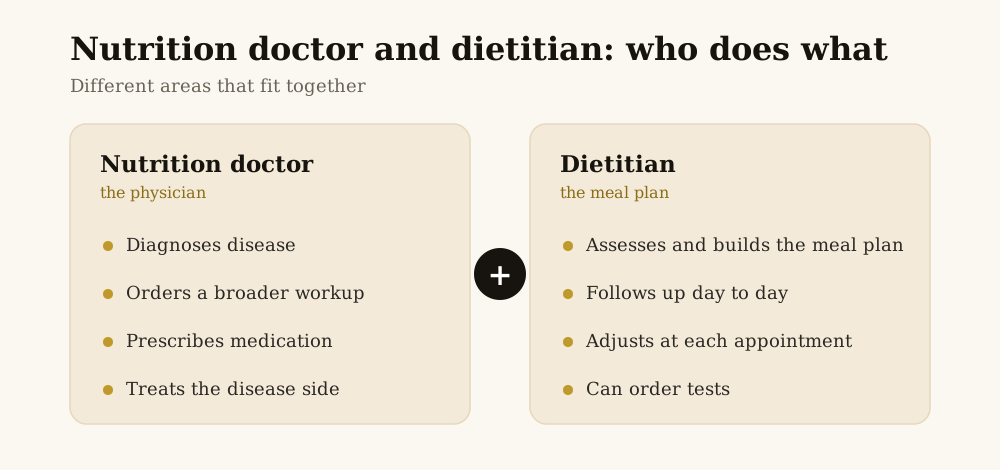
In Brazil, a dietitian completes a four-year Nutrition degree, then specializes in an area such as sports, clinical or maternal and child nutrition. The work is the most hands-on and the one that weighs most on the result: understanding how a person eats and why, building a meal plan that fits their real routine (not the photocopied diet that doesn’t last a week) and following up closely, adjusting from one appointment to the next. Habits change slowly, and it is this repeated follow-up that holds on to the result.
Dietitians also read tests and can order them, and behind that point there is a law, a professional council and even a fight with health insurers.
What a Nutrition Doctor Does
A nutrition doctor is a physician. That means six years of Medicine plus specialization in Nutrition Medicine (Nutrologia, in Brazil). This medical training opens up what a dietitian, by law, does not do: diagnose a disease, order a broader workup and prescribe medication. When there is a disease involved, suspicion of something more serious or a chance of needing medication, the case belongs to the physician, because diagnosis and prescription are acts reserved for physicians.
So, Who Can Read and Order Tests?
Reading tests is not exclusive to physicians. Dietitians are trained to interpret the markers related to their work, and the law backs them in ordering tests: Brazilian Law 8.234/91 and the resolutions of the Federal Council of Dietitians provide for this to assess and follow up the patient.
The snag is health insurance. In 2023, Brazil’s Supreme Court (STF, ADI 7376) ruled that insurers are not required to cover tests ordered by a dietitian, so many people get the right order and run into the insurer’s refusal when booking. In my opinion, it is a bad rule: it dumps on the patient a cost that did not need to exist and turns its nose up at a competence the law already gave to nutrition professionals.
And Who Can Prescribe the Diet?
Prescribing a diet is the most disputed point between the two professions, and not even the Supreme Court ended the fight. In ADI 803, with Justice Gilmar Mendes as rapporteur, the Court kept the activities in Law 8.234/91 as exclusive to dietitians, but with an important caveat: respecting the scope of other regulated professions. The vote separates the purposes, nutrition on one side and health on the other, and recognizes that other professions, under their own laws, also recommend diets.
It is on this caveat that Brazil’s Federal Council of Medicine (CFM) relies to argue that physicians can prescribe a diet within their specialty, nutrition doctors and endocrinologists included. The Federal Council of Dietitians (CFN) reads the same decision the other way and argues that diet prescription remains exclusive to dietitians. There is still no consensus.
At my clinic this tug-of-war does not come up. The person who builds and follows the diet day to day is Natalia, our dietitian, and I handle the medical part. For me it works better this way, and nobody ends up stepping onto gray legal ground.
When to See Each One
In practice, the choice usually goes like this, with the caveat that it is almost always worth having both.
See a dietitian when the subject is food:
- adjusting your eating, losing weight or gaining muscle;
- building an eating routine you can keep up;
- understanding the nutritional side of your tests.
See a nutrition doctor, the physician, when a disease is involved:
- suspected obesity with complications, diabetes or a hormonal change;
- a more serious deficiency to investigate;
- the possibility of needing medication.
If you don’t know where to start, start with either one. That is already more than most people do, and a good professional refers you to the other when needed.
How We Work at the Clinic
A physician alone, or a dietitian alone, delivers less than the two together. That is why, here, Natalia (dietitian) and I (nutrition doctor) work in an integrated way: I take the medical part, the diagnosis and the medication when needed; she takes the meal plan and the day-to-day follow-up. The patient leaves with a single plan, thought out by two people, instead of two messages that don’t match.
If I were the patient, that is how I would want to be cared for.
Conclusion
Nutrition doctor and dietitian are not one to pick and one to discard. They are a physician and a dietitian taking care of different parts of the same problem: one with the disease and the medication, the other with the food and the change in habits.
If you keep putting it off, book with one of the two. The right professional will show you the next step.
Take care, and see you next time!
Responsible physician: Dr. Gilberto Nering Junior, CRM-SP 160822. This text is for information only and does not replace an individual assessment.
Quick Questions About Nutrition Doctors and Dietitians
What is the difference between a nutrition doctor and a dietitian?
The nutrition doctor is a physician and takes care of the disease side: diagnoses, investigates with tests and can prescribe medication. The dietitian assesses, builds and follows the meal plan day to day. Different areas that fit together.
Can I be followed by both at the same time?
Yes, and it is almost always ideal. The physician takes care of the clinical part, the dietitian takes care of the meal plan and the follow-up. Together, the care is more complete.
Can a dietitian order tests?
Yes. In Brazil, Law 8.234/91 and the resolutions of the Federal Council of Dietitians guarantee this right, to assess and follow up the patient.
My health insurance didn’t cover a test ordered by my dietitian. Is that right?
It can happen. In 2023, Brazil’s Supreme Court ruled that insurers are not required to cover tests ordered by a dietitian, so the refusal is usually within the law. In these cases, you can pay for the test separately or talk to your doctor.
Can a physician prescribe a diet?
It is a disputed issue. The CFM holds that yes, within the specialty (based on the caveat in the Supreme Court’s ADI 803); the CFN argues that diet prescription is exclusive to dietitians. There is no consensus.
Where do I start?
With the professional closest to your question. If it is about food and habits, a dietitian. If it smells like disease or medication, a physician. Each one refers you to the other when needed.
References
- Brasil. Lei nº 8.234, de 17 de setembro de 1991. Regulates the Dietitian profession (art. 3, exclusive activities; art. 4, VIII, ordering laboratory tests).
- Brasil. Lei nº 12.842, de 10 de julho de 2013 (Medical Act Law).
- Supremo Tribunal Federal. ADI 803 (rapporteur Justice Gilmar Mendes): kept the dietitian’s exclusive activities, respecting the scope of the other regulated professions.
- Supremo Tribunal Federal. ADI 7376 (2023): health insurers are not required to cover tests ordered by dietitians.
- Conselho Federal de Nutricionistas. CFN Resolutions 306/2003 and 600/2018 (ordering tests and the dietitian’s areas of practice).