Also in: Português · Español · Italiano · 中文 · हिन्दी
Main points
- Vitamin D mainly looks after bone and calcium, and it makes a big difference in people who are deficient.
- In healthy people without a risk factor, routine testing and taking supplements on your own don’t prevent disease or improve performance.
- The test is worth it when there’s a reason: little sun, obesity, poor absorption, osteoporosis or medicines that affect vitamin D.
- By the 2011 Endocrine Society cutoffs, below 20 ng/mL is deficiency; for athletes, the ranges vary between organizations.
- Once deficiency is confirmed, replacement has a set dose, a timeline and a repeat test, always with medical guidance.
Vitamin D is the trendy vitamin, the kind everyone wants to test and start taking just in case. In real life, it’s worth it for people who are deficient or have some reason to run low. For healthy people without that risk, taking it on your own doesn’t prevent disease, doesn’t improve performance, and you can even end up overdoing the dose.
Is it worth taking vitamin D?
It is if a test confirms a deficiency or you have a clear reason to run low. For healthy adults with no symptoms and no risk factors, current guidelines don’t recommend routine testing or supplements to prevent disease, because large studies found no benefit in this group. The 2024 Endocrine Society guideline went further and stopped recommending a target blood level for the general population.
What vitamin D is (really) for
Vitamin D mainly looks after bone. It helps the gut absorb calcium and phosphorus, keeps the skeleton strong and also plays a part in muscle function, as summed up in the classic review on vitamin D deficiency published in the New England Journal of Medicine in 2007. In people who are truly deficient this makes a big difference, because a shortage leads to weak bones, pain and muscle weakness, and in severe cases to rickets in children and osteomalacia in adults.
The problem starts when vitamin D is sold as if it fixed everything, from immunity to cancer and even weight loss. The science doesn’t back that package, and the proven effect is still on bone and calcium. The same marketing hype shows up with other supplements, as I explained in the post on collagen.
Where vitamin D comes from
Most of your vitamin D comes from the sun. When your skin gets UVB radiation, it makes the vitamin itself, so people who live somewhere sunny and get some exposure usually have better levels. Food contributes little: oily fish such as salmon and sardines, egg yolk and some fortified foods contain a small amount, which rarely covers your needs on its own. The same New England Journal of Medicine review and a review on micronutrients published in the same journal in 2025 describe this role of sun and diet.
Sun exposure creates a dilemma: it helps with vitamin D, but too much sun without protection raises the risk of skin cancer and premature aging. Common sense solves most of it: a little regular sun, without overdoing it, and protection when exposure is long. When the level still falls short, and there’s a reason to worry about it, that’s when a supplement comes in, with guidance.
Who should get tested (and who doesn’t need to)
Testing vitamin D in every healthy person is not recommended. The 2024 Endocrine Society guideline and the US Preventive Services Task Force (USPSTF) consider that there isn’t enough evidence that screening and treating low levels in healthy adults without symptoms improves fractures, mortality or heart risk. Without a reason, the test usually brings only worry and a supplement that changes nothing.
Testing starts to make sense when there’s a reason. The main ones are:
- little sun exposure, working indoors all day, constant sunscreen use;
- darker skin, which makes less vitamin D in the sun;
- obesity, which traps vitamin D in body fat;
- poor gut absorption, bariatric surgery, kidney or liver disease;
- osteoporosis or bones that are already fragile;
- use of medications that affect vitamin D metabolism;
- pregnancy and some specific diseases.
People with one of these benefit from testing. People without them, most of the time, don’t need it.
What are normal levels?
The test measures 25-hydroxyvitamin D, in nanograms per milliliter (ng/mL); some labs report the result in nanomoles per liter (nmol/L), and 20 ng/mL equals 50 nmol/L. The general population cutoffs in the table come from the 2011 Endocrine Society guideline. The 2024 guideline from the same society stopped defining deficiency and sufficiency ranges, since no study had tied a number to a benefit, but the 2011 ranges are still the most cited reference. In Brazil, the 2020 position statement from the Brazilian endocrinology and laboratory medicine societies (SBEM and SBPC/ML) considers 20 to 60 ng/mL normal for the general population, calls below 20 deficiency and recommends staying above 30 in specific groups, such as people over 65, pregnant women and people with osteoporosis, fragility fractures, frequent falls, chronic kidney disease, cancer or medicines that affect vitamin D. For athletes, the reference is the 2016 joint position statement of the American College of Sports Medicine, along with sports medicine reviews:
| Range | General (Endocrine Society 2011) | Athletes (ACSM 2016) |
|---|---|---|
| Deficiency | below 20 ng/mL | below 20 ng/mL (50 nmol/L) |
| Insufficiency | 21 to 29 ng/mL | 20 to 30 ng/mL (50 to 75 nmol/L) |
| Sufficiency | 30 to 100 ng/mL | from 30 ng/mL (75 nmol/L) |
| Above the limit | above 100 ng/mL | no specific cutoff |
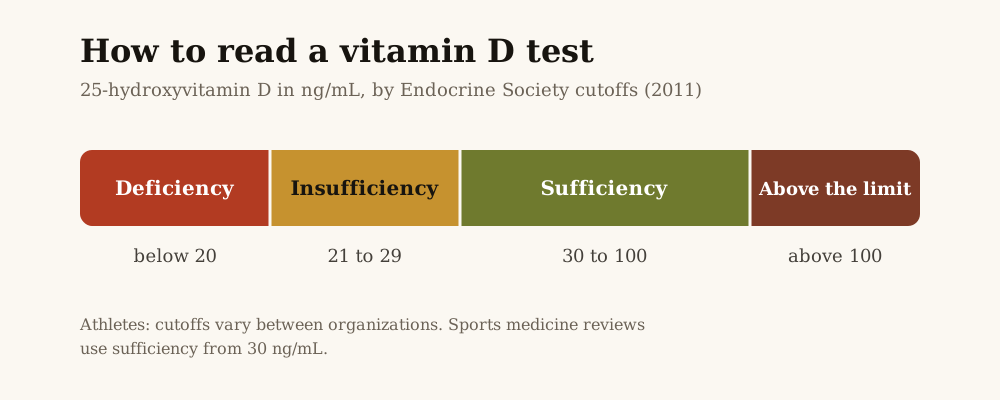
For athletes, the definitions vary between sources. The American College of Sports Medicine joint position statement uses insufficiency at 50 to 75 nmol/L and deficiency below 50 nmol/L. Sports medicine reviews, for their part, usually set sufficiency from 30 ng/mL (75 nmol/L). Low levels aren’t rare: a 2022 meta-analysis of 51 studies and more than 5,000 elite athletes found insufficiency (below 50 nmol/L) in 30% of adults, and slightly more in teenagers.
The cutoffs change depending on the organization (the US National Academy of Medicine, for example, considers about 20 ng/mL sufficient for most people), and results also vary from one lab to another. So the number should be read in your context, not on its own.
What supplements do and don’t do
In people who are truly deficient, replacing vitamin D corrects the bone and calcium side, and that is treatment. The mistake is imagining that, in people who already have enough, taking more brings some extra benefit.
Large studies don’t show that benefit. In VITAL, a large American trial published in the New England Journal of Medicine, 2,000 IU a day did not reduce cancer, heart attacks or fractures in middle-aged and older adults, and the USPSTF even recommends against low-dose supplements just to prevent fractures in healthy postmenopausal women. Taking vitamin D for prevention, when you’re already fine, doesn’t deliver what the advertising promises.
Immunity entered the picture in recent years, with vitamin D tested to prevent flu, respiratory infections and even COVID. The largest trial on the topic, CORONAVIT, published in the BMJ in 2022, followed more than 6,000 adults in the UK, tested their vitamin D and offered a supplement to those with low levels. There was no reduction in respiratory infections or COVID. A 2021 meta-analysis in The Lancet Diabetes & Endocrinology had found a small effect with low daily doses, but the 2025 update, with more studies included, lost statistical significance. The idea that vitamin D supercharges the defenses of people who are already fine hasn’t held up.
Vitamin D and people who train
People who train are more likely to have low vitamin D. Indoor training, low-sun hours, sunscreen, more body fat and winter all pull levels down. Keep an eye on it, especially if you have a stress fracture, pain or unexplained muscle weakness. A bone that breaks under training can also be a sign that the energy in your diet isn’t adding up, the subject of the post on RED-S, or relative energy deficiency in sport, and pain that shows up when you run has its own roadmap, in the post on running pain.
Raising vitamin D above sufficient doesn’t improve performance. Correcting a deficiency helps the athlete get back to normal, and that’s where it ends. A 2017 meta-analysis in Sports Medicine pooled trials in athletes and found that supplements raised blood levels, but none of the studies that measured performance showed any improvement. The American College of Sports Medicine consensus follows the same line: supplement when deficiency is documented, not as a routine to try to perform better. If the goal is to gain strength and muscle mass, creatine has much more solid evidence, and dietary protein, including whey, counts for more than any vitamin.
D2 or D3, and how to take it
At the pharmacy you’ll find two forms: D2 (ergocalciferol) and D3 (cholecalciferol). D3 is the same form your skin makes and, in a 2012 meta-analysis, it raised blood levels more efficiently than D2, especially with spaced-out doses. That makes it the preferred form. Because it’s fat-soluble, it’s absorbed better with a meal that has a little fat: in a 2015 study, the peak in the blood was about 32% higher than with a fat-free meal.
The right amount depends on your level and your case, and it comes from an assessment, not from the label. Buying the most concentrated bottle on the shelf and taking it on a whim only brings you closer to excess.
How to replace it when you need to
Once deficiency is confirmed, your doctor guides the replacement: a correction dose for a few weeks, then maintenance, and a repeat test after a few months. For athletes with low levels and little sun, a 2018 review in Sports Medicine suggests correction doses between 2,000 and 4,000 IU a day, always with follow-up.
Vitamin D in excess is harmful: megadoses without medical guidance can raise blood calcium too much and overload the kidneys. The 2020 Brazilian position statement warns that toxicity, which can be serious, appears with blood levels above 100 ng/mL, so replacement has a set dose, timeline and reassessment. For most people, the basics are enough: a little sun with common sense, balanced food and moving your body.
In practice
- If you’re healthy, with no symptoms and nothing that raises your risk of running low, you don’t need routine vitamin D testing.
- If you have a risk factor (little sun, obesity, poor absorption, osteoporosis, medicines that affect vitamin D), talk to your doctor about getting tested.
- Read the result in your context: by the 2011 cutoffs, below 20 is deficiency, and the unit on the report (ng/mL or nmol/L) changes the number.
- If deficiency is confirmed, follow guided replacement, with a timeline and a repeat test in a few months.
- If you do take it, choose D3 with a meal that has a little fat.
- Don’t take megadoses on your own: too much vitamin D raises calcium and overloads the kidneys.
Conclusion
Vitamin D matters for bone and calcium and makes a big difference in people who are deficient, which is a long way from the magic vitamin it’s sold as. In people with no risk of running low, testing and supplementing because it’s trendy doesn’t prevent disease, doesn’t improve performance, and carries its own risk. If you have a risk factor or symptom, it’s worth testing and treating with guidance, in your context.
Take care, and until next time!
Responsible physician: Dr. Gilberto Nering Junior, sports medicine physician, CRM-SP 160822, RQE 142486 (Sports Medicine, Brazil).
This text was not sponsored, is for information only and does not replace an individual assessment. Questions about the content: contact the clinic.
Frequently asked questions about vitamin D
Do I need to take vitamin D every day for prevention?
Not as a rule: in healthy people without a risk factor, taking vitamin D for prevention didn’t reduce cancer, heart attacks or fractures in the studies. Supplements are worth it when there’s a deficiency or a risk of one.
Should I test my vitamin D in a routine checkup?
Only if there’s a reason, because the guidelines don’t recommend screening vitamin D in healthy adults without symptoms. Testing is indicated when there’s a risk factor, symptom or disease that justifies it.
What is a normal vitamin D level?
By the 2011 Endocrine Society guideline cutoffs, below 20 ng/mL is deficiency, 21 to 29 is insufficiency and 30 to 100 is sufficiency. The 2024 guideline no longer defines these ranges, and for athletes they vary between organizations. The value changes a little from one lab to another, so it should be read in context.
Does the sun give you enough vitamin D?
For many people, yes, since most of it comes from the sun. But people who get little sun, use a lot of sunscreen, have darker skin or more body fat may fall short with exposure alone.
Does vitamin D prevent flu or COVID?
The data don’t support that idea: the largest trial on the topic, CORONAVIT, published in 2022, didn’t reduce respiratory infections or COVID, and the most recent meta-analysis, from 2025, showed no statistically significant protection. The role of vitamin D is to correct deficiency in people who lack it.
D2 or D3, which is better?
D3 (cholecalciferol) is preferred because it raises blood levels more efficiently, especially with spaced-out doses. Because it’s fat-soluble, it’s absorbed better with a meal that has a little fat.
Is too much vitamin D harmful?
Yes: in excess, it can raise blood calcium too much and overload the kidneys. Blood levels above 100 ng/mL already carry a risk of toxicity, which is why replacement has a set dose and timeline, with follow-up.
References
- Allen LH. Micronutrients: assessment, requirements, deficiencies, and interventions. N Engl J Med. 2025;392(10):1006-1016. doi:10.1056/NEJMra2314150
- Dawson-Hughes B, Harris SS, Lichtenstein AH, et al. Dietary fat increases vitamin D-3 absorption. J Acad Nutr Diet. 2015;115(2):225-230. doi:10.1016/j.jand.2014.09.014
- Demay MB, Pittas AG, Bikle DD, et al. Vitamin D for the prevention of disease: an Endocrine Society clinical practice guideline. J Clin Endocrinol Metab. 2024;109(8):1907-1947. doi:10.1210/clinem/dgae290
- Farrokhyar F, Sivakumar G, Savage K, et al. Effects of vitamin D supplementation on serum 25-hydroxyvitamin D concentrations and physical performance in athletes: a systematic review and meta-analysis of randomized controlled trials. Sports Med. 2017;47(11):2323-2339. doi:10.1007/s40279-017-0749-4
- Harju T, Gray B, Mavroedi A, et al. Prevalence and novel risk factors for vitamin D insufficiency in elite athletes: systematic review and meta-analysis. Eur J Nutr. 2022;61(8):3857-3871. doi:10.1007/s00394-022-02967-z
- Holick MF, Binkley NC, Bischoff-Ferrari HA, et al. Evaluation, treatment, and prevention of vitamin D deficiency: an Endocrine Society clinical practice guideline. J Clin Endocrinol Metab. 2011;96(7):1911-1930. doi:10.1210/jc.2011-0385
- Holick MF. Vitamin D deficiency. N Engl J Med. 2007;357(3):266-281. doi:10.1056/NEJMra070553
- Jolliffe DA, Camargo CA Jr, Sluyter JD, et al. Vitamin D supplementation to prevent acute respiratory infections: a systematic review and meta-analysis of aggregate data from randomised controlled trials. Lancet Diabetes Endocrinol. 2021;9(5):276-292. doi:10.1016/S2213-8587(21)00051-6
- Jolliffe DA, Camargo CA Jr, Sluyter JD, et al. Vitamin D supplementation to prevent acute respiratory infections: systematic review and meta-analysis of stratified aggregate data. Lancet Diabetes Endocrinol. 2025;13(4):307-320. doi:10.1016/S2213-8587(24)00348-6
- Jolliffe DA, Holt H, Greenig M, et al. Effect of a test-and-treat approach to vitamin D supplementation on risk of all cause acute respiratory tract infection and covid-19: phase 3 randomised controlled trial (CORONAVIT). BMJ. 2022;378:e071230. doi:10.1136/bmj-2022-071230
- Kimball SM, Holick MF. Official recommendations for vitamin D through the life stages in developed countries. Eur J Clin Nutr. 2020;74(11):1514-1518. doi:10.1038/s41430-020-00706-3
- LeBoff MS, Chou SH, Ratliff KA, et al. Supplemental vitamin D and incident fractures in midlife and older adults. N Engl J Med. 2022;387(4):299-309. doi:10.1056/NEJMoa2202106
- Manson JE, Cook NR, Lee IM, et al. Vitamin D supplements and prevention of cancer and cardiovascular disease. N Engl J Med. 2019;380(1):33-44. doi:10.1056/NEJMoa1809944
- Moreira CA, Ferreira CEDS, Madeira M, et al. Reference values of 25-hydroxyvitamin D revisited: a position statement from the Brazilian Society of Endocrinology and Metabolism (SBEM) and the Brazilian Society of Clinical Pathology/Laboratory Medicine (SBPC). Arch Endocrinol Metab. 2020;64(4):462-478. doi:10.20945/2359-3997000000258
- Owens DJ, Allison R, Close GL. Vitamin D and the athlete: current perspectives and new challenges. Sports Med. 2018;48(Suppl 1):3-16. doi:10.1007/s40279-017-0841-9
- Peeling P, Sim M, McKay AKA. Considerations for the consumption of vitamin and mineral supplements in athlete populations. Sports Med. 2023;53(Suppl 1):15-24. doi:10.1007/s40279-023-01875-4
- Thomas DT, Erdman KA, Burke LM. American College of Sports Medicine joint position statement: nutrition and athletic performance. Med Sci Sports Exerc. 2016;48(3):543-568. doi:10.1249/MSS.0000000000000852
- Tripkovic L, Lambert H, Hart K, et al. Comparison of vitamin D2 and vitamin D3 supplementation in raising serum 25-hydroxyvitamin D status: a systematic review and meta-analysis. Am J Clin Nutr. 2012;95(6):1357-1364. doi:10.3945/ajcn.111.031070
- US Preventive Services Task Force. Screening for vitamin D deficiency in adults: US Preventive Services Task Force recommendation statement. JAMA. 2021;325(14):1436. doi:10.1001/jama.2021.3069
- US Preventive Services Task Force. Vitamin D, calcium, or combined supplementation for the primary prevention of fractures in community-dwelling adults: US Preventive Services Task Force recommendation statement. JAMA. 2018;319(15):1592. doi:10.1001/jama.2018.3185