Also in: Português · Español · Italiano · 中文 · हिन्दी
Main points
- Stomach trouble while running is common: between 30% and 50% of endurance athletes have complaints such as nausea, cramps, gas or an urgent need to go to the bathroom.
- There are three causes: less blood reaching the gut during exercise, the impact of running, and what you eat and drink before and during the race.
- The gut can be trained. In studies with runners, two weeks of eating carbohydrate during training reduced symptoms and improved absorption. In practice, you do this on long runs, increasing the amount little by little.
- Race day is not the place to test anything new. What you will eat and drink on the day needs to have been practiced before.
Unlike Brazilian influencer Pablo Marçal and the group of coaches who tried to finish a half Ironman on about 15 days of training, athletes train for months for a half marathon or a marathon. And even with all that preparation, many people have their race spoiled by their stomach. Nausea, cramps, a heavy stomach and a dash for a bathroom in the middle of the course are common complaints among runners. The gut also adapts to training, and you can prepare it for race day the same way you prepare your heart and muscles.
Why your stomach complains when you run
A review on the subject estimated that 30% to 50% of endurance athletes have some gastrointestinal symptom during exercise. Most are mild and carry no risk, but they hurt performance and can knock someone out of a race.
The symptoms fall into two groups:
- Upper gut: nausea, reflux, a feeling of a full stomach, burping and, sometimes, vomiting.
- Lower gut: cramps, gas, bloating, an urgent need to have a bowel movement, and diarrhea.
There is no single cause. Usually, three things add up.
Less blood in the gut
During exercise, blood is diverted to the working muscles and to the skin, which has to cool the body down. The gut gets less blood, and that gets in the way of digestion and absorption. Heat and dehydration make this diversion worse, which is why symptoms are more common in hot races and in people who drink little.
The stress of the effort also affects the hormones and nerves that control the gut, which changes the pace of digestion.
The impact of running
Running shakes the abdomen with every stride, for hours. This mechanical side helps explain why stomach symptoms, especially lower-gut ones, are so frequent in runners.
What you eat and drink
The amount, concentration and type of carbohydrate, the volume of fluid and the presence of fat, protein and fiber change how fast the stomach empties and how much the gut can absorb. A food that sits well at rest can become a problem at kilometer 30.
How much carbohydrate to use in a race
Carbohydrate is the main fuel for running at a hard pace, and the body’s stores do not last a whole long race. So, beyond a certain duration, eating during the race improves performance.
The recommendation from the American College of Sports Medicine, together with the nutrition organizations of the United States and Canada, depends on duration:
| Exercise duration | How much carbohydrate | Note |
|---|---|---|
| Under 45 minutes | Not needed | The body’s stores are enough |
| 45 to 75 minutes | Small amounts or a mouth rinse | Contact with the mouth already helps the brain |
| 1 to 2.5 hours | 30 to 60 g per hour | Gel, sports drink or food |
| More than 2.5 to 3 hours | Up to 90 g per hour | Best with a mix of glucose and fructose |
To give you an idea, a typical gel has between 20 and 30 g of carbohydrate, but this varies a lot between brands, so check the label.
Why mix glucose and fructose
Glucose and fructose enter the gut through different doors. The glucose door has a limit, and when it is full, whatever is left over stays in the gut, pulls in water and causes cramps and diarrhea. By mixing the two sugars, the gut absorbs more carbohydrate per hour with less discomfort.
A review of studies, most of them in male cyclists, found that at high carbohydrate doses (above about 80 g per hour), drinks with this mix gave better performance in 2.5- to 3-hour tests than glucose-only drinks, with less stomach discomfort. That is why gels and drinks made for long races usually contain the mix. At lower doses, like those used in shorter races, the advantage of the mix is not yet clear.
The gut can be trained
The gut adapts to what it receives. A 2017 review explains that a carbohydrate-rich diet increases the number of glucose transporters in the gut, which lets it absorb more during exercise. The stomach also gets used to receiving volume while the body is moving, and the feeling of a full stomach decreases.
In a 2017 Australian study, runners trained for two weeks while eating carbohydrate during their runs. Afterwards, on a long test run, stomach symptoms dropped by about 60% and they ran farther in the final test. In the gel group, the gut also absorbed carbohydrate better and blood glucose stayed higher. Those who trained without carbohydrate did not improve.
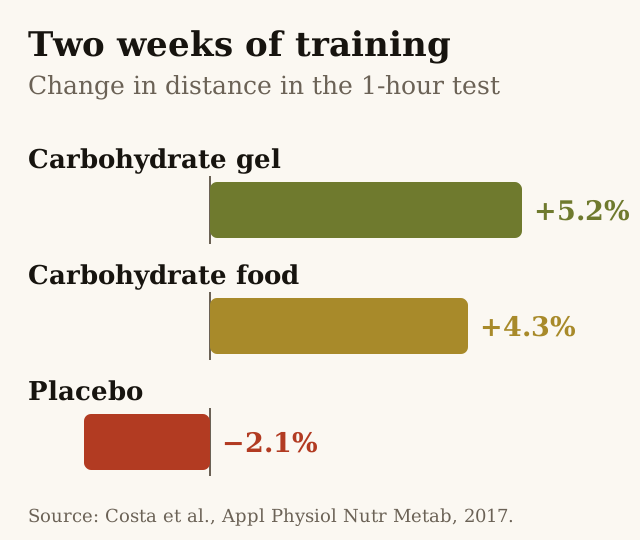
A 2023 review pooled eight studies on this kind of gut training. With two weeks of carbohydrate during training, stomach discomfort fell by 47% on average. The studies are still few and small, so nobody can promise an exact result for everyone, but they all point the same way.
In the two studies that measured how fast the stomach empties, it did not change. The improvement seems to come more from absorption in the gut and from getting used to eating while running.
How to train your gut in practice
The idea is to train your race nutrition together with your running. One way to do it:
- Write down what you use on your long runs today: which product, how much per hour, how much fluid, your pace, the temperature and your symptoms. Without that starting point, adjusting becomes trial and error.
- Set your race target from the table above, based on how long you expect to run.
- Start below the target. If you use one gel per hour today, move up to one and a half, then two, over the weeks.
- Do this on long runs and race-pace runs, which are the ones most like race day.
- Use the same products you will use in the race: the same gel, the same drink, the same timing between them. Each product behaves differently in the stomach.
- Train your hydration too. Knowing how much you usually lose in sweat helps you plan how much to drink in the race, without getting thirsty and without overdoing it.
- If the race will be in the heat, do part of this training on hot days.
In the studies, two weeks of daily training already brought results. In practice, you can do this over the weeks of preparation, on your long runs, and arrive at the race knowing what your body can handle.
What to eat before the race
What you eat in the hours before the start also matters. The American College of Sports Medicine advises meals rich in carbohydrate, low in fiber and fat, with moderate protein in the hours before long races, because fiber, fat and protein take longer to leave the stomach.
A few precautions that help:
- Test your race breakfast on long runs, at the same time you will eat it on race day.
- In the days before, go easy on foods that give you a lot of gas.
- Do not try anything new on race day: a new gel, a new supplement, different food handed out on the course.
What about the low FODMAP diet?
FODMAPs are carbohydrates that ferment in the gut and cause gas, found in foods like beans, onion, garlic, wheat, milk and some fruits. A diet low in these foods has been used for years for irritable bowel syndrome.
For athletes, an expert opinion published in 2026 argues for using it strategically. For people with strong symptoms, cutting FODMAPs for a short time, in the days before important sessions or the race, can help. For people with mild symptoms, the advice is to keep a more relaxed diet, without cutting FODMAPs. And neither approach has been shown to improve performance consistently.
What works and what does not
A 2025 position statement from Australian sports dietitians reviewed what works and what does not for stomach symptoms during exercise. The strategies with the most consistent results were eating carbohydrate and protein and staying hydrated before and during exercise, adjusting FODMAPs and training the gut.
On the other side, some strategies did poorly: low-carbohydrate, high-fat diets, probiotics and the use of medication. Before you buy the trendy supplement for your stomach, get the basics right.
When to see a doctor
Most symptoms are mild and improve with the adjustments above. But some signs call for a medical assessment:
- Blood in the stool or dark stools after running.
- Vomiting blood.
- Severe abdominal pain that does not go away after you stop.
- Symptoms that continue for hours or days after the race.
- Stomach symptoms on days without training too, which may point to another problem, such as a food intolerance or irritable bowel syndrome.
In rare cases, intense effort can cause bleeding in the stomach or a lack of blood flow to the gut, and both need medical care.
At my clinic in São José dos Campos, Brazil, we assess these cases in the sports medicine consultation, and the dietitian helps build and train the race nutrition plan. If your running also comes with pain in your legs or joints, I wrote about that in my post on running pain. And if you train a lot and eat little, it is worth reading about RED-S.
Conclusion
Stomach trouble while running is common and has a cause: less blood in the gut, the impact of each stride and what you eat. The gut can be trained like the rest of the body. In the studies, eating carbohydrate during training reduced symptoms. Doing this on long runs, increasing little by little and using the same products as in the race, is the practical way to carry that result to race day. On the day itself, the rule is to improvise nothing.
Have a great race, and see you next time!
Responsible physician: Dr. Gilberto Nering Junior, sports medicine physician, CRM-SP 160822, RQE 142486 (Sports Medicine, Brazil), who sees athletes and active people in São José dos Campos, Brazil. This text was not sponsored, is for information only and does not replace an individual assessment. Questions about the content: contact the clinic.
Cover photo: Mārtiņš Zemlickis on Unsplash.
Quick questions about the gut and running
Why do I need to go to the bathroom when I run?
Exercise diverts blood from the gut to the muscles and skin, and the impact of running shakes the abdomen. Heat, dehydration and what you ate beforehand make it worse. It is common and usually improves with changes to what you eat and with gut training.
How much carbohydrate should I use in a marathon?
Since a marathon takes more than 2.5 to 3 hours for almost everyone, the recommendation is up to 90 g of carbohydrate per hour, preferably with a mix of glucose and fructose. For races of 1 to 2.5 hours, like the half marathon for many people, it is 30 to 60 g per hour. The amount you tolerate needs to be trained beforehand.
Can you train your gut?
Yes. In runners, two weeks of eating carbohydrate during training reduced stomach symptoms and improved absorption. In practice, it is done on long runs, increasing the amount little by little.
Does a low FODMAP diet help with running?
For people with strong symptoms, cutting FODMAPs in the days before the race can help. For people with mild symptoms, restricting is usually not worth it. Neither approach has been shown to improve performance consistently.
When is a stomach problem during running serious?
Blood in the stool, vomiting blood, severe pain that does not go away, or symptoms that last for hours after the race call for a medical assessment.
References
- Costa RJS, Gaskell SK, Henningsen K, et al. Sports Dietitians Australia and Ultra Sports Science Foundation joint position statement: a practitioner guide to the prevention and management of exercise-associated gastrointestinal perturbations and symptoms. Sports Med. 2025;55(5):1097-1134. doi:10.1007/s40279-025-02186-6
- Costa RJS, Miall A, Khoo A, et al. Gut-training: the impact of two weeks repetitive gut-challenge during exercise on gastrointestinal status, glucose availability, fuel kinetics, and running performance. Appl Physiol Nutr Metab. 2017;42(5):547-557. doi:10.1139/apnm-2016-0453
- de Oliveira EP, Burini RC, Jeukendrup A. Gastrointestinal complaints during exercise: prevalence, etiology, and nutritional recommendations. Sports Med. 2014;44(Suppl 1):S79-S85. doi:10.1007/s40279-014-0153-2
- Jeukendrup AE. Training the gut for athletes. Sports Med. 2017;47(Suppl 1):101-110. doi:10.1007/s40279-017-0690-6
- Martinez IG, Mika AS, Biesiekierski JR, et al. The effect of gut-training and feeding-challenge on markers of gastrointestinal status in response to endurance exercise: a systematic literature review. Sports Med. 2023;53(6):1175-1200. doi:10.1007/s40279-023-01841-0
- Miall A, Khoo A, Rauch C, et al. Two weeks of repetitive gut-challenge reduce exercise-associated gastrointestinal symptoms and malabsorption. Scand J Med Sci Sports. 2018;28(2):630-640. doi:10.1111/sms.12912
- Rowlands DS, Houltham S, Musa-Veloso K, et al. Fructose-glucose composite carbohydrates and endurance performance: critical review and future perspectives. Sports Med. 2015;45(11):1561-1576. doi:10.1007/s40279-015-0381-0
- Scrivin R, Daniel NVS, Slater G, et al. Dietary FODMAP manipulation for exercise-associated gastrointestinal symptoms: why symptom severity should guide our approach. Sports Med. 2026. doi:10.1007/s40279-026-02474-9
- Thomas DT, Erdman KA, Burke LM. American College of Sports Medicine joint position statement: nutrition and athletic performance. Med Sci Sports Exerc. 2016;48(3):543-568. doi:10.1249/MSS.0000000000000852