Also in: Português · Español · Italiano · 中文 · हिन्दी
Main points
- Exercise improves memory and attention at every age, and even light activity helps.
- People who improve their fitness over the years get less dementia, but these studies show an association, not proof of cause.
- In a study of older adults, one year of walking enlarged the hippocampus, the brain area linked to memory, by about 2%.
- In adults with ADHD, one exercise session improves impulse control, without replacing treatment.
- Aerobic exercise is the most studied type for the brain, and starting at an older age also brings benefits.
You know that clearer head you get after a walk? Exercise changes blood flow and chemistry in the brain, and this shows up in memory and attention tests. When the question is whether exercise also protects the brain from dementia, the evidence is more limited, but it points the same way.
The short answer
Yes, there is good evidence that exercise benefits the brain. The strongest is for memory and attention: in thousands of randomized studies, people who exercised did better on the tests than people who didn’t, at every age. For dementia, large studies show that people who have good fitness and keep it get the disease less often. This kind of study can’t prove that exercise is the cause, but the results point in the same direction as the randomized studies on memory and attention.
How exercise protects the brain
A review published in The Lancet in 2025, by researchers from Norway and Australia, brought together what is known about the mechanisms. Both one exercise session and regular training increase blood flow to several areas of the brain, and more blood means more oxygen and nutrients. Exercise also raises BDNF, a protein that works like fertilizer for neurons, helping them survive and form new connections.
Regular training also lowers chronic low-grade inflammation, which speeds up brain aging. And working muscle releases substances into the bloodstream that reach the brain and take part in these effects.
The hippocampus, the area linked to memory, shrinks with age. In an American study, older adults were randomly assigned to walk or to do only stretching for one year. In the walking group, the hippocampus grew by about 2%, the equivalent of turning back its aging by one or two years. In the stretching group, it kept shrinking. And the people whose hippocampus grew the most also saw the biggest improvement in memory.
The gain depends on keeping it up. The Lancet review cites a small study in which hippocampal volume went back to where it started a few weeks after people stopped training.
Memory and attention at any age
In 2025, Australian researchers put together a huge overview of the topic, pooling more than a hundred reviews of randomized studies. Exercise improved general cognition, memory and executive function, which is the ability to plan, stay focused and hold back impulses.
Some findings from that overview are useful in practice:
- children and teenagers gained more in memory and executive function than adults;
- light and moderate exercise worked, sometimes even better than vigorous exercise;
- programs lasting one to three months already showed an effect;
- video games that require moving your body were among the activities with the largest effect.
Nobody needs to become an athlete to get a benefit for the brain.
Exercise and dementia
A Norwegian study that I find very interesting calculated the cardiorespiratory fitness (in practice, an estimate of VO₂ max) of tens of thousands of healthy adults. The measurement was taken twice, ten years apart, and then the researchers tracked who developed dementia.
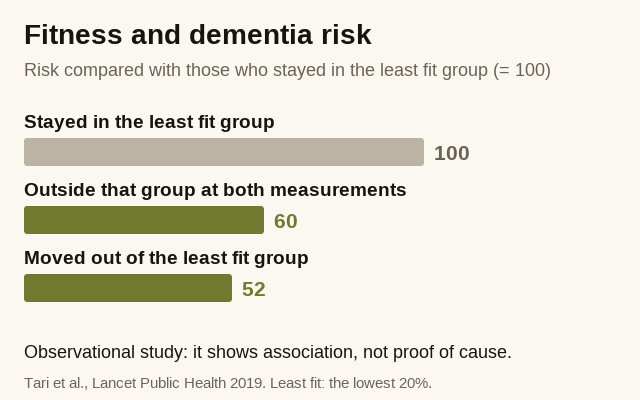
Those who were among the least fit and moved out of that group over the decade had about half the dementia risk of those who stayed there. Those who stayed outside the least fit group at both measurements also had less dementia. And the people who improved gained, on average, a few more years free of the disease.
An American study published in 2026 reached a similar result by a different route. The researchers followed nurses and other health professionals for three decades, asking them from time to time how much they exercised. The most active people had 28% less dementia than the least active, and people who walked more also had less dementia.
The caveat here is the type of study. Both observe people, without randomly assigning who trains. People who move more tend to have better blood pressure, weight and blood sugar, and part of the difference may come from that. The researchers adjusted the results for other risk factors, and the association held. On top of that, the American study only counted physical activity measured some years before diagnosis, to lower the chance that the disease, still hidden, had made the person move less. The question remains open, but these data weigh in favor of exercise.
The Lancet Commission on dementia, updated in 2024, puts physical inactivity on the list of risk factors that can be changed, alongside high blood pressure, diabetes, obesity and others. Exercise helps control several of them at once.
What about ADHD?
Attention deficit hyperactivity disorder, or ADHD, continues into adulthood in a good share of the people who have it in childhood. A 2026 Chinese review brought together the exercise studies in adults with ADHD.
The clearest finding was the effect of a single session. After exercising, adults with ADHD showed a moderate improvement in inhibitory control, which is the ability to stop an automatic response, and a small improvement in symptoms. Programs lasting several weeks had mixed results, and larger studies are still lacking.
The Australian overview also found that people with ADHD gained more in executive function than other groups. Exercise comes in as a complement to medication and therapy, without replacing them. Fitting in a workout before a task that requires concentration is a strategy that makes sense with what we know today.
The heart and attention
The brain depends on the heart for its blood supply, and that shows up in studies. A study from Taiwan published in 2026 measured dozens of heart and circulation parameters in healthy adults and compared them with a test of attention and thinking speed. A higher resting heart rate and blood vessels with more resistance to blood flow went along with worse performance. A heart that pumps more blood with each beat, on the other hand, went along with better performance.
It is a study done at a single point in time, which shows association. These measures usually improve with aerobic training.
Which exercise is good for the brain, and how much?
Aerobic exercise is the most studied for the brain: brisk walking, running, cycling, swimming, dancing. It’s the type that improves fitness the most, and fitness seems to explain a good part of the benefit.
The World Health Organization recommends that adults get at least 150 minutes a week of moderate exercise or 75 minutes of vigorous exercise, plus muscle strengthening on two or more days. The authors of the Lancet review argue that a little intensity makes a difference: they suggest adding about 30 minutes a week of hard effort, the kind where you can say a few words but can’t sing. This proposal is based on observational studies.
The Australian overview, on the other hand, showed gains with light and moderate exercise, and in the American study even walking was linked to less dementia. Intensity adds to the benefit, but you don’t need it to get started. If you’re inactive, start with whatever you can manage: the WHO points out that some activity is better than none. If you want to build your aerobic base without overdoing it, zone 2 is a good starting point.
What about weight training? It’s part of the WHO recommendation and brings benefits for muscle, bone and blood sugar, which protect your health as a whole. For the brain specifically, most of the evidence comes from aerobic exercise. If your question is how to set up a strength routine, I explained it in the post on weight training according to the ACSM.
Starting late is worth it too. The hippocampus study was done in older adults, and the Lancet review states that exercise protects the brain even when it starts later in life. Those who start early have the advantage of building up benefits for longer.
Summary: what science already shows
| Effect | Type of study | Strength of evidence |
|---|---|---|
| Better memory and attention | Many randomized studies, at all ages | Strong |
| Larger hippocampus | Randomized studies, smaller and short | Moderate |
| Less dementia | Large observational studies | Consistent association, no proof of cause |
| Improvement in adult ADHD | Few studies, effect of one session | Early |
| Efficient heart and better attention | Study at a single point in time | Association |
In practice
- Choose an aerobic activity you enjoy, because the benefit depends on sticking with it.
- Add up minutes over the week until you get close to 150 minutes of moderate exercise.
- Include muscle strengthening on two days a week and, after age 65, balance exercises such as tai chi on three or more days.
- Add a little intensity once your body has adapted.
- Keep the habit, because part of the gain can be lost when the exercise stops.
If you’re sedentary, have heart disease, high blood pressure or diabetes, or notice anything different during exertion, such as chest pain, shortness of breath that isn’t normal for you or dizziness, talk to your doctor before raising the intensity. In the post on sudden death and testing before training I explain who needs an assessment. And if your interest is the brain, I also wrote about creatine beyond the gym, including what is known about memory.
Conclusion
Exercise improves memory and attention, with strong evidence, and for dementia it shows consistent signals, although they come from observational studies. In practice, pick an aerobic activity you enjoy, add weight training and keep the habit going.
Big hugs, everyone!
Responsible physician: Dr. Gilberto Nering Junior, sports medicine physician, CRM-SP 160822, RQE 142486 (Sports Medicine, Brazil).
This text was not sponsored, is for information only and does not replace an individual assessment. Questions about the content: contact the clinic.
Cover photo: Richard Sagredo on Unsplash.
Frequently asked questions about exercise and the brain
Does exercise improve memory?
Yes. A 2025 overview that pooled thousands of randomized studies showed that exercise improves memory, attention and general cognition at every age. Even light and moderate exercise had an effect, and programs of one to three months already showed results.
Does exercise prevent dementia?
Large studies show that people who exercise more and keep good fitness have less dementia, and in one of them even walking was linked to fewer cases. These studies observe people and don’t prove cause, but the results hold after other risk factors are taken into account. Physical inactivity is among the risk factors that can be changed.
What is the best exercise for the brain?
Aerobic exercise, such as brisk walking, running, cycling, swimming and dancing, is the most studied. Light and moderate exercise already helps, and a little intensity seems to add to it. Weight training rounds out the routine and protects your health as a whole.
Does exercise help with ADHD?
In adults with ADHD, one exercise session brought a moderate improvement in impulse control and a slight improvement in symptoms. Longer programs had mixed results. Exercise is a useful complement, without replacing medication or therapy.
Is it still worth starting to exercise after 60?
Yes. The study in which walking enlarged the hippocampus was done in older adults, and the 2025 Lancet review states that exercise protects the brain even when it starts late. People who have heart disease or have been inactive for a long time should get an assessment before training harder.
References
- Bull FC, Al-Ansari SS, Biddle S, et al. World Health Organization 2020 guidelines on physical activity and sedentary behaviour. Br J Sports Med. 2020;54(24):1451-1462. doi:10.1136/bjsports-2020-102955
- Erickson KI, Voss MW, Prakash RS, et al. Exercise training increases size of hippocampus and improves memory. Proc Natl Acad Sci U S A. 2011;108(7):3017-3022. doi:10.1073/pnas.1015950108
- Li Y, Li Y, Liu Y, et al. Association of long-term physical activity levels with dementia risk and cognitive function in US adults: a prospective cohort study. Lancet Public Health. 2026;11(8):e530-e542. doi:10.1016/S2468-2667(26)00123-4
- Livingston G, Huntley J, Liu KY, et al. Dementia prevention, intervention, and care: 2024 report of the Lancet standing Commission. Lancet. 2024;404(10452):572-628. doi:10.1016/S0140-6736(24)01296-0
- Singh B, Bennett H, Miatke A, et al. Effectiveness of exercise for improving cognition, memory and executive function: a systematic umbrella review and meta-meta-analysis. Br J Sports Med. 2025;59(12):866-876. doi:10.1136/bjsports-2024-108589
- Tari AR, Nauman J, Zisko N, et al. Temporal changes in cardiorespiratory fitness and risk of dementia incidence and mortality: a population-based prospective cohort study. Lancet Public Health. 2019;4(11):e565-e574. doi:10.1016/S2468-2667(19)30183-5
- Tari AR, Walker TL, Huuha AM, et al. Neuroprotective mechanisms of exercise and the importance of fitness for healthy brain ageing. Lancet. 2025;405(10484):1093-1118. doi:10.1016/S0140-6736(25)00184-9
- Xu S, Zhao C, Hu L. The effects of acute and chronic exercise on executive functions and core symptoms in adults with ADHD: A systematic review and meta-analysis. Psychol Sport Exerc. 2026;84:103088. doi:10.1016/j.psychsport.2026.103088
- Yu TC, Wu WL, Ho WH, et al. From Fitness to Cognition: Machine-Learning Prediction of Cognitive Performance Using Physiological Parameters in Healthy Adults. Med Sci Sports Exerc. 2026;58(9):2048-2062. doi:10.1249/MSS.0000000000004024