
Also in: Português · Español · Italiano · 中文 · हिन्दी
Main points
- Training on an empty stomach makes the body use more fat during exercise, but the difference is small.
- In studies lasting several weeks, people who trained fasted lost about as much fat as those who trained after eating.
- In weight training, gains in strength and muscle were similar with and without food beforehand.
- For long sessions and races, eating beforehand improves performance.
- People who use insulin or certain diabetes medicines should not train fasted without a doctor’s guidance.
Wake up, have a black coffee and head out for a run before eating anything. Lots of people do this because they’ve heard that training fasted, especially cardio, burns more fat.
There’s some truth to this idea, but the conclusion often goes too far. In this post I explain what happens in the body during fasted training, what studies show after a few weeks and for whom eating first makes a difference. If your question is about intermittent fasting as a diet, I covered that in part 1 of the diet myths series.
Fasted cardio burns more fat during the workout
After a night without food, insulin is low and the body relies more on fat for energy. When you eat beforehand, especially carbohydrate, insulin rises and the body switches to using more sugar.
A 2016 review pooled 27 studies with 273 people and confirmed this: fasted cardio burned more fat during exercise. The average difference was about 3 grams of fat per session, less than a teaspoon of oil. The studies mostly tested light and moderate workouts, such as walking and jogging, the intensity of zone 2. Three grams per workout is very little, and fat loss isn’t decided in a single session.
But do you lose more weight? What counts is the whole day
How much fat you lose depends on your energy balance over days and weeks, as a 2020 review on the topic points out. The same review cites studies in which eating before training slightly raised energy expenditure after exercise, which may help cancel out that small advantage in the final tally.
Studies lasting several weeks bear this out. In an American study of 20 young women on a diet, one month of cardio, three times a week, led to similar fat loss whether they trained fasted or after eating.
Why some studies seem to show an advantage
You may come across studies in which only the fasting group lost fat. One of them was done during Ramadan with active men. The 2020 review points out the problem: diet was not controlled, and the fed group ate about 600 more calories a day in the first two weeks. With that difference on the plate, you can’t blame or praise the timing of the workout.
When daily food intake is matched between the groups, the fasting advantage disappears. If the scale has stalled even with training and diet, the problem usually lies elsewhere, and I wrote about it in the post on the weight loss plateau.
Weight training: can you do it fasted?
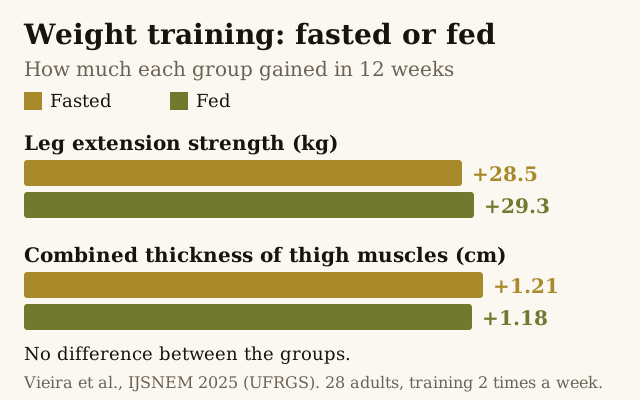
A Brazilian study, carried out at UFRGS and published in 2025, was the first to test this with a prescribed, monitored diet. It included 28 adult beginners, randomly assigned to 12 weeks of weight training, twice a week: half after an overnight fast and half 1 to 2 hours after eating carbohydrate. The training was the same, seven full-body exercises, two to three sets each, close to failure, and so was the diet for the rest of the day, with plenty of protein.
The results were practically the same. Thigh muscle grew, strength went up and leg power improved in both groups, with no difference between them. The 28 who finished completed all 24 sessions, and the total weight lifted was also similar. The diet was designed to maintain weight, so this study did not test weight loss: body fat stayed the same in both groups. In the fasted group, 1 in 3 people felt dizzy in at least one session, and there were also cases of tiredness and nausea.
A 2025 review by the same group of researchers pooled 4 studies and reached the same conclusion for muscle and strength. It found greater fat loss with fasting, but with a wide margin of error, and three of the four studies had problems with their methods. That difference can’t be trusted yet.
The UFRGS study was done with beginners and a low training volume, which limits the conclusion. The authors themselves cite a Ramadan study, with more sets and four sessions a week, in which only the fed group gained strength in the squat and the deadlift. It was also during Ramadan, with long fasts and disrupted sleep, so it’s a hint, not proof. For people who train hard and with a lot of volume, eating beforehand may make more of a difference.
If you train early and your stomach won’t take food, fasted weight training is an option, as long as you eat well for the rest of the day. If you want to build muscle, I wrote about how many sets and how much weight to use in weight training.
When eating beforehand makes a difference
Fasting takes its toll when the session is long, over an hour. A review of 46 studies showed that eating beforehand improved performance in prolonged cardio, but not in shorter sessions. The same review found that fasting increases some signals in muscle and fat tissue linked to metabolic adaptation, and how much that matters in real life is still unknown.
That’s why it’s worth eating before:
- a running, cycling or triathlon session longer than an hour;
- a race;
- a hard, long session in which you want to set a personal best or hold a fast pace to the end.
For these cases, the American College of Sports Medicine position statement on sports nutrition suggests 1 to 4 grams of carbohydrate per kilogram of body weight, 1 to 4 hours before, and 30 to 60 grams per hour during sessions lasting more than an hour to an hour and a half.
The same guideline notes that always training with little carbohydrate tends to lower the intensity of hard sessions. For people who compete, fasting becomes an occasional tool, not a rule.
What about metabolic health?
This is the side of fasting that interests me most. In a study from England of men with overweight or obesity, 6 weeks of fasted cycling lowered insulin after meals and improved insulin sensitivity, more than the same cycling done after taking carbohydrate. Blood sugar after meals was similar in both groups.
In the same study, the researchers saw that cycling before breakfast used more of the fat stored inside the muscle itself. It’s a small study, in men only, so the results can’t be generalized. It suggests that fasted training may have metabolic benefits, even if it doesn’t lead to more weight loss.
The limits of these studies
Studies on fasted training are small, with a few dozen people, and short, from 4 to 12 weeks. The Brazilian study had 22 women among its 28 participants, the American one only women, and the English one only men. A large, long study is still missing, but when diet is matched, the existing ones point in the same direction.
Who should avoid fasted training
Fasted training isn’t for everyone:
- people who use insulin or medicines that push the pancreas to release insulin, such as sulfonylureas, are at risk of hypoglycemia. The American College of Sports Medicine guideline on type 2 diabetes advises checking blood sugar and, depending on the case, eating carbohydrate or adjusting the medicine with your doctor;
- people who feel dizzy, see their vision go dark or start shaking when they train without eating;
- people about to do a long session or a race;
- people who have or have had an eating disorder;
- people who already eat little for how much they train, because adding fasting to a diet that is already short on food raises the risk of relative energy deficiency in sport (RED-S).
The same diabetes guideline shows that, for people with type 2 diabetes, exercise after meals controls blood sugar better. This doesn’t contradict the English study: it measured insulin sensitivity in overweight men, not blood sugar control in people already being treated for diabetes. If you have type 2 diabetes, agree on your training time with your doctor.
If you feel dizziness, cold sweats, shaking or darkening vision during fasted training, stop and eat something sugary. If it happens again, get checked before you carry on. Chest pain, unusual shortness of breath, strong palpitations, confusion or fainting need care right away: stop and call emergency services (192 in Brazil; in other countries, your local emergency number).
What to eat before and after training
In the Brazilian study, those who trained fed ate a meal with about 1 gram of carbohydrate per kilogram of body weight, 1 to 2 hours beforehand. For a 70 kg person, that’s around 70 grams, which can come from bread, fruit, oats or tapioca. This carbohydrate was not extra: the fasted group ate the same amount at another time of day. If you want to lose weight, the same idea applies, and the pre-workout meal comes out of your daily total instead of being added to it.
For a walk or a light session of up to an hour, eating beforehand is optional. For a long session or a race, test your meal in training and don’t try anything new on race day. I wrote about this in the post on training your gut for running.
After training, both groups ate a meal with protein, around 0.25 to 0.3 grams per kilogram of body weight, which comes to about 20 grams for someone who weighs 70 kg, something like 3 eggs or a scoop of whey. This meal applies whether you train fasted or fed.
In practice
- Choose the training time and style you can stick with. For weight loss, consistency matters more than fasting.
- If you train early and feel fine on an empty stomach, you can train that way, as long as the session is short or moderate.
- If the session is long or intense, or if it’s a race, eat beforehand.
- After training, have a meal with protein. If you need something practical, whey protein helps.
- Drink water before and during, especially in the heat.
If you have diabetes or use a weight-loss injection and want to train fasted, take a list of your medicines to your doctor first, because they change what is safe.
Conclusion
Fasted training makes the body use more fat during exercise, but studies lasting several weeks did not show greater fat loss in the end. In weight training, strength and muscle grew similarly with and without food beforehand. Eating beforehand helps in long sessions and races, and people who use insulin or medicines that can cause hypoglycemia, such as sulfonylureas, need a doctor’s guidance.
See you in the next post, everyone!
Responsible physician: Dr. Gilberto Nering Junior, sports medicine physician, CRM-SP 160822, RQE 142486 (Sports Medicine, Brazil).
This text was not sponsored, is for information only and does not replace an individual assessment. Questions about the content: contact the clinic.
Cover photo: Shengpengpeng Cai on Unsplash.
Frequently asked questions about fasted training
Does fasted training burn more fat?
During the workout, yes, but only a little: about 3 grams more fat per session. In studies lasting several weeks, people who trained fasted lost about as much fat as those who trained after eating.
Can I do weight training on an empty stomach?
You can, if you feel well and eat enough for the rest of the day. In a 12-week Brazilian study, gains in strength and muscle were similar with and without food before training.
Does fasted training make you lose muscle?
In studies where people ate enough protein throughout the day, muscle grew just as much with and without fasting before training. The 2020 review cites a study that found more protein breakdown during one hour of fasted cardio, so it makes sense to eat enough protein during the day, including after training. I wrote about how to lose weight without losing muscle.
Can people with diabetes train fasted?
People who use insulin or medicines that stimulate the pancreas, such as sulfonylureas, are at risk of hypoglycemia and should only train fasted with medical guidance. For people with type 2 diabetes, training after meals controls blood sugar better.
How long before training should I eat?
In the Brazilian study, those who trained fed had a carbohydrate meal 1 to 2 hours beforehand. A large meal too close to training can sit heavy on the stomach, so adjust it to what you tolerate.
References
- Aird TP, Davies RW, Carson BP. Effects of fasted vs fed-state exercise on performance and post-exercise metabolism: A systematic review and meta-analysis. Scand J Med Sci Sports. 2018;28(5):1476-1493. doi:10.1111/sms.13054
- Edinburgh RM, Bradley HE, Abdullah NF, et al. Lipid Metabolism Links Nutrient-Exercise Timing to Insulin Sensitivity in Men Classified as Overweight or Obese. J Clin Endocrinol Metab. 2020;105(3):660-76. doi:10.1210/clinem/dgz104
- Escalante G, Barakat C. Fasted Versus Nonfasted Aerobic Exercise on Body Composition: Considerations for Physique Athletes. Strength Cond J. 2020;42(5):71-78. doi:10.1519/SSC.0000000000000565
- Kanaley JA, Colberg SR, Corcoran MH, et al. Exercise/Physical Activity in Individuals with Type 2 Diabetes: A Consensus Statement from the American College of Sports Medicine. Med Sci Sports Exerc. 2022;54(2):353-368. doi:10.1249/MSS.0000000000002800
- Mountjoy M, Ackerman KE, Bailey DM, et al. 2023 International Olympic Committee’s (IOC) consensus statement on Relative Energy Deficiency in Sport (REDs). Br J Sports Med. 2023;57(17):1073-1097. doi:10.1136/bjsports-2023-106994
- Schoenfeld BJ, Aragon AA, Wilborn CD, et al. Body composition changes associated with fasted versus non-fasted aerobic exercise. J Int Soc Sports Nutr. 2014;11(1):54. doi:10.1186/s12970-014-0054-7
- Thomas DT, Erdman KA, Burke LM. American College of Sports Medicine Joint Position Statement. Nutrition and Athletic Performance. Med Sci Sports Exerc. 2016;48(3):543-68. doi:10.1249/MSS.0000000000000852
- Trabelsi K, el Abed K, Stannard SR, et al. Effects of fed- versus fasted-state aerobic training during Ramadan on body composition and some metabolic parameters in physically active men. Int J Sport Nutr Exerc Metab. 2012;22(1):11-8. doi:10.1123/ijsnem.22.1.11
- Vieira AF, Blanco-Rambo E, Bandeira-Guimarães M, et al. Impact of Overnight Fasted State Versus Fed State on Adaptations to Resistance Training: A Randomized Clinical Trial. Int J Sport Nutr Exerc Metab. 2025;35(4):291-302. doi:10.1123/ijsnem.2024-0215
- Vieira AF, Blanco-Rambo E, Macedo RCO, et al. Resistance training performed in the fasted state compared to the fed state on body composition and strength in adults: A systematic review with meta-analysis. J Bodyw Mov Ther. 2025;45:99-109. doi:10.1016/j.jbmt.2025.08.003
- Vieira AF, Costa RR, Macedo RC, et al. Effects of aerobic exercise performed in fasted v. fed state on fat and carbohydrate metabolism in adults: a systematic review and meta-analysis. Br J Nutr. 2016;116(7):1153-1164. doi:10.1017/S0007114516003160