
Also in: Português · Español · Italiano · 中文 · हिन्दी
Main points
- Carb loading fills the muscle’s glycogen stores and only makes a difference in races longer than an hour and a half.
- The current advice is to eat a lot more carbohydrate than usual in the two days before the race, with lighter training.
- The old phase of “emptying” the muscle, with days of almost no carbohydrate, is no longer needed.
- The scale goes up a little because the muscle stores water along with glycogen, and that is expected.
- Women who eat little day to day need to eat more food overall, not just a bigger share of carbohydrate on the plate.
On the Friday before a marathon, pasta becomes almost a ritual. Some people eat a huge plate at dinner the night before and think they’ve done their carb loading. Others do the opposite: afraid of feeling bloated, they cut carbohydrate right in race week.
What carb loading is and when it helps
Carb loading, or carbohydrate loading, means eating more carbohydrate than usual in the days before a long race to fill the muscle with glycogen, the fuel stored inside it. It helps in races longer than 90 minutes, such as the marathon, long-distance triathlon and road cycling. For a 5 km, a 10 km or a gym workout, it makes no difference. A 2026 review published in the Scandinavian Journal of Medicine & Science in Sports recommends more than 8 grams of carbohydrate per kilogram of body weight per day in the two days before the race, and says the old phase of emptying the muscle first is not necessary.
What glycogen is and why it runs out
The carbohydrate you eat turns into glucose in the blood. Part of it is stored in the liver and muscles as glycogen, a fuel reserve that is ready to use.
At race pace, the muscle burns through this store quickly. The body also burns fat, but fat alone can’t sustain a hard pace for long. At an easy pace, as in zone 2, fat covers a good part of the energy; at a hard pace, the muscle relies more on glycogen. When glycogen is close to running out, your legs feel heavy and your pace collapses. This is the famous “wall” that many people hit in the second half of a marathon. The point of carb loading is to start the race with a full tank and push that moment back.
Who it makes sense for
A 1997 review in the journal Sports Medicine showed how long a race has to be for this to pay off. In efforts of 60 to 90 minutes, there is still glycogen left in the muscle at the end, and topping up the stores beforehand doesn’t help. In longer races, starting with full stores delayed fatigue, and in fixed-distance races, finishing times improved. So carb loading makes sense for:
- the marathon;
- the half marathon, if it takes you more than an hour and a half to finish;
- long-distance triathlon;
- road cycling and mountain biking events lasting several hours;
- trail running and long mountain races;
- long open-water swims.
You don’t need it for a 5 km, a 10 km, short swimming races, strength training, CrossFit or a regular workout. In these cases, a normal diet, with carbohydrate in your meals the day before, does the job.
How much carbohydrate and for how many days
A review published in 2026 pooled the studies that measured glycogen directly in the muscle, with a small biopsy, after days of eating different amounts of carbohydrate. The more carbohydrate people ate, the fuller the muscle got, both in those training for long races and in those who are simply active.
Based on this, the authors made a practical recommendation: more than 8 grams of carbohydrate per kilogram of body weight per day, in the 36 to 48 hours before the race. The sports nutrition guideline from the American College of Sports Medicine (ACSM) goes a little further and suggests 10 to 12 grams per kilogram over this period.
If you’re short on time, training hard to empty the muscle and eating fast-absorbing carbohydrate can shorten this window to one to one and a half days, according to the same review. The catch is that training hard right before a race rarely pays off for anyone who isn’t an elite athlete.
The authors themselves point out that the response varied a lot from one person to another and that the studies are very different from each other. The amount of carbohydrate matters most, but training level, the length of the loading period and exercise in the days before also change the result.
No need for the “emptying” phase
The first carb loading method studied had two phases. First, three days of hard training with almost no carbohydrate, to empty the muscle. Then, three days of eating lots of carbohydrate. It worked, but the days without carbohydrate were hard to get through right in race week.
In 1981, a study of runners showed that a moderate plan, without the restriction days, filled the muscle almost as much as the old method. In 2002, an Australian study went further: eight endurance athletes stayed at rest and ate 10 grams of carbohydrate per kilogram per day.
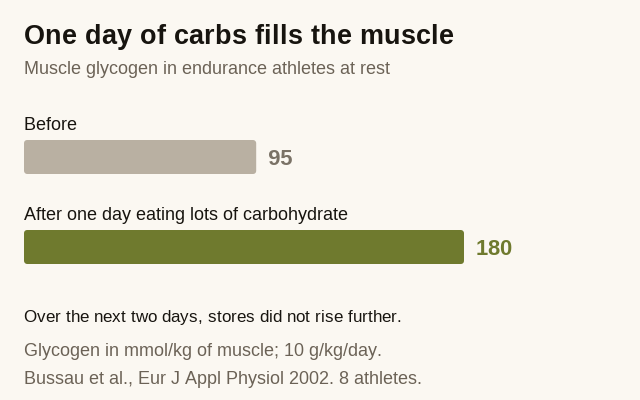
In just one day, muscle glycogen almost doubled, and it didn’t rise any further over the next two days. This result came with complete rest. Outside the lab, with some training and less controlled eating, the 2026 review points to 36 to 48 hours. Today’s advice is much simpler than the old method: cut back on training in the last few days and eat more carbohydrate, without going hungry beforehand.
How much that is on your plate
More than 8 grams per kilogram is far more than most people eat. A person who weighs 70 kg would need at least 560 grams of carbohydrate a day. For comparison, a full plate of cooked pasta (about 200 g) has around 60 grams. That works out to about nine plates a day, so the carbohydrate has to be spread across every meal and snack.
Rice, pasta, bread, potatoes, tapioca, couscous, fruit, juice, honey and sports drinks all count toward this total. To fit all of it in without feeling sick, most people need to cut back on fiber and fat during these two days, which is also what the ACSM guideline advises for pre-race meals. Big salads, beans, whole grains, fried food and creamy sauces fill your stomach and slow digestion, and they can cause gut trouble during the race. Since everyone responds differently, it’s a good idea to put this menu together with a dietitian and try it out beforehand, on a weekend with a long training session.
The scale will go up, and that’s fine
The muscle stores each gram of glycogen along with at least 3 grams of water. A Spanish study published in the European Journal of Applied Physiology measured this directly in biopsies from athletes.
So it’s common to see the scale go up a little and to feel your legs more “full” the day before. That is fuel and water stored in the muscle, and part of that water can be released during exercise. Cutting carbohydrate to avoid this weight leaves you lighter the day before and with less fuel at the moment you need it. If you’re still afraid of carbohydrate, I talked about it in the post on diet myths about calories and carbohydrate.
Women and carb loading
Early studies suggested that women stored less glycogen than men, but the difference was really in how much they ate. In a Canadian study at McMaster University, raising only the share of carbohydrate on the plate, without increasing total food, filled the men’s muscles but not the women’s. When the women ate more food overall, on top of the higher share of carbohydrate, their glycogen went up too. Many female athletes eat little day to day, and then the same percentage of carbohydrate adds up to only a few grams. If you train a lot and eat little because you’re afraid of gaining weight, read the post on RED-S, energy deficiency in sport, because eating too little for a long time drags down both performance and health.
Does it work outside the lab?
Researchers run lab studies with only a few people. A study at the London Marathon, published in the International Journal of Sports Medicine, looked at amateur runners in real life. Those who ate more than 7 grams of carbohydrate per kilogram the day before ran faster and held their pace better to the end, even after accounting for sex, weight and training volume.
This was an observational study, so it doesn’t prove that carbohydrate caused the difference. Still, it matches what the biopsy studies show.
Common mistakes the day before
- Thinking a giant plate of pasta at dinner the night before will do it. A single meal rarely gets you to the amount you need, and it also sits heavy in your stomach at bedtime.
- Loading your plate with fiber and fat. Pizza, huge salads, heavy bean stews and fried food are the top causes of discomfort at the start line.
- Trying a new food, gel or supplement in race week.
- Overdoing alcohol, which disrupts sleep and hydration and can hold back glycogen replenishment when it takes the place of carbohydrate.
- Cutting carbohydrate for fear of feeling bloated.
- Forgetting that carb loading fills the tank but doesn’t replace your race-morning breakfast or the carbohydrate you take in along the course.
And on race day
One to four hours before the start, eat a breakfast with carbohydrate that you’ve already tested in training. During the race, a 2011 review prepared for the International Olympic Committee’s sports nutrition consensus suggests 30 to 60 grams of carbohydrate per hour in long races, up to 90 grams per hour in races lasting more than two and a half hours. That much carbohydrate during the race only works if your gut is used to it. I explained how to get there in the post on training your gut for running.
As for drinking, follow your thirst and don’t overdo the water. In a study at the Boston Marathon, runners who gained weight during the race, a sign they drank too much, and those who took more than 4 hours were more likely to see their blood sodium drop, a condition called hyponatremia. After the finish line, what does and doesn’t help recovery is covered in the post on ice baths, compression boots and massage.
Summary: who needs carb loading
| Situation | Need carb loading? | What to do |
|---|---|---|
| Race of up to 90 minutes (5 km, 10 km) | No | Normal meal with carbohydrate the day before |
| Half marathon over 90 minutes | Yes | More than 8 g per kilogram per day, in the two days before (36 to 48 hours) |
| Marathon, long triathlon, long cycling events | Yes | More than 8 g per kilogram per day, in the two days before (36 to 48 hours) |
| Strength training, CrossFit, regular workout | No | Your usual diet |
Special care: diabetes, gut and eating habits
- If you have diabetes, especially if you use insulin, plan your carb loading with your doctor, because your medication dose may need adjusting.
- With a sensitive gut or irritable bowel syndrome, test your carbohydrate sources well in advance.
- If you have or have had an eating disorder, do this planning with professional support, because days of eating a lot and weighing more can affect your relationship with food.
- Anyone who follows a low-carbohydrate diet day to day should talk to their dietitian before changing everything suddenly in race week.
In practice
- Check whether your race lasts more than 90 minutes. If it doesn’t, eat normally, with carbohydrate in your meals the day before.
- In the two days before the race, cut back on training and add carbohydrate to every meal and snack.
- Aim for more than 8 grams per kilogram per day, ideally with a menu planned by a dietitian.
- On those days, eat less fiber and fat and stick to foods you already know.
- Test the whole plan beforehand, during a week of long training, and never for the first time in race week.
- Plan your breakfast and the carbohydrate you’ll take during the race as well.
Conclusion
Carb loading works when the race is long: filling the muscle with glycogen delays fatigue in efforts longer than an hour and a half. Today it’s simpler than it used to be, with no restriction days, just more carbohydrate and less training in the two days before the start. For short races, a good meal the day before is enough.
Bye, and have a great race!
Responsible physician: Dr. Gilberto Nering Junior, sports medicine physician, CRM-SP 160822, RQE 142486 (Sports Medicine, Brazil).
This text was not sponsored, is for information only and does not replace an individual assessment. Questions about the content: contact the clinic.
Cover photo: Christine Sandu on Unsplash.
Frequently asked questions about carb loading
What is carb loading?
It means greatly increasing the carbohydrate in your diet in the days before a long race, with lighter training, to fill the muscle with glycogen. With full stores, fatigue takes longer to set in during races of more than 90 minutes.
How many days before the race should I carb load?
The most recent recommendation is 36 to 48 hours, in other words, the two days before the race. One study showed that, at rest and eating lots of carbohydrate, the muscle can fill up in just one day.
Does carb loading make you gain weight?
The extra weight that shows up on the scale isn’t fat. It comes from the water the muscle stores along with glycogen, and part of that water can be released during exercise.
Does carb loading help for a 10 km race?
No. In races of up to an hour and a half, there is still glycogen left in the muscle at the end, and topping up the stores doesn’t improve your time. A normal meal with carbohydrate the day before is enough.
Do I need a no-carb diet before carb loading?
No. Emptying the muscle with days of almost no carbohydrate was part of the old method and is no longer recommended. Cutting back on training and eating more carbohydrate in the two days before is enough to fill the muscle.
References
- Atkinson G, Taylor CE, Morgan N, et al. Pre-race dietary carbohydrate intake can independently influence sub-elite marathon running performance. Int J Sports Med. 2011;32(8):611-617. doi:10.1055/s-0031-1273739
- Almond CSD, Shin AY, Fortescue EB, et al. Hyponatremia among runners in the Boston Marathon. N Engl J Med. 2005;352(15):1550-1556. doi:10.1056/NEJMoa043901
- Burke LM, Hawley JA, Wong SH, et al. Carbohydrates for training and competition. J Sports Sci. 2011;29 Suppl 1:S17-S27. doi:10.1080/02640414.2011.585473
- Bussau VA, Fairchild TJ, Rao A, et al. Carbohydrate loading in human muscle: an improved 1 day protocol. Eur J Appl Physiol. 2002;87(3):290-295. doi:10.1007/s00421-002-0621-5
- Fernández-Elías VE, Ortega JF, Nelson RK, et al. Relationship between muscle water and glycogen recovery after prolonged exercise in the heat in humans. Eur J Appl Physiol. 2015;115(9):1919-1926. doi:10.1007/s00421-015-3175-z
- Hawley JA, Schabort EJ, Noakes TD, et al. Carbohydrate-loading and exercise performance. An update. Sports Med. 1997;24(2):73-81. doi:10.2165/00007256-199724020-00001
- Jones RO, Areta JL, Fortis HO, et al. Dietary carbohydrate intake and skeletal muscle glycogen: a systematic review and meta-analysis to determine optimal carbohydrate loading strategies. Scand J Med Sci Sports. 2026;36(10):e70379. doi:10.1111/sms.70379
- Sherman WM, Costill DL, Fink WJ, et al. Effect of exercise-diet manipulation on muscle glycogen and its subsequent utilization during performance. Int J Sports Med. 1981;2(2):114-118. doi:10.1055/s-2008-1034594
- Tarnopolsky MA, Zawada C, Richmond LB, et al. Gender differences in carbohydrate loading are related to energy intake. J Appl Physiol (1985). 2001;91(1):225-230. doi:10.1152/jappl.2001.91.1.225
- Thomas DT, Erdman KA, Burke LM. American College of Sports Medicine joint position statement. Nutrition and athletic performance. Med Sci Sports Exerc. 2016;48(3):543-568. doi:10.1249/MSS.0000000000000852