
Also in: Português · Español · Italiano · 中文 · हिन्दी
Main points
- Sudden death in sport is rare, and most cases in young people come from heart diseases the person did not know they had.
- The conversation and physical exam alone miss a lot. The electrocardiogram finds most of these diseases.
- After age 35, the main cause becomes blockage of the heart’s arteries, and the exercise test comes in according to your risk.
- Fainting during exercise, chest pain while training and sudden death in the family call for an assessment before you keep training.
- If someone collapses and does not respond, chest compressions and a defibrillator in the first few minutes save lives.
When a player collapses on the field during a televised match, the topic dominates conversations for days. In my practice, the question comes right after: “Doctor, do I need any tests before I start training?”
The answer depends on your age, your symptoms, your family history and the type of sport you want to do. In this post I explain what causes sudden death in sport and which tests make sense for each person.
How common sudden death in sport is
It is rare. A review published in 2026 in the New England Journal of Medicine pooled data on cardiac arrest and sudden death in athletes. Among teenagers, it happens in about 1 in every 66,000 to 88,000 athletes followed for a year.
The risk is not the same for everyone. It is higher in males than in females, and in some sports, such as basketball and elite men’s soccer. In children up to about 12, before puberty, it is much lower.
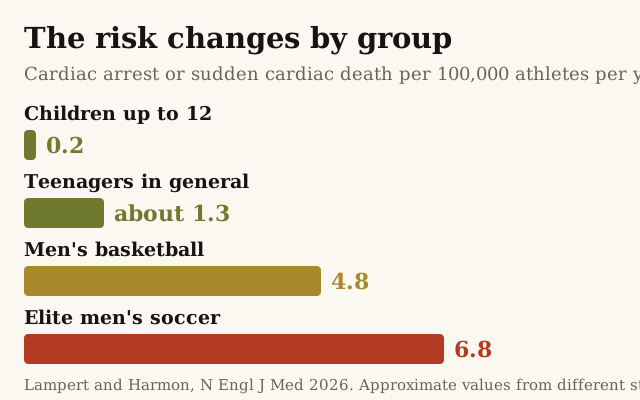
Even in the highest-risk group, the number is low. But a good share of these deaths happen in people who had heart disease without knowing it, and some of these diseases can be found beforehand.
The same review looked at a question that came up during the pandemic: there was no increase in cardiac arrest in athletes during the Covid-19 period.
What causes sudden death in athletes
The causes change with age. In young people, the main ones are:
- diseases of the heart muscle, such as hypertrophic cardiomyopathy, in which the heart wall becomes too thick;
- electrical diseases, such as long QT syndrome and Wolff-Parkinson-White syndrome, in which the heart’s electrical system works abnormally and can trigger an arrhythmia;
- heart arteries that start in the wrong place and can be squeezed during exertion;
- myocarditis, an inflammation of the heart that sometimes follows a viral infection, including dengue. Training hard with a fever or right after a viral illness is not a good idea. People diagnosed with myocarditis need to stay away from sport for months and be assessed before returning.
There is also a rare cause: a hard blow to the chest, such as from a ball, at a specific instant in the heart’s cycle.
From age 25, and especially after 35, the picture changes. Disease of the heart’s arteries, the same one that causes heart attacks, becomes responsible for most sudden deaths in people who play sport. That is why the assessment of a 50-year-old runner is different from that of a teenager who plays soccer.
In a study that followed more than 21,000 American physicians for 12 years, the risk rose during vigorous exertion but remained very low, and this increase was much smaller in those who exercised regularly. People who sit still all week and only do heavy exertion on the weekend are more exposed than those who train consistently.
Warning signs you should not ignore
Many people blame the symptom on tiredness or heat and keep training. The Brazilian sports cardiology guideline highlights some signs that call for an assessment:
- fainting or nearly fainting during exercise, not after it;
- pain, tightness or discomfort in the chest while training;
- shortness of breath out of proportion to the effort, which was not there before;
- palpitations, with the heart racing or skipping, especially if they come with dizziness;
- a case of sudden death, inherited heart disease or arrhythmia in the family before age 50.
The guideline also draws attention to people from regions with Chagas disease, common in parts of Latin America, which can affect the heart without symptoms for many years. In that case, a blood test for Chagas is part of the assessment.
If you have one of these signs, stop training and get assessed before going back. If chest pain, severe shortness of breath or fainting is happening right now, it is an emergency: call emergency services (192 in Brazil; in other countries, call your local emergency number) or go to the emergency room.
Pain in the legs or joints is a different conversation, which I explain in the post about when running pain needs a doctor.
What goes into the assessment before training
The pre-participation assessment starts with a detailed conversation and a physical exam. I ask about symptoms, medications, supplements, use of performance-enhancing substances and heart disease in the family. In the exam, I listen to the heart for murmurs and measure blood pressure.
This has limits. The New England review points out that the conversation and physical exam alone miss many cases and also create false alarms.
The electrocardiogram
The resting electrocardiogram (ECG) is a simple, inexpensive test, and it adds the most. According to the review, it finds about two thirds of the diseases linked to sudden death, including hypertrophic cardiomyopathy and the electrical diseases. But it does not find everything: an artery that starts in the wrong place, for example, usually shows nothing abnormal. People with symptoms during exertion need to be investigated even with a normal ECG.
The Brazilian guideline includes the ECG in the assessment at all ages, from recreational exercisers to professional athletes, and considers it mandatory for athletes aged 35 and over. Outside Brazil, ECG screening in young people is still debated. The American cardiology societies do not include it as routine, because of cost and false alarms. The European Society of Cardiology, FIFA and the International Olympic Committee, on the other hand, use it in athlete assessment.
People who train a lot often have a different ECG, with a slower heart rate and other changes that are simply adaptations to training. The Brazilian guideline notes that more than 80% of high-performance athletes have some of these changes. The test needs to be read by a doctor used to the athlete’s heart, so as not to bench someone healthy or miss someone who needs investigation.
For people under 25 who are going to compete, the review suggests repeating the assessment every two or three years.
The echocardiogram
The echocardiogram is an ultrasound of the heart. It is not routine for everyone. I order it when there is a murmur, an ECG change, a suspicious symptom or a family history that raises suspicion of heart muscle disease.
And the exercise test: who needs it?
The exercise stress test is the question I hear most. It shows how the heart behaves while you run on a treadmill or ride a bike.
The Brazilian sports cardiology guideline says people without symptoms and without risk factors for heart disease can be cleared without the test. The 2024 Brazilian exercise test guideline gives similar advice, according to age and goal:
- under 35 with no risk factors, to start light or moderate activity, the test is not indicated;
- between 35 and 59, it is worth considering before starting intense training or competition;
- from 35 with high risk, for example with diabetes, high blood pressure, high cholesterol, smoking or early heart attack in the family, the test is also worth doing before intense training and competition;
- from 60, the test is indicated before starting intense training or competition, and the guideline suggests considering it even for recreational activity.
After 35, the main goal of the test is to look for signs that the heart’s arteries are blocked. A normal test does not erase the risk, and looking after blood pressure, cholesterol and smoking still matters. For endurance athletes, it also helps set training zones, a topic that comes up in the post about VO₂ max.
There is no one-size-fits-all package of tests: a teenager without symptoms needs one thing, and a 52-year-old man who smokes and wants to run a marathon needs another.
If someone collapses during training
The other part of prevention is knowing how to act in the moment. The New England review is direct: any athlete who collapses and does not respond should be treated as being in cardiac arrest, and the defibrillator should be applied right away.
What to do:
- Call for help, call emergency services (192 in Brazil; in other countries, your local emergency number) and ask someone to fetch the automated external defibrillator, the AED, which many gyms, clubs and stadiums have.
- If the person does not respond and is not breathing normally, start chest compressions, hard and fast, in the center of the chest. Only stop when the device tells you to or when the paramedics take over, and do not be afraid of hurting them.
- When the AED arrives, turn it on and follow the voice instructions. It only delivers a shock if the heart rhythm needs it.
Two things confuse bystanders. A person in cardiac arrest may make movements that look like a seizure, and may take short, spaced-out breaths, like gasps. This is not normal breathing, and it is no reason to wait.
According to the review, when the shock is given within three minutes of the collapse, the chance of survival is much higher. With practiced emergency plans and defibrillators nearby, athlete survival has improved a lot over the last two decades.
If you train at a gym or club, it is worth knowing where the defibrillator is. If you are a coach, a teacher or organize events, it is worth taking a first aid course.
Does having a heart condition mean stopping?
For a long time, people diagnosed with a disease such as hypertrophic cardiomyopathy were simply banned from competing.
A review published in 2026 in the European Heart Journal describes how this has changed. Instead of a blanket ban, the decision became shared between doctor and athlete, looking at the risk in each case, the treatment and the type of sport. The New England review goes the same way: many athletes who survived cardiac arrest and received the right treatment are able to return to sport.
In practice, people who receive one of these diagnoses can often keep exercising, with follow-up and an honest conversation about what is safe in their case.
If you are still deciding how much you want to exercise, I wrote about the difference between moving, training and competing, which changes the type of assessment.
Conclusion
Sudden death in sport is rare, and some cases can be prevented. In young people, an ECG read by someone who knows the athlete’s heart finds most of the dangerous diseases. After 35, risk factors come into play and, depending on the case, the exercise test. If any warning sign appears, stop and get assessed. And if someone collapses next to you, chest compressions and a defibrillator in the first few minutes make the difference.
See you soon!
Responsible physician: Dr. Gilberto Nering Junior, sports medicine physician, CRM-SP 160822, RQE 142486 (Sports Medicine, Brazil).
This text was not sponsored, is for information only and does not replace an individual assessment. Questions about the content: contact the clinic.
Cover photo: Maarten van den Heuvel on Unsplash.
Frequently asked questions about sudden death in sport
Who needs testing before starting to train?
According to the Brazilian guideline, people who will train regularly at moderate or high intensity, from recreational to professional sport, should have an assessment with a conversation, physical exam and ECG. From age 35, a heart risk assessment is added. The exercise test depends on age, risk factors and type of training.
Is an ECG enough to be cleared for sport?
It finds about two thirds of the diseases linked to sudden death, but not all of them. It goes together with the conversation, the physical exam and, when there is suspicion, other tests, such as the echocardiogram.
From what age do you need an exercise stress test?
According to the Brazilian guidelines, people under 35 without risk factors do not need the test to start light or moderate activity. Between 35 and 59, it is considered before intense training and competition, especially for those at high risk. From 60, it becomes indicated for this kind of training and is worth considering even for recreational activity.
Which symptoms during training are warning signs for the heart?
Fainting or nearly fainting during exercise, chest pain or tightness, unusual shortness of breath and palpitations with dizziness. Sudden death in the family before age 50 also calls for an assessment.
What should you do if someone faints during exercise and does not respond?
Call emergency services (192 in Brazil; elsewhere, your local emergency number), start chest compressions and use the automated defibrillator as soon as possible. The device only delivers a shock if needed, and every minute counts.
References
- Albert CM, Mittleman MA, Chae CU, et al. Triggering of sudden death from cardiac causes by vigorous exertion. N Engl J Med. 2000;343(19):1355-61. doi:10.1056/NEJM200011093431902
- Carvalho T, Freitas OGA, Chalela WA, et al. Brazilian Guideline for Exercise Test in the Adult Population – 2024. Arq Bras Cardiol. 2024;121(3):e20240110. doi:10.36660/abc.20240110
- Ghorayeb N, Stein R, Daher DJ, et al. The Brazilian Society of Cardiology and Brazilian Society of Exercise and Sports Medicine Updated Guidelines for Sports and Exercise Cardiology – 2019. Arq Bras Cardiol. 2019;112(3):326-368. doi:10.5935/abc.20190048
- Lampert R, Harmon KG. Sudden Cardiac Arrest in Athletes. N Engl J Med. 2026;394(3):268-280. doi:10.1056/NEJMra2312555
- Zampieri M, Saberi S, D’Ascenzi F, et al. Hypertrophic cardiomyopathy: changing the paradigm of exercise prescription and competitive sport participation. Eur Heart J. 2026;47(8):902-915. doi:10.1093/eurheartj/ehaf770
{“@context”: “https://schema.org”, “@type”: “FAQPage”, “inLanguage”: “en”, “mainEntity”: [{“@type”: “Question”, “name”: “Who needs testing before starting to train?”, “acceptedAnswer”: {“@type”: “Answer”, “text”: “According to the Brazilian guideline, people who will train regularly at moderate or high intensity, from recreational to professional sport, should have an assessment with a conversation, physical exam and ECG. From age 35, a heart risk assessment is added. The exercise test depends on age, risk factors and type of training.”}}, {“@type”: “Question”, “name”: “Is an ECG enough to be cleared for sport?”, “acceptedAnswer”: {“@type”: “Answer”, “text”: “It finds about two thirds of the diseases linked to sudden death, but not all of them. It goes together with the conversation, the physical exam and, when there is suspicion, other tests, such as the echocardiogram.”}}, {“@type”: “Question”, “name”: “From what age do you need an exercise stress test?”, “acceptedAnswer”: {“@type”: “Answer”, “text”: “According to the Brazilian guidelines, people under 35 without risk factors do not need the test to start light or moderate activity. Between 35 and 59, it is considered before intense training and competition, especially for those at high risk. From 60, it becomes indicated for this kind of training and is worth considering even for recreational activity.”}}, {“@type”: “Question”, “name”: “Which symptoms during training are warning signs for the heart?”, “acceptedAnswer”: {“@type”: “Answer”, “text”: “Fainting or nearly fainting during exercise, chest pain or tightness, unusual shortness of breath and palpitations with dizziness. Sudden death in the family before age 50 also calls for an assessment.”}}, {“@type”: “Question”, “name”: “What should you do if someone faints during exercise and does not respond?”, “acceptedAnswer”: {“@type”: “Answer”, “text”: “Call emergency services (192 in Brazil; elsewhere, your local emergency number), start chest compressions and use the automated defibrillator as soon as possible. The device only delivers a shock if needed, and every minute counts.”}}]}
{“@context”: “https://schema.org”, “@graph”: [{“@type”: “Organization”, “@id”: “https://clinicanering.com/#org”, “name”: “Clínica Nering”, “url”: “https://clinicanering.com”}, {“@type”: “Person”, “@id”: “https://clinicanering.com/#dr-gilberto”, “name”: “Dr. Gilberto Nering Junior”, “jobTitle”: “Sports Medicine Physician”, “identifier”: “CRM-SP 160822 / RQE 142486”, “worksFor”: {“@id”: “https://clinicanering.com/#org”}, “sameAs”: [“https://www.doctoralia.com.br/gilberto-nering-junior”, “https://www.instagram.com/clinica.nering”]}, {“@type”: “MedicalWebPage”, “@id”: “https://clinicanering.com/blog/en/sports-medicine/sudden-death-in-sport-screening-before-training/#webpage”, “url”: “https://clinicanering.com/blog/en/sports-medicine/sudden-death-in-sport-screening-before-training/”, “name”: “Sudden Death in Sport: Which Tests to Have Before Training”, “inLanguage”: “en”, “datePublished”: “2026-11-13T09:00:00+00:00”, “dateModified”: “2026-11-13T09:00:00+00:00”, “author”: {“@id”: “https://clinicanering.com/#dr-gilberto”}, “reviewedBy”: {“@id”: “https://clinicanering.com/#dr-gilberto”}, “publisher”: {“@id”: “https://clinicanering.com/#org”}, “isPartOf”: {“@type”: “WebSite”, “name”: “Clínica Nering Blog”, “url”: “https://clinicanering.com/blog/”}}]}