Also in: Português · Español · Italiano · 中文 · हिन्दी
Main points
- PRP stands for platelet-rich plasma. It is a portion of your own blood, separated in a centrifuge and injected at the site of the injury.
- Platelets store substances that signal inflammation and repair. The idea behind PRP is to deliver more of these substances to a place where the body is not managing to heal on its own.
- The evidence varies a lot from one condition to another. It is most consistent in knee osteoarthritis, favorable in the medium term for tennis elbow, and weak or negative for the Achilles tendon.
- Since July 2026, Brazil’s Federal Council of Medicine (CFM) allows PRP as a complementary treatment in four situations: knee osteoarthritis, lumbar disc disease, tennis elbow and meniscus repair.
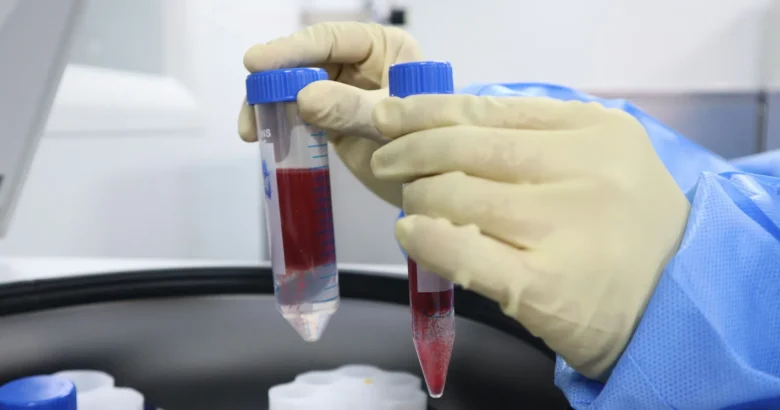
PRP stands for platelet-rich plasma, a preparation made from the patient’s own blood and used for injuries to joints, tendons and muscles. The blood is drawn and spun in a centrifuge, and the portion with the most platelets is injected at the site of the injury. Until 2026, Brazil’s Federal Council of Medicine (CFM) only allowed it in research. In July, it regulated PRP for four indications.
What PRP is
Blood has a liquid part, the plasma, and three main types of cells: red blood cells, which carry oxygen; white blood cells, which handle defense; and platelets, which help stop bleeding and close wounds.
Platelets are small, but they carry granules full of substances that tell the tissue there is repair work to do. These are the so-called growth factors, with names like PDGF, TGF-beta and VEGF. They attract repair cells, stimulate the formation of new blood vessels and of matrix, the structure that gives tissue its shape, and shift the balance of inflammation.
In blood, the normal platelet count is between 150,000 and 450,000 per microliter. PRP is that plasma with the platelets concentrated to several times the normal level. Because it comes from the patient, there is no risk of rejection or of catching a disease from another person.
How PRP works
PRP works as a concentrated chemical signal, placed where repair has stalled or become disorganized. The repair itself is still done by the tissue’s own cells. Laboratory and clinical studies point to three main effects:
- Growth factors call cells to the site and stimulate the production of collagen and other tissue components.
- Inflammation goes down. In a Chinese trial of 610 patients with knee osteoarthritis, the joint fluid of those who received PRP had, six months later, lower levels of two inflammatory substances (TNF-alpha and interleukin-1 beta) than that of those who received saline.
- When PRP is activated, a fibrin network forms, the same protein found in a blood clot, which serves as a scaffold where cells can attach and work.
The weight of each effect seems to change with the tissue. In a tendon, which is often degenerated and has poor circulation, the idea is to restart a repair that has stalled. In osteoarthritis, the effect seems to be more on inflammation and pain than on recovering lost cartilage.
How it is done
Everything happens in the same visit:
- Collection: blood is drawn from a vein in the arm, as in a routine blood test. The volume depends on the system used.
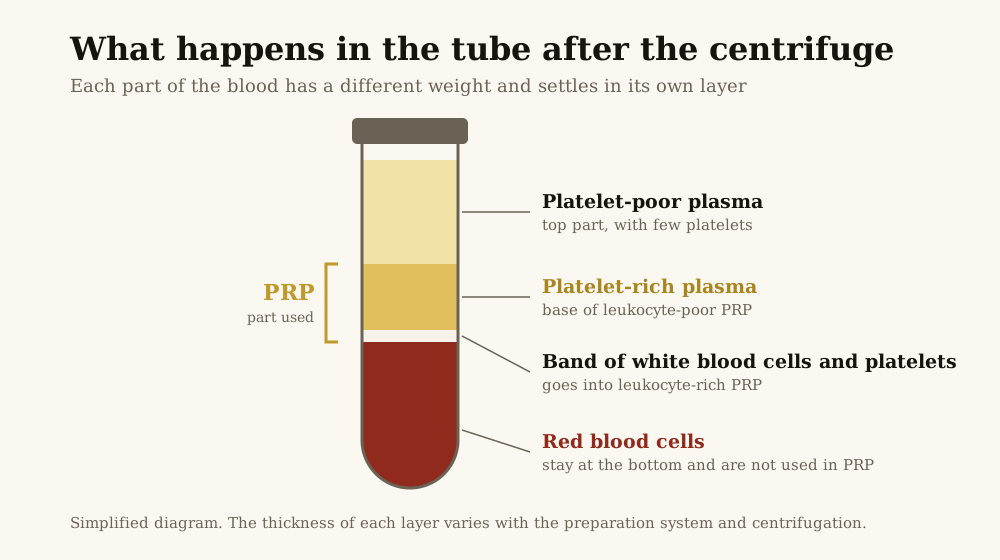
- Centrifugation: the tube spins at high speed in the centrifuge, once or twice. Because each part of the blood has a different weight, they separate into layers.
- Separation: red blood cells settle at the bottom. Just above them is a thin whitish band, rich in white blood cells and platelets. On top is the plasma, richer in platelets at the bottom and poorer at the top. The fraction used depends on the type of PRP wanted.
- Injection: PRP is injected at the site of the injury under sterile conditions. For deep or hard-to-reach structures, the CFM resolution asks that the injection be guided, preferably by imaging such as ultrasound.
Not all PRP is the same
“PRP” has become a single name for products that are quite different from each other. Preparation systems vary in how much blood is drawn, in the number and speed of spins and in which layer is used. The final product differs in at least four ways:
- The platelet concentration, which can range from a little above normal blood to several times more.
- White blood cells: PRP can be leukocyte-rich or leukocyte-poor, depending on whether that whitish band in the tube is used.
- The amount of red blood cells left in the preparation.
- Activation: some preparations receive calcium or thrombin before injection to release the growth factors, and others do not.
These differences affect the result. In knee osteoarthritis, a 2025 meta-analysis of 18 trials and 1,995 patients found that more concentrated PRP, with about 1 million platelets per microliter, relieved pain noticeably compared with placebo at 3, 6 and 12 months, and the less concentrated kind did not reach that level. In an Italian study of 253 patients, 15% of treatments with fewer platelets failed, compared with 3.3% in the medium- and high-concentration groups.
The problem is that many studies do not even report what was injected. Researchers have created minimum checklists of what every PRP study should report, such as MIBO from 2017, precisely so that one study can be compared with another. In practice, it is worth asking your doctor how the PRP is prepared and whether the platelet count is known.
What it is used for: what the studies show
PRP is used for many injuries, but the quality of the evidence changes a lot from one to the next, and the CFM has approved only some of them.
| Condition | What the studies show | Approved by the CFM (Brazil) |
|---|---|---|
| Knee osteoarthritis | The strongest evidence. In a review of 62 trials with 4,969 patients, PRP improved pain and function more than hyaluronic acid, corticosteroids and saline at 6 months | Yes |
| Tennis elbow (lateral epicondylitis) | Corticosteroids give more relief in the 1st month, and PRP pulls ahead at 3 and 6 months. Low- to moderate-quality studies | Yes |
| Meniscus repair (during surgery) | In 354 patients, re-tear in 18.2% with PRP and 30.5% without. No difference in pain and function questionnaires | Yes |
| Lumbar disc disease | A small trial of 47 patients showed improved pain and function. Only in a day hospital and by spine and pain specialists | Yes, with restrictions |
| Shoulder tendon (rotator cuff) | Eight trials with long-term improvement in pain and function, with very different techniques | No |
| Acute muscle injury | Mixed results. A 2026 review showed return to sport about a week earlier, with limited evidence, and a 2018 one did not confirm a benefit in the most rigorous studies | No |
| Achilles tendon | Trial of 240 patients with no difference from a sham injection at 6 months | No |
Knee osteoarthritis
This is where there are the most studies and the most agreement. Besides the review of 62 trials, the 2024 European consensus from ESSKA, the European society for knee and sports medicine, considered PRP a possible first-choice injection for mild to moderate osteoarthritis. Not every study agrees, and an Australian trial published in JAMA in 2021 found no difference between PRP and saline. I will cover the knee in detail in a separate post.
Tennis elbow
In lateral epicondylitis, pain on the outer side of the elbow, a 2023 meta-analysis of 13 studies compared PRP and corticosteroids. Corticosteroids gave more relief in the first month, and PRP was better at 3 and 6 months. The corticosteroid acts faster, and PRP takes longer to work.
Meniscus and spine
In meniscus repair, PRP is applied during surgery. In a 2026 review, people who received PRP had fewer re-tears, but their pain and function questionnaires were similar to those of people who did not receive it.
In the spine, PRP is injected into the degenerated disc. The most cited study is small: 47 patients, with improved pain and function at 8 weeks, and the improvement in function lasted at least a year. Because of the complexity, the CFM allows this procedure only in a day-hospital setting, performed by an anesthesiologist, neurosurgeon, orthopedic surgeon, interventional radiologist or pain physician.
Where the evidence is still weak
For the Achilles tendon, a British trial published in JAMA in 2021 compared a PRP injection with a sham injection, in which the needle did not reach the tendon, in 240 patients. At six months, both groups were the same.
In acute muscle injury, the studies disagree. A 2018 meta-analysis of 374 patients did not confirm a benefit when it looked only at the most rigorous studies. Another, from 2026, with 474 patients, saw return to sport about a week earlier with PRP, but the authors themselves rated the evidence as limited.
For the shoulder tendon, a meta-analysis of eight trials saw long-term improvement in pain and function, but the studies used very different preparations and comparisons.
None of these three situations is among the indications approved by the CFM. In them, treatment remains well-done rehabilitation and load management, as I explained in the post on running pain.
What the CFM approved
Until July 2026, the CFM treated PRP as experimental for diseases of the muscles, bones and joints. In practice, it could only be used within research approved by an ethics committee.
CFM Resolution 2.464/2026, published on July 15, 2026, allows PRP as a complementary treatment in knee osteoarthritis, lumbar disc disease, lateral epicondylitis and meniscus repair. The resolution also sets rules:
- PRP must be made only with the patient’s own blood, with traceability of the preparation and equipment registered with Anvisa, Brazil’s health regulator.
- Indication, injection and follow-up are medical acts.
- The patient signs a consent form that explains benefits, limits, alternatives and risks.
- Mixing PRP with stem cells, bone marrow concentrate or fat outside research is prohibited.
- Presenting PRP as a cure, guaranteed regeneration or a substitute for indicated surgery is prohibited.
Is it safe?
Because the material comes from your own blood, reactions are usually mild. The most common are pain, swelling and bruising at the site in the first few days. In the Achilles tendon trial, 97 of the 121 patients who received PRP and 73 of the 119 who received the sham injection reported discomfort at the site. Discomfort is common even without PRP, and a little greater with it.
There are situations in which PRP should not be done. The CFM resolution prohibits its use with infection at the site, active cancer, very low platelets or an uncorrected clotting disorder. In 2025, an international group of platelet injection specialists, GRIIP, published 23 recommendations for patients with infections, cancer or blood diseases, almost all based on expert opinion because there are still few studies on the subject. These points are reviewed at the consultation before the treatment is recommended.
Why the results vary so much
A 2026 review published in the American Journal of Sports Medicine grouped the causes into three groups:
- The product: each system delivers a different amount of platelets, leukocytes and red blood cells.
- The technique: volume, number of injections, interval between them and whether the needle was guided by imaging.
- The disease: worn cartilage, a degenerated tendon and a freshly torn muscle are different tissues, and PRP does not act the same way in all three.
On top of that comes the patient: age, weight, stage of the disease and what is done after the injection.
What to expect from the treatment
The effect of PRP is not immediate like that of a corticosteroid. Improvement, when it comes, appears over weeks, and the result is assessed after a few months. In the days after the injection, I recommend a simple painkiller and avoid anti-inflammatories, which can interfere with how platelets work.
PRP does not replace the rest of the treatment either. Strengthening, load adjustment and, when it makes sense, weight loss remain the foundation, and PRP comes in as a complement.
Conclusion
PRP is a concentrate of your own blood that delivers the repair substances stored in platelets to the injury. It has the most consistent evidence in knee osteoarthritis, favorable medium-term results in tennis elbow, promising evidence in the meniscus and spine, and weak or negative evidence for the Achilles tendon and muscle injury. Since the 2026 resolution, it can be used in Brazil for four indications, with rules on preparation, consent and follow-up.
Take care, and see you in the next post!
Responsible physician: Dr. Gilberto Nering Junior, sports medicine physician, CRM-SP 160822, RQE 142486 (Sports Medicine, Brazil).
This text was not sponsored, is for information only and does not replace an individual assessment. Questions about the content: contact the clinic.
Cover photo: Malcolm Choong on Unsplash.
Quick questions about PRP
Is PRP the same as stem cells?
No. PRP is made only from plasma and platelets from the blood. Stem cells come from bone marrow or fat, are a different type of treatment and, under the CFM resolution, cannot be mixed with PRP outside research.
Is PRP allowed in Brazil?
Since July 2026, yes, in four situations: knee osteoarthritis, lumbar disc disease, tennis elbow and meniscus repair. Always as a complementary treatment, performed by a physician and with a consent form.
How many PRP sessions are needed?
It depends on the injury and the preparation. In knee osteoarthritis, studies such as the Chinese trial of 610 patients used three injections one week apart, and the number is decided at the consultation. For tendons, a single injection is often used.
Does PRP hurt?
The blood draw is the same as for a blood test. The injection usually causes discomfort at the time, and mild pain and swelling over the following days are common and go away on their own.
How long does PRP take to work?
Improvement is not immediate. It usually appears over weeks, and the result is assessed after a few months, together with rehabilitation.
References
- A Hamid MS, Sazlina SG. Platelet-rich plasma for rotator cuff tendinopathy: a systematic review and meta-analysis. PLoS One. 2021;16(5):e0251111. doi:10.1371/journal.pone.0251111
- Bensa A, Fattini Fellini G, Boffa A, et al. Platelet-rich plasma accelerates the return to sport in athletes with acute muscle injuries: a systematic review and statistical fragility index-based meta-analysis of randomized controlled trials. Sports Med Open. 2026;12(1). doi:10.1186/s40798-026-01017-w
- Bensa A, Previtali D, Sangiorgio A, et al. PRP injections for the treatment of knee osteoarthritis: the improvement is clinically significant and influenced by platelet concentration: a meta-analysis of randomized controlled trials. Am J Sports Med. 2025;53(3):745-754. doi:10.1177/03635465241246524
- Bennell KL, Paterson KL, Metcalf BR, et al. Effect of intra-articular platelet-rich plasma vs placebo injection on pain and medial tibial cartilage volume in patients with knee osteoarthritis: the RESTORE randomized clinical trial. JAMA. 2021;326(20):2021-2030. doi:10.1001/jama.2021.19415
- Boffa A, De Marziani L, Andriolo L, et al. Influence of platelet concentration on the clinical outcome of platelet-rich plasma injections in knee osteoarthritis. Am J Sports Med. 2024;52(13):3223-3231. doi:10.1177/03635465241283463
- Centeno CJ, Berger DR, Pelle AJ, et al. Autologous platelet-rich plasma versus hyaluronic acid, corticosteroids or saline for knee osteoarthritis: can blood draw volume serve as a proxy for platelet dose? A systematic review and meta-analysis. Int Orthop. 2026;50(5):981-997. doi:10.1007/s00264-026-06782-7
- Chu J, Duan W, Yu Z, et al. Intra-articular injections of platelet-rich plasma decrease pain and improve functional outcomes than sham saline in patients with knee osteoarthritis. Knee Surg Sports Traumatol Arthrosc. 2022;30(12):4063-4071. doi:10.1007/s00167-022-06887-7
- Conselho Federal de Medicina. Resolução CFM nº 2.464, de 2 de julho de 2026. Regulamenta o uso de plasma rico em plaquetas como procedimento médico adjuvante no tratamento de condições osteomusculares específicas. Diário Oficial da União. 15 jul 2026; Seção 1:70. Text of the resolution (in Portuguese)
- Dave U, Rubin J, Chang N, et al. Platelet rich plasma augmentation for meniscus repair reduces failure but not complication rates or outcomes: a systematic review and meta-analysis. J Orthop. 2026;73:62-71. doi:10.1016/j.jor.2025.12.015
- Eymard F, Louati K, Noel É, et al. Indications and contraindications to platelet-rich plasma injections in musculoskeletal diseases in case of infectious, oncological and haematological comorbidities: a 2025 formal consensus from the GRIIP (International Research Group on Platelet Injections). Knee Surg Sports Traumatol Arthrosc. 2025;33(6):2293-2306. doi:10.1002/ksa.12682
- Grassi A, Napoli F, Romandini I, et al. Is platelet-rich plasma (PRP) effective in the treatment of acute muscle injuries? A systematic review and meta-analysis. Sports Med. 2018;48(4):971-989. doi:10.1007/s40279-018-0860-1
- Hohmann E, Tetsworth K, Glatt V. Corticosteroid injections for the treatment of lateral epicondylitis are superior to platelet-rich plasma at 1 month but platelet-rich plasma is more effective at 6 months: an updated systematic review and meta-analysis of level 1 and 2 studies. J Shoulder Elbow Surg. 2023;32(9):1770-1783. doi:10.1016/j.jse.2023.04.018
- Kearney RS, Ji C, Warwick J, et al. Effect of platelet-rich plasma injection vs sham injection on tendon dysfunction in patients with chronic midportion Achilles tendinopathy: a randomized clinical trial. JAMA. 2021;326(2):137-144. doi:10.1001/jama.2021.6986
- Laver L, Filardo G, Sanchez M, et al. The use of injectable orthobiologics for knee osteoarthritis: a European ESSKA-ORBIT consensus. Part 1: blood-derived products (platelet-rich plasma). Knee Surg Sports Traumatol Arthrosc. 2024;32(4):783-797. doi:10.1002/ksa.12077
- Murray IR, Geeslin AG, Goudie EB, et al. Minimum information for studies evaluating biologics in orthopaedics (MIBO): platelet-rich plasma and mesenchymal stem cells. J Bone Joint Surg Am. 2017;99(10):809-819. doi:10.2106/JBJS.16.00793
- Rothrauff BB, Featherall JT, Uppstrom TJ, et al. Platelet-rich plasma in the treatment of musculoskeletal disease in 2025 and beyond. Am J Sports Med. 2026;54(8):2058-2074. doi:10.1177/03635465251395284
- Tuakli-Wosornu YA, Terry A, Boachie-Adjei K, et al. Lumbar intradiskal platelet-rich plasma (PRP) injections: a prospective, double-blind, randomized controlled study. PM R. 2016;8(1):1-10. doi:10.1016/j.pmrj.2015.08.010
{“@context”: “https://schema.org”, “@type”: “FAQPage”, “inLanguage”: “en”, “mainEntity”: [{“@type”: “Question”, “name”: “Is PRP the same as stem cells?”, “acceptedAnswer”: {“@type”: “Answer”, “text”: “No. PRP is made only from plasma and platelets from the blood. Stem cells come from bone marrow or fat, are a different type of treatment and, under the CFM resolution, cannot be mixed with PRP outside research.”}}, {“@type”: “Question”, “name”: “Is PRP allowed in Brazil?”, “acceptedAnswer”: {“@type”: “Answer”, “text”: “Since July 2026, yes, in four situations: knee osteoarthritis, lumbar disc disease, tennis elbow and meniscus repair. Always as a complementary treatment, performed by a physician and with a consent form.”}}, {“@type”: “Question”, “name”: “How many PRP sessions are needed?”, “acceptedAnswer”: {“@type”: “Answer”, “text”: “It depends on the injury and the preparation. In knee osteoarthritis, studies such as the Chinese trial of 610 patients used three injections one week apart, and the number is decided at the consultation. For tendons, a single injection is often used.”}}, {“@type”: “Question”, “name”: “Does PRP hurt?”, “acceptedAnswer”: {“@type”: “Answer”, “text”: “The blood draw is the same as for a blood test. The injection usually causes discomfort at the time, and mild pain and swelling over the following days are common and go away on their own.”}}, {“@type”: “Question”, “name”: “How long does PRP take to work?”, “acceptedAnswer”: {“@type”: “Answer”, “text”: “Improvement is not immediate. It usually appears over weeks, and the result is assessed after a few months, together with rehabilitation.”}}]}
{“@context”: “https://schema.org”, “@graph”: [{“@type”: “Organization”, “@id”: “https://clinicanering.com/#org”, “name”: “Clínica Nering”, “url”: “https://clinicanering.com”}, {“@type”: “Person”, “@id”: “https://clinicanering.com/#dr-gilberto”, “name”: “Dr. Gilberto Nering Junior”, “jobTitle”: “Sports Medicine Physician”, “identifier”: “CRM-SP 160822 / RQE 142486”, “worksFor”: {“@id”: “https://clinicanering.com/#org”}, “sameAs”: [“https://www.doctoralia.com.br/gilberto-nering-junior”, “https://www.instagram.com/clinica.nering”]}, {“@type”: “MedicalWebPage”, “@id”: “https://clinicanering.com/blog/en/sports-medicine/prp-what-it-is-how-its-done-what-its-for/#webpage”, “url”: “https://clinicanering.com/blog/en/sports-medicine/prp-what-it-is-how-its-done-what-its-for/”, “name”: “PRP: What It Is, What It’s For and What the Evidence Shows”, “inLanguage”: “en”, “datePublished”: “2026-10-24T09:00:00+00:00”, “dateModified”: “2026-10-24T09:00:00+00:00”, “author”: {“@id”: “https://clinicanering.com/#dr-gilberto”}, “reviewedBy”: {“@id”: “https://clinicanering.com/#dr-gilberto”}, “publisher”: {“@id”: “https://clinicanering.com/#org”}, “isPartOf”: {“@type”: “WebSite”, “name”: “Clínica Nering Blog”, “url”: “https://clinicanering.com/blog/”}}]}